
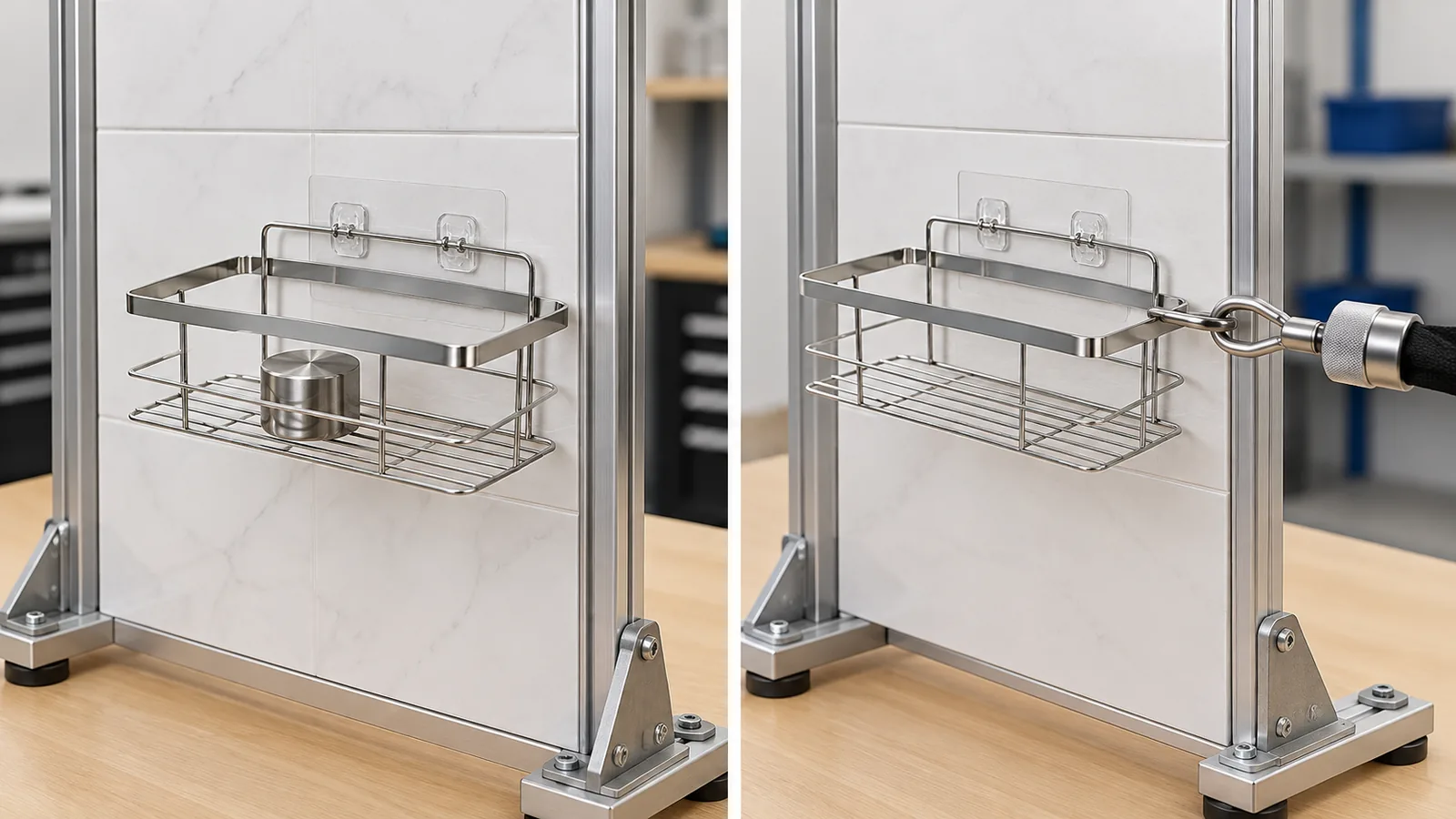
Adhesive tape static shear dynamic shear creep difference matters when a buyer is reviewing a bathroom accessory that must stay attached under a sustained downward load yet may also experience movement or intermittent force. A static-shear test applies a set load and records movement or time; a dynamic-shear test pulls bonded substrates parallel to the bond at a controlled rate and measures force to failure. They answer different questions. Neither alone proves that a wall-mounted basket or hook is suitable for a particular tile, surface preparation, humidity, load, or service life.
This guide focuses on separating timed holding evidence from a short pull test for adhesive-mounted bathroom accessories. It does not evaluate suction-cup mounts, mechanical anchors, or a specific tape product. Saint-Gobain’s bonding-tape reference guide describes static shear as a holding-power test under a weight, and dynamic shear as a parallel pull test. Those test descriptions help buyers ask better questions; project conditions and acceptance limits still need to be defined for the actual product and substrate.

What does a static-shear result tell a buyer?
In the Saint-Gobain reference guide’s described method, tape bonds two substrates while a weight is attached to one end; the amount of movement and/or elapsed time is recorded. The load acts parallel to the bonded surfaces. This type of result can help assess holding power under a sustained shear condition, but the result is meaningful only alongside the test setup: substrates, tape preparation, bond area, dwell time, load, temperature, humidity, and failure or movement criterion.
For a bathroom basket, sustained downward force may be relevant because the accessory’s contents pull along the wall. But the product experiences more than a simple static load. The contact surface may be wet or contaminated; the mounting plate may flex; users may place or remove items; and load can be uneven. A laboratory coupon with a specific load and substrate is not automatically equivalent to the installed accessory on a buyer’s tile.
Static shear can also reveal time-dependent movement that a quick pull test would not show. Adhesive systems are viscoelastic, and holding performance can depend on time and temperature. However, one reported duration under one test condition is not a service-life prediction. Buyers should not convert a lab result into a promise of years in service unless the supplier has validated that inference for the relevant design and conditions.
What does dynamic shear tell a buyer?
Dynamic shear applies a changing force parallel to the bonded substrates, commonly by pulling them at a controlled speed until separation or another defined endpoint. The reference guide lists dynamic shear among tests intended to characterize application-related stresses and records the force needed to separate the bond under its stated method. It is a short-duration measurement compared with a sustained hanging test.
This result can help compare bond systems or sample constructions under a defined test method. But a higher dynamic-shear value does not automatically establish better long-term holding in a bathroom. The force rate, bonded area, surface preparation, dwell, and substrate all matter. A bathroom wall accessory may also see peel at the edge, bending moment from an offset basket, or a mix of directions rather than pure parallel shear.
Do not treat a dynamic-shear test as the same as impact, peel, tensile, or a complete installed-load test. Ask what loading mode the result represents and whether it matches the accessory’s likely stress path. If the mounting plate projects away from the wall, the load may create leverage at the upper or lower edge. The product geometry and attachment arrangement should be included in the buyer’s review.
| Evidence type | Typical loading approach | Useful buyer question | O que isso, por si só, não demonstra |
|---|---|---|---|
| Static shear | Set sustained load parallel to the bond; record movement or time | Does the defined bond resist sustained shear under the stated conditions? | Long-term field life, wet-tile performance, or every installed geometry |
| Dynamic shear | Controlled parallel movement/pull; record force or failure | How does the bond respond to a defined changing shear test? | Sustained holding, peel resistance, or impact performance |
| Peel | Separate the bond from an edge at a defined angle/rate | How does the bond respond to edge-separation loading? | Pure shear or complete accessory performance |
| Installed assembly test | Load the actual product/substrate arrangement under a defined protocol | Does this sample assembly meet the product’s stated acceptance criteria? | Unspecified substrates, preparation, environments, or service life |
Use tests that map to the buyer’s actual decision rather than asking for every possible number. The table is conceptual; the applicable standard, method, and criteria must be confirmed in the project documents.
How are shear holding and creep related?
Creep is time-dependent deformation under sustained stress. In an adhesive assembly, movement can gradually accumulate even when the load is not changing quickly. A static-shear method may record movement or time under a fixed load, which can provide useful holding evidence. But “creep” is broader than one pass/fail result: the measured response depends on the adhesive system, core, bond thickness, surface, temperature, load, and test duration.
Buyers should ask what the supplier means by creep resistance. Is the claim based on a named static-shear test, a product data sheet, a test on the actual accessory, or field data under defined conditions? Do not assume that “no movement observed” means zero creep; the observation threshold and duration matter. If the project has a maximum permitted shift, define how it is measured and when the measurement is taken.
The adhesive tape static shear dynamic shear creep difference can therefore be summarized as follows: static shear focuses on sustained holding under a specified load; dynamic shear measures response to a controlled moving shear force; creep describes time-dependent movement under sustained stress. These concepts overlap in adhesive evaluation, but they are not interchangeable labels. A buyer needs the test method and conditions before comparing claims.
What should be controlled in an adhesive-mounted bathroom sample?
First confirm the attachment system. Is the product fixed by pressure-sensitive tape, a separate adhesive, suction cups, or a hybrid arrangement? These systems have different mechanisms and test needs. The image in this article is an illustrative adhesive-mount setup; it does not establish a specific Koitor product configuration. For a tape-mounted design, identify the tape supplier and type, adhesive/core construction where disclosed, die-cut shape, bond area, thickness, and backing or surface treatment specified by the design.
Next define the substrate and preparation. Tile glaze, glass, painted surfaces, plastics, and metal can present different bonding surfaces. A sample tested on a clean laboratory panel may not represent actual bathroom tile. Specify the approved substrate or range, cleaning method, surface dryness, application pressure, dwell before loading, and conditioning environment. Avoid turning one tape vendor’s recommendation into a universal instruction for all products.
The product geometry matters too. Record the attachment footprint, accessory offset from the wall, expected load location, and how multiple adhesive pads share load. If the product has two mounts, confirm both are attached in the intended positions and that the test fixture does not unintentionally support the accessory. Define whether the load is centered, uneven, or applied in a representative use position.
How should a supplier demonstrate sample performance?
Ask for evidence that corresponds to the approved construction. The record should identify the sample, drawing revision, tape or adhesive reference, substrate, preparation, bond area, dwell, conditioning, load direction, test duration or rate, and observation criteria. If a coupon test is used, clearly distinguish it from a full accessory assembly test. If a supplier reports a product-specific test, confirm that the sample geometry and substrate match the project’s intended configuration.
For static holding, agree what movement constitutes failure and how it is measured. A mark on the tile, a displacement measurement, edge lift, or detachment could be relevant, depending on the buyer’s requirement. Define the load and observation interval through the responsible engineering/quality authority rather than copying an arbitrary value from a different application.
For dynamic shear, ask how the specimen is loaded, what speed or method applies, and what endpoint is recorded. That result can be useful for comparison, but should not replace sustained holding evidence where the product hangs a load over time. A laboratory test standard can improve reproducibility, yet its standard coupon is still not identical to the installed item.

If service conditions include moisture or temperature variation, define how the sample is conditioned and whether it is tested during or after that exposure. Do not assume that a dry-room result proves performance on wet tile. Also specify whether the accessory is allowed to be repositioned after application; repeated removal and reapplication may change the bond and should not be treated as equivalent to a fresh mount.
Which specification gaps lead to misleading comparisons?
The first gap is comparing test values without matching the method. A static-shear value under one weight, dwell time, substrate, and temperature cannot be compared directly with a value from another setup. The same is true for dynamic-shear values obtained at different rates, geometries, or bonded areas. Ask for units and conditions before ranking tape suppliers.
The second gap is substituting peel or tensile data for shear evidence. These loading modes can reveal different bond behavior. A product may experience combined stresses, but the buyer should not assume one number represents every direction. Explain the failure concern and ask which evidence addresses it.
The third gap is omitting surface preparation and dwell. Pressure-sensitive tape performance can depend on contact and adhesion build. Saint-Gobain’s reference notes that initial tack differs from final bond development and that quick adhesion may trade off with longer-term holding. A buyer should distinguish installation handling from the later load-bearing condition.
The fourth gap is claiming service life from a short test. Static shear records a response under stated conditions; it does not automatically model years of environmental exposure, cleaning, intermittent use, or changing substrate condition. Any life claim needs appropriate support for the application and should not be inferred from a single test result.
How should buyers choose evidence without over-testing?
Begin with the failure mode that matters: gradual downward movement, edge lift, sudden detachment, or damage during installation. Then choose evidence that maps to it. A sustained hanging load may be relevant to holding power; dynamic shear may help compare response to controlled movement; peel may matter where an edge is lifted; an installed assembly test can examine the real product geometry. Requirements should be proportionate to product risk and the buyer’s market obligations. This gives buyers a usable adhesive tape static shear dynamic shear creep difference without treating unlike test results as interchangeable.
Ask the supplier to propose test conditions and explain the limits of the data. A useful supplier response names the specimen construction and distinguishes published product data from project-specific results. It should also disclose whether the test represents the accessory itself or only a material coupon. Buyers can then decide whether additional sample testing is needed.
Do not treat more tests as automatically stronger evidence. Repeating irrelevant coupon tests can consume time without resolving whether the basket will remain attached to the selected surface under intended use. The objective is a documented acceptance basis: approved substrate, preparation, bond layout, load condition, duration, failure criterion, and change triggers.
What belongs in the RFQ and approval record?
Include the accessory drawing and revision, mounting method, approved substrate or substrate range, attachment geometry, surface-preparation method, application pressure/dwell instructions if specified, expected load and direction, conditioning, and evidence requested. Identify the responsible party for choosing technical acceptance limits. If the supplier proposes a different tape, adhesive, die-cut pattern, or mounting layout, request a change review and representative sample before substitution.
The approval record should preserve sample identity, test method, substrate, setup, measurement, observed result, and reviewer decision. Record exclusions as well: no inference to suction-cup products, other tile types, or untested environmental conditions. If the test evidence is incomplete, mark the item open rather than translating a product brochure into a pass decision.
Perguntas frequentes
Does static shear measure creep?
A static-shear test can record movement or time under a sustained load and may provide evidence related to holding power and time-dependent movement. The exact method and duration determine what the result means; it is not a universal creep-life prediction.
Does dynamic shear show how long a basket will stay attached?
No. Dynamic shear measures response to a defined moving shear test. It may be useful for a particular application question, but it does not replace a sustained-load or installed assembly assessment when that is the buyer’s concern.
Can a high peel value replace shear data?
Not automatically. Peel and shear are different loading modes. Select evidence based on the product’s stress path and acceptance requirements.
Is a coupon test enough for an adhesive bathroom accessory?
It can characterize a material system under defined conditions, but it may not represent the actual accessory geometry, substrate, preparation, or loading. Decide whether a full assembly test is required for the project.
Can a dry tile test prove performance on wet tile?
No. The test conditions need to match the intended use or the limits should be stated. Do not infer wet-surface behavior from an unconditioned dry test.
Does this article confirm Koitor’s adhesive mounting capability?
No. It is a buyer framework for evaluating adhesive-mounted hardware and supplier evidence. Any specific product, tape, test, or mounting capability must be confirmed for the project.
Source
- Saint-Gobain Tape Solutions: Fundamentals of Bonding Tape Reference Guide
- Saint-Gobain Tape Solutions: Norbond A7100 Series
Review an Adhesive-Mounting Requirement
Share the accessory drawing, intended substrate, and supplier test evidence you need to review. Koitor can discuss manufacturing and sourcing requirements within the confirmed project scope; adhesive selection and acceptance criteria must be confirmed for the specific product.
OEM / MARCA PRÓPRIA
Transforme este guia de fornecimento num resumo do produto
Indique o produto pretendido, as dimensões, o acabamento, a quantidade a encomendar e os requisitos de embalagem. A sua equipa receberá uma análise prática da viabilidade de fabrico antes da apresentação do orçamento.

 English
 Español
 Português
 Français
 Deutsch
 العربية