
Buyer specification guide | Wire shelving and home storage
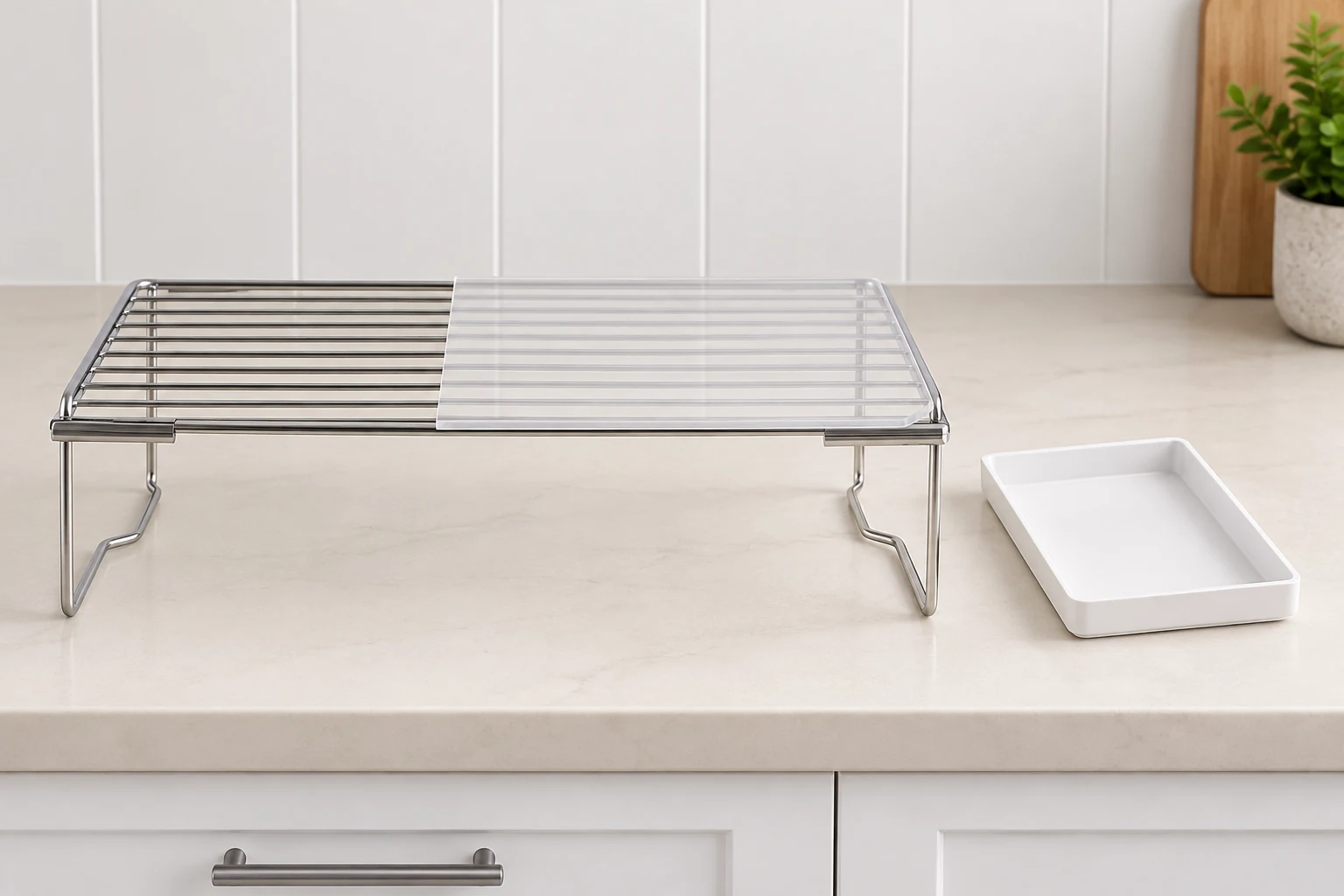
Wire shelving liner spill containment depends on more than whether a polymer sheet is described as waterproof. Buyers need to define the shelf dimensions, liner fit, perimeter geometry, and the type of accidental spill they intend to manage. A flat wipeable liner may cover the wires while still allowing liquid to run over an unraised edge; a solid shelf or raised-edge tray is a different construction. Put the intended function into the drawing and verify fit and edge behavior on the approved sample before making a product claim.
What problem does a wire shelf liner actually solve?
Open wire shelving lets air pass through the shelf, but a small spill can also pass between the wires. A liner or inlay creates a more continuous surface and can help retain small items or make a surface easier to wipe, depending on its design and material. Those are useful functions, but they are not automatically the same as containing a liquid at the perimeter.
A pantry user discussion describes the practical frustration of a spill passing through wire shelves and asks whether a flexible liner or a solid shelf would be more appropriate. That is a real use question, not a controlled product test. Seville Classics describes a model-specific fitted polypropylene liner as waterproof and wipeable, while Metro distinguishes open wire shelving from solid shelving for liquid containment. Metro also presents a clear shelf inlay for small-item retention; its stated purpose should not be expanded into an unverified spill-retention claim. See the user discussion, Seville Classics fitted liner, e Metro wire-shelving guide e clear inlay listing.
For an importer or private-label product manager, the decision is not simply “plastic or metal.” It is which job the accessory is meant to do:
- create a stable surface over open wires;
- reduce the chance that small items tip or pass through;
- provide a smooth, wipeable shelf surface; or
- retain a defined accidental spill within a perimeter.
The brief can combine some of these goals, but it should state them separately. If retention is required, specify the edge condition and a sample review method instead of relying on the word “waterproof.”
Why is waterproof material not the same as spill containment?
“Waterproof” describes a material or a product claim under particular conditions; it does not by itself describe how liquid behaves at an assembled shelf’s edges, corners, joints, or cutouts. A flat liner can be made from a water-resistant material and still be too small, sit unevenly, or have no raised boundary. Liquid can reach the perimeter and escape even if it does not pass through the sheet itself.
A shelf assembly has several interfaces to consider: liner to wire support, liner to front and side rails, corner transitions, any notches around uprights, and the shelf’s levelness in its installed position. The shape of the shelf matters too. A liner that fits one nominal width and depth may not sit correctly over a different wire pattern, frame lip, or corner radius.
A practical comparison asks what happens at the edge—not just what the material is called. A flat sheet or inlay may be appropriate when the objective is a smoother surface or small-item support. A fitted liner may follow a shelf outline but still have little or no edge height. A solid shelf or tray with a raised perimeter is a different design option when liquid retention is an intended function. None should be described as spill-proof unless the particular assembled product has been evaluated against a defined scenario and the claim has been approved.
For wire shelving liner spill containment, the perimeter design and the assembled shelf condition must be part of the specification; the material adjective alone is not an acceptance criterion.
Separate the claim from the construction. Record the function the buyer needs, then identify the feature intended to provide it. “Wipeable surface” and “retains a small accidental spill” are different acceptance statements. This distinction prevents a material description from silently becoming a performance promise.
How do flat inlays, fitted liners, and raised-edge trays differ?
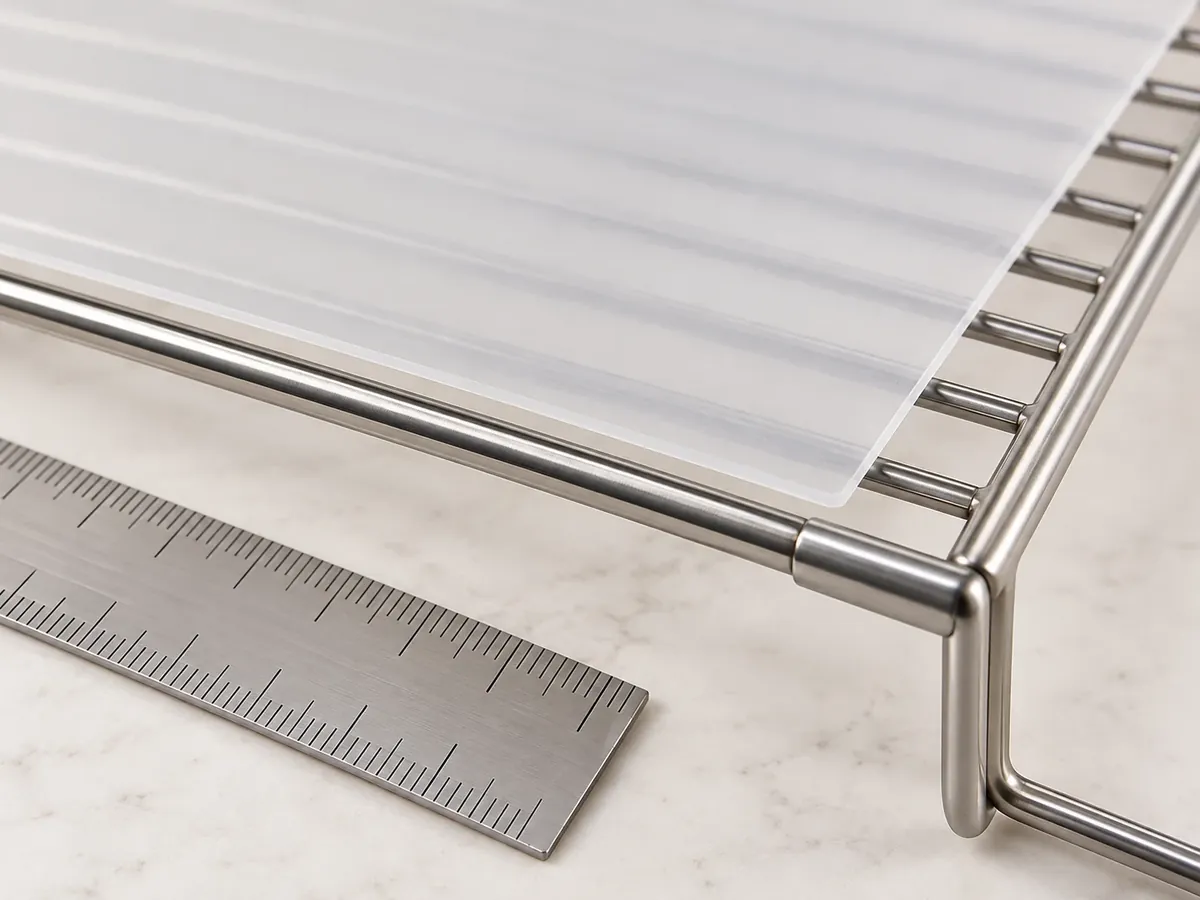
The product labels vary between suppliers, so compare the actual geometry and stated function. The following matrix is a buyer-side framework, not a performance rating of any brand or material.
| Construction | Typical purpose to confirm | What it does not prove by itself |
|---|---|---|
| Open wire shelf | Airflow and a light open shelf surface | Spill retention or support for every small item |
| Flat inlay or liner | A more continuous surface, wipeability, or small-item support | That liquid stays within the shelf perimeter |
| Fitted liner with shaped edge | Coverage that follows some or all shelf boundaries | Containment under every spill volume, shelf slope, or installation |
| Solid shelf or raised-edge tray | A continuous surface and a physical perimeter feature | A certified containment rating or suitability for every liquid |
Ask the supplier which component is included, whether it is removable, and which product dimensions it fits. “Fits a 36 by 18 inch shelf” is only useful when the tolerance and measurement points are clear. Confirm whether the liner covers the entire usable area, how it is retained, and whether any shelf wire or support can press through or distort it in the intended configuration.
If the project uses a separate tray, specify whether it rests on the shelf, replaces it, or clips to it. A tray that shifts during loading may not provide the same user experience as an integrated shelf. If the buyer needs only to stop small containers from rocking between wires, the relevant requirement may be a stable support surface rather than perimeter containment. Avoid asking a product to solve a problem the drawing never defines.
What should the RFQ and drawing specify?
A useful RFQ converts a broad phrase such as “waterproof shelf liner” into dimensions, interfaces, and an intended use. Give suppliers the shelf drawing or physical sample where possible. Then define:
- Shelf reference: overall width and depth, usable flat area, wire layout, frame profile, corner radii, and any upright or bracket interference.
- Liner dimensions: outside dimensions, thickness if controlled, coverage area, corner shape, cutouts, and allowable fit gaps. State the datum and where dimensions are taken.
- Edge design: flat cut edge, formed lip, raised wall, turned edge, or separate tray perimeter. Identify which sides have an edge and how corners join.
- Retention and removal: whether the liner is loose, clipped, or otherwise located; how it can be removed for cleaning; and whether the attachment changes the shelf assembly.
- Material identification: requested polymer or material family only when selected and confirmed for the project. Ask the supplier to identify the offered material and its source documentation; do not infer chemical or food-contact suitability from appearance.
- Intended scenario: describe the ordinary storage setting and the small accidental spill the buyer wants to address. Exclude hazardous, hot, chemical, or food-safety uses unless separately specified and substantiated.
- Appearance and packaging: color, transparency, surface texture, protective film or bag, packing orientation, and how the liner is protected from creasing or scratching in transit.
- Revision control: drawing number and revision, sample identification, and which changes require reapproval.
Tell suppliers whether the controlled measurement is the liner’s outer dimension, the inner usable surface, or the gap to the shelf frame. If both the wire shelf and liner are sourced separately, agree who owns final fit responsibility and how a dimensional change to either component will be communicated.
How can buyers review a sample without overclaiming?
A sample review should establish that the components fit and that the approved design behaves as described. It is not automatically a certified test, lifetime prediction, or proof that every spill will be retained. Write the review method before looking at the result so the buyer and supplier interpret acceptance consistently.
A simple project review can follow this sequence:
- Identify the shelf and liner sample by part number and drawing revision.
- Assemble the shelf as intended and place it on a level, stable surface.
- Check that the liner covers the specified usable area and does not rock, buckle, or interfere with brackets or uprights.
- Inspect corners, cutouts, perimeter height, and contact with the shelf frame.
- If the buyer has specified a small-spill scenario, agree in advance on the test liquid, amount, location, observation period, cleanup method, and pass/fail criterion. Do not invent a universal volume or call an informal check a certified test.
- Photograph the initial setup and observed result, record any leakage or movement, then clean and inspect the sample for deformation, residue, or other change.
- Confirm the result applies only to the tested configuration and stated conditions.
Use the same shelf, liner revision, installation method, and review conditions when comparing suppliers. Otherwise, the comparison may reflect different shelf geometry or test assumptions rather than a meaningful difference in product design. If the check is only a fit review, call it a fit review. If liquid retention is a contractual requirement, define a documented acceptance method and confirm whether a third-party or regulatory requirement applies.
What should buyers compare between supplier samples?
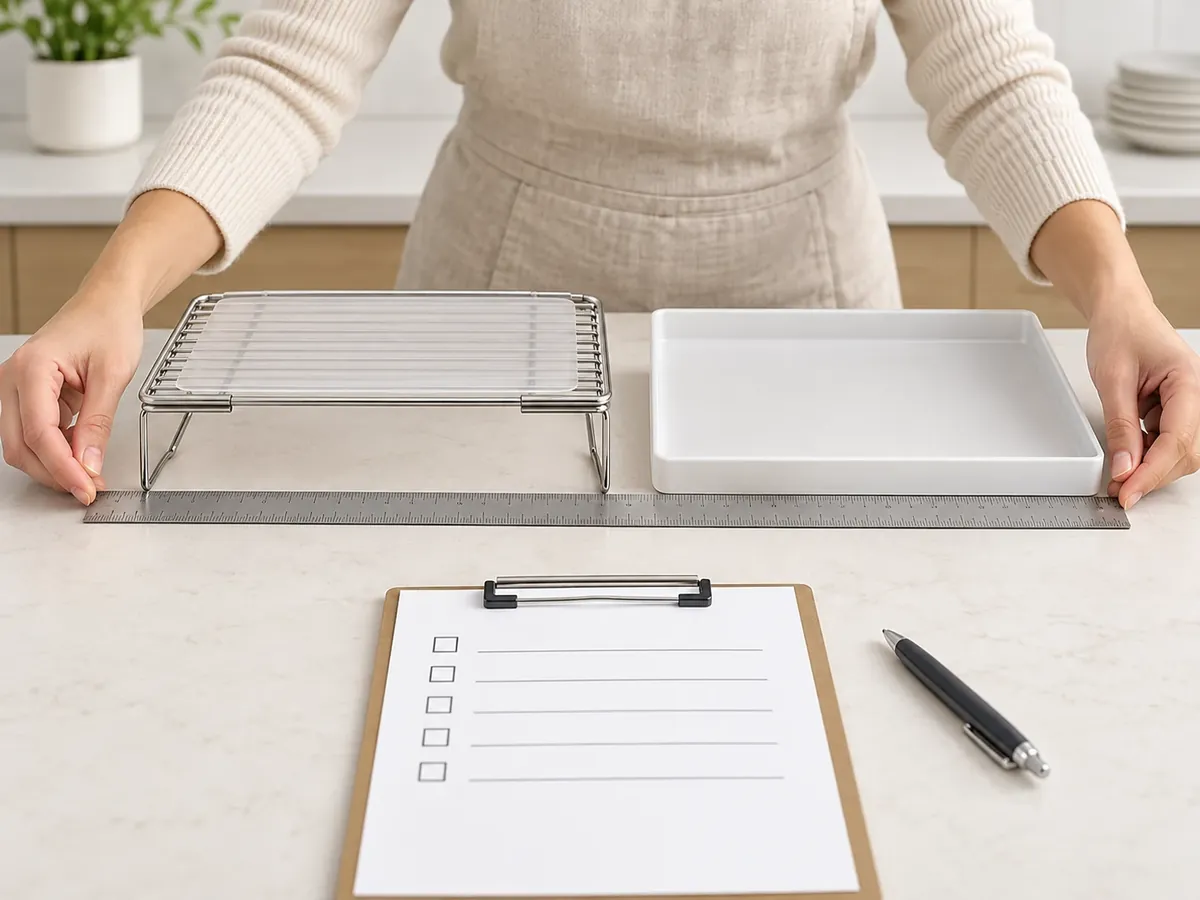
Make the comparison criteria visible in the quote review. A supplier may offer a liner with a convenient fit but a different edge; another may propose a tray or solid insert. Neither should be judged using a vague word such as “waterproof” alone.
| Comparison item | Record for each offer | Buyer decision |
|---|---|---|
| Shelf compatibility | Shelf model or drawing revision, width, depth, wire and frame interface | Does the sample fit the intended shelf without interference? |
| Surface coverage | Flat area covered and any uncovered zones | Is coverage sufficient for the intended stored items? |
| Perimeter geometry | Edge height and shape on each side and at corners | Is it a flat surface, a fitted edge, or a raised boundary? |
| Material and finish | Supplier-declared material and surface appearance | Are documentation and appearance requirements met? |
| Installation and cleaning | How the part is placed, retained, removed, and cleaned | Is the use method acceptable and clear to the end user? |
| Defined sample review | Conditions and acceptance criteria agreed before testing | Does the record support only the claim the buyer intends to make? |
| Embalagem | Protection against scratches, distortion, and missing components | Does the delivered sample arrive in reviewable condition? |
Do not compare material names without reviewing the assembled design. A polymer’s properties depend on its formulation and construction, and the project’s relevant documentation should come from the supplier for the selected part. This article does not establish a particular material’s chemical compatibility, food-contact suitability, or spill-retention performance.
Where can a metal hardware manufacturer add value?
Koitor’s confirmed expertise is in custom metal bathroom and home-storage hardware, not in a claimed certified liner-testing service or an asserted current liner product. That distinction matters. The metal shelf geometry, support locations, edge frame, and accessory interface can influence what an add-on must fit around, but polymer formulation and liquid-containment performance require their own evidence and supplier confirmation.
For a metal rack or shelf project, a buyer can share a drawing or sample and ask the factory team to review the shelf envelope, wire arrangement, frame edges, attachment points, and packaging interface. Koitor’s fabrico de estantes metálicas de armazenamento à medida and broader OEM home-storage hardware work can support discussion of the metal product and its manufacturability. Whether a liner is included, sourced separately, or developed with another supplier should be stated; do not assume that a metal hardware factory makes or certifies the polymer component.
This approach helps prevent a mismatch where a metal shelf is approved first and a liner is selected later without checking actual usable dimensions. If the overall project includes both components, align the drawing revisions and sample approval responsibilities. Small-batch OEM development can be useful for checking a new shelf structure or accessory interface before a larger order, subject to project details and confirmation.
What mistakes should importers avoid?
Common specification gaps include:
- treating waterproof material wording as proof that a finished shelf contains liquid;
- asking for a liner without providing the target shelf’s dimensions or wire layout;
- confusing a flat inlay with a raised-edge tray;
- measuring only outside width and depth while ignoring usable surface and corner interference;
- approving a photo instead of an assembled sample;
- reviewing a sample under conditions different from the intended acceptance scenario;
- assuming the accessory is included or supplied by the metal shelf manufacturer;
- allowing material, edge shape, or shelf geometry to change without identifying whether the prior approval still applies; and
- writing “spill-proof” or similar packaging copy without evidence for the exact product and conditions.
Resolve these points in the RFQ rather than after the sample is packed. The purchase specification should identify who supplies each component, what revision is approved, how the part is fitted, and what the buyer will inspect before production or repeat orders.
Buyer checklist before requesting a quotation
Include these items in the inquiry package:
- shelf drawing, dimensions, wire pattern, frame profile, and physical sample if available;
- whether the goal is small-item support, wipeability, edge containment, or a combination;
- preferred liner, inlay, or raised-edge tray construction;
- measured coverage area, edge geometry, corner and cutout details, and fit tolerances;
- supplier-declared material and any project-specific documentation required;
- installation, removal, and cleaning expectations;
- the exact sample review conditions and acceptance statement, if a spill scenario matters;
- color, surface appearance, packaging protection, and private-label requirements;
- order quantity, target market, and whether the metal shelf and accessory are sourced together; and
- drawing revision, sample identification, and change-approval process.
A clear buyer brief lets suppliers quote a defined component rather than guess at what “waterproof” is expected to mean.
Before comparing offers, keep wire shelving liner spill containment tied to a named shelf revision, liner outline, edge construction, and agreed sample method. If those inputs change, the earlier review may no longer describe the product being quoted.
Perguntas frequentes
Does a waterproof shelf liner automatically contain spills?
No. A waterproof or wipeable sheet may resist water through the material, but a flat perimeter can still allow liquid to run off. Check the assembled product’s edges and use scenario.
Is a clear shelf inlay the same as a spill tray?
Not necessarily. A clear inlay may be intended to provide a more continuous surface or retain small items. Confirm its stated purpose and geometry; do not infer spill containment unless the specific design and test support it.
Should a buyer choose a raised-edge tray for every wire shelf?
No. The required construction depends on the user problem, dimensions, access, cleaning, and product cost. If the goal is only to support small objects, a flat liner may be sufficient. If perimeter retention matters, define and review that requirement.
Can suppliers quote a liner from a shelf photo?
A photo can help identify the product family, but it is not a reliable dimensional specification. Provide measured dimensions, the shelf drawing, or a physical sample and confirm fit on an identified sample.
What should change control cover?
Review changes to shelf width or depth, wire pattern, frame edge, liner outline, material, edge height, attachment, and packaging whenever they could affect fit, function, or the claim shown to buyers. Specify which changes require a new sample approval.
Developing a Custom Metal Storage Shelf?
Send Koitor your shelf drawing, sample, dimensions, finish target, packaging needs or order quantity. The factory team can review the metal structure and discuss practical small-batch OEM options for a home-storage project. Liner material and spill-retention claims should be confirmed with the responsible component supplier.
OEM / MARCA PRÓPRIA
Transforme este guia de fornecimento num resumo do produto
Indique o produto pretendido, as dimensões, o acabamento, a quantidade a encomendar e os requisitos de embalagem. A sua equipa receberá uma análise prática da viabilidade de fabrico antes da apresentação do orçamento.
 English
 Español
 Português
 Français
 Deutsch
 العربية