
Buyer specification guide | Dish-rack accessory modules
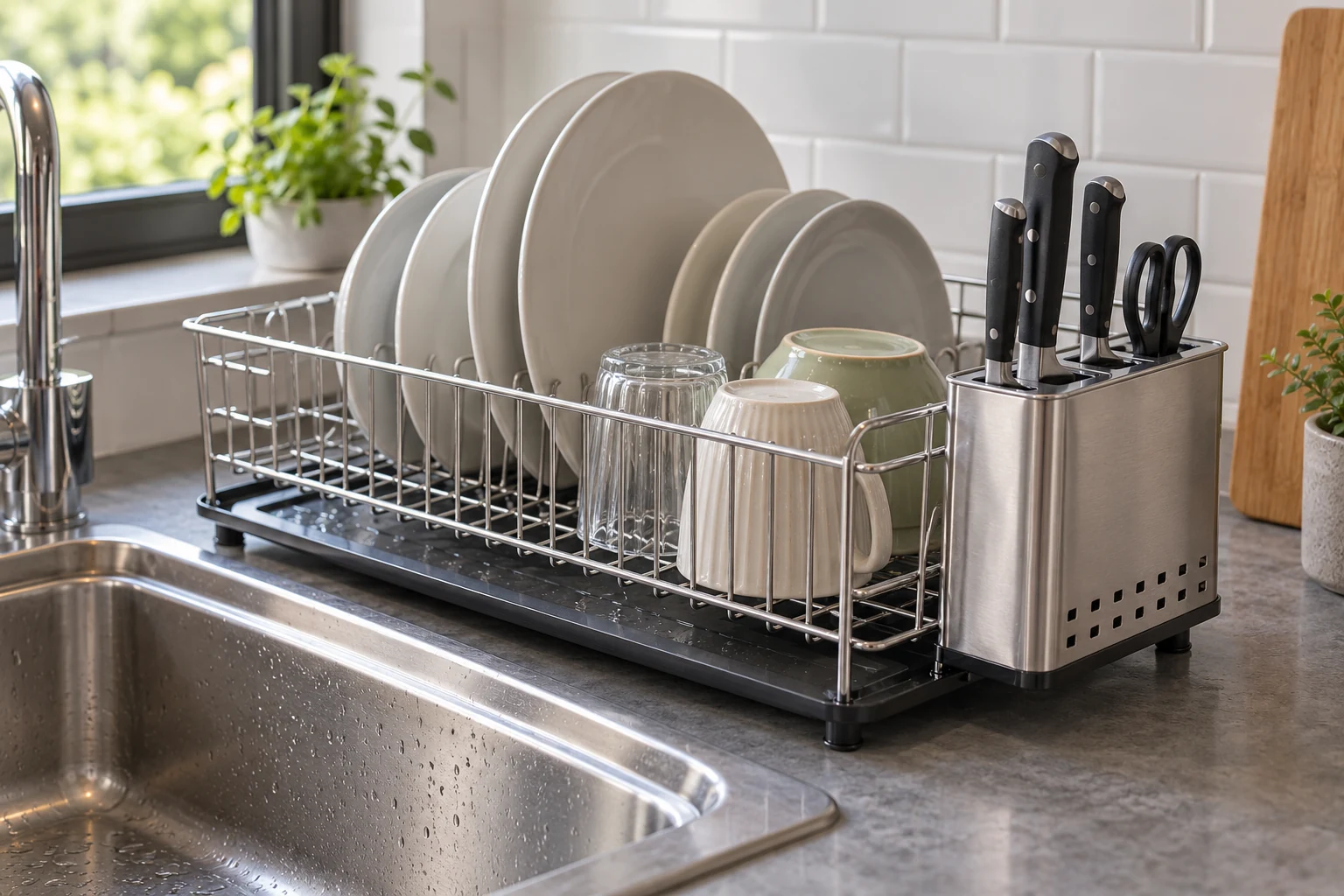
A dish rack’s general-purpose cutlery cup may not provide enough separated positions for a buyer’s target knife assortment. Adding a dedicated module raises several linked questions: how many handles fit, what blade lengths and shapes are intended, how the module attaches to the rack, and where water drains. A buyer evaluating a dish rack cutlery holder knife slot should define the actual knife set and approve a production-intent assembly. A slot count alone cannot establish fit, safe handling or compatibility with every knife.
Why might a dish rack need a dedicated knife module?
A user discussion reports that a dish rack did not provide enough knife positions. That observed complaint gives a real product-configuration problem, not evidence of how common it is. A buyer may be considering a dedicated knife area because the existing cutlery cup is crowded or because knives are not held separately in the intended layout. The article focuses on that assortment and interface decision, not consumer instructions for handling sharp blades.
Product examples show more than one approach. Simplehuman offers a knife-block module for its dish rack, while Joseph Joseph’s Dock cutlery drainer includes a dedicated knife-draining position. Simplehuman also documents a specific steel-frame dish-rack context. These products have distinct constructions and compatibility boundaries. They do not establish Koitor capability, a universal safest orientation, or a slot size that fits every knife.
For an importer or category manager, the design question is whether the buyer needs more knife positions, a separate accessory module, or a different general cutlery organizer. Those options change the rack footprint, attachment, drainage and cleaning. Convert the desired assortment into a fit matrix before choosing a module form.
Define the knife assortment before slot count
When comparing a dish rack cutlery holder knife slot layout, count usable positions only after checking each intended handle profile and the adjacent clearances.
“Four knife slots” is incomplete without the knife profiles they need to hold. Record representative handle widths and heights, blade lengths, bolsters, finger guards, rivets, and any unusual handle curve or end cap. Include only the intended product range; do not infer that a module fits professional, oversized or specialty knives unless those are in the target assortment.
A narrow slot may accept a thin handle but bind at a bolster. A wide opening may let a small handle tilt or share space with the adjacent knife. Slot depth also matters: a short module can leave less guidance for a tall handle, while a deep module may obscure the grip. The tray or sleeve needs a support geometry that matches the exact design objective. These conditions should be checked with samples from the buyer’s intended assortment, not guessed from a generic knife silhouette.
State whether the module should hold knives only or combine knives with forks, spoons or scissors. A mixed layout changes the separation and access needs. The article and packaging should describe the intended set and capacity; avoid inflated “fits all cutlery” wording when the module has model-specific openings.
What dimensions should buyers specify?
For each representative knife, capture handle width at the widest section, handle height, overall length, bolster or guard size, and any curve that affects insertion. The relevant outer envelope may not be the widest point if the knife enters at an angle. Record how it is intended to be inserted and removed, and keep the handle accessible for retrieval.
On the module drawing, label the number of positions, opening width and length, slot separation, support depth, divider height, outer module dimensions and required clearance from neighboring rack parts. Identify the front and back. If knife blades are meant to sit below a rim or support surface, show that relationship on the drawing for the approved samples. Do not present an AI-generated picture as proof of a safety feature; verify physical geometry and product instructions before claims.
Drainage needs a separate review. If water can collect in the module, show the intended openings, removable insert or cleaning path, and how the module interfaces with the dish rack’s drainage area. A set of holes does not automatically prove quick drying or hygiene. Confirm that the module can be cleaned and that debris does not remain in inaccessible corners. Any food-contact or antimicrobial statement needs separate substantiation and is not inferred from metal construction.
| Buyer input | What to record | Why it affects the module |
|---|---|---|
| Knife set | Sample IDs, handle and bolster profiles, overall lengths | Determines whether openings and support depth fit |
| Position count | Number and intended sequence of knives | Controls footprint and spacing |
| Module form | Separate removable block, slotted insert or integrated drainer | Determines attachment and cleaning approach |
| Rack interface | Rail location, wire diameter or mounting points | Affects retention and compatibility |
| Drainage | Water path, removable parts and access | Supports review of cleaning and water escape |
| User access | Hand clearance and insertion direction | Helps evaluate ordinary placement and retrieval |
Values should be developed for the buyer’s actual SKU. This is a specification framework, not a standard slot dimension.
Which module-to-rack interface should be reviewed?
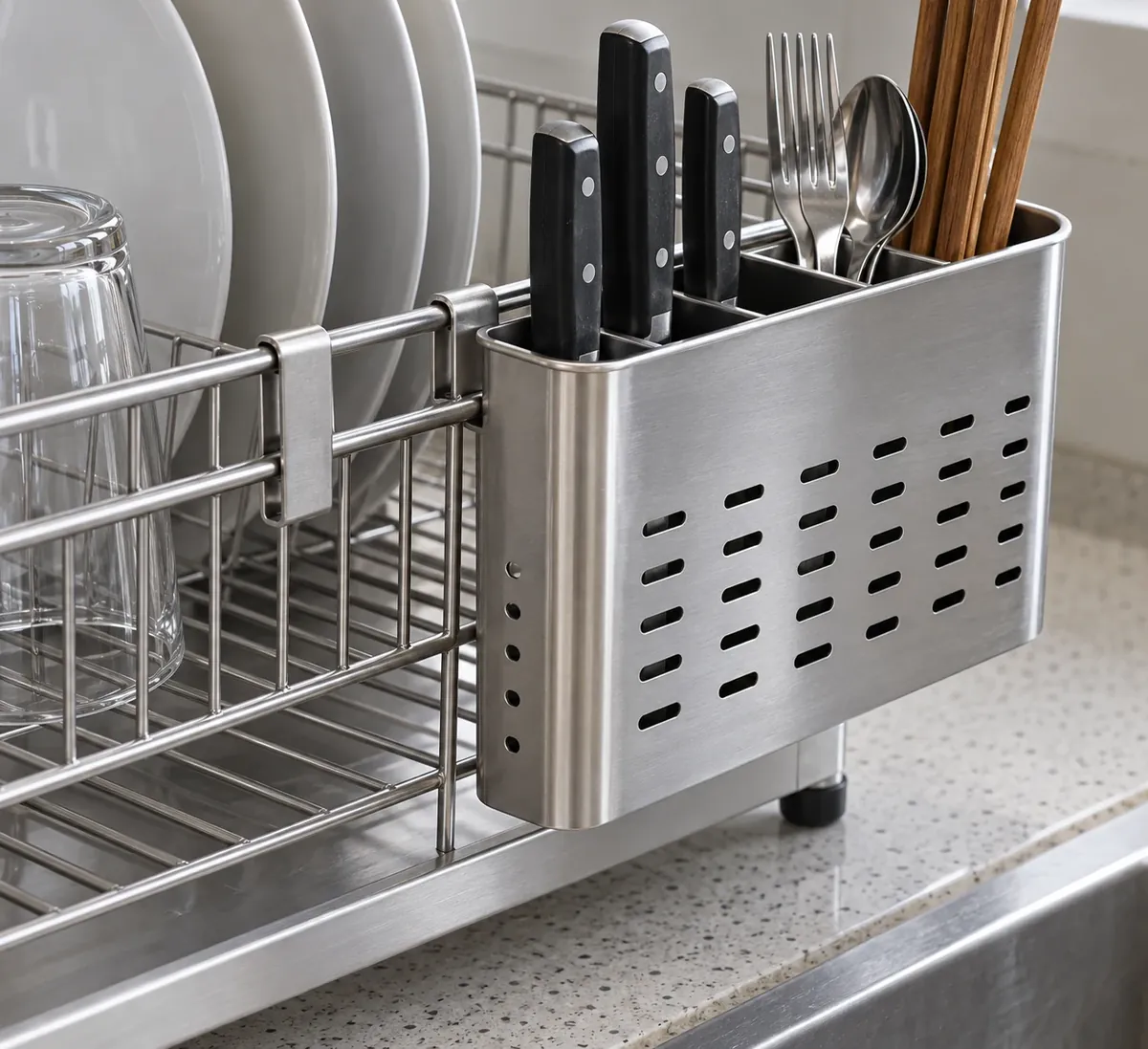
A removable module may hook over a rack rail, clip to a frame, sit in a basket, or attach through a dedicated bracket. Each approach has different effects on movement, footprint and cleaning. The buyer should specify which rack model or rail section the module must fit and whether it is intended to be removed by the end user. A universal-fit claim requires evidence across the named range; a single successful sample proves only the tested combination.
Show the interface in an assembled drawing and a close-up section. Identify the rail or attachment datum, insertion direction, stop feature and any secondary retention. Check whether a loaded module shifts, rocks or disengages during ordinary handling of the rack. That check is not a structural or load certification; it is a buyer review of the actual intended use. If a separate insert is used, confirm that it cannot be installed in a reversed position that blocks drainage or access.
Check neighboring clearances. A side-mounted knife module can collide with the sink, faucet, counter edge or dish-rack handle. An end-mounted module may reduce available plate space. For multi-tier racks, verify that a handle remains reachable and that the module does not block drainage or removal of another part. The finished layout should be reviewed at full scale with representative tableware and the rack’s expected location.
Decide what “removable” means
Removable might mean detachable for cleaning, transferable between rack configurations, replaceable after damage or simply separate from the main frame during shipping. State the intended reason. A friction clip may be convenient but could shift under use; a screw-fixed module may be stable but slower to remove. No attachment is universally best. Compare cleaning need, service plan, packaging, cost and assembly instructions for the target market.
If users remove the module, instructions should show the release direction without requiring force against a sharp edge. If the module is not intended for removal, avoid advertising it as a detachable accessory. If a replacement module is planned, identify its part number and supported rack revisions. A visually similar rail does not prove that two dish racks use the same wire spacing or attachment position.
How should the sample be checked?
Use the production-intent rack, module, finish and representative knife set. Record sample IDs and drawing revisions. Install the module following the proposed instructions, then seat each knife in its intended position. Check fit, tilt, contact, access and removal. Observe whether adjacent handles interfere, whether the module shifts, and whether the intended number of positions remains usable at once.
Review drainage and cleaning under the actual module construction. Confirm that water can exit through the intended path and that removable parts can be accessed for cleaning. Avoid claiming antibacterial performance, food-safety compliance or a particular drying time from a visual sample review. Those claims require appropriate evidence outside this fit checklist.
Check the assembly at the dish rack’s intended location or a representative counter setup. Use plates and cups in their normal positions to see whether the module reduces the rack’s usable capacity. An isolated photo of a knife block beside an empty rack can hide collisions that appear when the rack is loaded. Record the arrangement and take images from top, side and user approach angles.
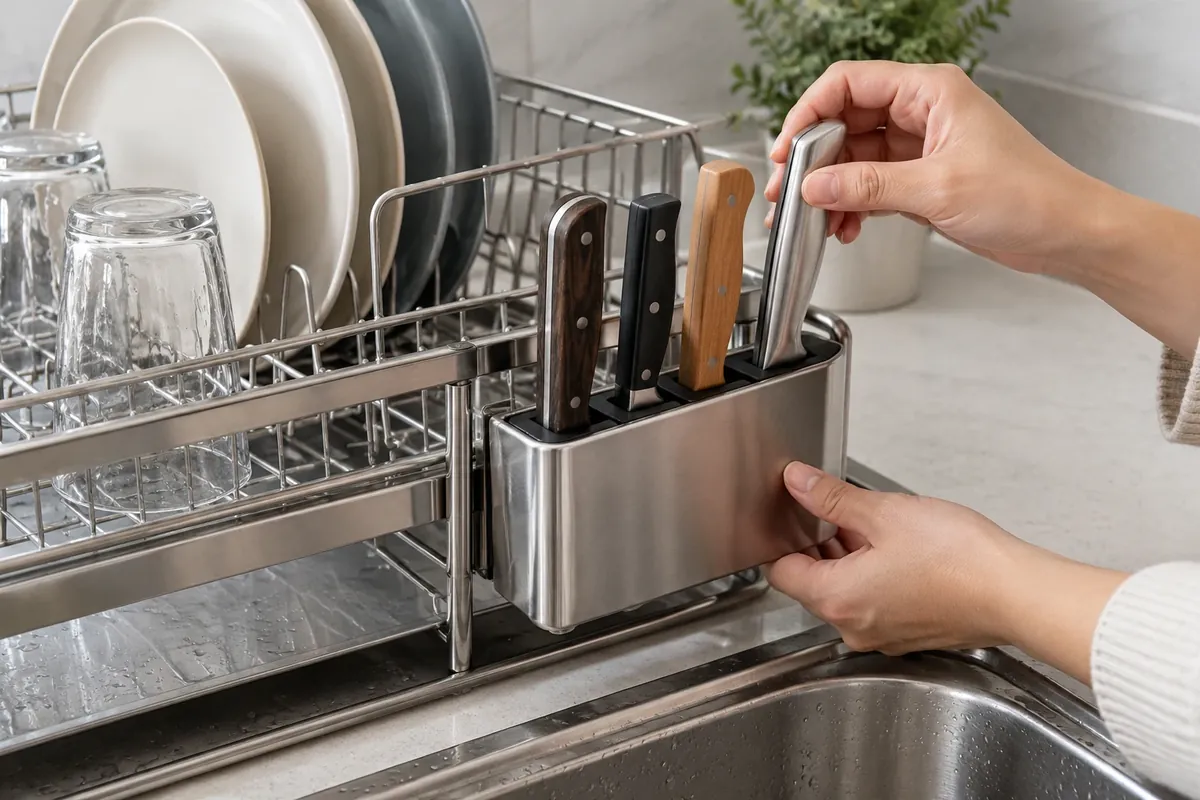
The acceptance sheet can separate four results: knife assortment fit; module attachment; interaction with dishes and sink-space; and drainage/cleaning access. A pass in one area should not be taken to prove the others. If one handle does not fit, record its profile and whether the issue is opening width, slot depth or collision. That gives the supplier a clear change request.
What belongs in the RFQ and change-control record?
Send the rack drawing or sample, target knife set, required position count, module concept, sink/counter context, finish, packaging needs and order quantity. Ask the supplier to identify whether the module is included, separately packed, user-installed or sourced as a bought-in component. Confirm responsibility for the rack interface and replacement parts before comparing quotations.
Koitor’s verified wire and metal kitchen-storage context supports discussion of dish-rack structure, formed components and sample review. The cited Simplehuman and Joseph Joseph modules are not Koitor products; current production of a knife-specific module and food-contact testing are not established. The buyer can use Koitor’s custom kitchen storage rack manufacturing page for a sourcing conversation, but project capabilities and component ownership should be confirmed directly.
Maintain one approved drawing revision linking the module, rack and instructions. Recheck if the rail diameter, attachment clip, slot layout, drain opening, finish or module material changes. A new module may look similar but shift the usable dish space or knife spacing. For service, list spare modules and compatible rack revisions separately.
Buyer checklist before production approval
Use the dish rack cutlery holder knife slot requirement as a traceable drawing and sample criterion, not as a claim of universal knife compatibility.
- Define the intended knife models or representative handle and blade profiles.
- State the required number of positions and whether the module is dedicated or mixed use.
- Dimension openings, separation, support depth and outer module envelope.
- Show the module-to-rack interface in assembled and detail drawing views.
- Specify whether the module is removable, replaceable or fixed.
- Review drainage openings and access for cleaning without unsupported hygiene claims.
- Test fit and retrieval using the intended samples on a loaded rack.
- Check module stability, neighboring tableware and counter/sink clearance.
- Record sample ID, drawing revision, instructions and fit results.
- Define which changes require a new sample review and identify replacement parts.
Perguntas frequentes
How many knife slots should a dish-rack module have?
Choose the number from the intended retail assortment and the available rack footprint. Record which knife profiles each position must accept and confirm that all positions can be used together in the sample.
Does a dedicated slot mean every knife will fit?
No. Handle thickness, bolster, length and insertion path differ. Use representative samples or a measured fit envelope and limit product compatibility statements to what has been checked.
Should the knife module be removable?
That depends on cleaning, service, packaging and user needs. State what “removable” means, how it attaches and whether the buyer expects it to transfer across rack models.
Can a buyer claim the module is safer?
Do not make a broad safety claim from slot count or a sample fit check alone. Any safety language must be reviewed against the exact design, instructions and applicable evidence.
What sample should be approved?
Approve a production-intent rack and module with the actual finish and attachment, loaded with the intended knife and tableware samples. Record fit, access, module movement and drainage observations separately.
Developing a Custom Metal Dish Rack?
Share your rack drawing or sample, knife assortment, module position count, attachment idea, finish, packaging plan and order quantity. Koitor can discuss the metal rack structure and practical OEM development options. Knife compatibility and any safety or hygiene claim should be confirmed against the finished product and supporting evidence.
OEM / MARCA PRÓPRIA
Transforme este guia de fornecimento num resumo do produto
Indique o produto pretendido, as dimensões, o acabamento, a quantidade a encomendar e os requisitos de embalagem. A sua equipa receberá uma análise prática da viabilidade de fabrico antes da apresentação do orçamento.
 English
 Español
 Português
 Français
 Deutsch
 العربية