

A rolled towel storage rack should be specified around the actual dry towels and the way a buyer expects customers to retrieve them. A product may have enough overall width but still fail to accept the buyer’s largest rolls, keep smaller rolls from shifting, or allow one towel to be removed without disturbing the next. For an importer, the approval target is therefore a defined reference set, divider arrangement, usable compartment geometry and retrieval action—not a generic claim that the rack “fits towels.” This guide covers metal organizers with discrete spaces or adjustable dividers for dry rolled towels. It does not cover towel bars, hanging towel racks, paper-roll dispensers or general folded-towel shelves.
What should this product help the buyer decide?
The product is a small assortment system: the buyer is deciding whether one organizer configuration can serve the intended towel sizes and retail or hospitality use. Search results for rolled-towel storage mix product listings with towel bars, wall racks and shelving, so the page type should be made explicit in the RFQ. A towel bar supports a textile by its edge; a roll organizer supports a cylindrical bundle between or within dividers. Dimensions and use checks are not interchangeable.
A first-party example illustrates why size and adjustability need to be treated as product-specific inputs. Yamazaki Home’s steel towel organizer identifies the maximum roll thickness for its own shelf and says its units can be assembled in narrow or wide configurations. Those details can help a buyer formulate questions, but they are not a universal towel-size standard and do not verify a different rack. The importer should nominate the towels, measure them in their intended dry rolled condition, and approve the proposed divider layout against those samples.
The key decision is whether the range belongs in one SKU or needs multiple configurations. A compact single-width organizer may be easier to pack, while adjustable dividers can accommodate more than one roll size but add a retention and assembly question. For a rolled towel storage rack, the right answer depends on the buyer’s actual assortment, shelf or countertop envelope, number of compartments and desired pack configuration. Define the customer use case before choosing the metal structure.
Which reference towel rolls should be measured?
Use physical towel samples or identified SKU references from the intended assortment. Record the towel’s dry state, fabric type if it affects roll compression, fold method, number of folds and rolling direction. Then measure the resulting roll’s largest outside diameter and length. A towel that is folded differently can produce another envelope even when the textile itself is the same. If a hospitality buyer expects a repeatable housekeeping fold, include that fold in the sample method.
Choose boundary examples instead of averaging several towels together. Include the thickest roll that the buyer wants to fit, the smallest roll that should remain supported, and any common intermediate size. If different towel collections have different pile thickness or length, mark them separately. “Standard bath towel” is not sufficiently precise for sample release. A roll diameter without its length may also be incomplete: a long roll can protrude beyond a short divider or interfere with neighboring items even when its diameter clears the opening.
The measurement record should identify the sample, orientation and method. Measure without compressing the towel unless compression is explicitly part of the intended use. If the rack will be sold for more than one towel category, define which combinations are expected to fit together. A bath towel and a smaller hand towel may occupy the same divider width differently, and mixing them can change how easily one roll is lifted out.
| Reference roll | Record | Sample check | Buyer release question |
|---|---|---|---|
| Largest dry bath-towel roll | Outside diameter, length, fold and roll method | Place in each intended compartment | Does it enter without forcing, deforming a divider or overhanging the usable area? |
| Smallest supported roll | Outside diameter and length | Place in the intended divider setting | Does it remain separated and accessible, or can it lean/shift into an adjacent space? |
| Hospitality or hand-towel roll | Exact towel reference and housekeeping fold | Test as a separate set and in planned mixed use | Is this configuration included in the product claim or excluded? |
| Alternate fabric/pile | Textile type, dry condition and roll method | Repeat fit and removal with the alternate reference | Does the changed roll envelope affect fit or friction? |
Do not convert a sample observation into a broad promise such as “fits every towel.” State the tested towel references or a defined maximum envelope and the conditions used to establish it. A product description should not extend beyond what the buyer and supplier have actually checked.
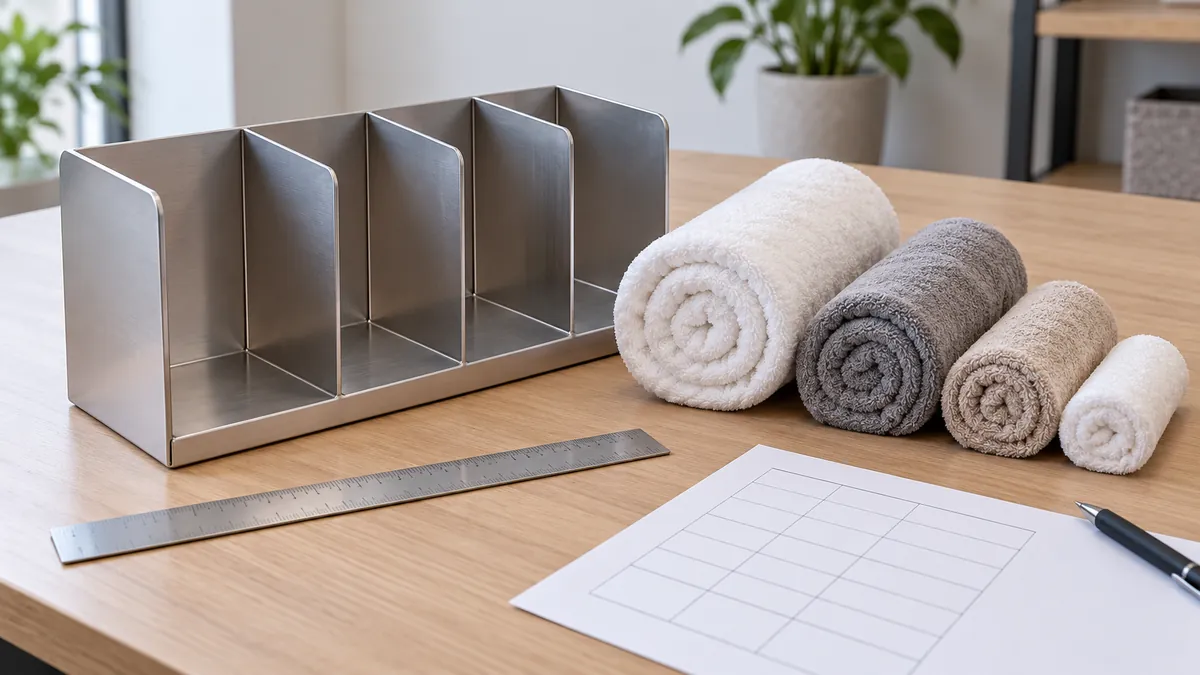
How should dividers and usable space be specified?
Separate outside dimensions from usable compartment dimensions. Overall width, depth and height determine whether the organizer can sit in the target location, but they do not tell the buyer the space available for a towel. For each compartment, specify the clear width at the narrowest point, clear height, usable depth, divider thickness, and any curved or angled surfaces that reduce the opening. If a divider can be repositioned, record the permitted positions and the resulting clear openings rather than saying “adjustable” without limits.
The roll’s access path matters as much as static fit. Determine whether towels are inserted from the top, from the front or from an open side. Check any upper lip, crossbar, handle or adjacent shelf that could restrict insertion or lifting. A larger roll may fit when the organizer is empty but be difficult to remove when neighboring compartments are occupied. A product may also appear to hold more rolls when viewed from above than it can support with enough clearance for a user’s fingers.
Measure the intended installation or storage location. A rack may be placed inside a cabinet, on open bathroom shelving, on a vanity or in a hospitality supply area. Each location can impose a different height and reach constraint. Record nearby walls, cabinet doors, shelf edges and any objects that limit hand access. If buyers expect the organizer to slide into a shelf bay, verify the full outside footprint and the clearance needed to remove the largest roll.
For adjustable systems, define how the divider is held in position and what prevents an unintended shift during normal loading and cleaning. If dividers interlock, record the assembly sequence and whether the buyer can change the width without tools. If the organizer uses fixed compartments, state the dimension that controls each opening. The sample should reflect the production-intent finish and all supplied components, since coating thickness, caps or pads can change clear dimensions or contact with the shelf.
A useful drawing should show both functional datums and open space. Mark the shelf plane, inside faces of dividers, front access line and roll center or envelope where needed. Identify which dimensions are critical for fit, which may vary within a tolerance and which are cosmetic. That distinction helps the factory focus measurement and avoids treating every visible gap as equally important.
How can the buyer check one-roll retrieval?
Approve the action sequence, not just the loaded appearance. Place the reference rolls in the agreed compartments and remove one from the center, from an end and from any location that is less accessible. Observe whether a neighboring towel moves, whether the roll snags on a divider edge, and whether a user must tilt or compress the towel to clear the opening. Repeat the check with the largest and smallest specified rolls, because their removal paths can differ.
The test should use the actual shelf location or a representative fixture. A wide open table does not reveal whether a top shelf blocks upward lifting or whether a side wall prevents the required angle. For a hospitality use case, the buyer may want to check the motion with the organizer at its intended storage height and with the towel arrangement used by staff. The purpose is to expose an interface problem early, not to simulate every possible user.
If the sample has adjustable dividers, check whether the selected spacing remains where the user set it after multiple loading and retrieval cycles. If the adjustment requires force, tools or removal of neighboring towels, record that behavior and decide whether it matches the intended customer. Do not claim the dividers are secure or easy to adjust without defining the configuration and reviewing the finished sample.

A sample record can include the towel references, divider positions, shelf location, insertion direction, retrieval positions and observations. If an issue appears only when multiple rolls are present, take a photo from above and from the user’s side. Link the record to the drawing revision and product copy. This makes later inspection and claim review more useful than a simple “fit approved” note.
Which material, finish and packaging decisions matter?
Metal selection and surface finish should follow the product’s use environment and buyer specification. A bathroom or hospitality organizer may be exposed to routine dampness, cleaning and repeated handling, but this does not justify a blanket claim that a particular finish will never corrode or remain unchanged. Name the intended finish, color, gloss or texture, cleaning instructions and any relevant appearance criteria. If the buyer requires a corrosion or coating test, define the method and acceptance criteria separately and do not infer a result from a photograph.
Review edges and divider ends for the expected contact with textile. A sharp or rough point can snag fibers; a rounded, capped or otherwise protected edge may change the opening dimension. Confirm whether any end caps, feet or pads are supplied, who provides them, and how they are retained. If separate components are sourced from another supplier, identify them in the bill of materials and confirm that replacements or material changes require buyer approval.
For welded or formed constructions, discuss the geometry with the manufacturer before the drawing is frozen. Divider spacing, corner radii, base flatness and weld placement can affect the usable compartment, appearance and assembly. Any suggestion to move a joint or alter a divider should be reflected in the revised drawing and checked again with the reference rolls. A visually neat joint does not prove a particular load capacity or durability result.
Packaging should protect the finish and keep dividers in the approved arrangement. Review whether the product ships assembled or flat-packed, how components are separated, whether the package allows dividers to rub in transit, and whether retail instructions clearly show any assembly or adjustment. Approve a packed sample if the organizer has projecting dividers or removable parts. The carton, protective inserts and product orientation should be evaluated together rather than added after the product geometry is complete.
What sourcing mistakes should be avoided?
One frequent mistake is using only one towel roll to approve a range. A sample that fits a medium cotton towel does not automatically fit a thicker bath sheet, a small hand towel or a different fold. Another is specifying a roll diameter without stating the dry condition and rolling method. If those assumptions change between the buyer’s measurement and the end user’s use, the sample comparison may not be meaningful.
A second mistake is treating “adjustable” as an adequate specification. Buyers should ask how many positions are available, what the clear opening is at each position, whether the divider stays put, and whether adjustment is possible after the organizer is loaded. A flexible design may widen the assortment range, but it can also introduce more parts or a more involved assembly. Evaluate the benefit against the buyer’s actual product line.
A third mistake is confusing an adjacent towel category with a roll organizer. A towel bar, multi-arm rack, wall-mounted shelf and a discrete roll divider have different support and retrieval questions. Search pages and product listings may group them broadly, but an RFQ and article should preserve the distinction. This helps prevent irrelevant supplier quotes and unhelpful product-copy comparisons.
Finally, buyers sometimes approve the bare metal prototype and defer finish, package and instructions. A finished coating can affect clearances, end protection and contact surfaces. A package can allow parts to move or scratch. A revised towel assortment can change capacity language. Keep the approved sample, drawing, component list, package and fit claims connected by revision so each change triggers the right recheck.
How can a custom metal manufacturer support the project?
A specialized metal hardware manufacturer can review drawings or physical samples, discuss forming and joining options, and help identify dimensions that may be difficult to produce or inspect consistently. For a rolled-towel organizer, that conversation should begin with the buyer’s roll references, required compartment openings, finish, target package and any variable divider positions. It does not mean that the manufacturer currently makes this exact product or has validated a particular towel capacity.
Koitor’s approved profile supports custom bathroom and home-storage metal hardware, sample development from drawings or physical samples, metal forming and welding, finishing, assembly and packaging preparation. Buyers should confirm the exact product scope, material, order quantity, sample timing, MOQ and production lead time for their project. A small-batch trial may be appropriate for evaluating a new assortment, subject to product complexity and confirmed commercial terms.
For an initial RFQ, include dimensioned drawings if available, reference towels or clear photographs with measurements, target market, finish requirements, adjustment needs, intended assembly and package format. Ask the factory to list open assumptions rather than filling in missing dimensions on its own. The custom bathroom hardware page gives general category context, while the home-storage OEM overview describes related metal storage work. For a project-specific discussion, contact Koitor Ferragens.
Lista de verificação do comprador e perguntas frequentes
- Define whether the product stores discrete rolls, folded towels or hanging towels.
- Provide the exact towel references, dry condition, fold/roll method, outside diameter and length.
- Identify the smallest and largest rolls that the proposed SKU should support.
- Specify compartment clear width, height and depth, divider thickness, positions and retention method.
- Show the insertion and retrieval direction and any adjacent shelf, wall or cabinet constraints.
- Test one-roll removal at the end and middle positions with neighboring rolls loaded.
- Record the production-intent finish, edge protection, pads or caps, assembly and cleaning instructions.
- Approve a packed sample and confirm how divider spacing and finish are protected in transit.
- Tie the final compatibility language to the tested towel set and drawing revision.
Does a rolled towel storage rack fit every towel size?
No single size claim should be assumed. Towel dimensions, thickness, pile and rolling method change the resulting roll envelope. Identify the target references and state only the range that has been checked on the proposed product.
Should buyers specify roll diameter or compartment width?
Both can matter. Roll diameter describes the textile envelope; compartment clear width and height describe the organizer’s available opening. The buyer should compare these measurements and then confirm loading and retrieval on a finished sample.
Are adjustable dividers always better?
Not necessarily. They may serve several roll sizes, but the adjustment range, retention, assembly and user effort need to be reviewed. A fixed compartment may be simpler if the assortment has a narrow, stable range.
Can one product listing prove another organizer will fit?
No. A published size or compatibility statement applies to the named product and tested configuration. Use competing product pages as examples of questions to ask, then qualify the buyer’s own design with actual samples.
The most reliable release decision connects towel references, compartment geometry and retrieval behavior. Keep that evidence with the drawing and package revision, and limit product claims to the configuration the buyer actually approved.
Discuss a Rolled-Towel Organizer Drawing or Sample
Share the reference towel sizes, divider layout, finish and packaging requirements with Koitor Hardware to discuss the metal design and sample-development questions. Compatibility and performance claims still require buyer-defined checks.
OEM / MARCA PRÓPRIA
Transforme este guia de fornecimento num resumo do produto
Indique o produto pretendido, as dimensões, o acabamento, a quantidade a encomendar e os requisitos de embalagem. A sua equipa receberá uma análise prática da viabilidade de fabrico antes da apresentação do orçamento.

 English
 Español
 Português
 Français
 Deutsch
 العربية