
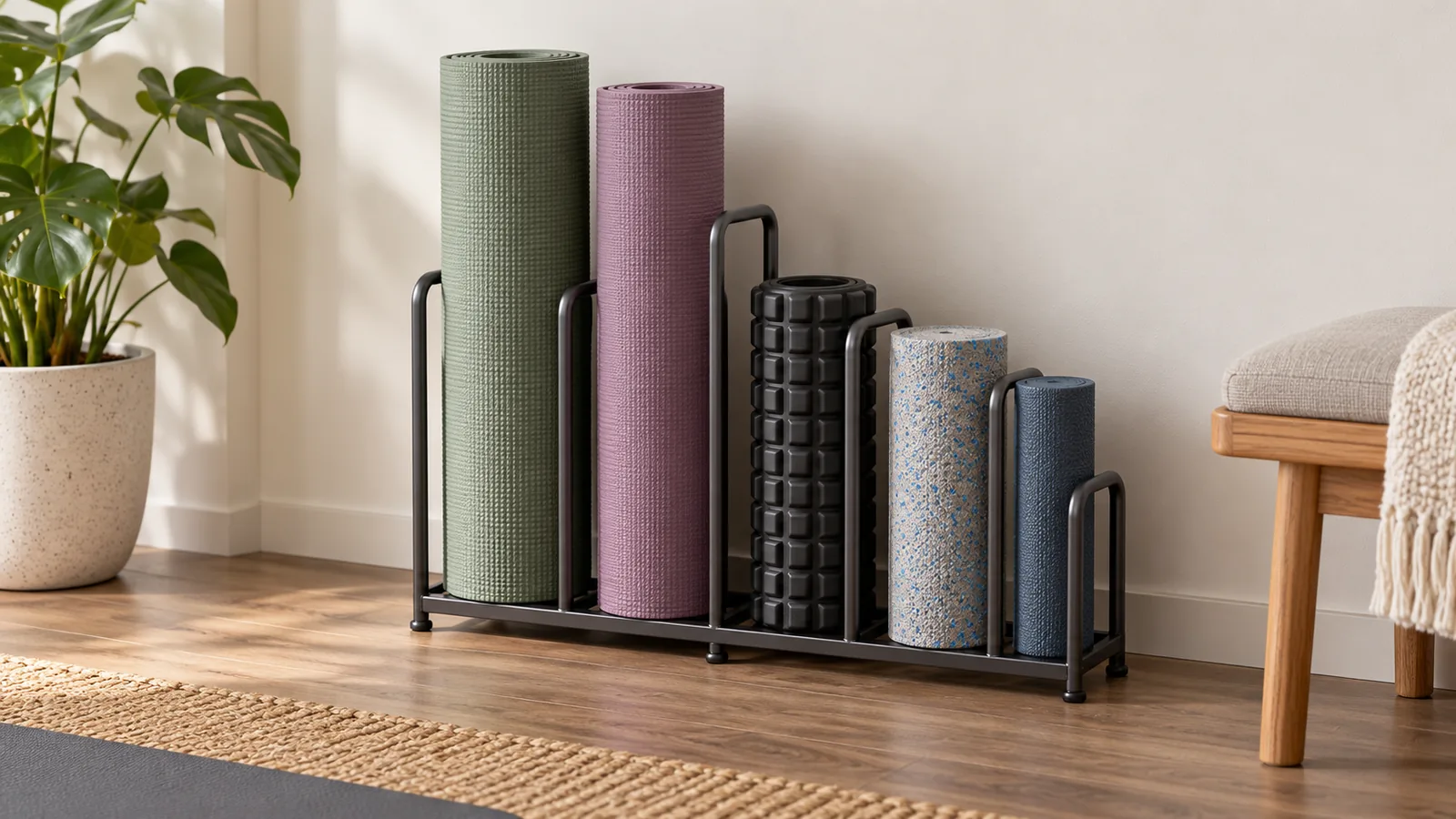
A yoga mat foam roller storage rack should be specified against the exact rolled items and storage location planned for the product. Yoga mats and rollers vary in diameter, length, surface texture, compression and rolling method; a nominal slot size or a photograph cannot establish that a mixed set fits. Importers should name reference items, decide whether they will be stored vertically or horizontally, measure the usable opening and removal path, and approve a finished sample in the intended home environment. This guide covers compact freestanding home storage only. It does not cover commercial gym carts, wall-mounted fixtures or claims that a metal rack is suitable for exercise use.
Which buyer decision does a compact home rack answer?
A buyer developing a yoga mat foam roller storage rack is specifying a home-storage product for particular bulky, rolled items rather than a general fitness equipment stand. A compact home organizer may sit beside furniture, inside a closet or on a shelf. Its envelope, access and appearance differ from a mobile cart designed for a studio or commercial training area. Public listings mix these product types, so the RFQ should state the intended product class and environment before comparing supplier photos or advertised capacities.
A current Yamazaki Home fitness storage rack listing asks buyers to consider rolled-mat diameter for its own product. Body-Solid’s GYR500 product information describes a larger mobile rack with wheels and multiple storage positions. These examples show that storage geometry and product class are model-specific. Their roll limits, item counts, materials and warranty terms cannot be transferred to another design. Use them to frame questions, not as proof for a proposed OEM item.
The first decision is which items a single SKU must accommodate. If the buyer wants only rolled mats, the cross-section and support points may differ from a mixed mat-and-roller rack. A foam roller may be shorter, heavier or textured differently from a yoga mat. If the item set includes blocks, straps or other accessories, those are separate interfaces and should be specified separately rather than silently expanding a roll rack into a multi-purpose fitness cart.
Which reference mats and rollers should be measured?
Build a named reference set from the intended assortment. For each yoga mat, record its SKU or source, material description if known, thickness, width, length and roll method. Measure the outside diameter after rolling it as the buyer expects a user to store it. For foam rollers, record length, diameter, surface profile and whether the roller is smooth, grooved or otherwise textured. These details help explain why two items with similar nominal dimensions may behave differently in an opening.
Choose the largest and smallest relevant envelopes, plus one or two representative mid-range items. The largest roll tests whether the opening and surrounding space are sufficient; the smallest can reveal whether an item sits securely or shifts into adjacent space. If a buyer plans to support both short rollers and full-length mats, the support arrangement must account for their different lengths and centers of contact. Do not treat a single “standard yoga mat” as a complete specification.
Record storage orientation. A vertical arrangement may use a narrow footprint but require a tall clear area and stable support at the base. A horizontal arrangement may need more floor width or several tiers, while access to an item can depend on its position. The buyer should decide which orientation fits the product concept and test it with the actual references. Do not change the orientation during sample review without updating the drawing and use description.
| Reference item | Record before RFQ | Sample check | Release question |
|---|---|---|---|
| Thickest rolled mat | Rolled outside diameter, length and rolling method | Place in the intended slot or bay | Does it enter and leave without forcing the structure or adjacent items? |
| Slim or shortest mat | Diameter, length and strap or band if used | Test the smallest opening or vertical position | Does it remain in the intended position without slipping through or leaning into another item? |
| Largest foam roller | Diameter, length and surface profile | Load and retrieve from its planned position | Do texture or end caps affect contact and removal? |
| Mixed mat-and-roller set | Exact item list and orientation | Load the planned combination, not each item alone | Can the user reach each item without shifting the rest of the set? |
If a product is meant to fit a defined range rather than named models, state how that range was derived and identify the measurement method. Keep the claim bounded to the test set. A compatibility statement should not suggest that all mats or rollers fit simply because several samples did.
How should the rack opening and footprint be specified?
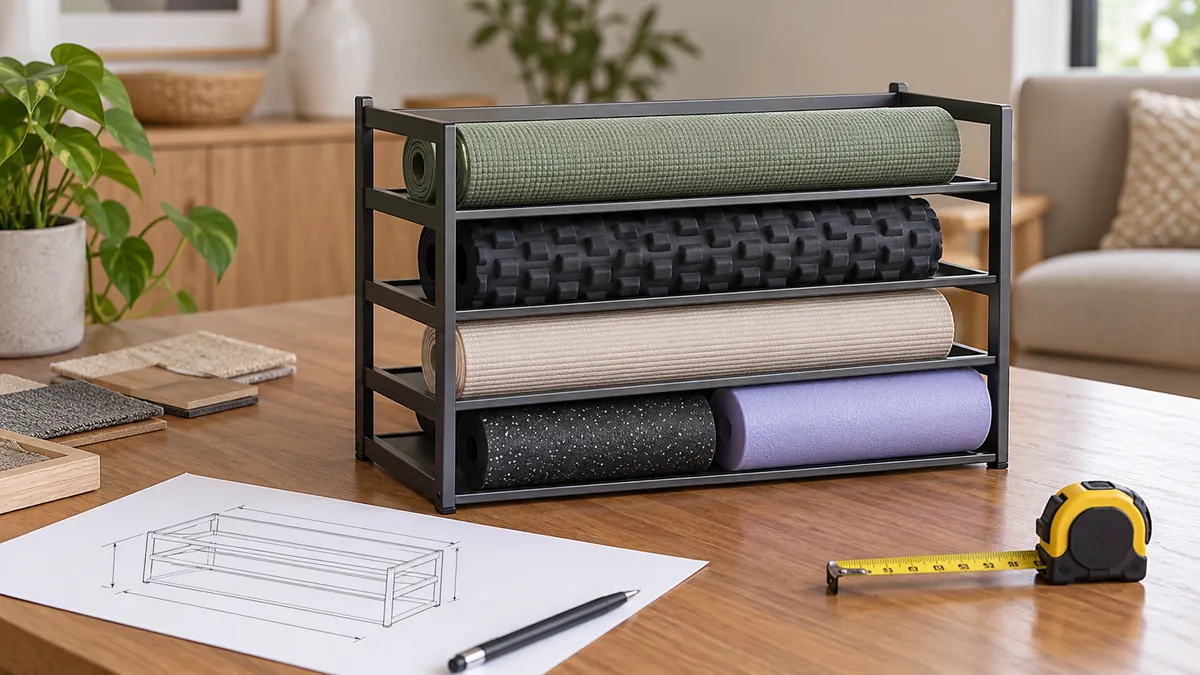
Start with the item envelope and the product opening. A slot’s nominal width does not always equal its usable opening: crossbars, end caps, retaining lips or divider thickness can reduce clear space. Mark the measurement points on the drawing and distinguish outside rack dimensions from clear width, depth and height. For a vertical holder, identify the depth of the base channel and the height of any retaining feature. For a horizontal rack, identify the usable bay width and the clearance above each level.
Then compare the rack’s total footprint with the intended location. Measure the usable space beside a cabinet, under a shelf or in a designated room corner. Note skirting boards, nearby furniture, doors and the access needed to lift a mat or roller out. A rack can fit within the floor rectangle but still make removal awkward if the user must tilt a long mat around a table or pull it past a wall. The product page should describe the intended storage arrangement accurately.
Specify which product surfaces contact the stored item. A mat or roller may rest against two rails, a shelf, a base cradle or a retaining bar. The contact geometry can influence how the item sits and how much of it remains accessible. Do not assume a strap or hook shown in a competitor image is required in the buyer’s design. If a strap, pad or cap is part of the proposed bill of materials, identify who supplies it and how its location and replacement are controlled.
For a low-profile rack, note floor support points, base width, overall height and any intended wall clearance. For a rack with tiers, mark each tier’s clear opening and the access path to the lowest position. Avoid a generic “compact” statement without the actual dimensions and intended location. A simple dimensioned drawing with an item envelope overlaid can expose conflicts before a sample is made.
How should fit and retrieval be checked on a sample?
Check the sample with the named items and the intended layout. First compare the physical rack against the drawing: overall dimensions, clear openings, divider positions, assembly and contact surfaces. This does not establish load rating or long-term performance; it confirms that the sample reflects the design being reviewed. If the sample differs from the drawing, record the difference and decide whether it is an approved revision before judging fit.
Load the largest reference item first, then the smallest and the planned mixed set. Observe whether each item can be placed without twisting, compressing or forcing it into the opening. Remove an item from the most constrained position while the neighboring items stay in place. Note whether a mat catches on a crossbar, whether a textured roller contacts a sharp or rough edge, or whether lifting one item pulls another out of position. Define what “easy retrieval” means for the intended user in a simple observable way.
For a vertical orientation, check the loaded sample on the floor surface and in the intended location. Observe rocking or movement while placing and removing the items. For a horizontal or tiered arrangement, check whether the rack shifts as an item is slid in or lifted out. A short sample demonstration is not a certified stability or load test. If the product requires a performance threshold, agree on the loading setup, surface, method and acceptance criteria with the responsible technical team before making a claim.
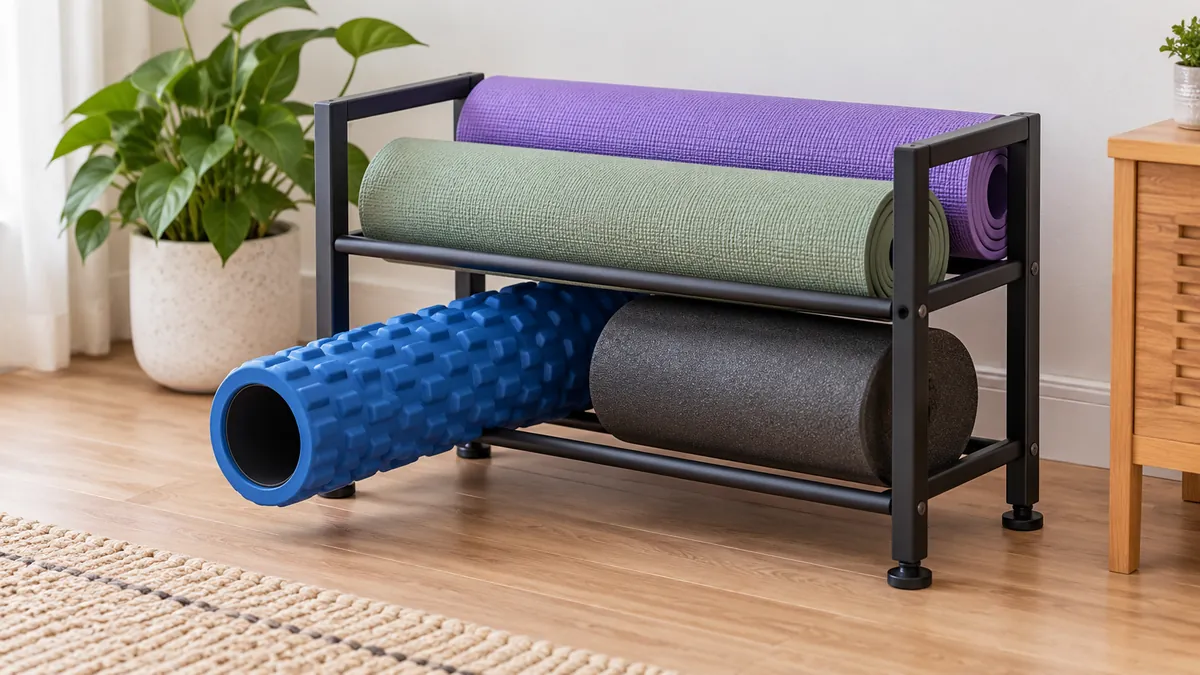
The approval record should include the rack revision, reference-item IDs, orientation, location, loaded arrangement and retrieval actions checked. Photos from the front and side can show protrusion or clearance that a single product shot misses. If item dimensions or use direction changes, repeat the affected checks and review any packaging text or online compatibility statement.
What construction, finish and package details affect fit?
The proposed rack may use formed wire, rod, tube, sheet parts or a combination, depending on the design. That is a design discussion with the factory, not an assertion that Koitor currently makes a fitness rack. Identify the parts that define the opening, the parts supporting the stored item and the joints that keep the frame aligned. A change in material section or bend position can affect clear dimensions and how a long item rests, so review such revisions against the same reference set.
Specify the finish and appearance criteria for the intended use. If a coated surface is selected, check color, texture, coverage at edges and joints, and any areas where a pad or end cap must fit. Do not claim that a finish is scratch-proof, moisture-proof or suitable for every item surface without evidence. Check edges and exposed ends for the proposed contact points. If accessories such as rubber feet or straps are required, list their material, supplier responsibility and retention method in the project specification.
Assembly and packaging also matter. A rack shipped flat-packed may need joints or fasteners that affect alignment after assembly. Confirm the assembly sequence, required tools, supplied hardware and instructions on the production-intent sample. Review the packed sample to see whether rails can rub together or the finish can be marked in transit. If the package is intended for e-commerce, evaluate how the rack dimensions and protection affect the carton configuration, while avoiding an unsupported claim about transit performance.
The final approval should tie the drawing, reference item matrix, finish, components, package and product copy to a revision. If the buyer changes the mat range, opening, orientation, wheel or foot design, or assembly, identify which sample checks need repeating. This change discipline is more reliable than carrying forward an approval that applied to another configuration.
What mistakes should importers avoid?
Do not borrow dimensions or capacities from a commercial gym cart when developing a compact home product. The cart may use a different base, wheel system, frame height and assortment. Likewise, a wall-mounted holder has attachment and wall-substrate questions that do not apply to a freestanding product. Similar nouns in product search results do not mean the products share a release specification.
Do not approve only an empty frame. The fit question depends on actual mats and rollers. A slot may look generous with no items but become crowded when a textured roller and a wide mat occupy neighboring positions. Test the intended mixed arrangement, not just one item at a time. If the buyer intends to sell multiple rack sizes, evaluate whether each size serves a distinct reference set and whether labels or SKU differentiation will prevent mix-ups.
Avoid vague claims such as “universal home gym storage,” “holds all mats,” or “stable under heavy equipment.” Define the supported items, orientation and conditions actually reviewed. The product’s visual impression, metal thickness or number of rails is not evidence of a specific load or safety performance. If a claim is commercially necessary, develop an appropriate specification and test evidence before approving the copy.
Finally, do not treat an adjacent home-fitness assortment as proof of factory capability. Koitor’s approved positioning covers custom bathroom and home-storage metal hardware and related processes. A buyer exploring an adjacent fitness product should share drawings, physical references and expected order details so the factory can assess scope before promising a route, sample or production schedule.
How can an OEM partner support a new rack concept?
A custom metal hardware manufacturer can review a drawing or physical sample, discuss whether a proposed frame can be formed and joined, and identify dimensions or assembly details that need clarification. For a yoga mat foam roller storage rack concept, provide the reference roll set and intended home location early. The manufacturer should confirm whether the design fits its actual capability and commercial scope. This article does not establish that Koitor currently offers a yoga-mat or foam-roller rack.
Koitor’s approved company information supports small-batch OEM and custom metal home-storage work, sample development from drawings or physical samples, forming and joining, finishing, assembly and packaging preparation. It does not establish a fitness equipment range, certification, rated capacity or current SKU. Ask for product-specific confirmation before requesting a quotation or making an assortment commitment. Confirm MOQ, sample timing and lead time for the particular design rather than reusing generic assumptions.
An initial RFQ should include the target item list, measured roll envelopes, orientation, location footprint, finish, package, target order quantity, and any required compatibility statement. Attach drawings and representative items if possible. Ask the factory to identify open questions and propose a sample-review plan. The home-storage OEM overview gives general context for custom metal storage work; the custom kitchen rack page describes adjacent rack development. For a project-specific assessment, contact Koitor Ferragens.
Lista de verificação do comprador e perguntas frequentes
- State that the intended product is a compact freestanding home organizer, not a gym cart or wall fixture.
- Identify each yoga mat and foam roller by model or representative physical sample.
- Record rolled diameter, length, roll method, texture and any strap or end cap.
- Choose vertical or horizontal storage orientation and show the item retrieval direction.
- Specify clear opening, support spacing, usable bay length, overall dimensions and floor footprint.
- Check the largest, smallest and mixed reference sets in the intended location.
- Observe item interference, rack movement and whether removal disturbs adjacent items.
- Specify finish, edge/contact expectations, bought-in accessories, assembly and package.
- Keep compatibility claims, sample approval and drawing revisions linked together.
Does one rack fit every yoga mat and foam roller?
No. Item diameter, length, texture, rolling method and orientation differ. A buyer should define a supported reference set or measurable envelope and test the proposed design against it.
Should the buyer choose vertical or horizontal storage?
Choose based on the intended location and removal motion. Vertical storage may use a different floor footprint and base geometry from a horizontal rack. Measure the available space and check the named items in the planned orientation.
Can a product-page capacity be used for an OEM rack?
No. Capacity statements apply to the listed product and its stated setup. An OEM claim should be supported by the buyer’s chosen items, rack revision and defined sample or test conditions.
Is a fitness rack automatically safe for gym use?
No. A home-storage article or product appearance does not establish commercial fitness use, load rating or certification. Define the intended environment and obtain evidence appropriate to any required claim.
A good release decision ties the rack to specific roll references, a defined location and observable retrieval actions. Approve that combination on a representative finished sample, then keep claims within the evidence for that design.
Discuss a Home-Storage Rack Drawing or Sample
Share the reference mats and rollers, target storage envelope, drawing or sample, finish and packaging requirements with Koitor Hardware to discuss the metal design and sample-development questions. Capacity and fitness-use claims require separate buyer-defined evidence.
OEM / MARCA PRÓPRIA
Transforme este guia de fornecimento num resumo do produto
Indique o produto pretendido, as dimensões, o acabamento, a quantidade a encomendar e os requisitos de embalagem. A sua equipa receberá uma análise prática da viabilidade de fabrico antes da apresentação do orçamento.
 English
 Español
 Português
 Français
 Deutsch
 العربية