
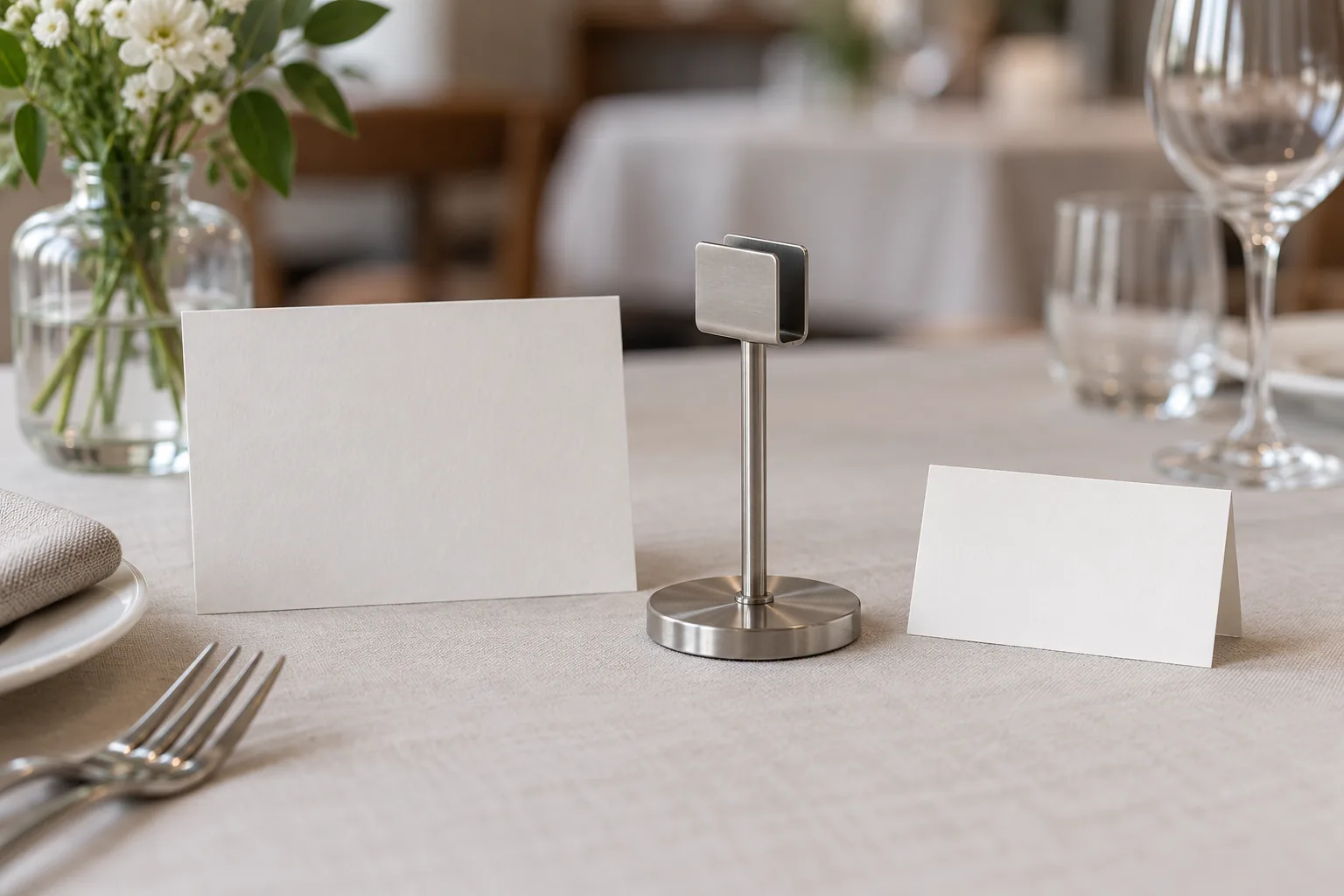
A metal menu card holder specification should identify the actual card dimensions and thickness, the holder’s usable opening, the displayed height, and the tabletop conditions for the intended setting. Approve a physical sample with the cards or inserts that will be supplied or recommended, rather than relying on a product name or nominal card size. A holder can match a card’s outside width yet still pinch a laminated edge, hide important text, or feel unstable when touched. The checks below create a practical RFQ and sample-approval brief for importers; they do not establish a universal fit or performance rating.
Which card or menu format will the holder actually display?
Start with the insert, because “menu holder” can describe several different jobs. A place card may be a small folded tent, a single flat card, a printed insert inside a clear sleeve, or a thicker laminated piece. A menu may be a single sheet or a multi-page folded panel. The outer dimensions alone do not describe what the holder grips or supports.
Create a reference set for every intended format. Record the finished width and height, material, thickness at the edge that enters the holder, whether the card is folded, and whether it will be used alone or with a transparent protective sleeve. Include the tolerance or variation expected from the printing supplier. If the card is printed on both sides, mark which side should face the guest. If it is a tent card, note the crease and the point where the holder contacts it.
The difference between a card’s nominal size and its real sample matters. Paper can vary by stock, coating, lamination, folds, and finishing. A sleeve can add thickness or a seam at one edge. A double-sided menu can also be heavier or less rigid than a single sheet. Ask the printer or insert supplier for a controlled sample and bring it to the holder review.
A product listing from Cal-Mil, for example, presents a particular Luxe holder for two named card formats. That is useful evidence that hospitality assortments may be organized around specific display sizes; it is not proof that another holder accepts those formats. Likewise, a supplier specification sheet for one Tablecraft item lists a slot width for that model. Keep such details attached to the named SKU and request the current technical drawing when deciding fit.
| Insert or display | Buyer records | Sample question |
|---|---|---|
| Flat paper card | Finished width, height, stock and edge thickness | Does the card enter and sit without buckling? |
| Folded place card | Fold position, footprint and displayed height | Does the fold remain aligned and visible? |
| Laminated card | Total thickness and corner finish | Does the holder accept the finished edge? |
| Clear sleeve or frame | Outer dimensions, seam and insert removal | Is the sleeve included, and who supplies it? |
| Multi-page menu | Number of leaves, open footprint and weight | Does the support retain the menu in the intended position? |
How should the slot, clip or contact interface be measured?
A metal menu card holder specification should distinguish the holder’s overall outside size from the dimension that performs the retention. Depending on the design, the card may sit in a formed slot, between two pieces, under a clip, behind a lip, or in a separate transparent insert. Buyers should not assume these mechanisms are interchangeable.
Ask the supplier to show the functional opening and the contact points on a drawing or annotated sample. Capture the minimum and maximum opening if the feature varies, and say how each value is measured. For a slot, record the clear gap, useful depth, entry angle, and any burr or return that could catch the insert. For a clip, note the grip area, travel or opening method, and whether the card can be removed without bending it. For a separate frame, identify the insertion direction and how the insert is retained.
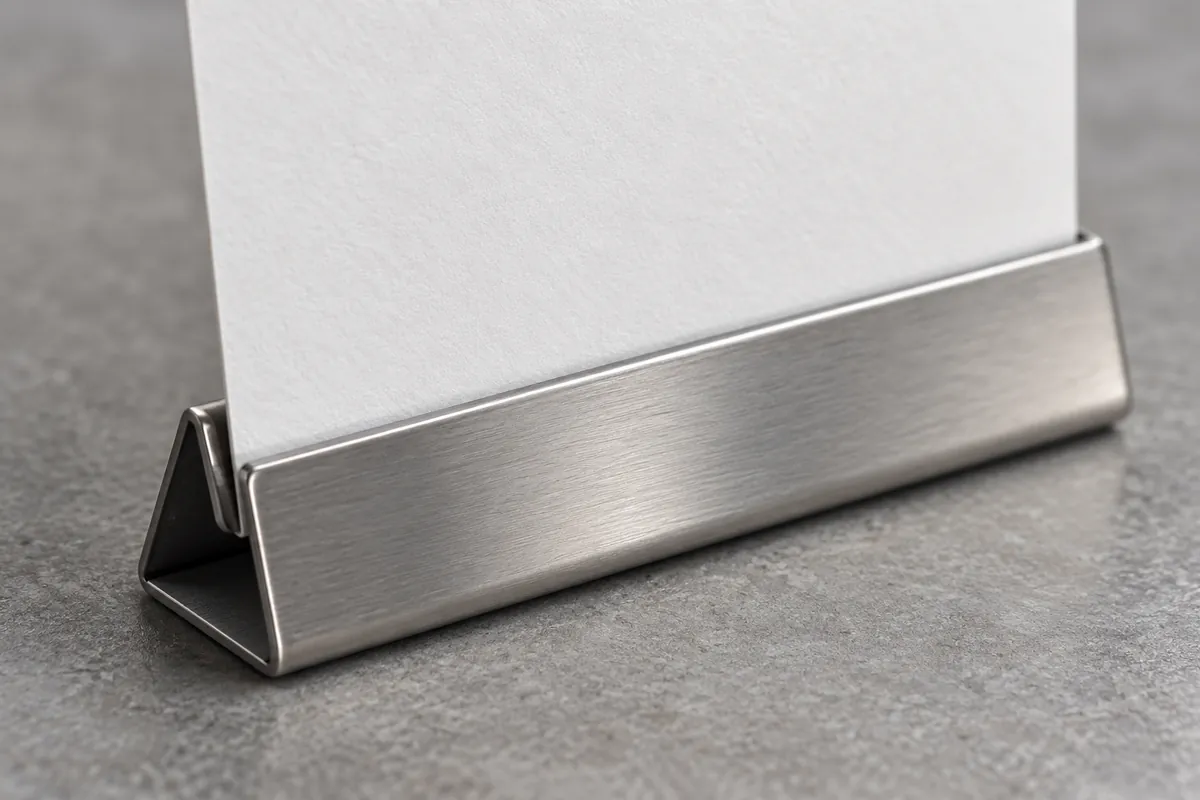
Test the full combination, not only the empty holder. Insert the thinnest and thickest intended pieces, then remove and reinsert them several times using the expected motion. Observe whether the card slides freely, tips, curls, scuffs, catches at a corner, or requires an awkward pinch. If a user must lift the holder or use a tool to change the card, record that as part of the operating requirement.
Do not invent a universal insertion force. The acceptable feel depends on the application, insert material, and service routine. Agree on a representative sample and a qualitative or measured acceptance method before approval. If the opening relies on spring behavior or a purchased clip, ask who supplies that component and which party owns its specification.
What determines visible height and message readability?
The holder must present enough of the message for its use. Measure how much of the card is hidden below the retention point and how high the displayed area sits above the table. Check the viewing angle from the guest’s normal seated or standing position. A small place card may need a short exposed area, while a menu panel may need a larger uninterrupted field.
Use a printout with realistic text blocks and margins, not a blank rectangle alone. The buyer should confirm that the holder does not cover a name, price, allergen note, item description, or other important line. This is a layout check, not a certification of the printed content or its regulatory suitability. The responsible brand or food-service operator remains responsible for the text and applicable rules.
Orientation also matters. Test portrait and landscape only if both are intended. A holder designed for a narrow vertical card can behave differently when a wider panel is inserted. The center of gravity and exposed area change; therefore, the same base may not feel the same under incidental contact. Capture the approved orientation in the product brief so merchandising photography and packaging instructions do not imply unsupported formats.
If a clear sleeve, acrylic panel, or printed insert is included, identify its source and replacement process. Koitor’s current approved capability information does not confirm manufacture of these parts. They may be supplied by another vendor or by the buyer. A metal holder’s design should be reviewed around the actual component drawing and tolerance rather than an assumed “standard” insert.
How should the base and tabletop stability be reviewed?
There is no single stability test that applies to every tabletop holder. Base footprint, mass, holder height, card area, material, surface texture, and contact pads all affect how the assembly behaves. Buyers should describe the expected table and the normal interaction: a quiet display, frequent menu changes, or a place card that may be brushed as guests sit down.
Inspect the underside and contact points. Confirm whether the holder sits directly on the tabletop, uses pads, has a weighted base, or has another construction. Record pad material and placement if pads are part of the approved configuration. Check that all contact points touch as intended on a flat reference surface, and consider the actual table finish if the product is marketed for a specific environment. A photograph on a studio table cannot prove that a holder behaves the same on every table.
Test the most demanding format in the intended card range, including the largest exposed area and the thickest insert. Repeat with the smallest format if it changes the balance or retention. Observe movement during normal placement and replacement of the card. If the buyer needs a defined tip, sliding, or contact criterion, state the method and pass condition in the RFQ. No load, tilt angle, or wind-resistance threshold should be assumed from a generic image or a supplier’s unrelated model.
Inspect edges, welds or joints, finish consistency, and any sharp transition near where hands handle the holder. A polished surface can still have an edge or corner that needs review; visual appearance alone does not prove durability. Define the cosmetic faces that will be visible to a guest, and ask the supplier how the accepted finish will be protected in transit.
What should importers put into a comparable RFQ?
A useful RFQ lets suppliers quote the same item and lets the buyer compare like with like. Attach the card samples, a simple dimensioned sketch, and photographs of the intended table setup. State whether the holder is a single piece or a set with sleeves, clips, labels, or other components. If the design is custom, mark which dimensions are fixed and which may be adjusted after sample review.
Use a short interface matrix:
| Campo «RFQ» | Information to provide | Comprovativo de aprovação |
|---|---|---|
| Intended card formats | Sample, width, height, edge thickness and orientation | Signed or identified reference insert |
| Retention feature | Slot, clip, lip, frame or supplied insert | Dimensioned drawing and physical fit check |
| Display position | Exposed area, viewing side and hidden margins | Printed sample viewed in the intended orientation |
| Base/contact | Footprint, pads and tabletop context | Sample check on an agreed surface |
| Material and finish | Requested substrate and visible finish requirements | Drawing, approved sample and cosmetic notes |
| Pack contents | Holder quantity, sleeves, pads, instructions and spares | Pack list and checked packed sample |
| Order plan | Trial quantity, target repeat quantity and timing | Supplier quotation with assumptions stated |
Ask suppliers to separate the cost of the metal holder from purchased inserts or other accessories if responsibilities differ. State the private-label requirements, packaging language, and barcode or carton-marking expectations where applicable. Do not leave a supplier to infer a finish from a website photo; specify a sample, finish reference, or agreed process description.
For small-batch OEM development, a family-owned custom metal hardware factory may review a drawing or physical reference sample and discuss forming, finishing, assembly, and protective packaging. That conversation is a feasibility review, not a promise that a specific retail holder is already in the Koitor catalog. Koitor’s documented manufacturing experience relates to metal hardware; the buyer should separately identify who supplies a transparent sleeve, spring clip, printed insert, or any other unconfirmed purchased component.
Which sourcing mistakes create avoidable sample revisions?
The first common mistake is specifying the paper format but not its thickness or finish. A supplier can meet the outside width while the actual laminated insert fails to enter. Send a real insert and its tolerance, not only a label such as “business-card size.”
The second is approving the holder with a blank mock-up and later changing to heavier, larger, folded, or sleeved cards. The sample approval should identify the exact revision of the insert and holder. If the marketing team changes the layout or protective sleeve, recheck the interface.
The third is treating overall dimensions as the working opening. Product names may describe a format rather than a functional slot. Ask separately for overall width, usable insertion width, clear opening, retention depth, and exposed display area. A current supplier drawing is better evidence than a cropped marketplace photograph.
The fourth is checking only the front appearance. Review the base, underside, edges, joints, pads, and packed sample. A small accessory can be scratched or bent when several pieces move against one another in a carton. Packaging design should match the finish and shipping route; “one holder per bag” is not automatically necessary or sufficient.
The fifth is requesting “stable” without defining the use. A buyer may mean that the item does not rock on a level table, that it stays upright when the card is changed, or that it tolerates a particular incidental contact. Put the scenario and agreed method into the sample brief. Do not present one observation as a universal performance guarantee.
How can Koitor support a bounded feasibility discussion?
Koitor Hardware is a family-owned custom metal hardware manufacturer serving bathroom and home-storage hardware programs. Its documented experience includes metal forming and fabrication, finishing, sample development, assembly, and packaging. Those capabilities can inform a discussion about a buyer’s drawing, formed support geometry, visible finish, assembly steps, and protective packing. They do not establish that Koitor currently sells this adjacent menu-holder product or makes the buyer’s inserts.
A useful first conversation includes the actual card set, the desired holder concept, a sketch showing the retention interface, target finish, expected order quantities, and a description of the tabletop use. If a spring clip, clear sleeve, base pad, or printed component is essential, identify its source and include its technical data. A buyer can then ask whether the metal portion is suitable for a sample-development review and what additional information is needed to quote it.
For consistent sampling, mark each revision with a date or version. Record which insert was used, which surfaces were reviewed, and what remains unresolved. A sample sign-off should not silently imply approval of a changed card stock, finish, accessory source, or production method. The buyer and supplier should agree how the production sample relates to the approved reference.
Importers evaluating wider bathroom or home-storage programs can review Koitor’s OEM home-storage hardware context e custom metal storage-rack information. Those pages describe the factory’s core metal-hardware positioning; they do not list this adjacent product as a confirmed item. For a feasibility question, send the drawing, sample and target quantity through the Página de contacto do Koitor.
What should the buyer confirm before approving a sample?
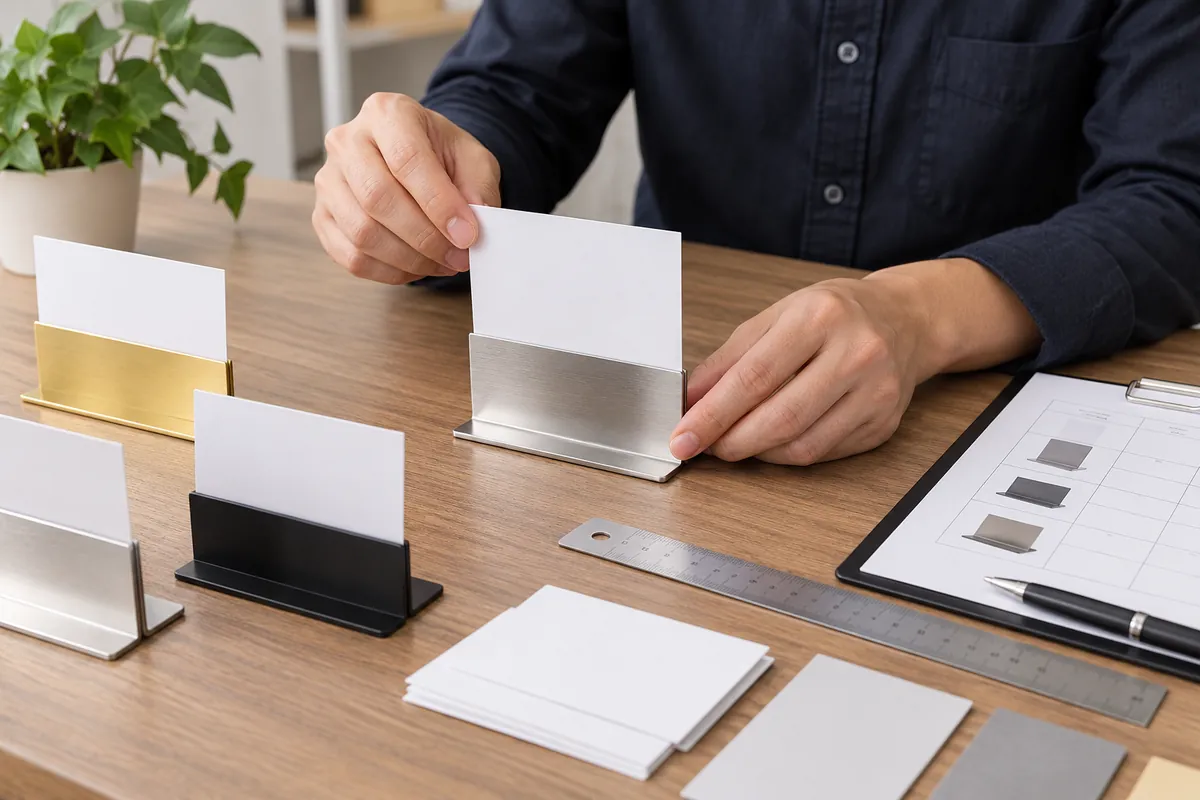
Use this checklist to close the RFQ and sample loop:
- Insert identity: Card or menu version, supplier, finished dimensions, thickness, fold, sleeve and orientation.
- Functional opening: Slot or clip clearance, insertion direction, retention point and useful depth.
- Display area: Visible text area, hidden margins, viewing side and expected tabletop position.
- Base: Overall footprint, contact points, pads, visible underside and sample behavior on the agreed surface.
- Handling: Insert and removal method, likely user interaction, pinch points and edge condition.
- Materials and finish: Agreed metal component, visible faces, color or finish sample, and acceptable cosmetic variation.
- Acessórios: Clear sleeve, clip, pad, label or printed insert owner and replacement responsibility.
- Embalagem: Unit protection, separation between metal parts, pack count, carton marks and transit review.
- Version control: Drawing revision, insert revision, sample identifier, approval date and open items.
- Claims: Formats and uses supported by the reviewed sample; no implied universal compatibility or unverified performance.
A metal menu card holder specification is complete only when the buyer can identify exactly which insert was evaluated, what the holder must do with it, and which conditions were outside the sample review. Keep the approved reference with the supplier’s drawing and purchase record. This makes reorder checks more reliable and reduces the chance that a new card or sleeve silently changes the interface.
Perguntas frequentes
Should a buyer specify the card’s outside size or the holder slot?
Specify both. The card’s finished dimensions describe the insert, while the slot or clip dimensions describe the receiving interface. Also record the insert’s thickness and any sleeve, fold, or seam at the contact edge.
Does a holder that fits one business card support other card formats?
Not automatically. Width, thickness, height, weight, orientation, and exposed area can all change fit and handling. Test every format that will be included in the assortment.
Can a supplier’s listed dimensions be used as the approval drawing?
Use the listing to identify a model, but request the current drawing and a physical sample for the intended application. A product listing may not show the functional opening or all relevant tolerances.
Does a stable feel during one desk test prove the holder will stay upright in every venue?
No. It records only the observed sample and test conditions. If stability is a product claim, the buyer should define the surface, insert, interaction and acceptance method with the responsible supplier.
Trabalhe com a Koitor Hardware
Reviewing a Metal Menu Card Holder Concept?
Share the actual card formats, holder drawing, finish reference, tabletop context and target quantity for a bounded metal-component feasibility discussion.
OEM / MARCA PRÓPRIA
Transforme este guia de fornecimento num resumo do produto
Indique o produto pretendido, as dimensões, o acabamento, a quantidade a encomendar e os requisitos de embalagem. A sua equipa receberá uma análise prática da viabilidade de fabrico antes da apresentação do orçamento.


 English
 Español
 Português
 Français
 Deutsch
 العربية