
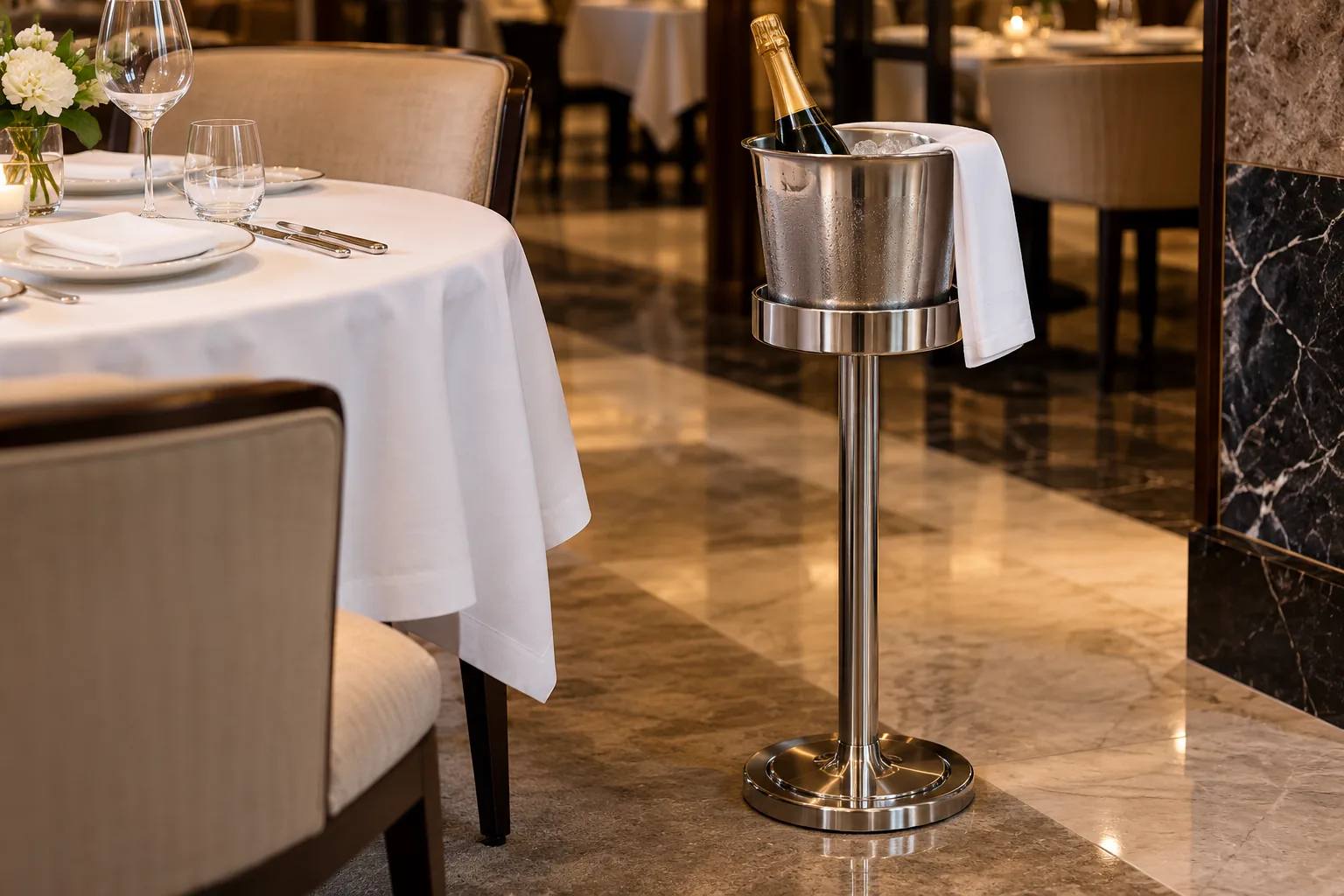
For procurement, the ice bucket stand specification starts with the exact reference parts and intended arrangement. An ice-bucket stand specification should name the actual vessel and describe where its body or base meets the support. Nominal bucket volume alone does not establish fit: two vessels with similar capacity may differ in body taper, base diameter, rim, handles or sidewall shape. Buyers should check the empty and intended filled assembly, then confirm that placement, access and lift-out work in the planned tableside arrangement.
This guide covers a metal support stand paired with a separately sourced beverage bucket. It does not establish a safe load, stability threshold, food-contact approval, thermal limit, care performance or universal bucket compatibility. The supplier and project owner must define any required engineering or compliance assessments for the exact product and use conditions.
Why should a buyer pair models instead of matching liters?
Tablecraft’s official product listing for model 5288 identifies a chrome-plated steel stand specifically paired with its 5188 bucket. Its barware sell sheet also distinguishes that pair from another model pairing. This illustrates a supplier-specific approach: a named vessel and stand are treated as a compatible set. It does not prove that every bucket of the same stated volume fits either stand or that a new stand can inherit that claim.
Start with the vessel model, drawing and intended service contents. Record its outside profile at the support height, base, taper, rim and handles. If the bucket is filled with ice, liquid or bottles during service, specify that arrangement for review. Its occupied envelope and weight differ from the empty vessel, but this article provides no capacity value or safe-load conclusion. The responsible supplier or engineer should assess such requirements using a defined protocol.
A product page that gives liters or quarts is useful for category selection, but it does not define the stand contact surface. Ask the vessel supplier for a drawing or provide a physical sample. If the buyer wants to support more than one bucket model, test each model and state the approved variants separately.
What should be controlled at the vessel seat?
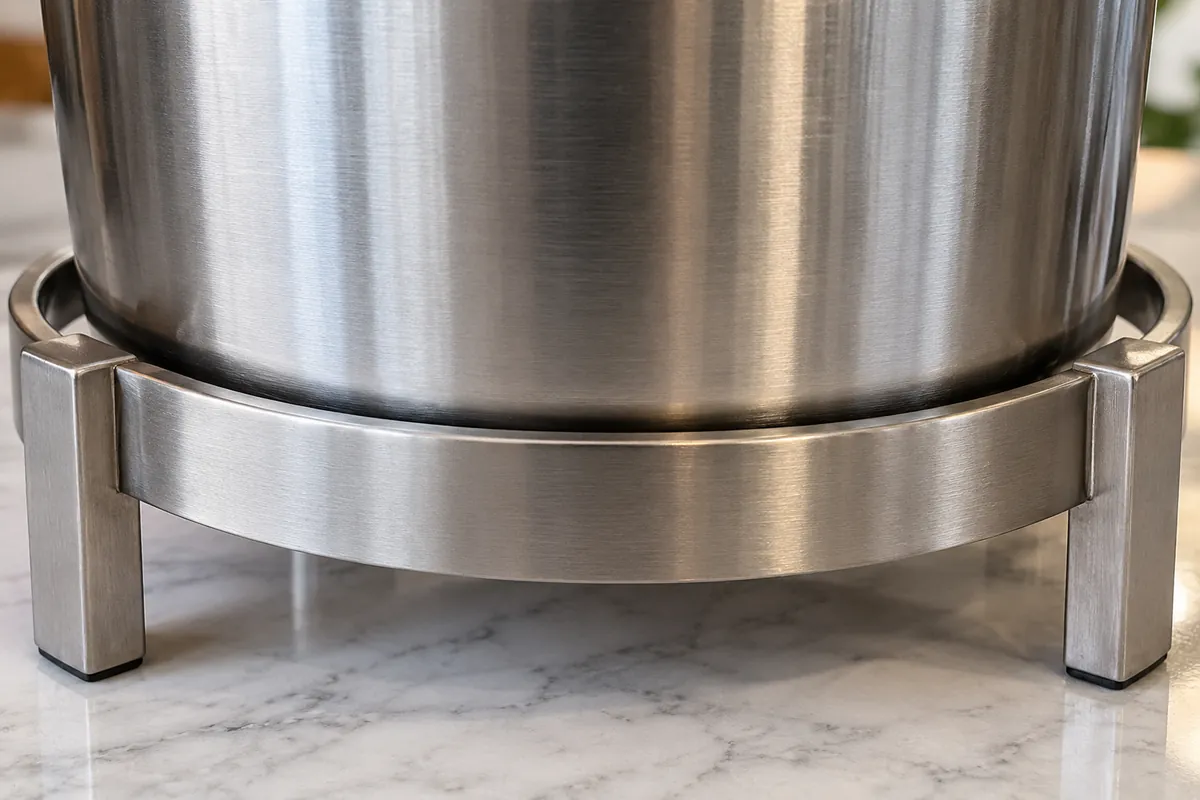
Identify the stand’s ring, cradle, arms or other support features and compare them with the actual vessel at the intended contact elevation. Does the vessel sit on its base, sidewall or a defined shoulder? Does the handle, rim or sidewall meet a crossbar? The drawing should show the interface and intended orientation; the sample should confirm the exact named vessel rests as planned.
Do not create a “universal” ring diameter based on volume. There is no single geometry implied by a liter count. Record the points of contact and note any visible gaps or interference for the supplier’s review. If protective pads or liners are used, identify their material, thickness and source. Do not claim anti-scratch or anti-slip performance simply because a soft-looking part is present.
| Buyer input | Stand and vessel check | Approval record |
|---|---|---|
| Bucket identity | Supplier, model, revision and profile | Controlled reference |
| Contact elevation | Ring or cradle position relative to vessel | Drawing and sample observation |
| Base and taper | Seating surface and sidewall angle | Contact point record |
| Handles and rim | Clearance at the support structure | Actual orientation and photos |
| Service contents | Empty or defined filled arrangement | Agreed use configuration |
| Access path | Bottle access, hand reach and lift-out | Observed sequence |
| Stand configuration | Feet, pads, finish, joints and assembly | BOM and drawing revision |
| Saleable scope | Stand, vessel, liner and accessories | Included/excluded list |
This matrix organizes a purchasing review. Dimensions and criteria should come from the current source drawings and the buyer’s own reference items, not from generic assumptions.
How should tableside access and lift-out be assessed?
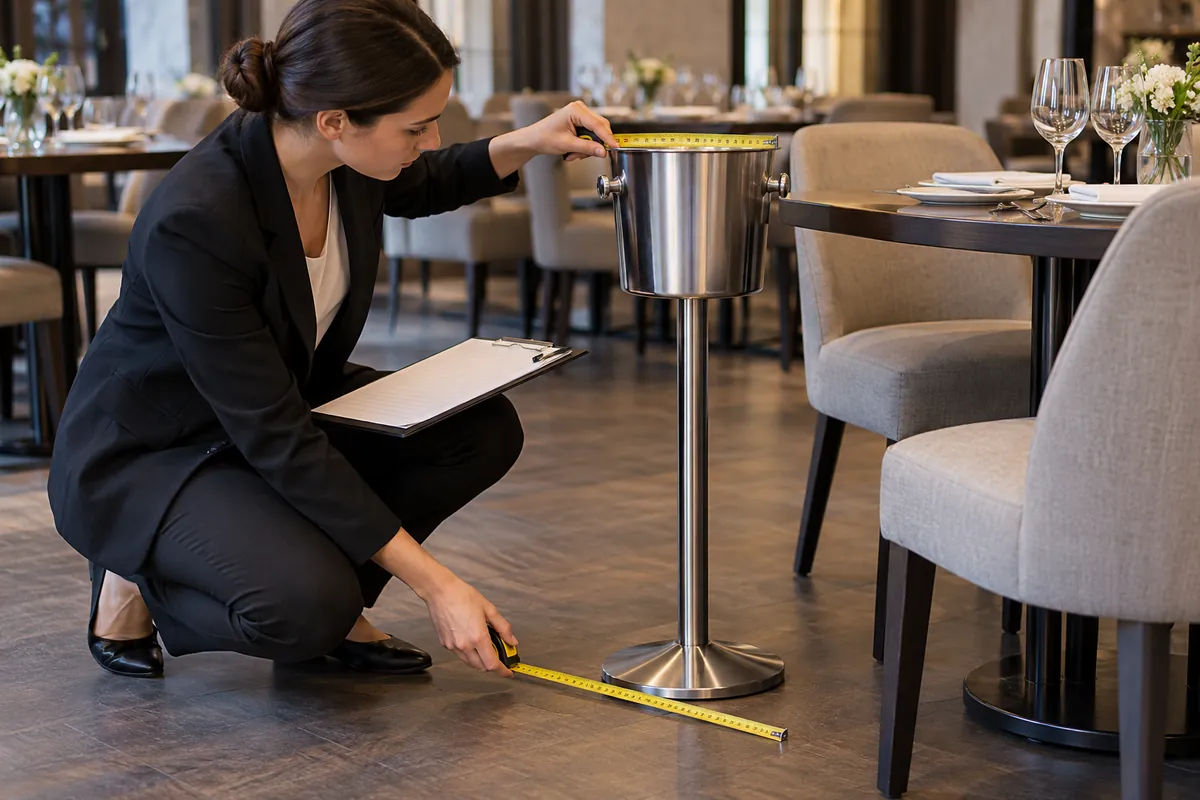
Place the assembled stand in the planned service orientation. Check whether the intended bucket can be positioned and lifted out without the rim or handle catching on the support. If bottles are part of the service configuration, record how the user reaches them and whether the stand or adjacent table obstructs that path. These are observations for the exact sample and setting, not generalized ergonomic or service claims.
Review the filled configuration only when the buyer and responsible supplier define it. State what is inside the vessel and where the stand will be used. Confirm that the protocol and acceptance criteria come from a qualified source; a short placement check is not a structural test. Do not infer that an assembly is stable or safe because it appears upright on a flat floor during a brief review.
Check the floor contact points and any feet shown in the drawing. If the stand is intended for a specific floor or placement surface, identify it. Avoid claims about rolling, slipping, tipping or floor protection without evidence. The stand can be reviewed for visible finish quality and assembly details, but those observations do not prove long-term performance or coating resistance.
How should the RFQ define the complete product?
Provide the bucket supplier and model, reference drawings, intended contents, target stand height and footprint, access requirements, finish target, accessories and packaging scope. Ask the stand supplier for a drawing showing the support geometry, frame joints, feet or pads and components supplied. If the bucket and stand are sold separately, state that in the order, product page and packing list.
A useful RFQ checklist includes:
- Exact vessel model and current drawing revision.
- Outside profile at all stand-contact areas.
- Intended empty and filled use configurations.
- Stand seat geometry, contact and retention intent.
- Handle, rim and sidewall clearances.
- Service access and vessel removal sequence.
- Feet, pads, finishes and purchased parts with sources.
- Required engineering or compliance evidence, if applicable.
- Kit contents, packaging and assembly instructions.
- Sample approval record and any excluded variants.
If a vessel is not supplied for the sample review, mark fit as pending. A drawing can be useful for early screening, but it may omit production variation or finish buildup. Do not advertise compatibility until the approved evidence is available.
For broader context on metal storage components, see Koitor’s fabrico de estantes metálicas de armazenamento à medida e Hardware de armazenamento doméstico OEM pages. They do not confirm a current ice-bucket stand product or vessel manufacturing capability. Buyers can share a drawing and sample through the contact page for a bounded metal-component feasibility discussion.
How should the buyer inspect finish and assembly?
The sample review can also check visible finish coverage, sharp edges, weld appearance and alignment of the stand components against the approved drawing. Mark the cosmetic faces and contact areas that matter to the buyer. A visual check can identify an obvious mismatch or defect for follow-up; it does not prove coating adhesion, corrosion resistance, structural capacity or long-term service life. Those properties require their own specified evidence.
If the stand is assembled from several parts, confirm that all fasteners and feet are included and that the assembly sequence matches the instructions. Inspect the completed sample rather than judging only loose parts. Where a separate bucket or protective ring is purchased, record the supplier and its revision. Do not assume a similar-looking substitute preserves the original vessel seating.
Retail or hotel product imagery should show the sold configuration. If the bucket is not part of the stand SKU, say so in the item description and packing list. If a particular Tablecraft bucket is shown as a fit reference, distinguish it from what is actually sold and avoid implying authorization or interchangeability.
How should source claims be kept in scope?
Materials and care statements in a supplier catalog belong to the cited model. Tablecraft’s stand and bucket pairing cannot establish the finish, material, use temperature, care instructions or capacity of a different product. If the importer needs a particular finish or corrosion performance, define the environment and specification separately and request product-specific evidence. Do not treat a marketing adjective as a test report.
Food-contact and thermal claims concern the actual vessel and surfaces, not merely the stand. If the stand does not contact food, the project should still clarify the scope of any product claim and the components it covers. The buyer must consult current applicable requirements and responsible suppliers. The geometry worksheet here is not compliance approval.
What changes should trigger another sample review?
A different bucket model, handle, rim, base shape or fill condition can change the interface. A stand ring diameter, height, protective pad, finish, foot, weld or assembly change can also alter seating or access. During a reorder, compare the new drawing and component sources against the approved sample. If any change touches the seat or the service envelope, repeat the relevant checks.
Save the actual vessel identifier, stand revision, observed contact, intended content arrangement, removal path, finish documents and pack configuration. Product copy should refer only to the approved named pairings. If the buyer has not reviewed an alternate model, do not imply compatibility based on capacity alone. Include the excluded or unreviewed variants in internal documentation to prevent a sales description from gradually broadening.
How should the buyer compare supplier quotations?
Ask each supplier to quote the same scope: stand alone or a complete stand-and-vessel set, the identified finish, purchased pads or feet, assembly state, fasteners, instructions and carton pack. Record any separate bucket price and whether it is available from the same source. A low stand price cannot be compared fairly with a bundled configuration that includes a vessel or accessory. This is a commercial-scope comparison, not a claim about cost or supplier quality.
The quote should reference the drawing revision used for the sample and identify deviations. If a supplier proposes an alternate bucket, request its model and drawing before accepting a compatibility statement. This keeps the purchasing decision anchored in actual product identity rather than a volume label or verbal assurance.
What should hospitality teams decide before ordering?
The buyer should align the stand sample with the service brief before placing a bulk order. Confirm the intended table location, vessel and accessory set, floor or tabletop contact, replenishment route, and who supplies the bucket. If a project uses more than one bucket model, distinguish which stand variant is matched to each. A purchasing team can then compare supplier quotations on the same configuration rather than compare a stand-only price with a complete kit.
The final order should identify the stand drawing, finish, feet or pads, bucket reference, assembly instructions and carton contents. Any accepted limitation should appear in both the technical approval record and the product data used by sales or project teams. For example, if the stand has only been reviewed with one named vessel, the internal record should prevent an unqualified “fits standard buckets” claim from appearing later.
If the product will be used in a hotel, restaurant or event setting, the operator or project designer should define additional requirements such as placement, cleaning, access and applicable local rules. Do not copy a third-party catalog’s certification, care or load statement into the purchase specification. Ask the responsible supplier for evidence that matches the exact configuration and destination market.
When is the sourcing decision ready?
The buyer can approve a specific configuration when the actual bucket model is identified, its contact area is supported as intended, handles and rims clear the frame, the service and removal sequence is reviewed, and the order makes clear which parts are included. Any load, stability, floor, thermal or compliance requirement must have its own evidence and acceptance owner.
The central lesson is to specify the stand around the actual vessel interface and service arrangement. “Fits an eight-quart bucket” is not sufficient unless the supplier identifies the exact bucket models and evidence behind that statement. A named pairing and a controlled sample create a more reliable purchasing decision.
How can buyers separate a stand-only quote from a bundle?
Request a line-item quotation that identifies the stand, bucket, feet, pads, fasteners and packaging separately. A stand-only offer can appear less expensive than a complete package, so the buyer should compare like-for-like contents and revisions. Ask the supplier to state whether the bucket in a reference photograph is included or serves only as a fit sample. The quote should point to the drawing used for the sample and list any deviations.
When a hotel or restaurant distributor needs several vessel pairings, map each bucket model to the stand model that has actually been reviewed. Keep untested pairings outside the listing. Changes to the bucket source, vessel height or handle shape can affect seating and access even if capacity is unchanged. Revalidate those interfaces before adding a new compatibility row.
Source basis: Tablecraft 5288 stand for 5188 bucket e Tablecraft barware sell sheet. Pairings, material and care statements are source-model-specific and are not transferred to another product.
Keep the ice bucket stand specification tied to the named sample, drawing revision and included components.
Keep the ice bucket stand specification tied to the named sample, drawing revision and included components.
Developing a Metal Hospitality Support?
Share a vessel model, contact drawing, service configuration, finish target and packing scope for a bounded metal-component feasibility discussion.
OEM / MARCA PRÓPRIA
Transforme este guia de fornecimento num resumo do produto
Indique o produto pretendido, as dimensões, o acabamento, a quantidade a encomendar e os requisitos de embalagem. A sua equipa receberá uma análise prática da viabilidade de fabrico antes da apresentação do orçamento.



 English
 Español
 Português
 Français
 Deutsch
 العربية