

A buyer evaluating unheated plate dispenser plate weight adjustment should specify the actual crockery and stack that the mechanism supplier will serve. Nominal plate diameter alone does not define the rim, base, profile, unit mass, stack height or presentation condition. Those variables can affect guide selection and the supplier’s configuration of a spring-supported module. The buyer should therefore review a defined plate reference and complete dispenser configuration, not approve a mechanism by a single catalog label.
This guide is for catering-equipment importers, hospitality distributors, buffet-equipment buyers and private-label product managers. It is a sourcing and approval framework, not a setup or maintenance manual. The actual mechanism maker must define configuration, commissioning, safe operating instructions and any applicable capacity evidence. Do not adjust springs, reach into a loaded mechanism, or assume that an unheated unit carries the electrical, temperature, food-contact, hygiene or certification claims of a different heated model. For buyers assessing unheated plate dispenser plate weight adjustment, the controlling record is the approved configuration, supporting evidence, and named approval owner.
Separate a Passive Plate Rack From a Spring Presentation Module
A passive rack supports plates in a fixed or manually selected position. A spring presentation module may use a moving platform and a supplier-configured mechanism to present plates as the stack changes. They are not the same purchasing scope. A buyer should first establish which product architecture is quoted, which elements are included, and which supplier owns the mechanism’s configuration.
Manufacturer information for Moffat’s Versilift UP unheated dispensers describes adjustable guide rods and a variable spring system associated with plate weight. It also states that the number of plates can depend on plate type, profile and thickness. The maker’s UP product information is model-specific; its claims should not be converted into a universal capacity rule. A related manufacturer manual covers both heated and unheated product variants and distinguishes their configuration. The buyer should obtain current instructions and confirmation for the exact model being quoted.
The article’s procurement point is simple: a product description such as “adjustable” does not answer what reference crockery was used or which configuration is approved. Ask the mechanism supplier to identify the quoted model and the information it needs before it selects or commissions a setup. The buyer’s role is to supply accurate references, review the agreed presentation and keep the approval linked to that configuration. It is not the buyer’s role to invent spring counts or modify the mechanism.
A first-pass scope record can state:
- Whether the dispenser is unheated or belongs to a different configuration.
- Which maker and exact model are quoted.
- Whether guides, platform, springs, housing, lid or other items are included.
- Which party supplies the mechanism and who configures or commissions it.
- Whether the buyer is reviewing a complete unit or a module installed into another housing.
- Which plate family and stack the quote is intended to serve.
- Which claims remain outside the supplier’s evidence.
This scope check helps prevent model-family mixing. For example, a manual can cover heated and unheated variants in the same document. The presence of electrical information for one variant does not mean that the unheated version contains electrical features. Likewise, a source statement about one model cannot be reused for a different dispenser without confirmation. Record the model code and document revision every time a specification is carried into a purchase order or product listing.
Give the Supplier the Actual Plate Profile and Stack
Crockery differs in more ways than outside diameter. Two plates with a similar rim-to-rim measurement may have different wells, rims, feet, underside rings, curvature or nesting behavior. Thickness and mass may also vary by model and material. These are reasons to provide a real plate reference or controlled drawing and ask the mechanism maker which features govern its recommendation.
The buyer’s plate record should capture:
- Manufacturer or source and exact plate SKU or sample reference.
- Current product revision or drawing date, when available.
- Outside rim profile and any material steps or flanges relevant to the guides.
- Base or foot profile and the geometry that contacts the platform or adjacent plate.
- A supplier-measured or buyer-measured unit mass, clearly labeled by source.
- The reference stack: how many plates, which plate orientation, and whether the stack is full, partial, or another agreed state.
- The intended top-of-stack presentation or withdrawal arrangement as defined by the responsible equipment supplier.
- Known variations between colors, sizes, materials, production lots or replacement ranges.
The buyer should not supply a single “diameter” and expect the specialist to infer all other properties. If the plate comes from an existing catering supplier, request the manufacturer’s drawing or a representative sample. If the plate is still under development, mark the product information preliminary. If a supplier uses a named plate series for its own setup, confirm whether that exact series is being offered and whether a proposed alternative has been reviewed.
Do not convert a source’s plate count into a universal number. Moffat’s source-specific product information explicitly ties the stated count to plate type, profile and thickness. That tells buyers that the plate matters; it does not provide a universal maximum or imply that one setup serves every plate with a matching nominal size. The buyer should ask the responsible maker for the expected stack configuration with the exact reference plates and get any limitations in writing.
A useful RFQ makes clear which data are measured and which are supplied by a manufacturer. For example, “plate mass measured by buyer on sample lot” is different from “mass specified by crockery maker.” If the measurement method or lot variation is material to the supplier’s decision, ask the supplier to tell you what it requires. Do not invent a tolerance or sampling plan. Preserve the actual source and date, so a later change in crockery does not silently inherit an approval made for an earlier reference.
| Buyer input | How to identify it | Why the equipment supplier needs it |
|---|---|---|
| Plate model | Maker, SKU, revision, controlled drawing or physical sample | Ties the review to a repeatable crockery reference |
| Rim and base | Drawing/profile details or supplier-reviewed sample | Helps the supplier assess guide and support interfaces |
| Unit mass | Measured or maker-published value with source stated | Informs the mechanism supplier’s configuration review |
| Stack reference | Agreed quantity and state represented by the sample | Defines the condition being discussed |
| Variation | Range of plate sizes or models intended for the SKU | Shows whether one configuration is expected to cover multiple plates |
| Change trigger | New plate, changed profile, material, thickness or supplier | Indicates when the earlier review must be reopened |
Review Guide Geometry Separately From Stack Weight
Guides help locate or constrain the plate stack according to the design of the specific dispenser. Their configuration should be reviewed with the actual rim and base profile. Guide position and mechanism response are related but different questions. A plate may sit within the guide envelope, yet that observation alone does not establish that the moving platform presents it as intended or that the supplier has approved the complete stack.
Ask the supplier to show which parts are adjustable and which settings or positions are permitted for the quoted model. The K1444 research pack identifies a manufacturer product description with adjustable guide rods and variable spring systems; this can inform the questions, but the buyer must not copy an adjustment procedure, spring count, or setting from a different configuration. Use model-specific documentation and qualified supplier commissioning.
During a sample review, the buyer can document:
- The exact guide arrangement shown on the supplier’s current drawing.
- Whether the actual plates used in the review match the buyer’s recorded reference.
- Which plate surfaces contact the guides in the reviewed sample.
- Whether any plates in the sample show an obvious mismatch or interference requiring supplier review.
- What the supplier identifies as the intended plate orientation and replenishment method.
- Whether the observed condition is a visual fit review, a supplier-run setup review, or a separate performance evaluation.
- Which limitations or unanswered issues remain.
The buyer should avoid creating a “fits any plate up to X” statement based on one sample. If a supplier provides a range, record the source and the exact model to which it applies. If a buyer wants to add another plate range later, seek confirmation from the equipment supplier and preserve the new sample or drawing revision. A guide adjustment that appears simple may still change the approved product configuration.
The plate stack itself can vary from the first item loaded to the final item removed. A proper review should describe which states the maker recommends evaluating, rather than assuming that a fully loaded stack represents every condition. The supplier is the correct party to define mechanism behavior and safe review procedure. This guide does not direct the buyer to raise or lower a platform, add or remove springs, or test a loaded dispenser without instruction.
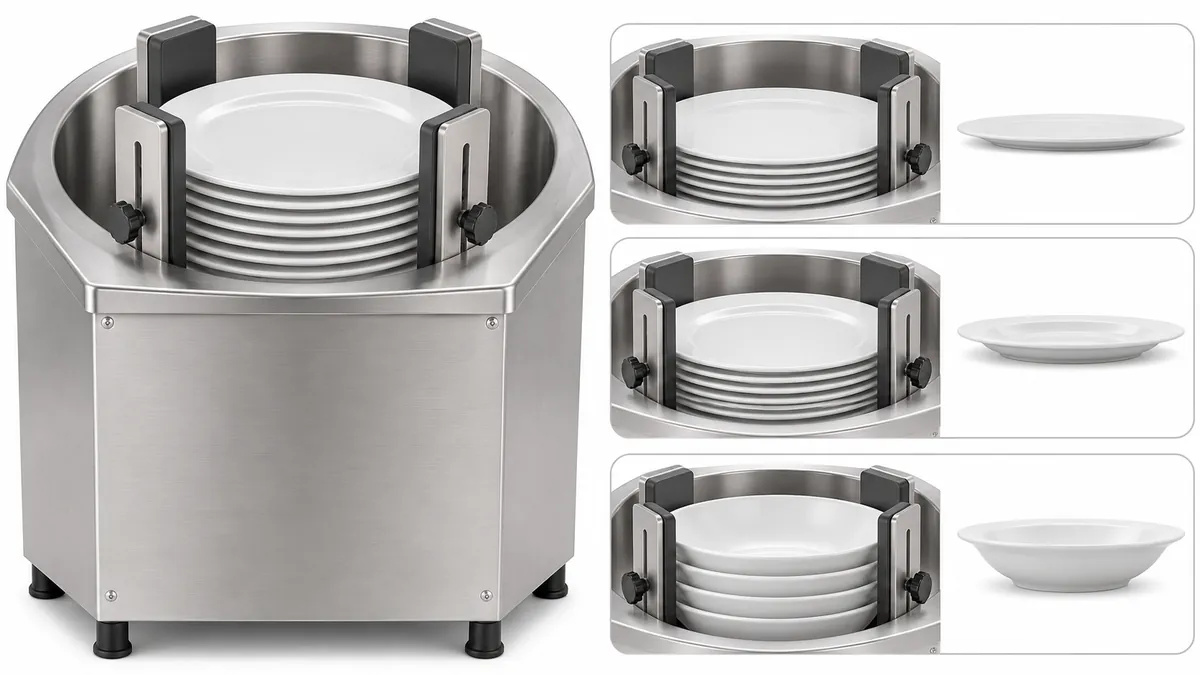
Treat Unit Mass, Stack Height, and Presentation as Different Inputs
A buyer can be tempted to use one number—plate diameter or total stack mass—to describe the entire loading condition. That shortcut can obscure other important information. Unit mass describes an individual item. Stack count and height describe how many items are present and how they are arranged. Presentation height or withdrawal conditions describe the user-facing result that the responsible supplier defines. Each should be tied to a reference and not conflated.
When preparing the procurement record, ask the mechanism supplier what inputs it uses. The supplier may request sample crockery, unit mass, a stack reference, and a target presentation. Let the supplier define its model-specific setup and any test or verification it considers appropriate. The importer should not assume that adding or removing a spring is the buyer’s choice, or that an intuitive adjustment improves the product. Mechanism configuration should remain under the party that designed or approved it.
The word “capacity” should also be handled carefully. A supplier may publish a product-specific count with stated assumptions. A buyer should preserve those assumptions and avoid using the count as an unconditional promise across different plate designs. The stack may reach a different height or contain a different mass when the plate profile or thickness changes. A product team planning a multi-SKU assortment should confirm each intended combination rather than copying one capacity figure into every listing.
For an approval sample, record the complete observation context:
- Unit and quantity of each plate reference.
- Whether the sample is at the starting, intermediate, or another maker-defined stack state.
- The dispenser model and mechanism revision.
- The guide arrangement identified by the supplier.
- The presentation condition the maker asked the reviewer to observe.
- The approved procedure followed by the responsible supplier or qualified reviewer.
- Any observed issue and the party that will determine its significance.
This context allows a later reviewer to understand what “approved” meant. It does not create a universal service-height or plate-count standard. If the final application includes a counter cutout, surrounding serving equipment, removable covers, or a housing that the mechanism maker did not supply, those interfaces should be reviewed by the responsible parties. A standalone module review does not automatically approve the installed counter or buffet line.
Coordinate the Metal Housing and Specialist Module Scope
A dispenser can contain formed sheet or tubular components, guides, a platform, springs, lids or other purchased modules. A buyer should identify which company supplies each element. If the buyer is sourcing an outer housing separately from a specialist mechanism, the handoff must be explicit: which drawing is controlling, which dimensions and interfaces have been approved, and who approves the combined sample.
Koitor’s verified expertise is in bathroom and home-storage metal hardware. Its general metal forming, finish, assembly and drawing-review experience may be relevant to a bounded housing or component-scope discussion. The research pack does not establish that Koitor designs plate-dispenser springs, supplies a complete catering module, offers a current plate-dispenser SKU, runs food hygiene tests, or certifies catering equipment. An article should not imply those capabilities.
A supplier responsibility matrix can keep the project within evidence:
| Work item | Responsible party to identify | Buyer record |
|---|---|---|
| Plate reference and variation | Crockery maker or buyer | SKU, sample, profile and source |
| Mechanism model and configuration | Specialist module maker | Model/revision and written setup scope |
| Spring or platform commissioning | Mechanism maker or qualified service party | Current instructions and commissioning record |
| Metal housing or support interface | Housing supplier and equipment designer | Drawing revision and combined-fit approval |
| Countertop or buffet integration | Project designer, equipment maker, or qualified installer | Host dimensions and approved installation documents |
| Food-contact or hygiene claim | Responsible compliance owner | Exact claim, applicable evidence and scope |
| Packaging and spare parts | Equipment/product supplier | BOM, instructions, service-part references |
This matrix is a decision aid. The parties must agree responsibility for the actual project. Do not assign technical accountability based only on which company ships the metal shell. Likewise, a specialist module supplier’s performance statement should not automatically be attributed to a housing supplier.
If the module is purchased, ask how changes are controlled. A substituted mechanism, revised guide, altered platform, or different lid can affect the combined product. The importer should determine whether a revised sample or drawing approval is needed. Keep product labels, instruction sheets, images, and specification copies aligned to the same model. Do not use an old approval to cover a changed stack or a different housing without supplier confirmation.
Plan Sample Review, Reorders, and Technical Claims
A sample review is useful when it can be repeated and linked to the purchase configuration. Identify the exact unit, date, model, plate references, drawing revision and supplier instructions. Record which party configured or commissioned the mechanism and who observed the presentation. If the review is only a visual check, say so. If the supplier ran a separate evaluation, request its method and results with the model and conditions stated.
A practical review checklist can include:
- Verify that the sample model matches the RFQ and quotation.
- Verify that the plates match the controlled buyer references.
- Confirm guide and support parts against the supplier’s current drawing.
- Ask the mechanism supplier to explain its configuration, without making an independent adjustment.
- Observe the agreed stack states using the supplier’s procedure.
- Record the visible presentation and any question for the supplier.
- Note what the review did not assess, including hygiene, temperature, durability or certification.
- Confirm which housing, counter or surrounding components were included.
- Save the accepted sample, drawing, BOM and instructions together.
- Reopen approval when a relevant product or plate input changes.
This checklist is not a substitute for the equipment maker’s commissioning or safety process. Do not perform an improvised loaded test or reach into a mechanism to investigate it. If a sample is unstable, damaged, incomplete or unclear, stop and ask the responsible supplier for an approved method. A buyer should document the issue rather than probing the mechanism.
Claims should match evidence. A source-specific statement that a model is unheated or has adjustable guides can be repeated only for the applicable model and current documentation. A product count or stack description should retain its plate assumptions. Do not add unverified terms such as “hygienic,” “food-safe,” “commercially certified,” “safe at any height,” or “fits all dinner plates.” For electrical, temperature or environmental statements, confirm applicability to the exact variant; do not transfer heated-model details to unheated equipment.
Reorder control depends on keeping product information current. Plate models can be revised, mechanisms substituted, and module suppliers changed. A private-label buyer should request notice of relevant changes and define what requires renewed review. The approver should verify whether existing documents still apply. The packaging, maintenance information and spare-part list should reflect the same configuration.
Keep evidence attached to the exact unit and variant
An approval note should make it possible to tell whether a supplier’s statement applies to the dispenser under order. Save the source title, model, revision, date and any plate assumptions with the quotation and product file. If the maker provides a manual covering several models, mark the pages or sections that describe the quoted unheated version, and do not copy nearby details from a heated variant. If the official page and a sales sheet use different model references, ask the maker to reconcile them before the buyer publishes a capacity or setup statement.
This practice also matters when a buyer changes the plate range after launch. A new crockery line may have a different underside, mass or thickness even when its advertised diameter looks similar. The product team should compare the new plate against the approved reference, ask the mechanism supplier whether the existing configuration still applies, and document the response. If the supplier needs another sample or commissioning review, treat that as a new approval item. Do not silently extend the earlier result to a new plate because both fit inside the same guide at first glance.
A concise evidence index can list each claim, its source, the exact product model, the applicable plate reference, and the owner who confirmed it. This makes future reorder decisions faster and keeps sales language within the bounds of actual supplier documentation.
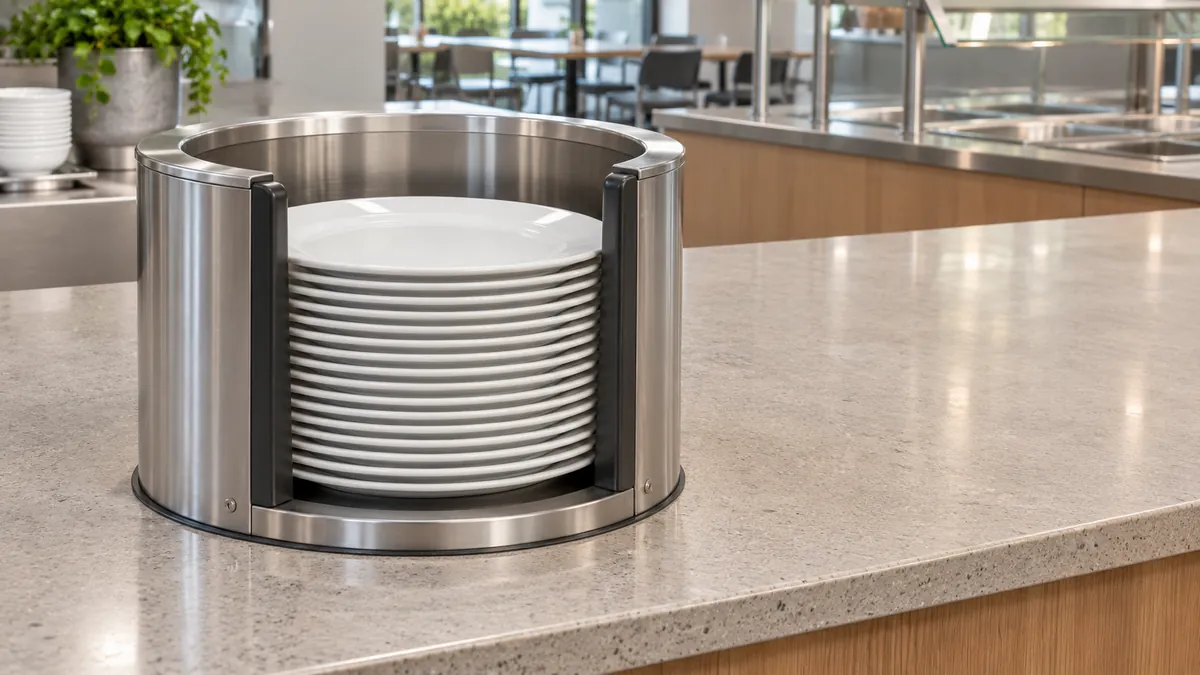
Buyer Questions Before Ordering
Does plate diameter determine dispenser capacity? No. The manufacturer’s source-specific information ties plate count to plate type, profile and thickness. Buyers should provide the actual plate and ask the responsible supplier to confirm the setup.
Does a fixed plate count cover different crockery profiles? Not automatically. Record each intended plate reference and obtain model-specific supplier confirmation.
Does a plate sitting inside the guides prove the correct presentation? No. That is one observation. The specialist maker must define the configuration and safe presentation review.
Who should adjust or commission springs? The mechanism supplier or qualified party it identifies. The buyer should follow current model-specific instructions and should not improvise spring changes.
Can a heated model’s information be applied to an unheated unit? Not unless the manufacturer confirms applicability. The actual manual distinguishes variants, and electrical or temperature details may not apply to an unheated model.
Can Koitor be assumed to supply a complete plate dispenser? No. Current complete-product and spring-module capabilities are unconfirmed. Discuss only a bounded metal housing or component scope if a project drawing supports it.
A Buyer-Ready Reference Stack
Before placing the order, identify the unheated model, provide the actual plate profile and source, state the unit mass and reference stack with their measurement sources, and ask the specialist mechanism supplier to define its configuration and commissioning responsibility. Review the guide arrangement and presentation with the exact sample. Record the housing and counter interfaces separately, preserve model-specific capacity statements, and define what changes require a new approval.
A clear unheated plate dispenser plate weight adjustment record is a procurement aid, not a spring adjustment instruction or a universal capacity guarantee. It allows distributors to compare a defined plate and module combination, while keeping mechanical configuration, installation, hygiene, and other claims with the responsible parties. Koitor’s OEM home-storage hardware information describes its confirmed area of work; for an adjacent metal housing request, the buyer can send the controlled drawing and purchased-module scope through Página de contacto do Koitor for a feasibility discussion.
Trabalhe com a Koitor Hardware
Discuss an Adjacent Metal Hardware Scope
Koitor’s confirmed focus is bathroom and home-storage metal hardware. For an adjacent product, share a controlled drawing, representative sample and any bought-in component scope so the team can assess whether the request fits its confirmed capabilities. This review does not imply that the complete product is currently manufactured.
OEM / MARCA PRÓPRIA
Transforme este guia de fornecimento num resumo do produto
Indique o produto pretendido, as dimensões, o acabamento, a quantidade a encomendar e os requisitos de embalagem. A sua equipa receberá uma análise prática da viabilidade de fabrico antes da apresentação do orçamento.
 English
 Español
 Português
 Français
 Deutsch
 العربية