

How to clean galvanized metal depends on what coating is actually on the product and what is dirty or stained. For light soil on a known, unpainted zinc-coated surface, begin with water and a soft cloth or suitable non-metallic brush, rinse with clean water and dry; first check the product maker’s instructions and test an inconspicuous area. Do not aggressively polish away a dull patina, use steel bristles, or apply acids and solvents from a generic recipe. Painted, topcoated, mixed-metal or damaged products need care guidance for their exact finish.
What does cleaning galvanized metal need to protect?
Galvanized metal has a zinc coating over steel, but the word “galvanized” does not tell a buyer every detail of the finished surface. The product may use hot-dip galvanizing after fabrication, pre-galvanized sheet or wire formed into a product, zinc plating, a post-treatment, paint or another topcoat. The coating route and any additional finish affect how the surface should be cleaned. Do not assume every silver-colored zinc surface is identical.
The purpose of gentle cleaning is to remove soil or a compatible surface contaminant while preserving the coating and appearance. Zinc develops a surface patina during exposure; a duller or less bright look does not automatically mean that the product is dirty or defective. Repeated abrasion can remove zinc or change the surface. Trying to make every galvanized item look newly bright can undermine the very layer the buyer needs to preserve.
For users, the immediate goal may be removing dust, mud, handling marks or a stain. For importers and product managers, the goal includes giving customers safe, specific care instructions and distinguishing a cleaning question from a coating-damage complaint. A generic “metal cleaner” instruction may be unsuitable if the product includes a topcoat, adhesive pad, plastic insert, stainless fastener or decorative surface.
This guide is for conservative care and condition triage. It is not an industrial galvanizing repair standard, a recommendation for chemical stripping, or a specification for coating repair. Where the finish is unknown, the surface is badly stained or the product maker provides different instructions, follow the maker or ask a qualified coating professional.
What should you identify before choosing a cleaning method?
Start by identifying the product, surface and contaminant. Review the order record, product label, drawing, material declaration or supplier care sheet. If the part has paint, clear coat, powder coating, adhesive, rubber, plastic or mixed metals, treat it as an assembly rather than as an exposed zinc surface. A method suitable for an unpainted galvanized-steel structure may damage a decorative topcoat or adjacent component.
Look at the condition without scraping it. Note whether the surface has loose dust, dried mud, oily soil, a white deposit, a wet-storage stain, red rust, chipped coating or exposed steel. Take a photo before any cleaning. The appearance can guide the next question but cannot establish the coating route, remaining zinc thickness or source of a mark. If corrosion or flaking is visible, stop and seek product-specific advice.
Ask how the item was stored and exposed. Was it kept wet, wrapped while damp, left in a poorly ventilated area, exposed to salt or chemicals, or placed in contact with another metal? Was it cleaned with a brush that may have carried iron particles? Did a shipping protector trap moisture? These details help explain what needs checking, but one clue alone does not prove a root cause.
The American Galvanizers Association guide addresses cleaning hot-dip galvanized steel and stresses identifying the contaminant before selecting an approach. That scope should not be silently transferred to every pre-galvanized wire, plated fitting or topcoated consumer product. Product-specific instructions take precedence.
How should you clean light soil from a known zinc-coated surface?
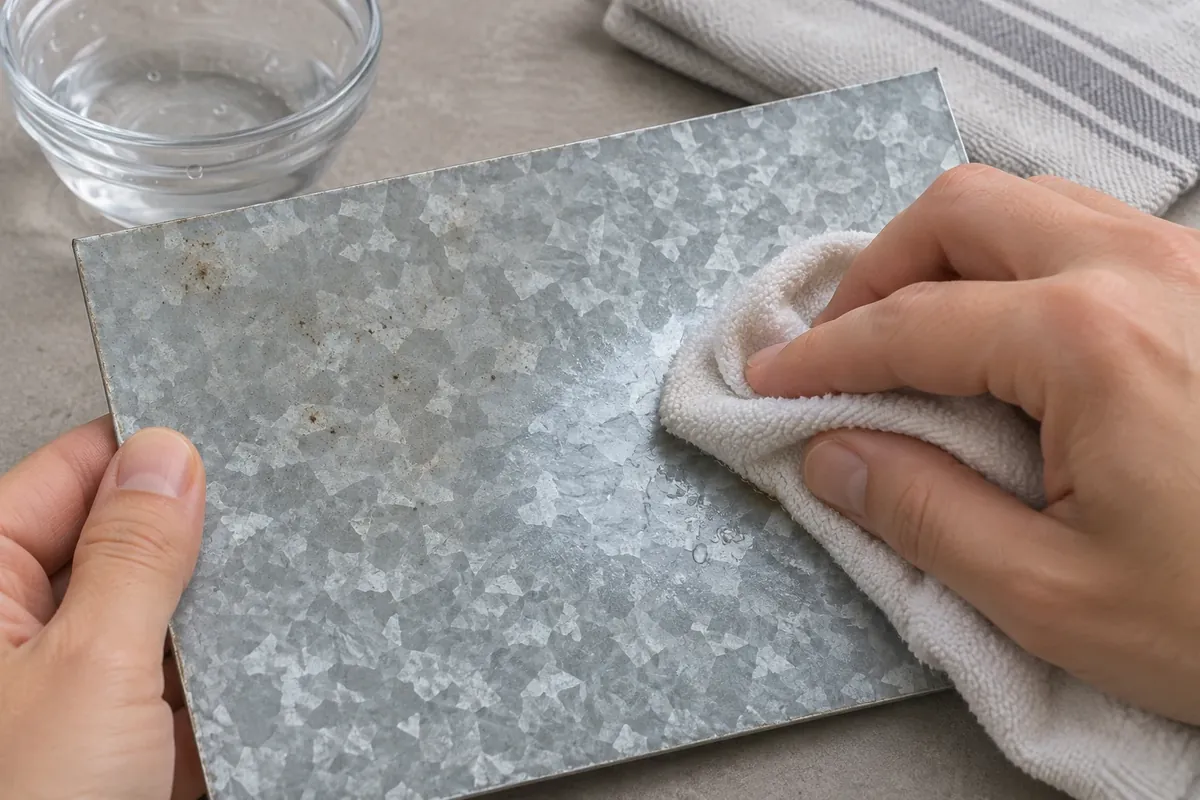
For a buyer who asks how to clean galvanized metal, the practical answer begins with the least aggressive method that fits a confirmed surface. For light soil on a compatible surface, use the least aggressive practical method. Remove loose debris without grinding it into the coating. Wipe with clean water and a soft cloth, or use a soft non-metallic brush for a textured surface if the product instructions allow it. Rinse away loosened material and dry the product. Work gently over a small area and inspect the result before continuing.
If the maker permits a mild detergent, follow the product’s directions and rinse it off completely. Do not assume that any household cleaner is mild for every zinc coating. Avoid leaving cleaner or water to dry on the surface. If a component has seams, hollow sections or adhesive interfaces, keep liquid from entering areas that cannot be drained or dried according to the product design.
Use a clean cloth that has not been used on steel fabrication residue, rust or abrasive compounds. A steel brush or contaminated tool can transfer particles and scratch the zinc layer. Do not use a grinder, sanding disc or aggressive pad to remove ordinary dirt. If light cleaning does not resolve the issue, stop and determine whether the mark is a deposit, patina, coating damage or a different condition.
Rinsing and drying matter because the goal is not to leave cleaner residue. In an assembled item, inspect around joints and interfaces where water can remain. Let the product dry with airflow where appropriate. Do not seal, wrap or store a damp product unless the supplier’s packaging instructions specifically address that condition.
How should you interpret patina, white deposits and wet-storage marks?
Do not treat every change in appearance as dirt that must be polished away. Galvanized coatings change appearance as they weather. A dull finish may be normal for the product and its exposure. White deposits or wet-storage staining can have several causes and need to be assessed in context. Some conditions may improve with airflow or mild care; severe or persistent cases may require a coating specialist or product-maker review.
| What you observe | What it may indicate | Appropriate next step |
|---|---|---|
| Dust, fingerprints or loose soil | Surface contamination | Use a compatible soft wipe and rinse; dry the item |
| Dull, matte or uneven brightness | Patina, process variation or another appearance condition | Check the approved sample and care guide; do not polish automatically |
| White deposit after damp storage | A wet-storage or moisture-related condition may be involved | Improve airflow if safe, document condition and ask the maker before treatment |
| Red rust, flaking or exposed steel | Damage or corrosion may be present | Stop cleaning and request product-specific technical assessment |
| Topcoat peeling, blistering or color change | A finish system beyond bare zinc may be affected | Identify the coating system and follow its own repair or care procedure |
The Galvanizers Association of Australia maintenance guide recommends conservative maintenance and warns that repeated abrasion can consume the zinc layer. Its general guidance supports avoiding steel bristles and checking an inconspicuous area, but does not approve a chemical or pressure-washing method for every hardware product. The actual construction, topcoat and environment still matter.
Do not promise that a household treatment will restore a galvanizing surface. Cleaning can remove some contaminants; it cannot reconstruct zinc that has been worn away, repair an unknown coating defect, or certify performance. If the product is still under warranty, consult its instructions before treating the surface.
Which cleaners and tools should you avoid?
Avoid steel wool, steel-bristle brushes, aggressive abrasive pads and mechanical polishing unless the product maker explicitly specifies a professional repair method for the exact surface. Such tools can scratch, remove or thin the zinc coating and may transfer iron particles. Once the surface is altered, polishing marks may be more conspicuous than the original soil.
Do not use acids, vinegar, ammonia solutions, solvents or high-pressure washing simply because an online article mentions them for a different galvanized structure. Technical guidance may describe a controlled method for a particular contaminant and after-fabrication hot-dip product; it is not a blanket consumer recipe. Concentration, coating age, topcoat, part geometry, drainage, adjacent materials and safety handling can change the outcome.
Never mix household chemicals. Follow the cleaner label and the product maker’s material-compatibility guidance. If the finish is painted or coated, even a product advertised for metal may affect gloss, color or adhesion. Test only when the maker permits and in a discreet location. If you cannot identify the finish, stop rather than experiment on a visible face.
Pressure washers can also be inappropriate for small assemblies, wire joints, adhesives, labels or parts where water can enter internal spaces. Do not infer a safe pressure from a general galvanizer page or a building-structure recommendation. Ask the product supplier whether water pressure is permitted for the product and keep the cleaning method within that scope.
What should importers include in galvanized-product care instructions?
Care instructions should match the exact product and finish, not an assumed coating category. Confirm whether the item is hot-dip galvanized after fabrication, formed from pre-galvanized stock, zinc plated or topcoated. Verify this information from the approved specification or supplier rather than describing a process based on appearance. If the product combines galvanized metal with paint or other components, include the relevant limitations for the assembly.
For a useful buyer-facing care sheet, state the permitted routine method, cloth or brush type, rinse and drying guidance, and what users should avoid. Tell customers when to stop and contact the supplier—for example, if red rust, flaking, persistent deposits or visible coating damage appears. Avoid an unqualified chemical list or claim that the surface will remain bright indefinitely.
| Care-instruction field | What the importer should confirm |
|---|---|
| Product identity | Model, coating route if known, topcoat and adjacent materials |
| Routine cleaning | Approved detergent or water-only method, tool type and rinsing direction |
| Prohibited actions | Abrasives, metal brushes, solvents or chemicals not approved for the product |
| Drying and storage | Whether joints can retain moisture and how the item should dry before packing |
| Stain escalation | Which marks are normal appearance variation and which require supplier review |
| Controlo de alterações | How the buyer learns about coating, cleaner or supplier changes |
Use a representative finished sample to review the appearance after the agreed cleaning process. Record the method and condition so a different team member can reproduce the same check. Do not interpret a sample cleaned by an unapproved method as evidence that a production lot has a coating defect.
Care copy should distinguish “routine cleaning” from “stain removal” and “coating repair.” A short instruction can say which mild method is approved for the product and where users should stop. It should not combine unrelated procedures into one list of interchangeable choices. If a particular stain condition requires a specialist or galvanizer, say that clearly and provide a support route. Translate the instruction carefully for target markets so the product name, finish and prohibited tools remain unambiguous.
Before approving the copy, test the instruction against the physical product and its packaging. Confirm that the suggested cloth can reach the relevant surfaces, that rinsing will not trap water inside the design, and that the user can dry the item without dismantling it. If the product has a removable tray or accessory, specify whether the parts should be separated for cleaning. Review whether labels, adhesives, plastic caps or rubber feet need separate treatment instructions.
Record the care text revision with the product revision and approved sample. If the supplier changes from a bare zinc surface to a painted or clear-coated version, the old care instruction may no longer fit. Buyers should review cleaner compatibility, drying and warranty language after a coating change. A product assembled from multiple finishes may need a simple instruction that points users to the most restrictive approved method rather than suggesting one cleaner for every component.

How to clean galvanized metal should never be answered without separating visible appearance from coating condition. Buyers may receive questions about a dull or uneven surface that is within the approved sample range, while another mark may need a technical review. Keep care support factual: ask for the model, lot reference, photos and cleaning history, compare the condition with the product acceptance record, and route unresolved coating questions to the supplier responsible for that finish. A consistent response template also helps customer-service teams give the same safe direction across channels and distinguish a cleaning inquiry from a formal quality claim. Record who reviewed the case and which supplier instruction was used so later follow-up does not restart from assumptions. Keep the reference available to purchasing, support and quality staff handling the same product family during future orders. Do not tell users to polish a surface to match a photograph if that could remove zinc or a topcoat.
When a supplier advises a cleaning product, archive its exact brand or product name, instructions and applicable finish. If the supplier later changes the formulation or coating supplier, revisit the care advice. A generic phrase such as “wipe clean” can be too vague for a buyer who needs to protect a surface over repeated maintenance. Conversely, an overlong chemical list can create confusion and accidentally recommend a method for a finish that was not evaluated. Prefer one approved routine, a clear list of prohibited tools, and an escalation instruction for unusual stains.
How can a hardware manufacturer help prevent care confusion?
Koitor Hardware is a family-owned factory and specialized OEM manufacturer of bathroom and home-storage hardware. For confirmed product scope, buyers can discuss drawings, samples, metal construction, assembly, finish, packaging and care communication. This does not mean Koitor owns a galvanizing line, performs coating repair, manufactures every type of zinc-coated stock, or certifies a cleaner’s compatibility; those capabilities must be verified for a specific project.
Importers can reduce ambiguity by listing coating and topcoat requirements in the RFQ, identifying cosmetic faces and exposure, asking which supplier controls the coating, and reviewing a representative sample. Include packaging expectations that protect finished surfaces and avoid conditions that trap moisture. If the part uses mixed materials, ask which cleaner instructions apply to each component and the assembled product.
Packaging and warehousing are part of the care story. A finished surface can be affected before a customer uses it if items are packed damp, stored without airflow, or placed in contact with residues or unsuitable packaging materials. Ask the responsible supplier how the product should be dried, separated and protected before carton closure. Define how parts are identified so zinc-coated, painted and stainless components are not mixed during kitting. If a receiving inspection finds moisture or staining, record the carton condition and storage timeline before cleaning samples. These details can help determine whether the issue began during product use, warehouse storage or transit, though a packaging observation alone is not proof of a coating defect.
A buyer may also need separate expectations for first-sample approval and routine production. The first sample can confirm the intended appearance and that the approved care method does not visibly alter it. Production inspection can verify correct product and finish identification, visible coating condition, clean packaging and absence of obvious damage. If the contract specifies additional coating tests, identify the standard, method and responsible lab or supplier; this care article does not create a test requirement or establish a pass level.
The OEM home-storage hardware page provides broader information about the confirmed product-development context. Buyers working on baskets can also review the custom metal storage basket manufacturing page and identify the exact finish and cleaning requirements in their project brief.
When the buyer is unsure whether a mark is a care issue or a quality concern, provide photos, order references, coating identity, packaging and storage conditions, and the cleaning history. This helps the relevant supplier route the question without prematurely blaming the coating or promising a repair. If the finish is outside the metal OEM’s control, identify the responsible coating or material supplier and request its guidance.
Document the condition at receiving and after the approved care step, including who handled the item and where it was stored. This small record gives the buyer a clearer basis for follow-up and helps prevent a later cleaning attempt from obscuring the original surface condition.
Buyer checklist and frequently asked questions
Before cleaning galvanized metal, check:
- The exact product and whether its surface is bare zinc, plated, pre-galvanized, hot-dip or topcoated.
- The maker’s care instructions and any warranty limitations.
- Whether the mark is loose dirt, patina, wet-storage staining, red rust or coating damage.
- Which cloth, brush or cleaner has already been used.
- Whether moisture could be trapped in seams, tubes or adhesive interfaces.
- Whether a mild water-based wipe, rinse and dry method is approved.
- Whether the product needs specialist assessment instead of abrasion or chemical treatment.
- How the approved sample and care directions will be recorded for repeat orders.
Is galvanized metal supposed to stay shiny?
Not necessarily. Zinc-coated surfaces can change in brightness and appearance as they are exposed. A duller patina is not automatically a defect. Compare the product with its approved sample and supplier information before trying to polish it bright.
Can I use vinegar or acid to clean galvanized steel?
Do not apply a generic acid recipe to an unidentified product. Technical sources may describe specific methods for defined contaminants and product forms; that does not approve those methods for every topcoat, assembly or consumer item. Follow the maker’s care guidance or request advice.
Should a white deposit always be scrubbed away?
No. A white deposit can have different causes, and hard scrubbing can damage the zinc surface. Document the product and storage condition, improve airflow if safe, and ask the supplier before treatment when the deposit is severe or persistent.
What if red rust remains after gentle cleaning?
Stop before escalating to abrasive or chemical treatment. Red rust, exposed steel, flaking or persistent corrosion may require a supplier or coating-specialist assessment. Cleaning alone cannot establish or restore the product’s coating condition.
Trabalhe com a Koitor Hardware
Review Finish and Care Requirements for Your Metal Storage Product
Share the product drawing or sample, finish description, storage and cleaning conditions, target quantity and packaging expectations. Koitor can discuss confirmed OEM hardware scope and the information needed for a supplier-specific finish review.
OEM / MARCA PRÓPRIA
Transforme este guia de fornecimento num resumo do produto
Indique o produto pretendido, as dimensões, o acabamento, a quantidade a encomendar e os requisitos de embalagem. A sua equipa receberá uma análise prática da viabilidade de fabrico antes da apresentação do orçamento.


 English
 Español
 Português
 Français
 Deutsch
 العربية