
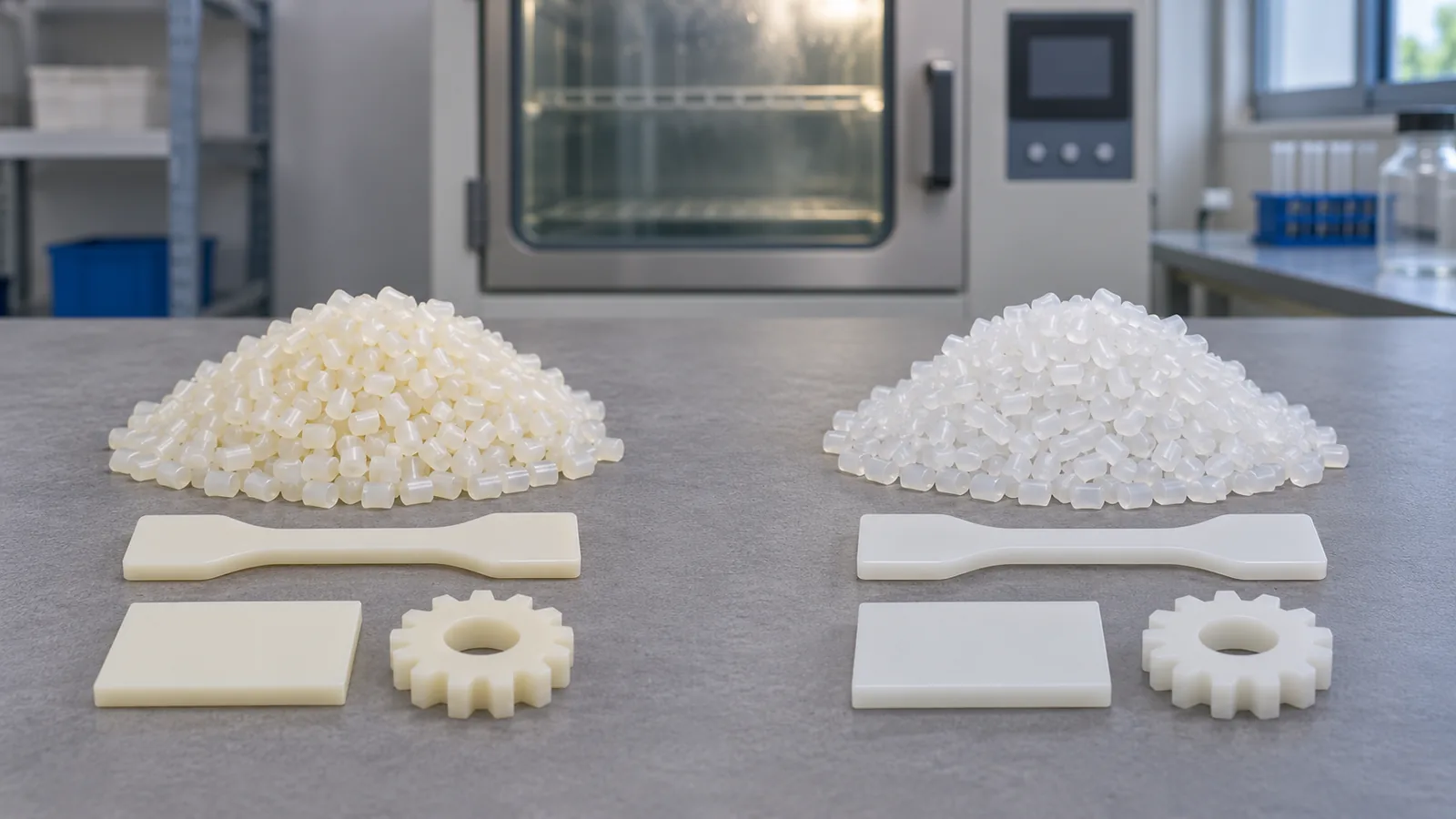
Nylon 6 vs nylon 66 is a comparison between two different polyamide families, not a simple choice between a lower and higher quality version of one material. Their polymer structures differ, and their properties can differ, but the actual result also depends on the named grade, additives or reinforcement, manufacturing route, product geometry, and moisture condition. Buyers should compare the same form of material under relevant conditions and request the exact supplier grade before deciding that one can replace the other.
The distinction matters when a bathroom or home-storage hardware project includes a bought-in clip, spacer, roller, insert, bushing, end cap, or other polymer component. A resin family name may appear on a drawing or quote, but it rarely identifies all characteristics needed for a functional substitution. A safe sourcing conversation separates four things: polymer identity, commercial grade, product form and processing route, and the state in which any property data was measured. If one of those differs between the reference and proposal, the comparison needs to say so explicitly.
Why “nylon” is not a complete material specification
Nylon is a common name for polyamides. The number notation distinguishes polymer families by the structure of their repeating units. PA6, often called Nylon 6, and PA66, also written Nylon 6/6 or Nylon 6,6, are separate materials. They are related members of the polyamide family, but their names do not mean that they share an identical formulation or that one is universally better.
The repeat-unit description explains chemical identity, not the complete behavior of a finished component. Commercial material may be unfilled, reinforced with glass or mineral, impact modified, lubricated, stabilized, colored, or formulated for a particular processing route. Even within one family, two suppliers’ grades may be designed for different needs. A material data sheet for an unfilled extrusion grade cannot automatically establish the properties of a glass-filled injection-molded clip from another supplier.
The product form is another boundary. Buyers may compare pellets, a molded part, machined stock shape, a film, fiber, or a finished assembly. These forms have different processing histories and may have different orientation, surface, dimensions, and test methods. The word “nylon” appears across many product forms; it is not proof that reported values apply to the component under review.
Moisture and conditioning state also matter for polyamides. Material references describe moisture absorption and its potential effect on dimensions and properties. A dry-as-molded sample, a conditioned test specimen, and a part used in a humid or wet environment are not necessarily equivalent states. The relevant comparison should identify how samples were prepared, how long they were conditioned, and what environmental conditions the project expects. Do not take a property number from one condition and treat it as a guaranteed value in another.
What buyers can compare between PA6 and PA66
A material comparison is useful when it translates polymer identity into a project decision. The following table is a framework for questions, not a universal scorecard. Values and outcomes are grade-, form-, method-, and condition-specific.
| Comparison dimension | What the buyer should identify | Why the comparison can change | Provas a solicitar |
|---|---|---|---|
| Polymer family | PA6 or PA66, with the supplier’s exact designation | Similar names can hide different base polymers | Grade data sheet and supplier declaration tied to a purchase line |
| Formulation | Unfilled, reinforced, modified, lubricated, or stabilized condition | Additives can shift stiffness, impact behavior, processing, color, and other characteristics | Full grade name, revision, and technical data for the exact grade |
| Product route | Injection molded component, machined stock, extruded form, or other route | Orientation, molding details, geometry and finishing affect the finished part | Part drawing, process scope, and representative sample identity |
| Moisture state | Dry, as-molded, conditioned, or service-conditioned data | Moisture can affect dimensions and measured behavior in polyamides | Test condition, sample preparation, and the relevant method |
| Geometry | Wall thickness, ribs, bosses, snap features, holes, and load path | The same grade can behave differently in different part geometry | Controlled drawing and fit/function review |
| Intended function | Retention, spacing, sliding, impact, sealing, or another role | Different use cases prioritize different properties | Application description, acceptance criteria and approval owner |
| Traceability | Manufacturer, production lot, and lot-to-document link | A generic certificate may not correspond to the material actually supplied | Lot-linked records and incoming identification procedure |
The table deliberately avoids claiming that PA66 always has greater strength or that PA6 always absorbs more water by one fixed amount. Those simplified statements suppress the exact grade, specimen, test condition, and source. If a property is important, compare current data from the makers of the actual grades and ask whether the test specimens and conditioning states are comparable. A datasheet is evidence about the described grade and method; it is not an automatic performance guarantee for a different molded geometry.
How the two families differ—and where the comparison stops
PA6 and PA66 are chemically distinct polyamides. The naming convention indicates differences in repeat-unit structure. Engineering suppliers publish grade-specific data, and educational material commonly compares their processing and property profiles. Such comparisons can help form questions, but buyers should not convert general descriptions into a universal winner. One grade may be a better fit for a defined part and environment, while a different formulation or design may reverse the result.
Ensinger’s material references describe the polyamide family, variants and moisture-related context. Protolabs’ discussion of nylon types provides a manufacturing-oriented comparison. These are useful background sources, but their values and examples do not certify a separate supplier’s grade or a Koitor project component. For a real substitution, obtain the actual grade documents and confirm whether the material form and conditioning match the design decision.
A buyer should distinguish several common comparison errors:
- Comparing a generic PA6 label with a fully specified PA66 grade.
- Comparing an unfilled sample with a reinforced formulation.
- Using one supplier’s stock-shape data as if it described another supplier’s molded part.
- Comparing dry data for one grade with conditioned data for the other.
- Treating an individual data sheet’s typical value as an acceptance limit or guaranteed minimum.
- Assuming that a color or surface appearance identifies a polymer family.
- Treating a supplier’s “equivalent” statement as approval without knowing the buyer’s functional criteria.
If a supplier proposes a substitution, ask the supplier to identify the exact material and provide a side-by-side comparison for the properties that matter to the part. “PA6 to PA66” by itself is not a complete change description. Record what remains unchanged and what differs, including grade, additives, processing route, conditioning, color, and source. The responsible product or engineering owner should decide whether the change needs a sample, test, fit check, or formal approval.
Conditioning and moisture: match the state before comparing data
Polyamide materials can take up moisture from their surroundings. Depending on the grade and geometry, absorbed moisture can affect dimensions and measured properties. That broad statement is not a prediction that a given clip will swell by a specified amount or fail in a bathroom. The effect is a project-specific question that should be answered using the exact material, part design, conditioning procedure, and application.
A meaningful data comparison identifies at least: the material grade, specimen form, conditioning method, test environment, measurement time, and property method. If one data sheet reports dry values and the other reports conditioned values, put that difference in the comparison table. Do not combine values from separate conditions and describe them as a direct head-to-head test.
For a part with a tight fit, document the mating dimensions and the state in which fit is assessed. A nominal dimension by itself may not describe how the part behaves after storage or exposure. The product owner should decide whether the relevant check is assembly fit, retention, movement, or another criterion. This article does not set a universal moisture conditioning duration, humidity target, tolerance, or acceptance threshold.
For a related polymer test-method decision, see the plastic impact test comparison for hardware buyers; it covers a different evidence question. For glass-filled PA66 and directional stiffness, see the separate glass-filled nylon anisotropy guide. The broader PBT versus PA66 comparison covers a different material pair. This page should remain focused on identifying and comparing PA6 with PA66, not repeat those owners’ full technical chapters.
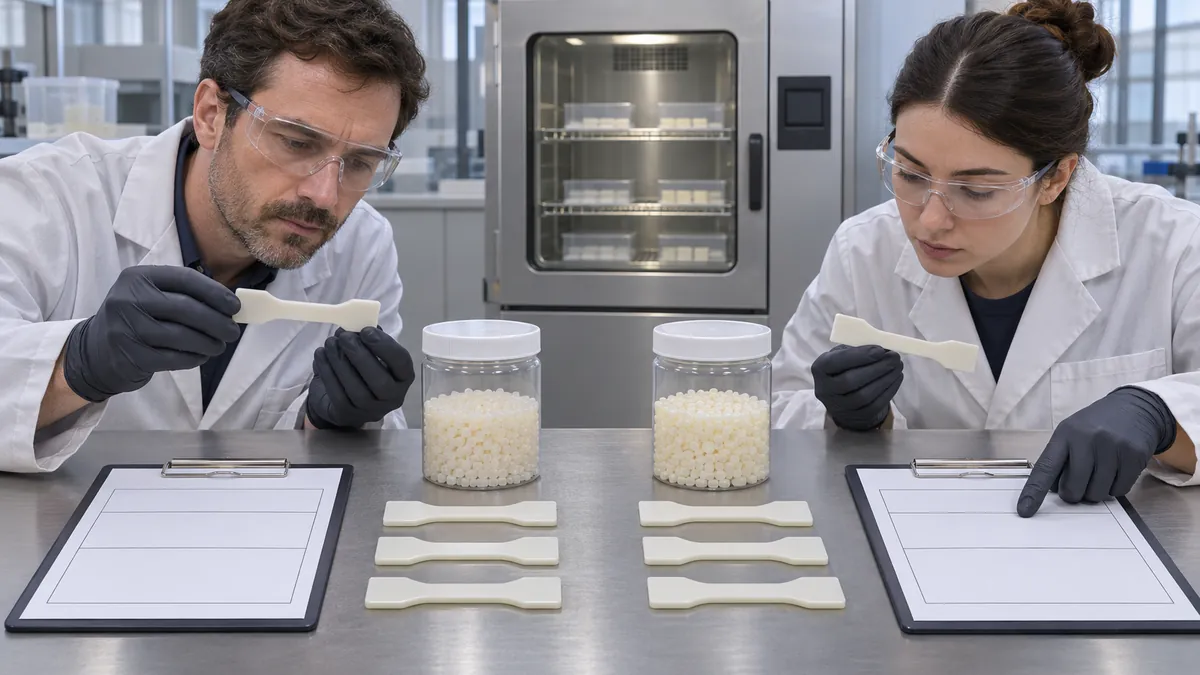
Build a defensible material substitution review
A substitution review should begin with the function of the component, not the marketing name. Write down what the component does in the assembly: retain a part, maintain spacing, guide motion, absorb impact, provide a surface, or serve another defined role. Then identify which consequences would matter if the material or dimensions changed. The buyer can then request evidence directed to those criteria rather than demanding a generic “better plastic.”
Step 1: Lock the reference
Capture the currently approved drawing revision, part number, supplier, material designation, and any available lot or grade records. If a drawing says only “nylon,” flag that as incomplete identification. Preserve a representative approved sample if the project’s controls allow it, and label it with its revision and source. A sample should not be treated as a verified material standard unless it has been formally defined that way.
Step 2: Describe the proposed alternative
Obtain the proposed manufacturer’s name, exact grade, formulation, process route, color, and product form. Ask whether the supplier is proposing PA6, PA66, a modified grade, or a blend/trade name. If the name is a brand, request the underlying resin family and grade identity rather than assuming the brand word maps to a generic family in every market.
Step 3: Compare like with like
Review the current technical documents and note the test method, specimen, condition, and whether values are typical or guaranteed. Avoid building a table by pulling a favorable strength number from one source and an attractive moisture or processing claim from another. If data is missing, label it missing. A supplier’s statement that two materials are “similar” does not resolve an undocumented property.
Step 4: Tie the data to the part
Map relevant properties to the actual geometry and function. Ask whether the component has thin walls, snap features, a press fit, a threaded insert, a sliding interface, or a cosmetic surface. The part designer or qualified reviewer should decide what dimensions and functional checks matter. A resin comparison alone cannot determine whether the complete assembly will remain acceptable.
Step 5: Set review and approval ownership
Identify who approves material changes, who reviews technical evidence, who checks the first sample, and who updates the bill of materials. A purchase team can compare commercial terms, but it should not infer technical equivalence from the quote. Maintain the decision record and revision linkage so a later reorder does not silently revert to an old or different grade.
A useful substitution matrix may look like this:
| Review item | Approved reference | Proposed material | Open question / owner |
|---|---|---|---|
| Polymer family and grade | Record exact PA family and grade | Record exact PA family and grade | Does the source identify the real compound? |
| Formulation | Note reinforcement and modification | Note reinforcement and modification | Are additive differences acceptable? |
| Form and process | Record molded or stock-form part | Record proposed route | Does the comparison apply to this part? |
| Conditioning basis | State condition of reference data | State condition of alternative data | Are data states aligned? |
| Part function | State the controlled function | State any changed behavior | Which check demonstrates fit for purpose? |
| Approval | Name the change owner | Name the supplier and reviewer | Who signs the change before order? |
This kind of matrix is an original buyer decision tool, not an industry standard or Koitor test procedure. It creates a record of what has been compared and what is still unknown.
What an OEM hardware discussion can and cannot establish
A metal hardware OEM may encounter polymer components as bought-in items in an assembly. A factory can discuss the metal parts, mounting interfaces, packaging, drawing revision, and sample scope that fall within its confirmed capabilities. It should not claim to manufacture a particular polymer resin or certify the properties of an externally supplied component unless approved company facts and project evidence support that claim.
Koitor Hardware is positioned as a family-owned custom metal bathroom and home-storage hardware factory with customization from buyer drawings or physical samples and direct factory communication. This positioning does not establish that Koitor compounds or molds nylon, performs accredited polymer testing, owns a particular molding line, or provides material engineering approval. If a project includes a purchased polymer spacer, clip, or bushing, the component source and responsible material specialist should be identified separately.
A practical early conversation can still prevent avoidable confusion. Provide the drawing and sample status, mark the interface dimensions owned by the metal product, identify which polymer component is externally sourced, and name the decision that remains open. The factory can confirm whether the surrounding metal scope can be reviewed or quoted. The buyer and specialist supplier must resolve material identity, grade equivalence, performance evidence, and any test requirements within their own scope.
No universal minimum order quantity, price, tooling charge, lead time, or pass result follows from this overview. Those depend on the actual design, supplier, material, quantity, process, and project requirements. A quote should make assumptions and exclusions visible instead of presenting a family comparison as if it were a complete engineering decision.
Common sourcing mistakes
Choosing by a single headline property
A single tensile or stiffness value rarely captures the entire part decision. Geometry, condition, impact, fit, processing and environment may matter. Identify the function first, then compare the evidence that addresses it.
Treating dry-as-molded data as service data
The state of a specimen matters. If a part sees moisture, a dry number may not answer the project question. Ask the technical owner to define a relevant condition and test, rather than extrapolating a universal change.
Assuming PA66 is always the upgrade
A different family does not automatically mean a better part. The actual grade and application determine whether an alternative meets the need. Do not pay a premium or accept a substitution based solely on a general “higher performance” label.
Equating a resin family with a supplier grade
A supplier’s commercial grade may contain modifiers or fillers. The PA family name alone omits those details. Record the complete grade and ask for material documentation connected to the actual component or lot as appropriate.
Using data from a different product form
Stock shape, molded specimen, and finished component can differ in process history and geometry. Make sure the data source describes a relevant form and condition. If it does not, treat it as background information only.
Leaving the approved revision ambiguous
A material change affects the bill of materials and may affect interfaces. Keep drawing, sample, material designation, and purchase line aligned. Make the change explicit before a reorder.
In a nylon 6 vs nylon 66 review, family names must be paired with the exact compound grade and conditioning basis. Otherwise the comparison may mix unlike samples.
Buyer checklist before requesting a quotation
- What exact component is being sourced, and what function does it perform?
- Does the approved drawing identify PA6 or PA66, or only say “nylon”?
- What is the full manufacturer and grade designation?
- Is the material unfilled, reinforced, modified, lubricated, stabilized, or colored?
- Is the item molded, machined from stock, extruded, or made by another process?
- Which product properties or dimensions matter to the actual function?
- What moisture or conditioning state applies to the project and to the cited data?
- Are the compared values measured using the same method and specimen condition?
- Is the supplier proposing an exact match or a material substitution?
- Who owns technical review and who has approval authority?
- Which drawing revision, sample, lot record, and purchase line need to remain traceable?
- What details are still unknown and require the material supplier or product engineer?
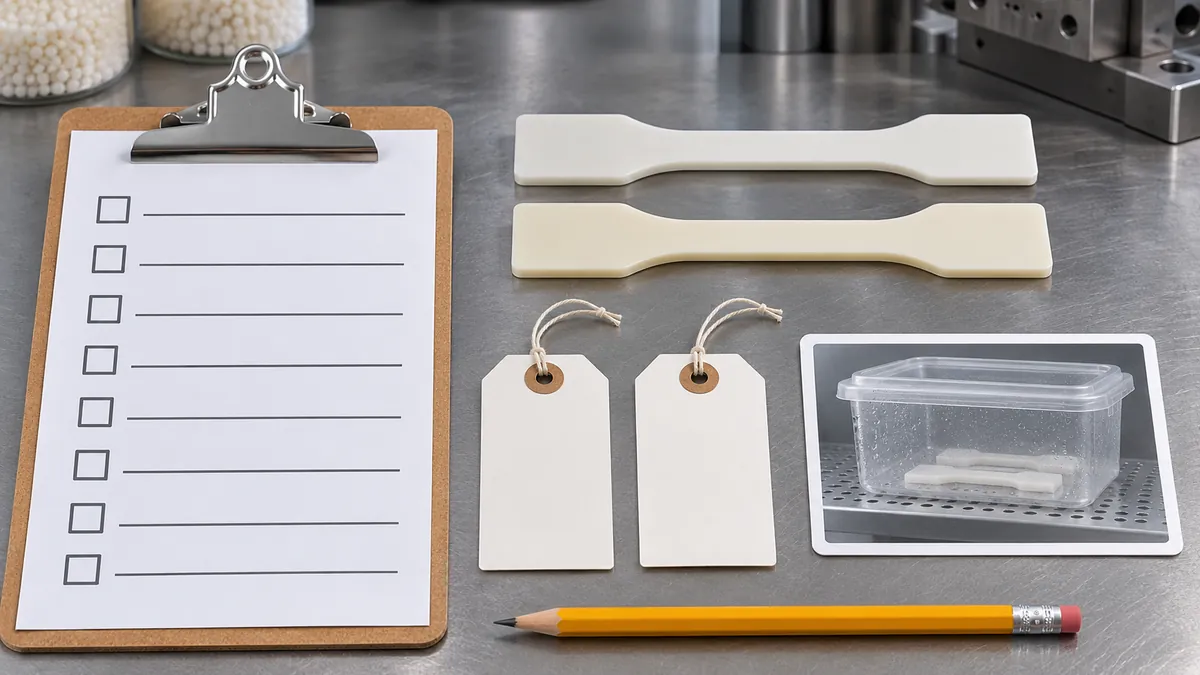
In a nylon 6 vs nylon 66 review, family names must be paired with the exact compound grade and conditioning basis. Otherwise the comparison may mix unlike samples.
Perguntas frequentes
Is nylon 6 the same material as nylon 66?
No. PA6 and PA66 are distinct polyamide families with different repeat-unit structures. Their commercial grades can also differ in additives and formulation. Use the exact grade designation rather than treating the family names as interchangeable.
Is nylon 66 always stronger than nylon 6?
That is not a safe universal conclusion. Properties depend on the exact grade, formulation, specimen, processing, conditioning, geometry, and test method. Compare current supplier data for the relevant product form and ask the responsible engineer to judge the application.
Does moisture affect PA6 and PA66?
Moisture can affect polyamides, including dimensions and measured properties. The practical effect depends on the material grade, form, part geometry, conditioning, and environment. Define the project’s condition and avoid applying one data point universally.
Can a molded PA6 component be replaced with machined PA66 stock?
Not based on family names alone. The product form, processing route, geometry, condition, and function differ. The substitution should be reviewed against the controlled drawing and relevant acceptance criteria by the responsible technical owner.
What should appear on a nylon component specification?
At minimum, identify the base polymer family and exact commercial grade, the required formulation or reinforcement where relevant, color or appearance requirements, the controlled drawing revision, and any approved conditions or functional criteria. Project-specific details vary.
Does a supplier data sheet guarantee the delivered part?
A data sheet describes a grade under stated conditions. It does not automatically prove that a delivered lot is the specified grade or that a finished geometry meets a requirement. Connect the documentation to the supplier, part, and project controls.
Can visual appearance distinguish PA6 from PA66?
Not reliably. Color, finish, and shape do not prove polymer identity. Use supplier identification, controlled records, or an appropriate qualified verification method when material identity matters.
Who should approve a PA6-to-PA66 substitution?
The project’s designated technical or product owner should approve it after reviewing the exact grade, form, condition, component function, relevant evidence, and any required sample or test. Purchasing should not declare equivalence from a quote description alone.
Trabalhe com a Koitor Hardware
If a custom metal product includes a bought-in polymer component, share the controlled drawing or sample, the metal interface dimensions, intended use, and the material question that remains open. Koitor can discuss the confirmed metal hardware scope; polymer grade selection and performance approval must stay with the responsible material supplier or technical owner.
Discuss material and component scope with Koitor Hardware.
Send your drawing, sample, target quantity, finish, packaging, and project questions for a scope discussion.
OEM / MARCA PRÓPRIA
Transforme este guia de fornecimento num resumo do produto
Indique o produto pretendido, as dimensões, o acabamento, a quantidade a encomendar e os requisitos de embalagem. A sua equipa receberá uma análise prática da viabilidade de fabrico antes da apresentação do orçamento.


 English
 Español
 Português
 Français
 Deutsch
 العربية