
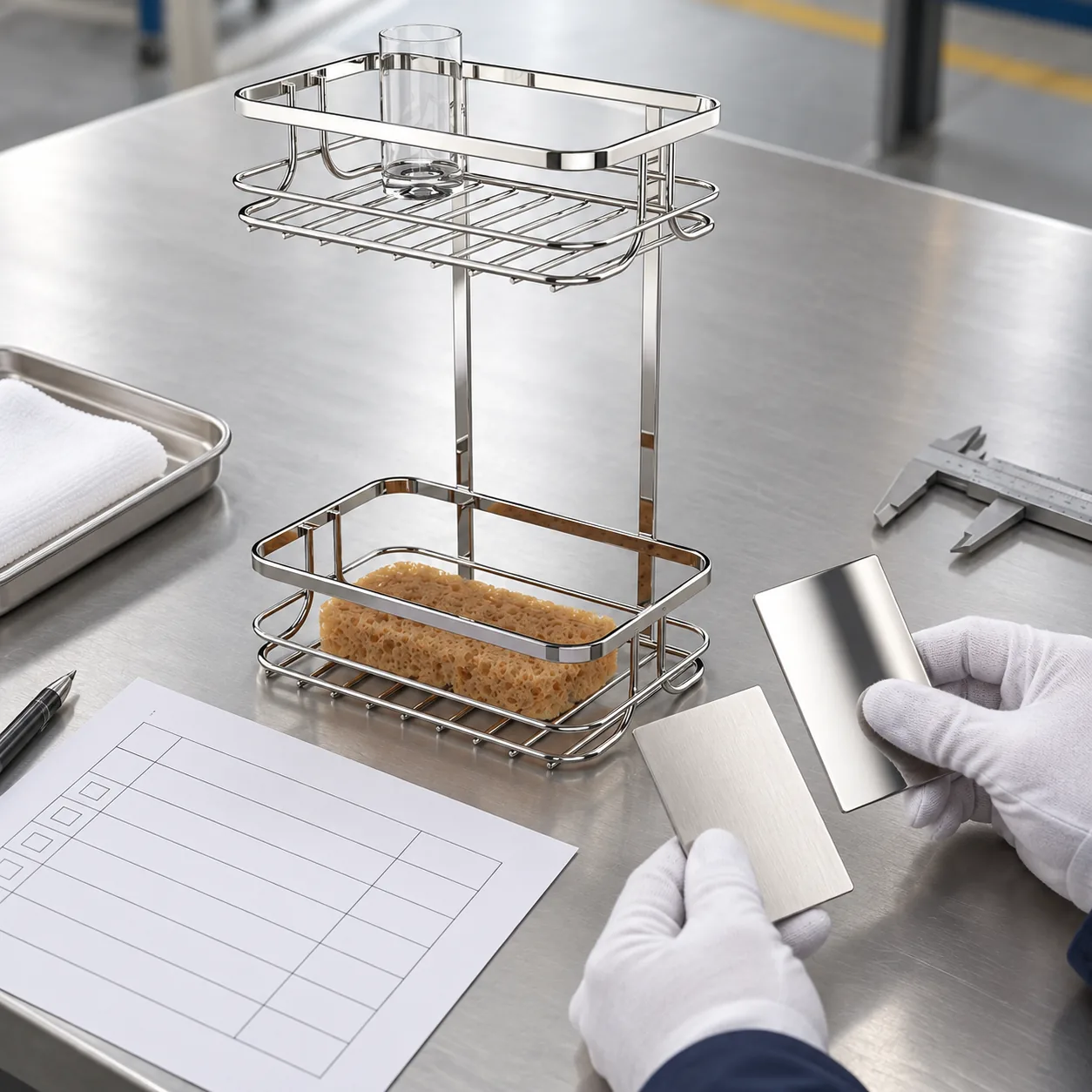
For abrasive belt loading glazing versus worn grit stainless, a buyer reviewing a bathroom rack sample may see dull bands, irregular scratches, smeared-looking areas or a finish that differs from the approved reference. Those observations do not identify the cause by themselves. Abrasive belt loading, glazing, worn grit, contact conditions, contamination and a changed finishing sequence can produce overlapping visual symptoms. The sourcing decision is not to diagnose a machine from a photograph; it is to define what the supplier should compare, record and reproduce on the actual part.
This guide explains abrasive belt loading glazing versus worn grit stainless as a buyer-facing investigation. It separates belt condition from the broader finishing route, shows how to structure a controlled sample comparison, and identifies evidence that can be requested without dictating unsupported machine settings. It applies to metal bathroom and home-storage hardware where visible stainless surfaces are mechanically finished before assembly or delivery. It does not claim that one belt type or grit sequence is universally correct.
For a custom program, the approved finish belongs to a representative product configuration—not just a verbal description such as “brushed stainless.” A buyer should connect the drawing revision, material and finish reference to the sample, then agree how changes will be handled. Koitor’s confirmed scope includes metal forming, welding, grinding, polishing, assembly and drawing/sample-based customization; exact equipment, abrasive brands, parameters and product-specific finish performance must be confirmed for each project.

What do belt loading, glazing and worn grit mean to a buyer?
An abrasive belt removes or refines material through abrasive grains carried on a backing. In service, the surface can change: debris may accumulate between grains, the cutting points may become less effective, or the belt may otherwise behave differently from a new or correctly conditioned belt. “Loading” and “glazing” are workshop descriptions that should be tied to an observed condition and supplier terminology. A visual label alone is not a reliable root-cause finding.
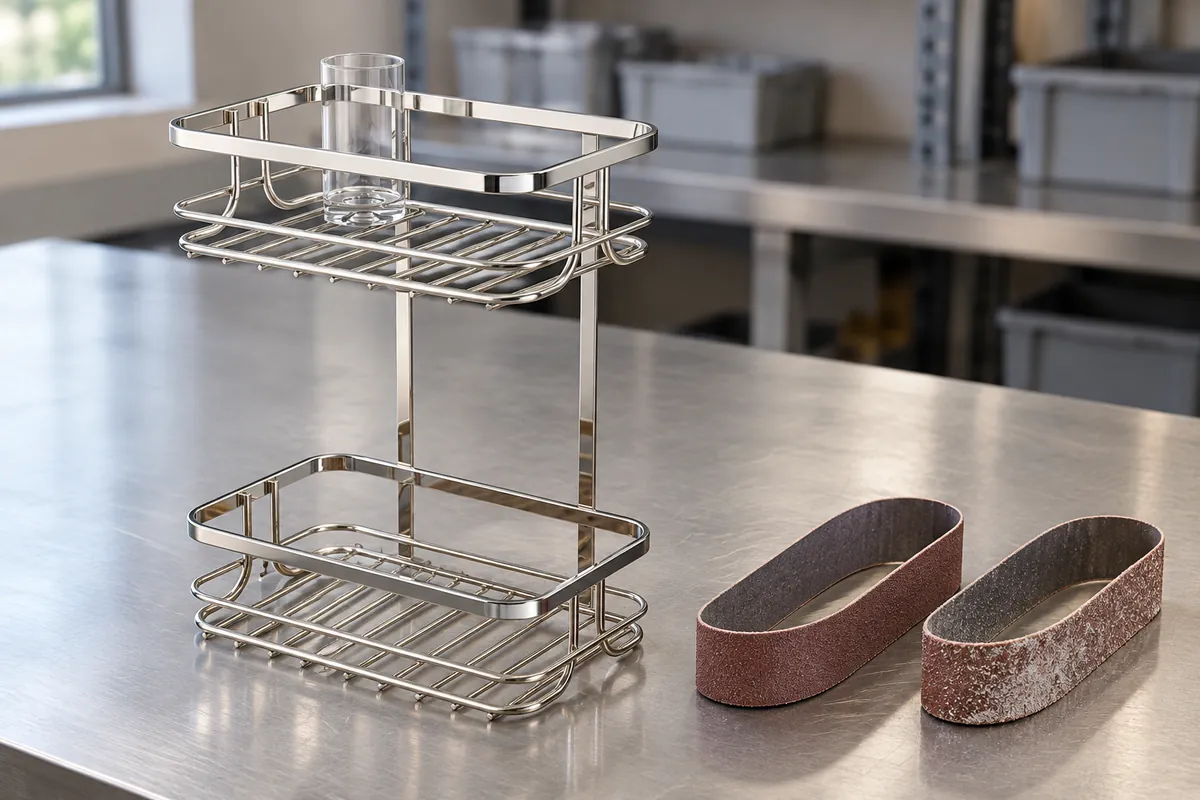
Worn grit is a different possibility: the abrasive cutting capability may have changed with use. Yet the mark left on a stainless component also depends on the belt construction, contact wheel or platen, pressure, speed, part geometry, operator path, prior scratches and the subsequent finishing steps. The same dull appearance may have more than one cause. Conversely, a belt that looks used is not automatically unacceptable if the finished part still meets the agreed sample and process controls.
That is why abrasive belt loading glazing versus worn grit stainless should be handled as a comparison question, not a vocabulary quiz. Ask the supplier to show what evidence supports its diagnosis: the belt identity and condition, the part location and orientation, the process sequence, and a comparison under controlled conditions. If the supplier uses different internal terms, have them define those terms in the corrective-action record.
3M’s public technical material illustrates why application and abrasive construction matter: product pages describe different belt designs for stainless finishing and explain that some products are intended for particular pressure or grinding conditions. Those product-specific statements should not be generalized into a universal belt-life or finish guarantee. The buyer’s task is to specify the desired product result and require a repeatable, disclosed process appropriate to the actual geometry.
Why can the symptom be confused with a grit-sequence problem?
Abrasive belt loading glazing versus worn grit stainless is narrower than grit sequence selection. A sequence question asks how successive abrasives or finishing stages create the target appearance. A belt-condition question asks whether a specific abrasive has changed during use and whether that change relates to observed variation. The topics can interact: if an earlier stage leaves deeper scratches, later stages may not remove them consistently; if an abrasive changes condition, the apparent result of a given grit may also shift.
| Question | Possible evidence | Buyer interpretation | Limit |
|---|---|---|---|
| Belt loading or glazing? | Supplier-defined belt condition, identified belt, controlled comparison samples | Check whether the changed condition tracks with the finish symptom | A visual label alone does not prove root cause |
| Worn abrasive? | Use/change record and comparison with a known reference condition | Determine whether performance changed during the relevant run | Appearance also depends on geometry and process inputs |
| Grit-sequence issue? | Stage sequence and representative samples before/after finishing | Check whether earlier scratches remain or later stages vary | Not interchangeable with belt-condition diagnosis |
| Other process cause? | Orientation, support, contamination and downstream-stage review | Keep the investigation open if the belt comparison does not explain the result | Requires qualified process-owner judgment |
Other causes can mimic both. A different material heat or surface condition, changed stock removal near a weld, belt tracking, pressure variation, contact-wheel condition, contamination from a prior operation, or inconsistent part orientation can alter the finish. If a visible scratch is deeper than the next operation can remove, changing only the belt may not solve it. If the visible band follows a fixture contact path, the issue may be handling or support rather than abrasive loading.
The buyer should therefore resist a premature single-cause statement. Record the symptom and its location first, then ask the supplier to test a short list of plausible causes. Avoid asking for proprietary operating recipes if they are not needed to establish conformity; instead request a controlled comparison and the evidence that connects the selected corrective action to the agreed result.
A practical record can separate “what was seen” from “what is believed.” For example: “A dull band repeats along the outer bend on three returned samples” is an observation. “The belt glazed” is a hypothesis until the supplier provides supporting evidence. This distinction prevents a corrective-action report from converting an early guess into a permanent specification.
How should the buyer define the finish before comparing samples?
Start with the intended product and the surfaces buyers or end users will see. Identify the part number, drawing revision, material grade or approved material description, visible faces, assembly state and finishing sequence at a level appropriate for the program. For a wire basket, include the bends, corners, weld transitions, mounting supports and any surfaces revealed after installation. A polished flat coupon may help evaluate a finish, but it cannot represent the complete product geometry.
Next, define the acceptance reference. It may be a signed production-intent sample, controlled limit samples, an agreed visual standard, or a combination. Record who owns the master sample, where it is stored, how it is identified and what happens if it is damaged or replaced. If a photograph is used for communication, note its lighting and viewing limitations; a screen image cannot reliably substitute for a physical finish reference.
State how the product will be inspected. Align the viewing distance, illumination direction, part orientation, cleanliness and inspection areas. Use the same conditions when comparing alternatives. A directional brushed finish can appear different when rotated relative to a light source, so a buyer and supplier should agree whether grain direction, scratch pattern, uniformity, gloss impression or a specific defect is the controlling attribute.
Do not invent a roughness number or universal scratch limit just to make the specification look precise. If a numerical measurement is needed, identify a suitable method, instrument, location, calibration responsibility and acceptance basis with the qualified process owner. If the program has no validated numeric criterion, a controlled physical sample and documented visual inspection may be more honest and useful.
What controlled comparison helps separate belt condition from other causes?
A useful comparison changes one relevant factor at a time while holding the rest of the route as constant as practical. First, select representative parts from the actual material and geometry. Identify sample IDs and mark the inspected face and direction. Keep drawing revision, upstream preparation, part orientation, fixture, operator or approved work method, and later finishing stages stable when the investigation permits.
Then ask the supplier to document the abrasive belt identity, grit designation or product code where available, belt age or use condition in the supplier’s own defined terms, and any change in belt supplier or specification. The goal is traceability, not an assumption that all suppliers can provide the same belt-life counter or automated measurement. If the process does not track belt usage quantitatively, record the actual control used and its limitations rather than inventing a usage number.
Compare the suspect condition with a known reference condition only under a safe, approved process. The process owner should determine how to prepare or change the belt and ensure the trial follows applicable machine-safety procedures. The buyer does not need to direct machine operation. Ask for the result on equivalent product areas and compare it with the approved sample using the same inspection conditions.
If a changed belt condition improves the finish while other variables remain stable, that supports—but does not alone prove—the hypothesis. If the visual result remains, investigate other variables such as prior-stage scratch depth, contact support, material variation, contamination or downstream polishing. Record what was changed, what stayed fixed, what was observed and what remains uncertain.
The comparison should include at least one product feature that is difficult to finish consistently, such as a tight bend, joint or transition. Also include an ordinary visible area. This prevents a supplier from demonstrating success only on the easiest flat region while the buyer’s complaint concerns a more complex location.
What evidence should importers request from a supplier?
A concise evidence package can be more useful than a long narrative. Request the following only to the extent it is practical and relevant to the product:
- Part number, drawing revision, material description, sample ID and the exact location of the reported appearance.
- Photos of the defect under agreed lighting, with orientation and scale context; photos support review but do not replace the physical sample.
- The supplier’s definition of loading, glazing or worn condition, plus the observed basis for using that term.
- Abrasive product identification and grit or grade information where available, with change history if the belt specification changed.
- Relevant finishing-stage sequence and which steps were held constant during the comparison.
- Trial samples from the suspect and comparison conditions, tagged so they cannot be confused.
- Inspection method, viewing setup, acceptance reference and the person responsible for the disposition.
- Containment decision for work in process or finished stock, where applicable and agreed by the parties.
- Corrective action, effectiveness check, control owner and notification trigger for any approved process change.
The request should remain proportional. A buyer may need a clear sample comparison and change record, not a complete machine program or commercially sensitive production recipe. If the issue involves potential contamination of stainless surfaces, the supplier and buyer should determine whether a separate cleaning or passivation question is relevant. ASTM A380 describes practices for cleaning, descaling and passivation of stainless-steel parts and explains that surface contaminants may impair normal corrosion resistance in some services. That reference does not mean every cosmetic belt mark requires passivation; it identifies a separate technical boundary that should be evaluated by the qualified owner.
How does the investigation affect cost, lead time and repeat orders?
The lowest unit quote may not reflect the effort needed to hold a stable visible finish across batches. Belt selection, replacement control, fixture support, additional polishing, inspection, sample approval and rework can all affect process cost. The buyer should avoid comparing supplier quotations unless the acceptance reference and finishing scope are aligned.
When requesting a quotation, state whether the part has a cosmetic inspection zone, whether the target is tied to a supplied sample, what evidence is required for first approval, and how process changes are notified. If the buyer requests additional samples or controlled comparisons after a defect appears, clarify whether those activities are part of the initial development scope or a separately approved corrective-action task. Do not assume every supplier’s quotation includes the same level of sample documentation.
For repeat orders, preserve the approved sample identity and the process inputs that are relevant to the finish. A substitute abrasive, changed sequence, altered part geometry or new supplier may warrant review depending on the risk and the approved change-control agreement. The buyer should define notification triggers in advance. That is more workable than demanding that every minor shop-floor adjustment be escalated, or allowing any change to pass without a review.
Cost engineering can also prevent over-control. If the finish area is hidden after installation, the buyer may not need the same appearance criterion used on a front-facing rail. If only certain surfaces are visible, mark them on the drawing. Clear inspection zones reduce subjective disputes and focus supplier effort where the end market actually sees a difference.
What common troubleshooting mistakes should buyers avoid?
First, do not equate every dull or streaked region with belt glazing. Describe the location, orientation and repeat pattern, then request evidence. Second, do not assume that installing a fresh belt is automatically the correct permanent action; it can be a useful comparison but may not resolve a geometry, sequence or contamination issue. Third, do not compare photographs captured under different lighting or angles and call the result a controlled trial.
Avoid specifying a particular abrasive brand or grit solely because it appeared on one acceptable sample unless the program truly requires that control and has validated the trade-off. Overly prescriptive purchasing language can lock the supplier into a process without guaranteeing the finished result. A performance-based sample and change-control agreement is often more adaptable, while an identified abrasive input can still be recorded where it materially affects consistency.
Do not use a supplier’s root-cause label as the acceptance criterion. A buyer ultimately needs the product to match the agreed sample and functional requirements, with a credible corrective action if it does not. Do not ask an unqualified reviewer to infer stainless corrosion performance from cosmetic appearance alone. Surface appearance, contamination and corrosion behavior are related but distinct issues.
Finally, do not silently accept a revised sample as the new master. Record whether the sample is approved, conditionally approved or rejected; identify deviations and open questions; and preserve the decision with the relevant drawing and sample revision. A clear disposition prevents a later repeat order from reopening the same discussion.
Buyer checklist for abrasive belt loading glazing versus worn grit stainless
Before approving a supplier investigation, buyers can use this compact checklist:
- Describe the visible symptom without assigning a cause.
- Identify the product, drawing revision, material, sample and exact surface area.
- Compare against a traceable physical reference under agreed inspection conditions.
- Ask the supplier to define its belt-condition terminology and evidence.
- Record belt identification and relevant process changes without demanding unnecessary proprietary detail.
- Hold other practical variables steady during the comparison and identify any that could not be controlled.
- Review representative bends, welds, transitions and visible faces—not only a flat coupon.
- Agree containment, corrective action, effectiveness review and change-notification ownership.
- Keep the original and approved samples identifiable for later repeat orders.
For an OEM or private-label program, this process makes abrasive belt loading glazing versus worn grit stainless a practical supplier-quality question rather than an unbounded search for the “right” abrasive. It helps the buyer connect a visible finish to evidence, sample identity and controlled change while leaving machine operation and safety decisions with the qualified manufacturer.
Perguntas frequentes
Can a photograph confirm abrasive belt loading?
Usually not by itself. A photograph can show a symptom, but belt condition, process history and a controlled comparison are needed to support a cause.
Does worn grit always create a rougher finish?
Not as a universal rule. The result depends on abrasive construction, use condition, pressure, support, material, geometry and later finishing steps. Confirm on representative samples.
Should an importer require a fixed belt-life number?
Only when the process owner can define and validate a useful control. Otherwise, agree on the supplier’s observable condition/change trigger and verify product output against the approved reference.
Is this the same topic as choosing a stainless grit sequence?
No. Grit-sequence selection addresses the finishing route; belt loading or glazing versus worn grit concerns a possible change in an abrasive’s condition. Both may affect the result, but the investigation question differs.
Does a visual finish defect prove a corrosion problem?
No. Appearance does not establish corrosion behavior. If contamination or corrosion resistance is at issue, define the exposure, material and appropriate technical evaluation separately.
Koitor is a custom metal bathroom and home-storage hardware manufacturer with confirmed grinding and polishing scope. Share the drawing or physical sample, the observed finish location, the reference sample and the supplier evidence you need. Review the Visão geral da produção OEM or contacte a Koitor to discuss a product-specific sourcing question. Exact abrasive inputs, equipment, inspection methods and finish acceptance criteria must be confirmed for each project.
Referências técnicas: 3M cloth belt product information for stainless-steel applications e ASTM A380 cleaning, descaling and passivation reference. Confirm current supplier and standard documentation for the applicable material and project.
Discuss a stainless finish approval
Share the product drawing, sample reference, visible issue and supplier evidence needed for a focused review.
OEM / MARCA PRÓPRIA
Transforme este guia de fornecimento num resumo do produto
Indique o produto pretendido, as dimensões, o acabamento, a quantidade a encomendar e os requisitos de embalagem. A sua equipa receberá uma análise prática da viabilidade de fabrico antes da apresentação do orçamento.


 English
 Español
 Português
 Français
 Deutsch
 العربية