

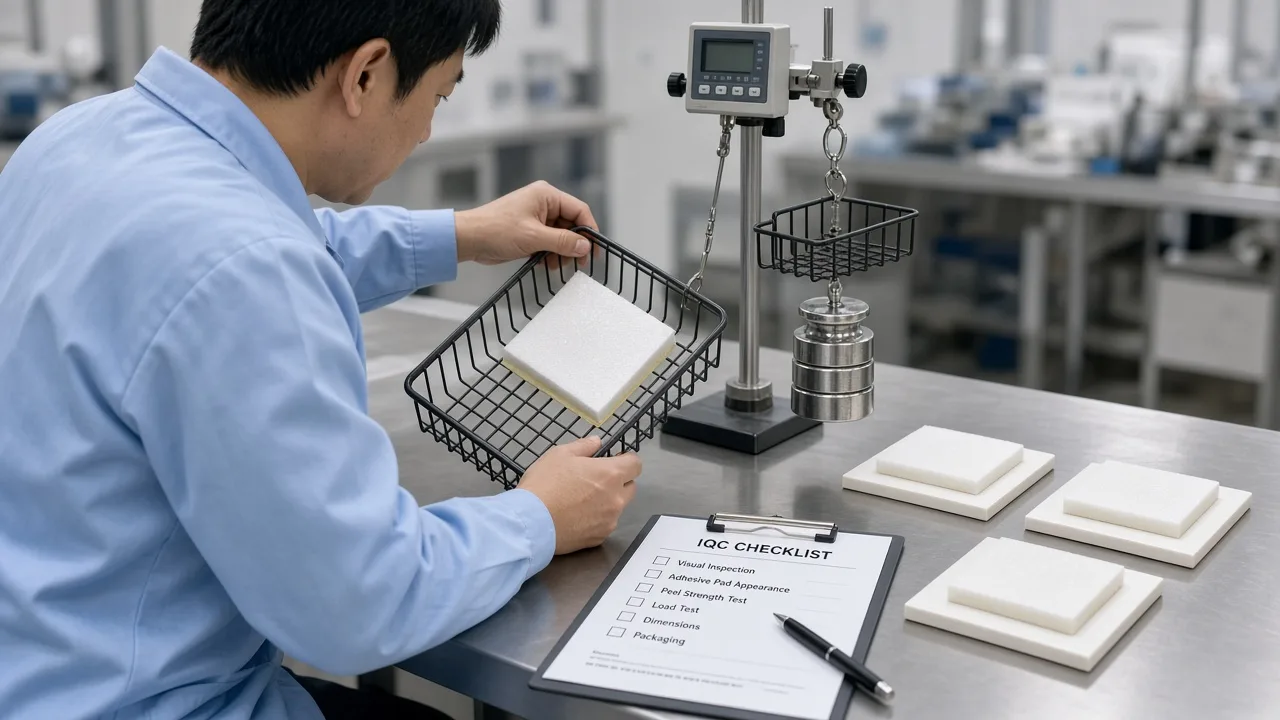
Buyers who source an adhesive shower caddy often inherit returns that look like “mounting failed,” when the real problem is a missing specification. Substrate lists, cure dwell, rated load method, peel disposition, humid-edge water paths, and instruction inserts were never frozen in the RFQ. This article is a buyer and OEM catalog of mounting, packaging, and finish failure modes for adhesive-mounted wire shower caddies—written as RFQ and IQC acceptance language, not as a factory capability pitch.
It deliberately differs from our no-drill capability overview. That page explains what programs can be reviewed. This page tells you what to name, measure, photograph, and accept or reject before mass production. Photos here are generic visual aids. They do not claim that every SKU ships from one plant. Koitor Hardware supports wire bathroom storage programs from Jiangmen, China, with practical specification language for importers and private-label teams.
In this guide
- Why Spec Failures Matter for Adhesive Wire Caddies
- How to Freeze an Adhesive Shower Caddy Spec for RFQ and IQC
- 10 Spec Failures Buyers Must Freeze
- Accept, Rework, or Reject: IQC Decision Rules
- RFQ Checklist Language for Pads, Cure, Load, and Inserts
- FAQ: Adhesive Shower Caddy Specs and Lot Disposition
- Send Your Adhesive Shower Caddy Spec for Review
Why Spec Failures Matter for Adhesive Wire Caddies
An adhesive-mounted wire shower caddy lives or dies at the pad–wall interface. Wire geometry, shelf load, bottle leverage, and daily wet–dry cycling all push peel and shear stresses into a thin foam stack. If your PO only says “strong adhesive, holds 5 kg,” the factory can ship a pad that passes a dry steel peel at room temperature and still fails on textured tile after a steamy shower week.
Retail and marketplace complaints rarely name “dwell time” or “substrate exclusion.” They say “fell off,” “left sticky residue,” “rusted behind the pad,” or “instructions unclear.” Your acceptance plan must translate those complaints into numbered failure modes with CTQs. Without that translation, IQC argues taste, and CAPA becomes a photo chat thread.
Boundary with no-drill capability pages
Capability pages describe mounting families—adhesive, suction, wall-mounted—and invite a project brief. Spec-failure catalogs do the opposite: they constrain the brief. Use the no-drill bathroom accessories manufacturer overview to frame the product family, then return here to freeze substrate, cure, load, peel, humidity, and insert language before tooling and first mass PO.
Commercial stories that start as “mounting issues”
Most adhesive returns cluster into five commercial stories: early drop after install, slow creep under bottle load, tile damage or residue on removal, corrosion at the pad footprint, and kits that arrive with crushed pads or missing inserts. Each story maps to one or more of the ten failures below. If your claim codes only say “adhesive,” you cannot trend root causes or compare two factories honestly.
Private-label teams also need frozen language for chargebacks and dual sourcing. Competing plants should not invent local nicknames for “soft foam” or “short dwell.” Harmonized failure IDs are how you compare true process capability instead of comparing who writes the friendlier inspection report.
Why wire geometry amplifies adhesive risk
Wire caddies concentrate mass away from the wall. Tall bottles create moment arms. Sparse pad footprints on a stiff frame raise peel at the top edge. A design that looks stable on a sample wall can still fail when the buyer’s channel uses textured tile, painted drywall, or glass with soap film. Spec language must therefore cover both the pad system and the frame finish that sits in the wet zone next to that pad.
Importer cost of an unfrozen mounting stack
Unfrozen adhesive stacks on an adhesive shower caddy program create silent margin leaks. A single viral “fell in the shower” review can erase the savings from a cheaper pad. Chargebacks for residue on rental property tile, replacement shipments, and influencer reseeding all hit after the PO was closed at the low quote. Freezing FAIL IDs before award is cheaper than renegotiating after month three.
Category managers should also budget lab time. An adhesive shower caddy that never sees a tile hang test in humidity will still face that test in customer bathrooms. Paying for first-article evidence once is usually cheaper than paying for three reactive CAPA rounds across two factories.
How to Freeze an Adhesive Shower Caddy Spec for RFQ and IQC
Write every mounting requirement as a closed loop: failure name, inspection location, measurement or photo method, severity class, and disposition. Ambiguous words such as “good stick,” “bathroom grade,” or “no drill safe” fail under dispute. For an adhesive shower caddy program, treat the mounting system as a CTQ family equal to weld integrity and dimensional fit.
Photo-spec labeling that survives email and WhatsApp
Golden-sample photos work only when each image carries a label block: SKU, pad lot, substrate type, temperature, dwell hours, viewing distance, and failure ID (for example, FAIL-03 Cure/Dwell Not Met). Mark accept / borderline / reject on the same frame or an annotated crop. Store the labeled set with first-article records so production IQC is not comparing against a faded chat screenshot.
Official test language for peel and shear—without overclaiming
For pressure-sensitive peel characterization, buyers commonly reference ASTM D3330/D3330M peel adhesion methods for tapes. For constant-load holding behavior, reference ASTM D3654/D3654M shear adhesion procedures. Both are quality-assurance tools for adhesive uniformity; they are not automatic product pass marks for a finished shower caddy on every bathroom surface.
Your RFQ must state which method variant, which panel or agreed substrate, dwell before test, peel angle or load, temperature, and acceptance limits. Do not mix ASTM ratings with informal “kg hold” marketing claims without stating the substrate and dwell. For humidity risk education with non-adhesive stakeholders, NIST’s work on moisture attack in adhesive bonds at high humidity explains why interface water can collapse strength above a critical humidity—useful context, not a shower-caddy product standard.
CTQ table starters for adhesive programs
Minimum CTQs for most adhesive shower caddy RFQs include: named allowed and excluded substrates; surface-prep and install-temperature window; cure/dwell before loading; rated load definition with method and specimen; peel failure mode and residue class; pad area, foam density or hardness class, and thickness window; humid-edge water-path rules; instruction-insert content checklist; spare-pad and liner packaging integrity; and finish integrity at and around the pad footprint. Add humidity or cyclic wet exposure only when your channel truly needs it—and when you can fund representative specimens, not only flat steel panels.
Documentation that survives staff turnover
Buyer teams change; factories change inspectors. An adhesive shower caddy program that lives only in chat threads will drift. Keep the failure catalog, photo masters, and CTQ table in a controlled folder with revision dates. Require suppliers to echo the same FAIL IDs on IQC sheets. When a new merchandiser asks why a lot was rejected, the photo-spec should answer in one page.
If you run dual sourcing, freeze the catalog before awarding the second tool. Align sampling with your broader shower caddy AQL photo-spec practice so mounting defects and wire defects use the same Critical / Major / Minor discipline.
10 Spec Failures Buyers Must Freeze for an Adhesive Shower Caddy
The ten failures below are the ones that most often escape vague POs and reappear as marketplace returns. Name each with a FAIL ID in your RFQ. Attach photo masters. Define disposition before first mass shipment.
FAIL-01 — Unnamed or unvalidated substrate list
Failure: marketing says “works on most bathroom walls” while engineering never listed allowed and excluded surfaces. Textured tile, silicone-sealed edges, painted drywall, wallpaper, and greasy glass behave differently. IQC cannot verify “most walls.”
Freeze: allowed substrates with finish notes; excluded substrates; any required tile smoothness or porosity class; statement that claims apply only after listed prep. Require first-article installs on at least the top two target substrates in your channel. Disposition: missing substrate list on artwork or insert = Major until corrected; shipping claims beyond frozen list = Critical for retail-facing packs.
FAIL-02 — Surface prep and install temperature omitted
Failure: consumers wipe with soapy water and stick cold pads in a winter bathroom. Bond strength collapses. Returns blame “weak glue.” Root cause is missing prep and temperature windows on the insert and carton.
Freeze: cleaning agent class (for example, isopropyl alcohol wipe, dry fully); wait time after cleaning; install temperature range; prohibition on silicone-contaminated surfaces. Put the same text on insert and retail carton if space allows. Disposition: insert missing prep steps = Major; carton claim contradicting insert = Major; known ship with blank insert = Critical for private-label launches.
FAIL-03 — Cure / dwell time not frozen
Failure: user hangs full bottles immediately. Foam has not developed contact. Early drop follows. Factories that only test after overnight dwell hide the field failure.
Freeze: minimum dwell before any load; optional staged load schedule; clock icon on insert; IQC lab dwell matching the insert, not a secret longer wait. Disposition: dwell missing from insert = Major; IQC using longer dwell than consumer instructions without disclosure = Major process NC; marketing “instant hold” contradicting dwell = Critical for claim packs.
FAIL-04 — Load claim without method, substrate, or specimen
Failure: “holds 5 kg” with no panel, dwell, temperature, or failure criterion. Shear and peel behave differently. Bottle leverage is not a hanging weight on steel.
Freeze: rated load in newtons or kgf; substrate; dwell; temperature; load direction (shear vs peel-prone); specimen definition (finished caddy or pad coupon); stop criterion (slip distance, time-to-fall, or peel initiation). Prefer method language aligned with ASTM D3654-style constant-load thinking for shear, plus a finished-goods hang test that mirrors shelf use. Disposition: load claim without method on retail pack = Critical; method present but IQC cannot reproduce = Major until protocol locked.
FAIL-05 — Peel failure mode and residue class undefined
Failure: pads peel leaving foam crumbs, adhesive smear, or tile paint lift. Buyers argue whether that is “normal.” Without a residue class, every complaint is subjective.
Freeze: allowed failure mode on named substrates (adhesive–substrate vs foam split); maximum residue class with photo masters; removal method guidance; whether tile coating lift is Critical. Reference ASTM D3330-style peel characterization for pad lot screening where useful, and still require finished-goods peel photos on target tile. Disposition: residue beyond master on allowed substrate after correct removal = Major or Critical by channel; foam crumb in unused kits = Major packaging/process NC.
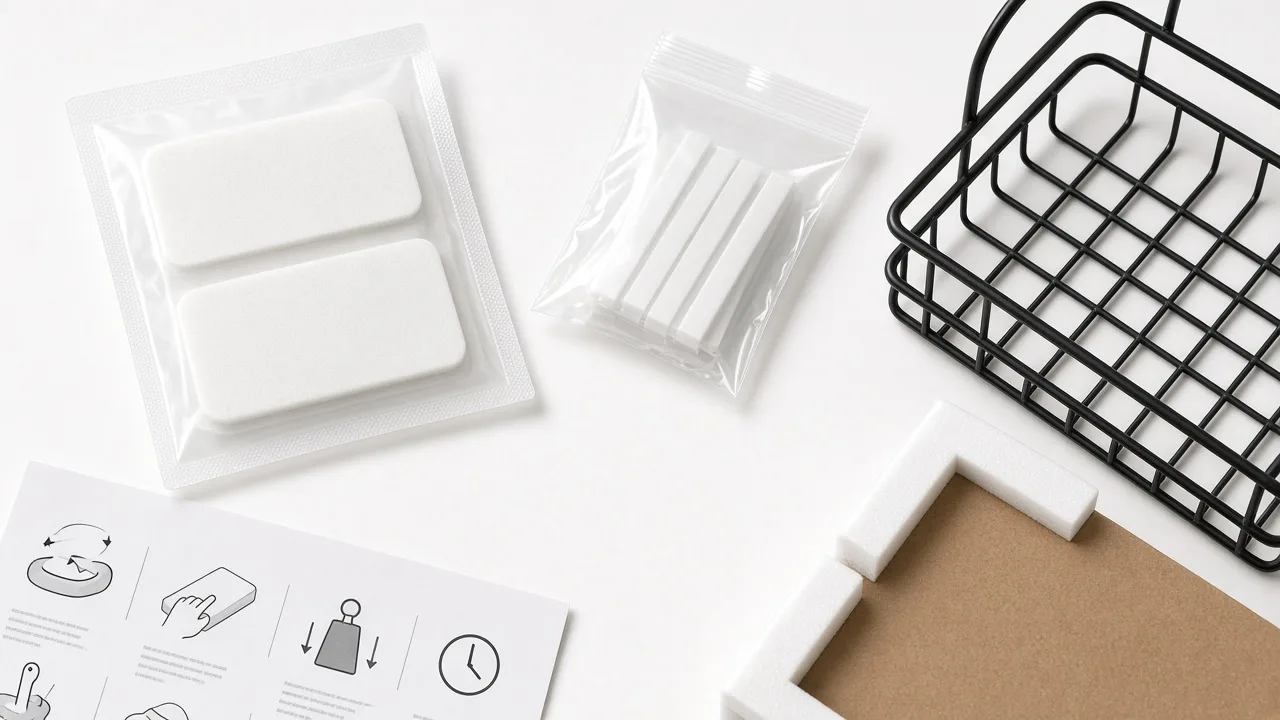
First-article package that prevents later arguments
A useful first-article pack for an adhesive shower caddy includes: labeled photos of install on each allowed substrate; dwell clock evidence; load-test setup photos; peel/residue masters; pad thickness measurements; insert PDF and print proof; carton BOM with pad protection; finish close-ups at pad zones; and a signed FAIL ID checklist. Anything missing becomes a negotiation after the first return spike—when leverage is gone.
What not to copy from marketing pages
Do not copy “holds up to X kg on any bathroom surface,” “instant hang,” or “never leaves residue” into the PO unless your lab evidence and insert match those words exactly. Marketing pages optimize conversion. RFQs optimize dispute survival. Keep the two documents aligned, or force marketing to soften claims to the frozen evidence.
How this catalog should sit beside coating and weld CTQs
Mounting failures on an adhesive shower caddy do not replace weld maps, edge safety, or powder-film CTQs. They sit beside them. A unit can pass weld and coating IQC and still fail FAIL-03 or FAIL-09. Build one inspection flow: geometry and welds, finish, mounting kit, packaging. Train inspectors that “pretty black basket” is not a complete pass.
When CAPA starts, ask whether the failure is pad chemistry, consumer misuse enabled by a weak insert, finish under the pad, or transit crush. Wrong root-cause coding wastes months. FAIL IDs exist so the first nonconformance report already points at the right subsystem.
FAQ: Adhesive Shower Caddy Specs and Lot Disposition
Is peel testing on steel enough for bathroom tile programs?
No. Steel peel screens adhesive uniformity. It does not prove tile, glass, or painted wall performance. Keep steel or standard-panel peel for pad lot screening, and require finished-goods installs on your top channel substrates.
Can we accept a lot if dwell on the insert is longer than IQC used?
Do not. Consumer dwell is the contract. If IQC used a longer secret dwell, the lot may look safer than the field. Either match IQC to the insert or revise the insert with evidence and artwork control.
How many spare pads should a retail kit include?
Freeze the count in the BOM. Many programs include one full spare set or at least one spare pad per mounting face. The right number depends on return policy and install error rates—not on leftover foam at the factory.
Should suction and adhesive share the same failure catalog?
Share classification discipline, not identical FAIL IDs. Suction has vacuum seal and cup hardness issues. Adhesive has dwell, peel residue, and foam thickness issues. Keep separate catalogs under the same Critical / Major / Minor system.
Where does finish fit if the complaint is “pad failed”?
Always inspect the pad footprint for coating chips and rust rings. Many “pad failures” are finish breaches that trapped moisture. Code FAIL-10 when evidence points to the interface metal, not only FAIL-04 or FAIL-05.
Do ASTM D3330 and D3654 replace a finished-goods hang test?
They do not. Use them as adhesive uniformity and holding-power tools where appropriate. Always keep a finished adhesive shower caddy hang or use-simulation test that mirrors shelf load, dwell, and substrate.
Send Your Adhesive Shower Caddy Spec for Review
If you are building or revising an adhesive shower caddy program, bring a short brief: target substrates and exclusions, pad footprint and foam class, dwell and load method, peel residue masters, insert languages, packaging BOM for pads, finish expectations in the wet zone, and whether dual sourcing is planned. Koitor Hardware can review the structure, mounting language, packaging method, and small-batch options from Jiangmen, China—without pretending one adhesive recipe fits every SKU.
Share drawings, sample photos, destination market, and expected quantity. We will help you turn FAIL-01–FAIL-10 into RFQ appendix lines and IQC checkboxes before mass production freezes the wrong pad stack.
Finally, keep a one-page “buyer card” for each adhesive shower caddy SKU for merchandisers: allowed surfaces, dwell hours, rated load with method footnote, and “do not claim” list. Most listing errors happen when a busy editor never opens the engineering appendix. The card is not a substitute for the RFQ—it is the bridge that keeps public copy honest.
Contact: https://koitorhardware.com/contact/ · simon@koitorhardware.com
OEM / MARCA PRÓPRIA
Transforme este guia de fornecimento num resumo do produto
Indique o produto pretendido, as dimensões, o acabamento, a quantidade a encomendar e os requisitos de embalagem. A sua equipa receberá uma análise prática da viabilidade de fabrico antes da apresentação do orçamento.
 English
 Español
 Português
 Français
 Deutsch
 العربية