
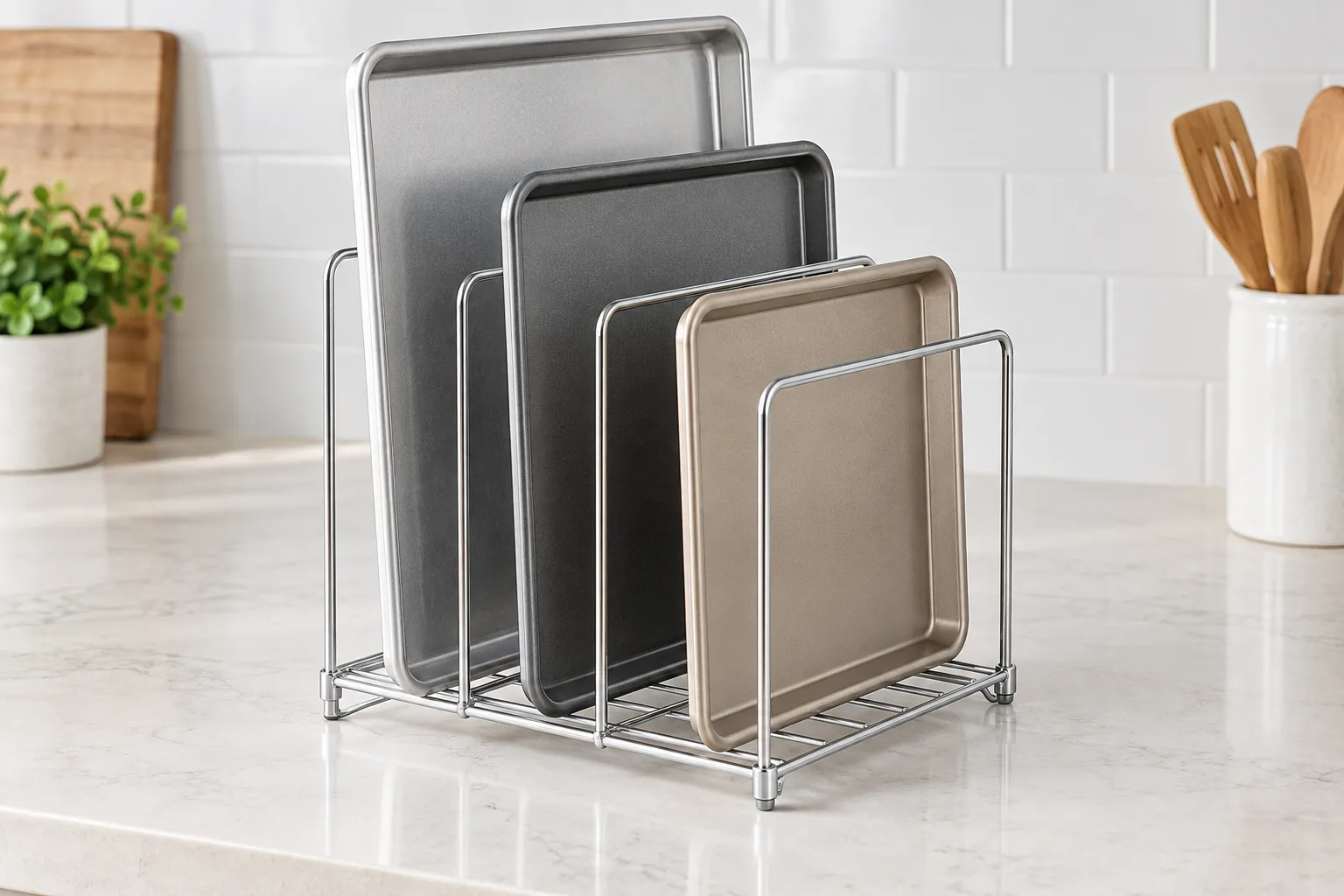
For a private-label metal bakeware organizer, baking sheet organizer divider retention specification should define how each divider engages the base, which tray envelopes it must separate, and how the loaded set is retrieved from the intended cabinet. Buyers should approve that relationship on a representative sample rather than rely on a product photograph or an assumed universal slot pitch.
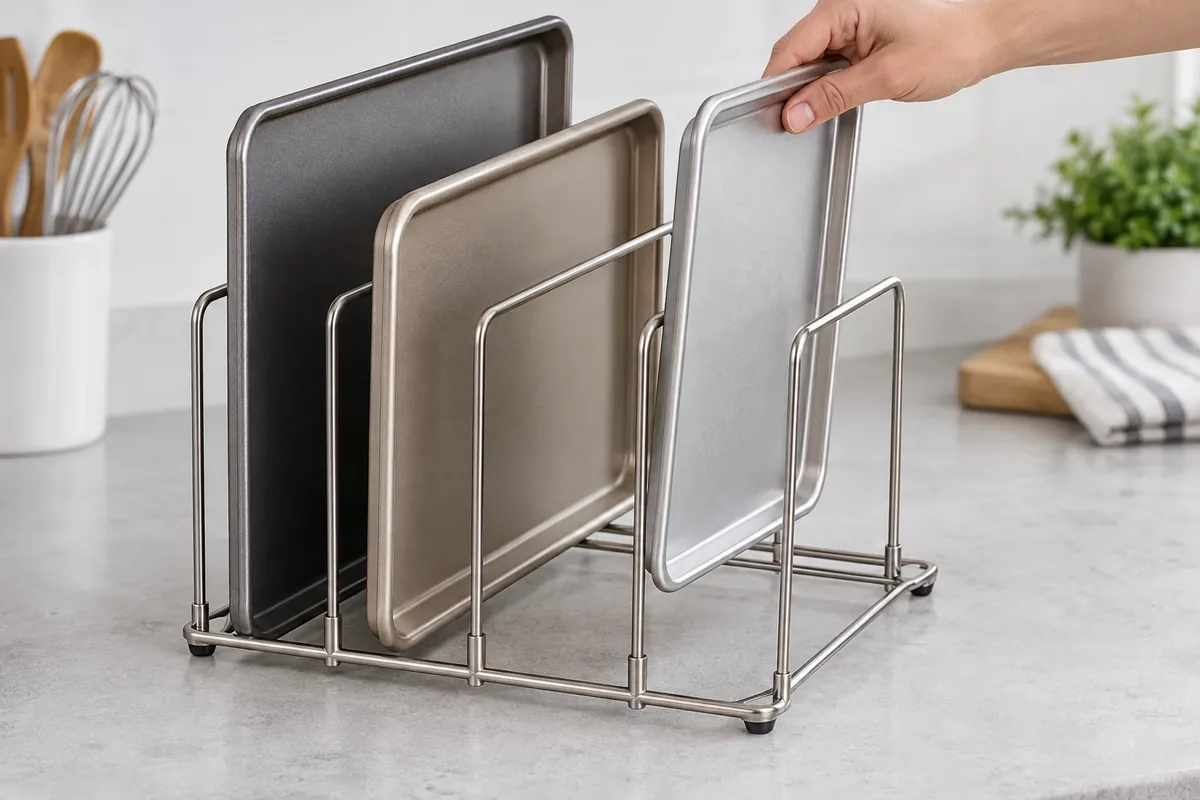
Why do divider arms loosen or let trays tip?
A divider is not merely a visual partition. It is a repeated support point that resists the sideways force created when a tray is inserted, removed, or nudged in a crowded cabinet. If its lower end sits loosely in a rail, an arm can lift or rotate during ordinary handling. If the base offers no repeatable position, sample-to-sample spacing may also drift. The buyer should therefore define both the intended adjustment and the way the divider remains seated during use.
Tray shapes vary more than a simple width measurement suggests. Rolled rims, projecting handles, deep sides, perforated surfaces, and nesting edges all change where a divider contacts the tray. A narrow pan may lean against one wire while a broad roasting pan pushes the neighboring divider. Record the outside envelope and contact zones for representative items, then review the organizer with the largest and smallest pieces together. A drawing based only on nominal pan width can miss the interference that matters during retrieval.
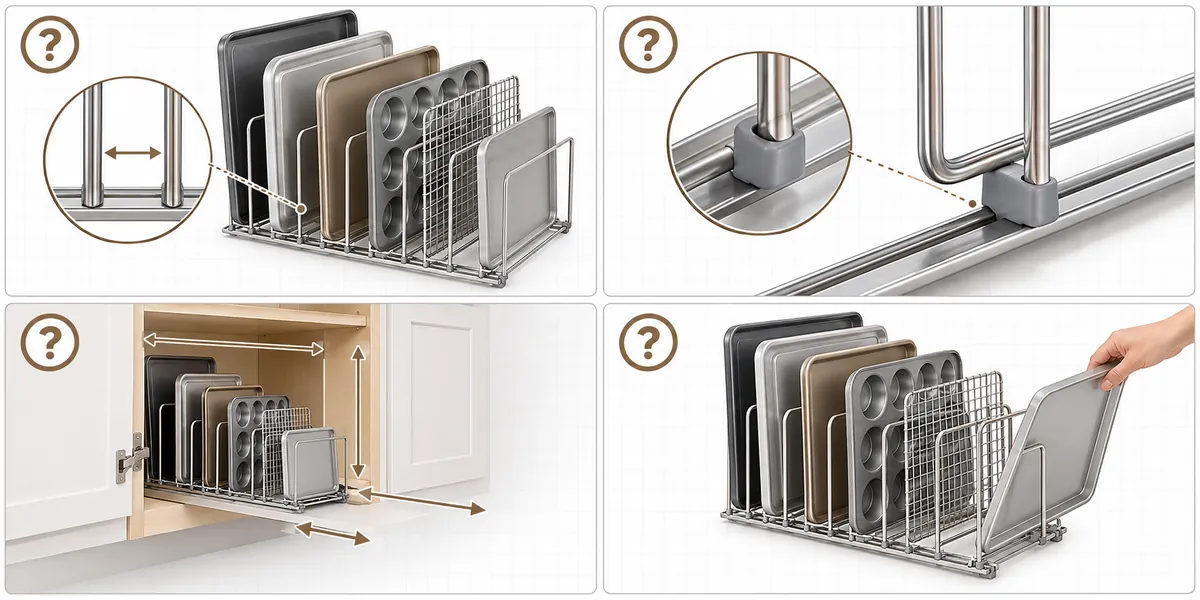
Cabinet access changes the force path. A user may pull an organizer forward, tilt a tray to clear the cabinet opening, or reach around a neighboring item. Each motion can load a divider differently from a static display. Where a sliding base is part of the design, travel and extension must be checked with the cabinet opening and handle clearance. Where it is freestanding, check whether the complete loaded footprint remains stable on the intended shelf. These are project conditions, not universal performance claims.
What should the drawing and RFQ define?
Start with a controlled plan view and side view that show the base perimeter, divider locations, usable organizer width, and any adjustment positions. Identify which dimensions are fixed and which may vary with the approved design. Buyers do not need to prescribe a manufacturing process without reason, but they should identify the functional interface: the divider foot, slot, clip, rail, or other retaining feature. If a concept changes during development, mark the revision and state which interface dimensions require reapproval.
Define the tray assortment as envelopes rather than isolated widths. For each representative sheet, note overall width, height, rim depth, handle projection if present, and any orientation required for storage. Include the cabinet opening, interior width, usable depth, shelf height, and the path by which the largest sheet is removed. A useful specification states whether the organizer must fit a fixed cabinet, a family of cabinet sizes, or only a retail package. These inputs let the manufacturer evaluate spacing without inventing an unsupported universal clearance.
The RFQ should also define finish expectations at contact points. A divider that slides through a coated slot may scrape the finish or change its feel. A retained foot may need enough clearance for assembly while still avoiding unintended lift-out. Ask the supplier to identify the proposed contact surfaces and to show how they are protected from sharp edges or exposed burrs. Do not assume that a particular wire gauge, coating, or retention force is suitable until a sample demonstrates the intended movement and appearance.
| Approach | Buyer benefit | Trade-off to validate |
|---|---|---|
| Fixed divider | Repeatable bay layout and fewer loose parts | Less assortment flexibility; confirm each tray envelope |
| Repositionable divider | Can accommodate a wider range of trays | Retention and repeatable approved positions need sample review |
| Removable divider | Simpler cleaning or packout options | Loose-part control, replacement identification and instructions |
| Sliding organizer base | Can improve cabinet reach in a designed system | Adds travel, cabinet and hardware interfaces; only include if specified |
Which retention approaches should buyers compare?
A fixed divider gives a repeatable position and can simplify assembly, but it may limit assortment flexibility. A repositionable divider supports varied pan widths, but its retention feature must resist accidental movement while remaining practical to adjust. A removable divider makes cleaning or repacking easier, although loose parts create a packing and replacement-control question. A buyer should compare these approaches against the intended assortment, expected cabinet use, package configuration, and service plan rather than select the most adjustable concept automatically.
The geometry at the base matters as much as the divider’s height. A short foot can reduce material and package volume but may concentrate contact at a small area. A longer foot or formed tab may improve engagement but require more clearance in the base. A clip can make repositioning intuitive but may introduce a separate component. These are design trade-offs to explore with a drawing and sample. The article is not specifying a single mechanism or asserting that Koitor currently produces a particular bakeware-divider SKU.
A useful design review asks what happens when one divider is moved and the adjacent bays become narrower or wider. Can the remaining trays still stand upright? Does a divider occupy space that the largest tray needs? Can the user remove a middle pan without lifting several other items? The answer depends on the actual product set. A marked-up assortment board or physical sample set can expose these interactions earlier than a generic empty-organizer photograph.
How should teams test a loaded sample?
Build a sample review around a representative tray set and the intended installation. Confirm that every divider is present, correctly oriented, and seated in the approved location. Load the largest and smallest trays in realistic neighboring positions. Remove and replace each tray through the expected path, including middle positions that are often harder to reach than the end bays. Observe whether a divider lifts, rotates, slides unexpectedly, or catches a tray rim. Record the exact setup and findings rather than calling the test a general load rating.
Repeat the sequence after moving a divider to another approved position. The goal is not to force a component beyond its intended use; it is to verify that normal repositioning remains clear and repeatable. Inspect contact edges and finished surfaces after the agreed handling sequence. If a movement is difficult, note whether the cause is slot geometry, coating buildup, component orientation, or an unclear user instruction. A change request should identify the affected drawing revision and the next sample needed for review.
Where a cabinet organizer includes a pull-out mechanism, evaluate the entire system, not only the divider. Fit it inside the stated cabinet envelope, open the door, extend the slide through its usable travel, and remove a tray at the furthest practical position. Check for contact with hinges, adjacent doors, shelf edges, or handles. If no slide is included, assess the organizer on the actual shelf surface. Documenting this distinction prevents an article or specification from implying that every bakeware rack is a sliding unit.
How do manufacturing control and repeat orders protect the design?
For a wire frame, repeatability depends on how the base geometry and divider-retention details are formed and assembled. A buyer can request a clear reference drawing, identification of critical interface dimensions, and a sample that reflects the intended production method. During review, compare the divider positions and base fit across more than one sample when the project stage allows. The purpose is to understand variation before release, not to claim a numerical process capability that has not been established for the specific order.
Finish and assembly can affect the same interface. A rail that accepts a divider before coating may feel different after finishing. A fixture or handling step can also shift an attachment point. Ask the supplier which features are checked after the final finish and which checks occur before it. Any agreed inspection should use a repeatable method and identify the reference sample or drawing revision. If the design changes, confirm whether the old sample remains valid or whether the updated interface requires a new approval.
Packaging is part of the retention decision. Dividers may be shipped installed, bundled separately, or placed in a compartment. Each option creates different risks of movement, abrasion, loss, or confusing final assembly. Review the packout with the retail assortment and assembly instructions in view. A replacement divider should be identifiable if after-sales support requires it. For broader metal-rack development context, buyers can review [custom kitchen storage rack manufacturing](https://koitorhardware.com/custom-kitchen-storage-rack-manufacturer/) and compare the project-specific process with the intended product.
The baking sheet organizer divider retention specification should also define the approved reference sample and the revision that controls the divider interface. A sample note can identify which bays were demonstrated, which trays were used, and whether any divider positions are optional. If a retail program later adds a wider roasting pan, do not assume the old layout still proves access. Recheck the changed assortment against the cabinet envelope and decide whether the divider locations, package insert or instructions need revision. This small change-control step helps purchasing, product development and incoming inspection discuss the same configuration. It also keeps supplier comparisons grounded in a shared setup: two offers should not be treated as equivalent when one assumes fixed partitions and the other assumes repositionable arms. Agree the configuration before comparing appearance, quote assumptions and final packout. Record the baking sheet organizer divider retention specification beside the approved tray set and cabinet setup so a later sample review uses the same envelope and decision criteria.
Use this list before approving the first sample: define tray envelopes and orientations; identify fixed versus adjustable divider positions; show the divider foot and base engagement in the drawing; specify cabinet opening and usable interior dimensions; confirm whether a slide is included; and record the expected loaded configuration. Add a clear method for testing removal from the middle bays, because end positions can appear acceptable even when central items are trapped by neighboring rims.
During the sample review, check that the divider stays in its intended position during normal loading and removal. Confirm that a moved divider can be reseated without tools if that is part of the design intent. Look for snag points, sharp edges, finish damage, or contact that makes insertion difficult. Verify that the complete unit fits through the intended cabinet opening and that the largest tray can be removed along the approved path. Record observed issues with photographs and a marked revision rather than relying on memory.
Before bulk release, align the approved sample, drawing, finish description, packaging layout, and assembly instructions. Decide who approves a design change and how the supplier will identify revised parts. Clarify what is inspected on incoming goods and what evidence accompanies a corrective action if dividers are missing or do not seat correctly. These controls keep a small design detail from becoming a repeat-order dispute. For a broader sourcing conversation, buyers may share a drawing or physical sample through Koitor’s [Hardware de armazenamento doméstico OEM](https://koitorhardware.com/oem-home-storage-hardware-manufacturer/) page.
Buyer approval checklist
- Tray assortment envelopes, rims and orientation are documented.
- Divider attachment and approved position range are shown on the drawing.
- Cabinet opening, interior depth and removal path are verified.
- Loaded sample review includes middle-bay retrieval and divider movement.
- Finish, packout, replacement parts and revision approval are controlled.
Frequently asked questions
Should buyers specify one universal slot pitch?
Not without validating the tray set. A useful pitch depends on rim shape, tray width, orientation and whether dividers move. Define representative envelopes and ask the supplier to demonstrate the approved assortment on a sample.
Is a tighter divider always more secure?
No. Tight engagement can make adjustment difficult or cause finish damage, while loose engagement can permit movement. The target is a project-approved balance between retention and intended repositioning.
Should baking sheets be stored vertically or horizontally?
The article concerns a vertical organizer concept, but the buyer should confirm orientation for the actual assortment and cabinet. If a different orientation is intended, the retention and access question changes.
Can a product photo approve the divider design?
A photo can show general appearance but rarely proves seating, adjustment, loaded retrieval, cabinet fit, or repeatability. Use a dimensioned drawing and a representative physical sample.
Does this guidance confirm Koitor makes bakeware organizers?
No. Bakeware organizers are an adjacent content topic. Koitor can discuss relevant metal-frame and sample-review questions, but current production capability for this exact product must be confirmed project by project.
Koitor is a family-owned custom metal hardware manufacturer focused on practical OEM communication. For adjacent product concepts, confirm exact process scope, specifications and sample expectations with the production team before making a sourcing decision.
Plan a buyer-ready product specification
Share your drawing, target assortment or physical sample so the project team can review the relevant geometry and questions.
OEM / MARCA PRÓPRIA
Transforme este guia de fornecimento num resumo do produto
Indique o produto pretendido, as dimensões, o acabamento, a quantidade a encomendar e os requisitos de embalagem. A sua equipa receberá uma análise prática da viabilidade de fabrico antes da apresentação do orçamento.


 English
  Español
  Português
  Français
  Deutsch
  العربية