
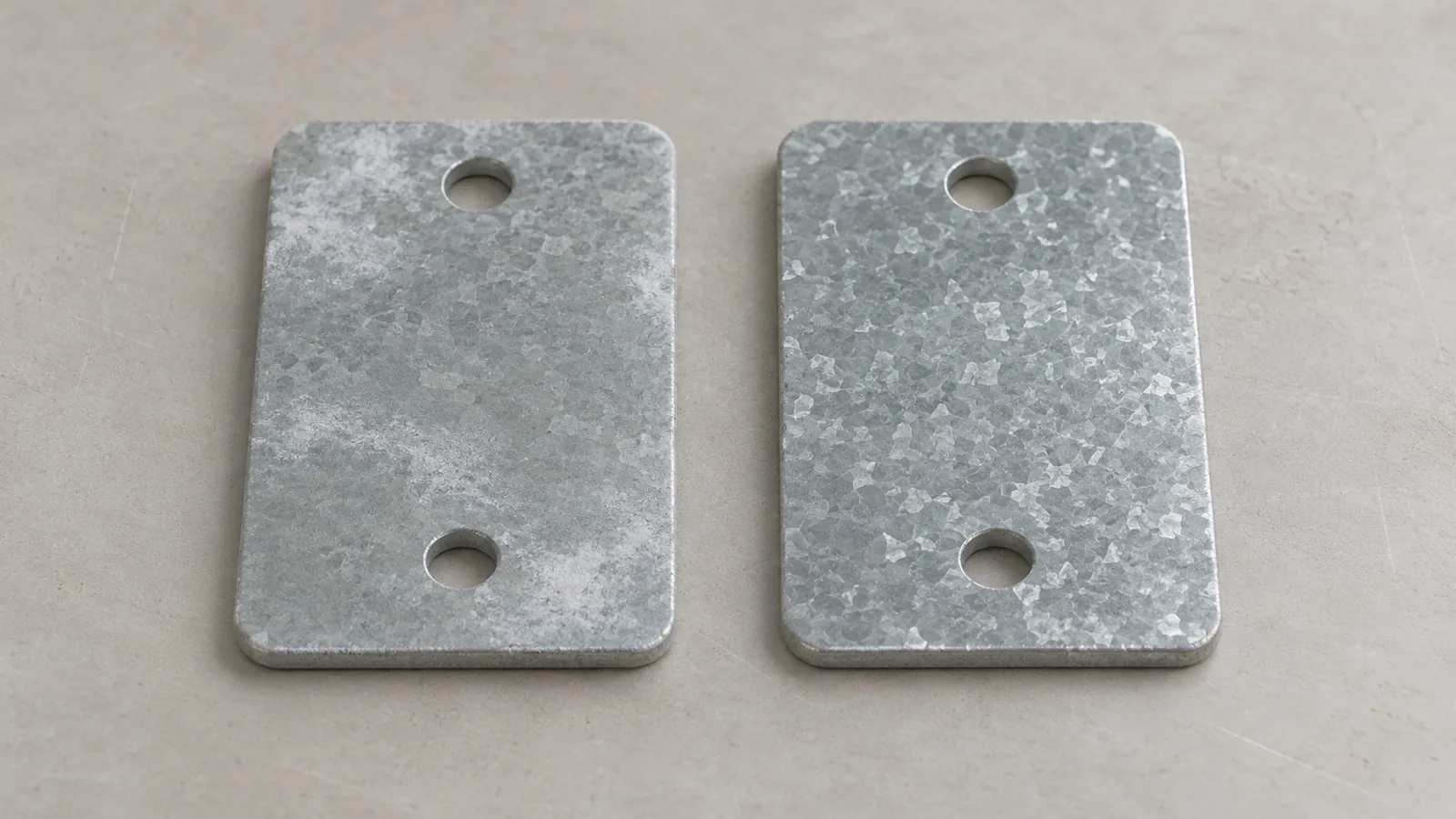
Does zinc rust? Zinc can corrode, even though it does not form the iron-based red rust associated with ordinary steel. In some atmospheric conditions, zinc corrosion products develop into a relatively adherent surface layer that slows later attack. Persistently damp conditions can produce a different, loose white corrosion product. The finish name, surface color and word “rust-resistant” therefore do not identify the complete material or prove that a particular part is acceptable. A buyer first needs to distinguish a zinc coating on steel from a zinc-alloy body, then evaluate the actual finish route, environment and observed condition.

Does Zinc Rust?
The short answer depends on what someone means by “rust.” In ordinary use, rust usually refers to corrosion products of iron or steel, often recognized by their reddish-brown appearance. Zinc is a different metal, so its corrosion is not iron rust. That distinction does not mean zinc is chemically inert. Zinc reacts with its environment and can lose material or develop visible corrosion products.
This matters when a product description says “zinc hardware,” “zinc finish,” or “rust resistant.” These phrases may refer to different things. A steel fastener may have a zinc coating. A bracket may be made from zinc alloy. A finished assembly may combine a coated steel part, stainless steel, adhesive, a polymer contact and a plated screw. One label cannot describe every exposed surface or the performance of the assembly.
The Canadian Conservation Institute describes zinc corrosion on historic zinc objects, including surface changes in indoor and outdoor settings. Its collection-conservation context is not a modern performance rating for plated hardware, die-cast alloys or bathroom products. The American Galvanizers Association explains atmospheric corrosion processes for hot-dip galvanized steel. That source is specific to its coating system and exposure context. Together, these sources help explain why zinc is corrodible and why some surface products may slow subsequent attack; they do not establish a universal service life for a bathroom fitting.
The word rust should not substitute for identifying the material. If a red-brown mark appears on a zinc-finished steel part, it may involve exposed or underlying iron-bearing steel, transferred contamination, another component or a different condition. Color alone cannot diagnose its source. Likewise, a pale or gray surface does not prove that a zinc layer is intact or that the product passed a required test.
For a buyer reviewing a sample, the first question is not “Is zinc rustproof?” It is: Which part is zinc, which part is steel, how was the surface produced, and what evidence describes this specific component? The answer belongs to the material and finish specification, not to a color-based assumption.
What Is the Difference Between Zinc Corrosion and Red Rust?
Corrosion is the broader process in which a material changes through interaction with its environment. Rust is commonly used for iron corrosion products. Zinc corrosion is still corrosion, but the products and appearance differ. A zinc coating can also be present on steel that may corrode if the coating is damaged, consumed or otherwise insufficient for the specified conditions. A buyer should keep the surface layer and substrate separate in both language and records.
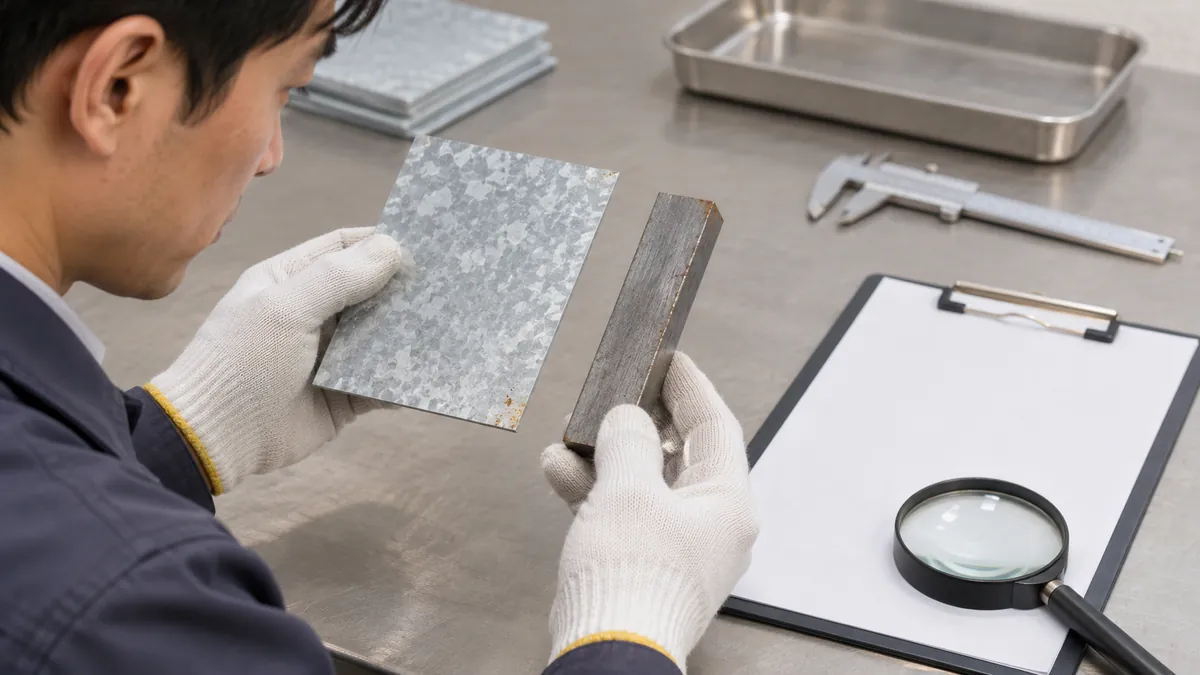
Consider three simple constructions. First, a zinc coating covers a steel fastener. The visible surface is zinc-bearing, while the substrate remains steel. Second, a zinc-alloy fitting has a bulk alloy body, perhaps with another decorative or protective finish. Third, a mixed assembly includes zinc-finished steel, stainless steel and an exposed edge. The same white mark on these three products does not necessarily mean the same thing, and the same red mark does not locate its origin without inspecting the construction.
The distinction also prevents a common wording error: “The zinc is rusting through.” That phrase may blur surface corrosion, coating loss and steel corrosion into one observation. A more useful report records the visible condition, its location, the product identity, the exposed substrate if known, the exposure history and the documentation available. The existing guide on white corrosion and red rust on zinc-plated hardware focuses on distinguishing report terminology and evidence. This article addresses the separate mechanism of zinc surface evolution.
Do not use a casual magnet test, a color chart or a household chemical as a definitive alloy or coating identification method. The research sources do not validate those methods for the product at hand. A finish declaration, controlled material record, supplier documentation or appropriate independent examination may be needed. The relevant method depends on the specification and decision being made.
How Can Zinc Corrode and Still Form a Protective Patina?
The apparent contradiction is that a metal can react with its surroundings while some resulting products slow further reaction. In atmospheric exposure, zinc can form oxide and hydroxide products and later carbonate-containing products as it encounters oxygen, moisture and carbon dioxide. Under suitable conditions, a compact, adherent surface layer can act as an additional barrier to subsequent attack.
That layer is not proof that corrosion has stopped. It is not a promise of indefinite protection, and it does not make every zinc-containing product suitable for every atmosphere. The American Galvanizers Association describes this process for galvanized steel in atmospheric exposure. Its explanation should not be transferred without evidence to every decorative zinc plating, zinc alloy, immersed fitting or mixed-metal assembly.
The condition of the environment matters. A surface that experiences intermittent atmospheric wetting and drying is not identical to a part held damp in packaging, a crevice or a wet interface. The conservation institute notes that persistently damp zinc can develop bulky, non-adherent white corrosion material. Such material should not be assumed to be the same as a stable, adherent patina. Nor should every dull gray surface be treated as approved corrosion protection.
An explanatory map is useful, provided it is not presented as a rate chart:
| Starting construction or condition | Possible observation described by the sources | What the observation does not prove |
|---|---|---|
| Zinc-bearing surface in suitable atmospheric exposure | Surface products may evolve into a relatively adherent layer that slows later attack | That reaction has stopped or that a fixed service life has been achieved |
| Zinc held persistently damp | Bulky, loose white corrosion products may form | That the deposit is harmless, stable or acceptable for the part |
| Zinc layer over steel | Zinc corrosion and steel-substrate condition are distinct questions | That red rust identifies where or how the steel became exposed |
The table is a bounded interpretation of the named sources, not an inspection standard. “May” is important: actual conditions, construction and exposure determine what can be concluded. The map also does not identify a finish by appearance or prescribe a cleaning response.
Is White Corrosion on Zinc Always Harmless?
No such universal conclusion follows from color alone. White material may be zinc corrosion product, but an observer needs the exact part, finish and exposure history to assess it. The conservation source distinguishes a relatively stable surface layer in certain outdoor conditions from loose products associated with persistent dampness. A coating supplier’s requirements and the product’s acceptance criteria still govern the specific hardware.
White deposits can also appear after products have been packed or stored while damp. The existing article on wet-storage staining on galvanized steel addresses that storage-related owner. It should be consulted for its separate scope rather than treating this article as a substitute diagnosis. A wet-storage mark, an atmospheric patina and a finish defect are not interchangeable just because each looks pale.
Avoid scrubbing an unknown zinc surface to restore shine before the condition has been documented. Aggressive cleaning can remove evidence, alter a finish or introduce another variable. The research pack does not provide a cleaning recipe, chemical compatibility list or restoration procedure. For routine care, follow the product maker’s finish-specific instructions. The separate galvanized metal cleaning guide owns care guidance; it does not make every zinc finish equivalent.
For a sample issue, photograph the area in context and at useful scale, record the lot or sample identifier and note whether the item was wet, sealed, exposed to salt or stored under known conditions. Preserve the part if a supplier or laboratory needs to examine it. These steps improve communication; they do not establish a chemical diagnosis or acceptance outcome.
How Should Importers Read a Zinc Finish Claim?
Start by asking the supplier to identify the actual construction. Is the part steel with a zinc coating, a zinc-alloy casting, or another substrate with a zinc-containing surface treatment? Request the specific finish route and the applicable drawing or purchase specification. A broad phrase such as “zinc plated” may not resolve what is controlled, how it is verified or whether it applies to all components in a product kit.
Then connect the finish to the intended environment. The relevant questions may include whether the component will be indoors, exposed to frequent moisture, cleaned with a defined product, stored before use or assembled against a different metal. These are project inputs, not reasons to promise a universal number of years. The cited atmospheric galvanized-steel source does not provide a lifetime guarantee for an unknown bathroom accessory or decorative plated fastener.
Ask which records accompany the specific item: material declaration, finish specification, supplier process information, inspection records or a test report required by the buyer. A report has a defined specimen, method, duration and acceptance scope. Do not assume that a test on one coating route proves all grades, edge conditions, welds or finished assemblies. The zinc-versus-nickel plating comparison covers the distinct finish-selection question; this article does not rank finishes for every environment.
If the assembly combines different metals, assess the complete interface and moisture conditions. Do not assume one zinc label resolves galvanic compatibility or eliminates the need to review adjacent materials. The galvanized versus zinc-plated hardware guide owns the separate route comparison. Product choice needs the actual substrate, finish, construction and intended use together.
The buyer can make the request concrete: “Please identify the substrate and zinc finish route for each component, state which drawing revision applies, and provide the agreed inspection or test evidence for the intended exposure.” That wording asks for traceable project information without asserting that a particular coating is sufficient.
What Does the Appearance of Zinc Prove?
Appearance is a clue that may prompt investigation, not a complete material analysis. A white area does not, by itself, distinguish stable atmospheric products from loose deposits, residue or another material. A shiny area does not prove that a coating has its specified thickness. A gray surface does not prove that it is a mature patina. A red mark does not establish the exact path by which steel became exposed.
Use a sequence that preserves uncertainty honestly:
- Identify the part and its construction from the drawing, bill of materials or supplier record.
- Record the visible observation and exact location without naming an unconfirmed chemical cause.
- Note the exposure and packaging history that can actually be established.
- Compare the observation with the applicable finish specification and acceptance criteria.
- Ask the responsible coating or component supplier which examination is needed if the evidence is insufficient.
This sequence is a communication aid, not a laboratory method. It avoids converting an image into a claim about material loss, coating integrity or product life. If the concern involves a customer return, preserve the item and associated records before cleaning or disassembly.
For buyers of metal bathroom and home-storage hardware, the same discipline helps during sample approval. A finish sample should be identified by material, route, color requirement and the stage at which it is inspected. If two suppliers provide components for one assembly, clarify who owns finish compatibility and what evidence closes the issue. The sample should represent the agreed specification, not merely look similar under one lighting condition.
How Should a Buyer Compare Samples and Records?
When a coating claim is important to a purchase, compare records against one named part rather than an assortment description. A hardware set may include several fasteners and brackets with different substrates or finish suppliers. Ask whether the declaration applies to every item, only the visible parts, or one selected component. The answer should identify the drawing revision and component name so that a supplier’s statement can be connected to the received lot.
Keep the inspection state with the sample. A loose component taken from a sealed package, a component after assembly and a part after a defined exposure are not necessarily comparable. If the product is inspected after storage, preserve the packaging and note whether moisture or condensation was observed. If the part has been installed or cleaned, record that history too. An unexplained mark may become much harder to investigate after it has been wiped away or exposed to a second environment.
An image should include an overview that identifies the component location and a closer view of the surface. Include neutral lighting and a scale reference only if it does not touch or alter the deposit. Do not annotate the image with a cause such as “coating failure” until that conclusion is supported. Instead, use descriptive language: “white deposit around the lower edge of component B” or “red-brown mark beside the exposed cut edge.” This keeps the observation separate from the diagnosis.
The supplier conversation can then ask a bounded question: Does the material and finish declaration match this component? Is the observed condition within the agreed specification? Is additional examination required? Those questions are more actionable than asking whether zinc is rustproof. They also make it clear when the issue belongs to the base-metal maker, coating supplier, assembler or buyer’s acceptance function.
What Zinc Corrosion Does Not Tell You
The presence of zinc does not reveal load capacity, corrosion-test performance, coating thickness, remaining metal, weld quality or suitability for a coastal or continuously wet installation. Those questions require their own specifications and evidence. The cited sources explain bounded corrosion mechanisms; they do not certify a particular part, manufacturer or assembly.
Nor does a protective surface layer mean that all underlying steel is protected in every location. Edges, cut surfaces, joints, scratches and dissimilar components may need specific treatment and assessment. The available source scope does not justify a numerical service-life calculation, universal corrosion rate or “never rust” statement. Such claims should be tied to the actual coating system, geometry, environment and accepted test evidence.
For the same reason, do not infer that every zinc corrosion product should be removed or that every patina should be retained. Cleaning and acceptance depend on product instructions, finish identity and buyer criteria. The correct next step may be documentation, supplier review or a specified test, not a generic home remedy.
How to Avoid Overstating the Meaning of a Corrosion Test
A test result is useful only when the tested construction and acceptance rule match the buyer’s question. A test on a zinc coating applied to a defined steel specimen cannot automatically establish the behavior of a different coating route, alloy body, edge geometry or assembled product. The report should identify the specimen, preparation, exposure method, duration and result interpretation. If the purchase specification calls for an acceptance threshold, that threshold must be stated by the responsible buyer or design authority rather than inferred from a result summary.
Do not compare two reports by elapsed hours alone when their methods or acceptance criteria differ. Do not treat a laboratory exposure as a direct calendar-life prediction unless the supplier has a validated relationship for the exact construction and environment. The sources in this research pack do not offer that conversion. Likewise, a passing result on a flat test panel does not prove that every edge, seam or fastener in a finished assembly has identical protection.
For product development, use the test to answer a narrow question. It may compare specified samples under a controlled condition or check a requirement in a purchase document. It cannot by itself identify an unknown white deposit, establish the cause of a field complaint or show that a product is suitable for an environment that was not represented. If the result is being used to approve a finish, preserve the report with the exact sample identification and specification revision.
This distinction keeps the discussion practical. Zinc chemistry explains why a surface can change and why some products may slow further attack. A test provides evidence only within its stated scope. A product decision joins both pieces of information to the actual part, exposure and agreed acceptance requirement; none should be substituted for the others.
Primary technical references: Canadian Conservation Institute zinc care note; American Galvanizers Association atmospheric corrosion explanation. Their scope and limits are described in the saved research pack; examples and guidance are not universal product specifications.
Keep the part identity with the observation. A zinc-coated steel fastener, a zinc-alloy casting and a multi-metal assembly can respond differently, so the same deposit description does not establish the same cause. Record the supplier, drawing revision, component and storage history before asking for a conclusion. If those records cannot identify the material or finish, state that limitation instead of filling it with a color-based guess.
Related Koitor guidance: zinc die-cast surface blisters and porosity.
Perguntas frequentes
Does zinc rust like steel?
Zinc can corrode, but it does not form iron-based rust. A zinc coating may sit on a steel substrate, so zinc-surface corrosion and corrosion of underlying steel are separate questions. Identify the construction before interpreting a mark.
What is white rust on zinc?
“White rust” is a common descriptive term for pale corrosion products on zinc-bearing surfaces. The term alone does not establish whether a deposit is stable, loose, acceptable or tied to persistent wet storage. Record the part and conditions and compare them with the applicable finish requirements.
Can zinc corrosion products protect the metal?
Under suitable atmospheric conditions, some adherent zinc surface products can slow subsequent attack. That conditional mechanism is not a guarantee that corrosion stops or that a given finish will last for a specific period.
Does a zinc finish make bathroom hardware rustproof?
No. A zinc finish is not proof that every part of an assembly is protected under every moisture, cleaning or storage condition. Ask for the actual substrate, finish route and evidence tied to the intended use.
Trabalhe com a Koitor Hardware
Review Your Product Requirements with Koitor
Share the relevant drawing or sample, intended use, material or finish requirements, and target quantity. Koitor can review the manufacturing scope for custom bathroom and home-storage hardware based on the information provided.
OEM / MARCA PRÓPRIA
Transforme este guia de fornecimento num resumo do produto
Indique o produto pretendido, as dimensões, o acabamento, a quantidade a encomendar e os requisitos de embalagem. A sua equipa receberá uma análise prática da viabilidade de fabrico antes da apresentação do orçamento.


 English
 Español
 Português
 Français
 Deutsch
 العربية