
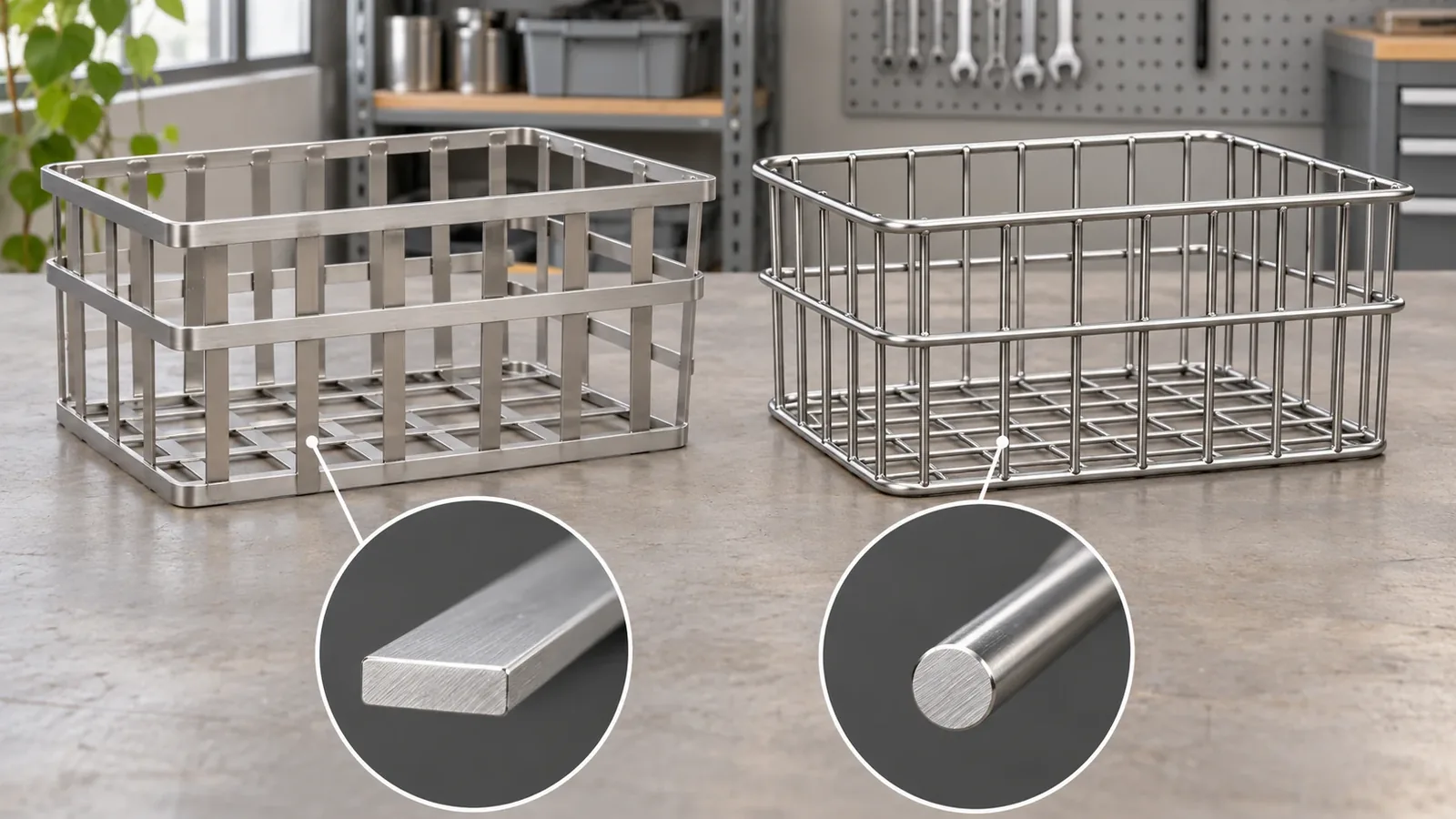
When comparing flat wire vs round wire baskets, buyers should specify the wire section and its orientation separately from the basket’s rim, edge and bottom-support design. A flat or shaped section can change the appearance, contact face and available dimensional references, but the section name alone does not establish a basket’s capacity or quality. Round wire is commonly described by diameter; shaped wire needs its relevant width, thickness, edge condition and orientation defined. The approved sample should show how each section is used in the finished basket, not only what raw stock the supplier calls it.
What does “flat wire” mean in a basket specification?
“Flat wire” can refer to a wire product with a non-round cross-section, while a basket can also contain strip, sheet, formed wire or several profiles in one assembly. These terms are not automatically interchangeable. A buyer should identify the supplied stock form and the finished part separately. If the supplier uses “flat wire,” ask for a drawing or section sketch that shows how the material is made, which dimensions are controlled, and which surfaces become visible after forming and assembly.
A wire processor such as Gibbs describes flat wire as material that can be produced from round feedstock by rolling or from other routes such as die drawing, and it distinguishes edge options and product requirements. That is a supplier’s explanation of its product range, not a universal process or evidence of Koitor’s equipment. See Gibbs flat wire for terminology context. The buyer should confirm the actual material route and condition with the supplier named on the quote.
The cross-section description also needs dimensional references. Round wire is often ordered by nominal diameter, while a shaped section may need width, thickness, corner or edge definition, and an orientation relative to the basket. For woven wire mesh, an architectural manufacturer separately discusses shaped-wire dimensions and open-area appearance; that is useful evidence that profile and spacing affect visual geometry, but it does not prove performance in a welded storage basket. Do not borrow woven-mesh specifications as basket acceptance criteria.
The buyer’s first task is therefore to map the parts. Which basket members use round wire? Which use flat wire or strip? Which parts form the top rim, perimeter, base, divider or mounting interface? Are the sections exposed, hidden, welded, folded or coated? A single product label can hide these differences. An itemized part drawing makes the quotation more precise and gives the sample inspector a clear reference.
How do the section shapes change what buyers should review?
A round section presents a curved profile around its circumference. A shaped or flat section presents different widths and faces, and its orientation can matter where a face contacts another part or remains visible. This geometry may change the way a product looks, how a joint is positioned, how the edge is felt, or how a coating appears on corners. These are design and process considerations; they do not establish that flat wire is automatically stronger, more stable, cheaper or more durable than round wire.
Orientation should be stated when the section is not symmetric. A supplier may need to know whether a broad face points outward, upward, toward an adjacent basket part or toward a fixture. A rotated section can change the visible line and contact geometry without changing the material designation. If the drawing uses a simple rectangular symbol, add a section detail or a note showing the intended orientation at critical locations.
Buyers should avoid collapsing the profile into a single “wire size.” A rectangular section has more than one principal dimension, and edge options may differ. In a finished part, bending and coating can also affect how the profile sits relative to adjoining components. State which dimension is measured across the broad face and which is the thickness, then identify the datum or location where inspection is expected. If the part is supplied as a custom profile, the processor’s drawing and tolerance record should be reviewed before production release.
| Specification feature | Round-wire member | Flat or shaped member | Buyer decision |
|---|---|---|---|
| Section reference | Nominal diameter and agreed condition | Width, thickness, edge and orientation | Identify the exact profile on the part drawing |
| Visible geometry | Curved line and contact region | Defined face, edge and orientation | Approve the appearance on a finished sample |
| Joint location | Position relative to the round section | Position relative to a selected face or edge | Mark weld/contact location and visible side |
| Dimensional check | Diameter at stated point and condition | Width/thickness at stated point and orientation | Agree method and coating state for inspection |
| Basket function | Depends on member layout and complete structure | Depends on member layout and complete structure | Do not infer capacity from section name |
The flat wire vs round wire baskets decision should start with the intended member, orientation and finished basket interface. A flat wire vs round wire baskets comparison should not be reduced to one dimension or a presumed strength ranking. Section shape is only one design variable. The basket’s overall dimensions, rim, base pattern, number and location of supports, attachment points, finish and installation all affect the finished product. A flat section may be selected for a visual line or a designed interface; a round section may suit another member or joint. The correct selection depends on the actual product brief and evidence, not on a universal hierarchy.

How should a buyer separate section from edge and bottom support?
The basket perimeter, top edge and bottom support answer different design questions from the cross-section of an individual member. A flat-wire side wall does not tell the buyer whether the top rim is rolled, formed, welded or reinforced. A round-wire basket does not tell the buyer how its base is supported. Buyers should review the complete architecture: wall members, rim, bottom grid, reinforcement, joints, mounting features and handles as applicable.
For example, a basket may use shaped members along a side while using round wire around the rim or across the base. Another design may use a separate perimeter frame and a different support spacing. Those constructions should be described on the drawing rather than generalized from one visible profile. If the basket is installed on slides, rails or cabinet supports, treat that interface as its own dimension set and record any spacer or finish allowance separately.
The bottom pattern matters because it is where stored items contact the basket and where the basket transfers their weight into its structure. But the appearance of a close grid or thicker-looking member does not provide a verified load capacity. The maker must define the product’s intended use and relevant evaluation basis. A buyer can compare samples using the actual intended items and assembly, but a casual demonstration should not be presented as a rated test.
Likewise, edge comfort and product handling should be checked on the finished sample. If a shaped edge remains accessible, the buyer can identify its location, edge condition and expected finish. If an edge is folded, covered or hidden by another component, document that relationship. Do not assume every edge is formed the same way or that a broad section automatically eliminates sharpness. The approved drawing should identify safety-sensitive or cosmetic areas for review.
The material and finish specification should name the substrate, coating or surface treatment at the part level where differences matter. A shaped profile can present a broad face and narrow edges; a round member presents a different surface geometry. That may matter to visual coverage and sample inspection, but the actual result depends on the material, preparation, process and finish. Ask the manufacturer what surfaces are intended to be coated and inspect the production-representative sample under agreed lighting and viewing conditions.
Make contact and orientation visible on the drawing
A useful detail view includes the section, orientation, joint or contact surface, finished edge and adjacent member. If the section changes along the basket, provide a separate detail for each configuration. Call out which face is cosmetic, which face contacts a support, and whether orientation must remain consistent across left and right sides. These notes help the supplier create a fixture or assembly method that respects the intended geometry.
The drawing should also state whether dimensions refer to raw stock or finished/coated parts. Measurement across a coating can differ from measurement before finishing, and a part may deform during forming or assembly. Define the acceptance point and the condition in which the measurement is made. For a critical interface, include the fit requirement in the assembled product and identify the mating part revision.
The Koitor article on wire diameter and basket design already addresses round-wire diameter and its product implications. Use it for that specific diameter question; this article’s added decision is profile selection and orientation across the complete basket. For measurement questions, refer to the wire measurement guide, which covers measurement ambiguity rather than selecting a basket architecture.
How can buyers compare supplier quotes and samples fairly?
Make each supplier quote against the same basket drawing and part list. State the required section, material, finish, orientation, overall dimensions, bottom pattern, rim, mounting interface and packaging scope. If the supplier proposes an alternative profile, require a marked-up drawing and an explanation of what changes in appearance, assembly or interfaces. Do not accept a substitute only because its outside dimensions are similar.
A buyer can use a side-by-side comparison sheet:
| Quote item | Supplier A | Supplier B | What must match |
|---|---|---|---|
| Side and base sections | Named profile and dimensions | Named profile and dimensions | Exact section and orientation |
| Material | Part-specific description | Part-specific description | Grade/condition required by the brief |
| Rim and edge | Construction and exposed edges | Construction and exposed edges | Defined appearance and contact locations |
| Joints | Marked positions and visible faces | Marked positions and visible faces | Approved drawing and sample |
| Concluir | Type, color reference and surfaces | Type, color reference and surfaces | Same approved finish expectation |
| Interface de montagem | Width, height and support details | Width, height and support details | Mating cabinet/runner requirements |
| Embalagem | Separation, protection and carton scope | Separation, protection and carton scope | Comparable delivery condition |
The sample review should start with identity. Record the supplier, drawing revision, material description, finish, sample date and any deviations. Verify the cross-section at representative locations using the agreed measurement method, and note whether the part is measured before or after finishing. Inspect orientation and joint placement against the drawing, then review the assembled basket’s dimensions and mounting contact points.
If the buyer wants to assess how the basket handles actual goods, define the use condition and who approves the evaluation. A plate basket and a pull-out pantry basket may carry different contents and interact with different supports. A short handling check can reveal interference or an obvious mismatch, but it is not proof of long-term strength, fatigue, corrosion resistance or a certified capacity. Where those properties are essential, request product-specific evidence from the manufacturer and agree a suitable test before purchase.
Sample comparisons should not hide packaging. A shaped section may have exposed faces that can rub against adjacent pieces; nested baskets can also move in a carton. Request packaging details and review a packed sample. Identify any protective sleeves, dividers, ties or surface separators by part. A finish that looks acceptable before packing may be scratched in transport if parts contact one another. Do not claim that a packaging method prevents all transit damage; define the agreed protection and inspect a representative shipment configuration.
When the supplier quote includes a proposed substitution, use a formal change record. Identify the old and new section, relevant dimensions, visual impact, joint change, finish implication, mounting interface and approval owner. Recheck the assembly sample with the new profile. Retain the first-approved design as the reference; otherwise, a series of “equivalent” changes can gradually alter the basket while the item code remains unchanged.
\1
Treating flat wire as a finished-product rating. The term describes a stock form or section, not the capacity or quality of a basket. Ask for the complete product construction and relevant evidence.
Using width without orientation. A shaped member may be rotated, changing visible and contact faces. Add a section sketch and orientation mark to the drawing.
Calling strip, sheet and flat wire interchangeable. Suppliers may use these words for different stock forms and edge conditions. Use the supplier’s technical drawing and named material reference rather than relying on a casual label.
Comparing a round-wire diameter with only one flat-section dimension. These are not equivalent dimensional descriptions. Record all relevant dimensions and measurement conditions.
Assuming a shaped section has a better edge or finish. Edge condition and coating result depend on the actual product geometry and process. Inspect the finished sample and define exposed areas.
Ignoring the rim and bottom. The visible side-wall profile does not define the basket’s support architecture. Review the perimeter, base and mounting interfaces separately.
Inferring capacity from a heavier appearance. Visual mass and section labels do not establish a verified performance rating. Use product-specific requirements and evidence.
Accepting a supplier’s alternative without assembly review. A profile can affect contact, weld positioning, clearances and packaging. Approve a revised drawing and representative sample before production.
\1
Koitor Hardware is a family-owned custom metal hardware factory focused on bathroom and home storage hardware. Its approved knowledge includes metal baskets, bending, welding, finishing and drawing or sample review. The research for this article does not establish that Koitor manufactures raw flat wire, operates a wire rolling line or offers a particular flat-wire basket SKU. Buyers should describe the finished metal components and request project-specific feasibility review rather than infer an existing product or equipment capability from the section comparison.
A useful request includes a basket drawing, a section sketch, material preference, finish, intended contents, mounting interface, packaging needs and target quantity. If a flat profile is proposed, identify the important face and edge. If the basket has round and shaped members, map each profile to its part. Include the approved sample or photos if the design is a revision of an existing product. These details allow a manufacturer to discuss bending, welding, finishing and assembly within its actual scope.
Small-batch customization can help a buyer evaluate a new design or private-label variation. MOQ can start from 100 pieces depending on the product, and sample development usually takes five to seven working days after project details are confirmed. Bulk production usually takes four to six weeks depending on order quantity, finish, packaging and product complexity. These are planning references, not guaranteed terms. A quotation should confirm minimum quantity and timing for the exact profile, finish and pack.
Where the buyer needs wire processed by a specialist, that supply chain should be named. A metal hardware factory may work from supplied or purchased material, but the source, section tolerance, edge condition and condition of the stock must be confirmed. Do not assume a basket fabricator also produces the raw wire. The buyer should define who owns material certification or traceability when those records are required and confirm what documentation is included in the order.
For a trial project, separate the product questions into decisions: profile and orientation, basket architecture, finish, mounting, sample acceptance and packaging. A sample can resolve how the chosen section looks and fits, while other product properties need their own evidence. If the design is later changed, the drawing and part list should be revised together so that the approved section remains identifiable in repeat orders.
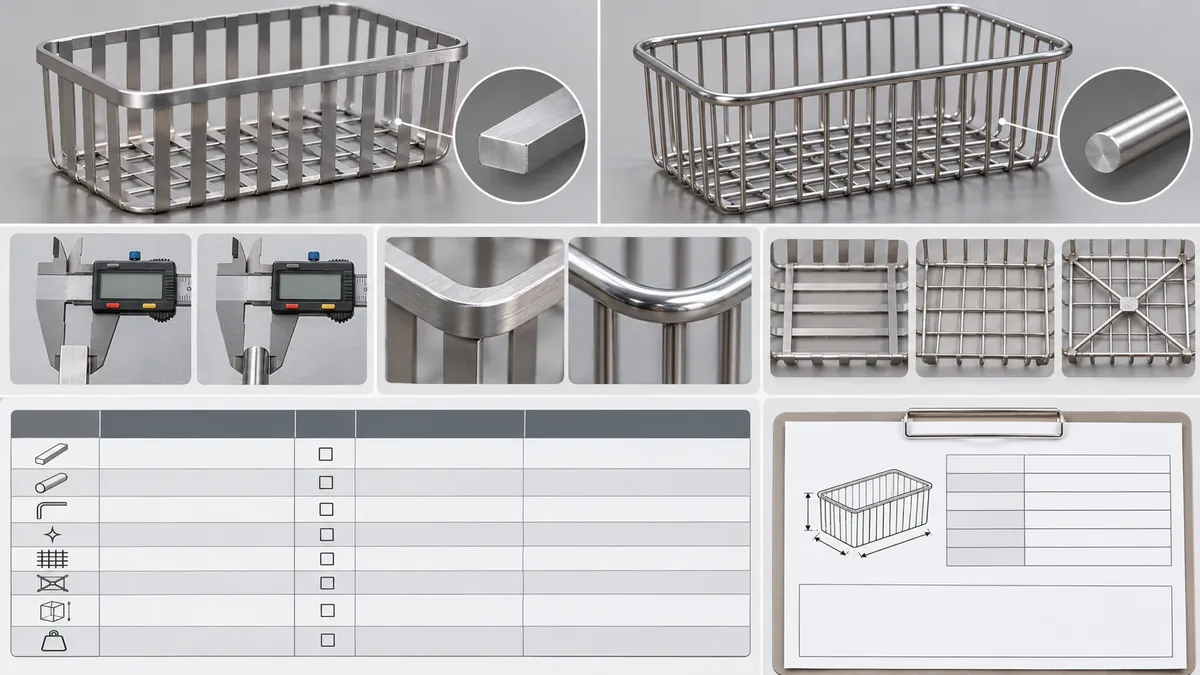
Buyer checklist before requesting a quotation
- Finished basket drawing, overall dimensions and mounting interface.
- Part-by-part section type: round, shaped wire, strip, sheet or another defined stock form.
- Width, thickness, diameter, edge condition and orientation where relevant.
- Rim, perimeter, base, divider and reinforcement architecture.
- Joint location, visible face and approved appearance.
- Material description, finish, color reference and inspection condition.
- Intended contents and the relevant product-specific performance evidence required.
- Cabinet, runner or support dimensions and mating-part revision.
- Sample quantity, target order quantity and target market.
- Packaging separation, scratch protection, carton and retail label requirements.
- Supplier responsibility for raw stock, formed parts and documentation.
- Revision control and approval owner for any proposed substitute.
Record the measurement state, not only the nominal profile
A profile may be measured as supplied stock or on a formed, welded and coated basket. Those states are not necessarily interchangeable. If a buyer needs to verify section dimensions, agree whether measurement occurs before or after finishing and choose a location that represents the relevant part. The measurement technique should suit the section and the supplier’s agreed tolerance. Do not assume that a caliper reading on a coated corner tells the same story as the raw-stock measurement from a processor.
When the basket includes different profile types, label each member on the drawing or BOM. A top rail may be round while a side member is shaped; a bottom grid may use another section. The buyer can then tie the sample inspection and quotation to named part marks rather than use one general term for the complete item. This detail also prevents a profile substitution from being missed when a supplier updates the process or finds a different raw-stock source.
For assortment buyers, the difference can affect product photography and customer descriptions. If an image emphasizes a broad, flat face, the purchased part should reproduce that orientation in the approved sample. If the profile is hidden after installation, the procurement reason may instead be joint geometry or manufacturing sequence. Write down the reason so that purchasing can evaluate an alternative on relevant criteria instead of assuming that any visually similar section is acceptable.
Perguntas frequentes
Is flat wire always stronger than round wire in a basket?
No general ranking follows from those labels. Finished behavior depends on the material, section dimensions, orientation, span, joint, basket geometry and support arrangement. Specify the product and review relevant manufacturer evidence rather than assuming one profile always provides greater strength.
Is flat wire the same as metal strip?
Not necessarily. Suppliers may distinguish flat wire, strip and sheet by stock form, edge condition and manufacturing route. Use the supplier’s drawing and agreed material description to identify what is being quoted.
Does a flat-wire basket need a special drawing detail?
If its orientation, edge, contact face or visible appearance affects the product, yes. A section sketch can show width, thickness, intended orientation and which face is exposed or joined. It also helps inspection use the correct measurement direction.
Can the section name tell me the basket’s load capacity?
No. A section name alone does not establish a verified rating. Capacity depends on the full design, material, joints, supports and use condition. Ask the responsible manufacturer for product-specific evidence where a rating is needed.
Can a supplier replace a flat profile with round wire without changing the product?
Not without review. The substitution can change appearance, contact, joining, fit and packaging. Request a marked drawing, review a representative assembly and document approval before production.
What should buyers send for a custom basket review?
Send a drawing or sample, the section and orientation concept, material and finish, intended contents, mounting interface, quantity and packaging brief. Identify whether raw stock comes from the buyer, a specialist processor or the fabrication supplier.
Trabalhe com a Koitor Hardware
Review a Custom Metal Basket Drawing
Share the basket drawing, section orientation, material, finish, intended contents and mounting interface. Koitor can discuss a defined metal storage project within its manufacturing scope; raw-stock supply and product-specific performance evidence should be confirmed with the responsible suppliers.
OEM / MARCA PRÓPRIA
Transforme este guia de fornecimento num resumo do produto
Indique o produto pretendido, as dimensões, o acabamento, a quantidade a encomendar e os requisitos de embalagem. A sua equipa receberá uma análise prática da viabilidade de fabrico antes da apresentação do orçamento.


 English
 Español
 Português
 Français
 Deutsch
 العربية