
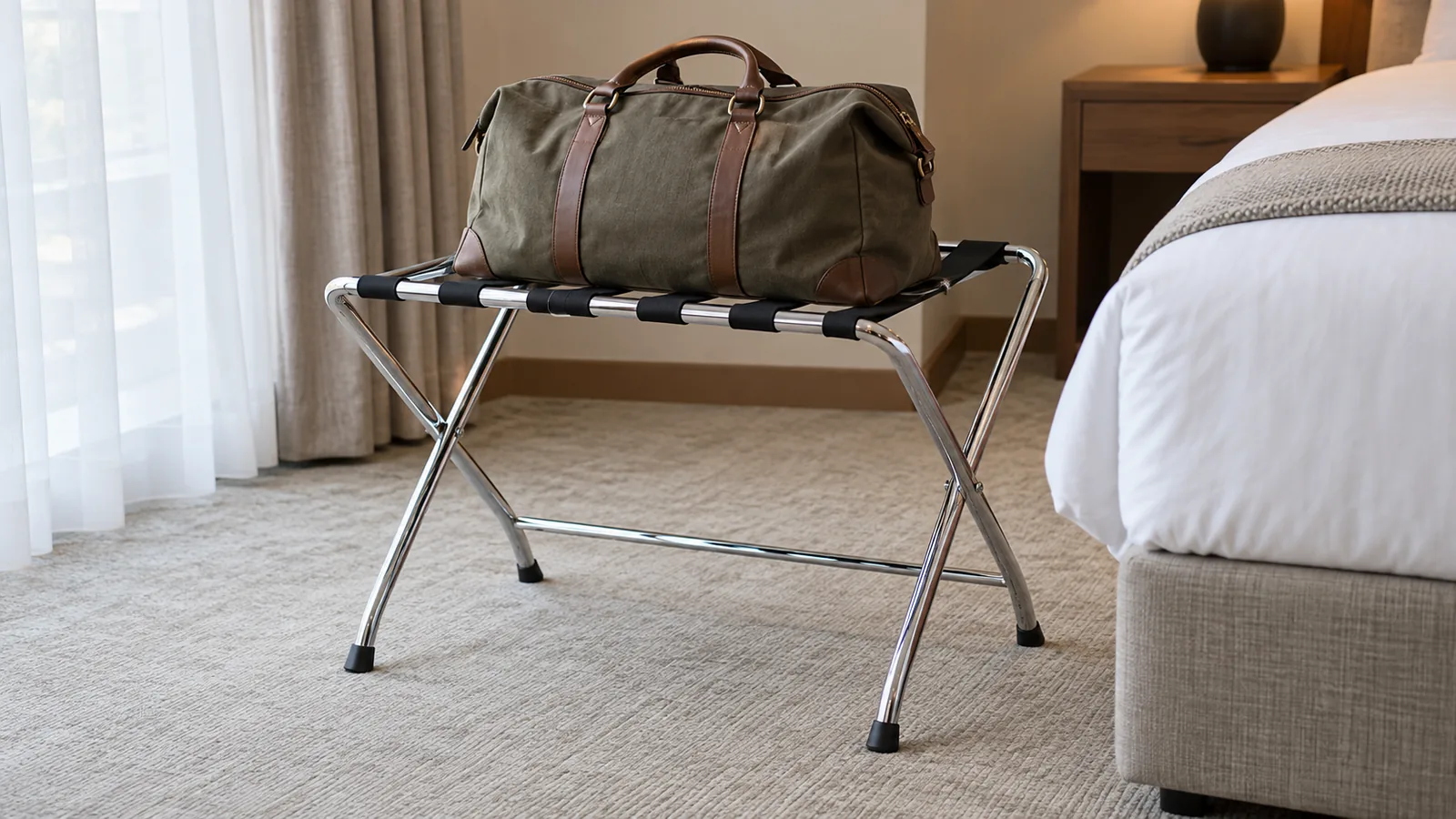
Hospitality product specification | Folding metal luggage stands
Short answer: Specify hotel luggage rack strap spacing by defining the usable support footprint, individual strap width, clear gap between straps and the bag types the rack must accommodate. Then test the proposed layout with representative soft bags and rigid suitcase bases. Overall frame width or strap count alone cannot show whether the intended bag will sit securely.
For importers and hospitality product teams, a luggage rack is more than a folding frame. The top support arrangement determines how a bag’s base contacts the rack. A small soft tote may sag into a wide opening, while a rigid suitcase can bridge across several straps. These are different fit questions, so a supplier sample should be reviewed against the intended assortment instead of approved from a photograph or overall dimensions only.
This guide concerns stationary folding metal luggage stands for guest rooms. It does not prescribe a universal strap count, gap, load rating or textile specification. A reviewed traveler discussion describes a tote falling between luggage-stand straps, which is a useful example of a possible fit problem, not evidence that all racks or bags behave the same way. Hospitality supplier listings also show different strap counts and configurations, reinforcing that the layout is a design choice rather than a single industry-wide number.
What should hotel luggage rack strap spacing describe?
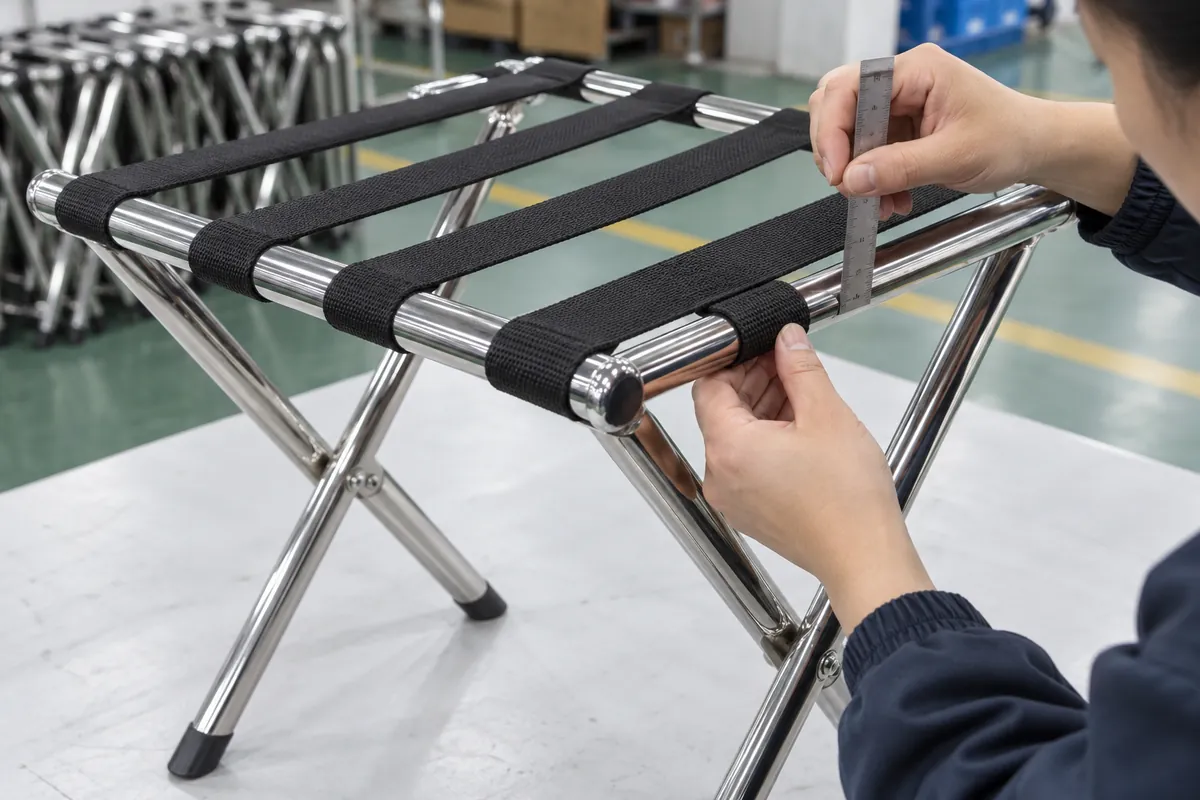
The phrase should refer to the support geometry that the bag actually contacts—not just the distance between the outer frame rails. A drawing should identify each strap’s usable width, the clear opening between adjacent straps, the support span across the rack and the intended orientation of a bag. These details let the buyer and supplier discuss the same physical layout.
Record the dimensions in a controlled view of the product drawing. If straps run across two side rails, show their attachment positions and the free span between attachment points. Note whether the listed width is the full textile width or the usable flat bearing surface after wrapping and fastening. A strap that looks wide in a catalog image may present a narrower surface once installed or tensioned.
| Drawing or sample item | What the buyer should record | Por que é importante |
|---|---|---|
| Overall opened footprint | Outside width, depth and height | Confirms room placement but does not define the support pattern |
| Strap width | Actual usable bearing width of each strap | Affects contact with soft and rigid bag bases |
| Clear gap | Open distance between adjacent support surfaces | Helps identify where a small or flexible base could dip |
| Support span | Distance between the outer bearing points | Shows the area available to bridge a bag base |
| Attachment layout | Strap ends, fastening method and rail interface | Makes the approved construction visible in the drawing |
| Folded envelope | Dimensions and any projecting parts when folded | Supports storage and packaging review |
Avoid writing only “four straps” or “wide support.” A count does not state where the straps sit, how broad they are or what clear openings remain. Likewise, the overall rack width can stay unchanged while the usable bearing footprint changes. The engineering drawing and sample should express both.
For clear supplier communication, label the measured layout as luggage rack strap spacing on the drawing and identify the measurement points. That gives purchasing, product development and quality teams one shared term to use during quotation review and sample approval.
Why do soft bags and rigid suitcases need different fit checks?
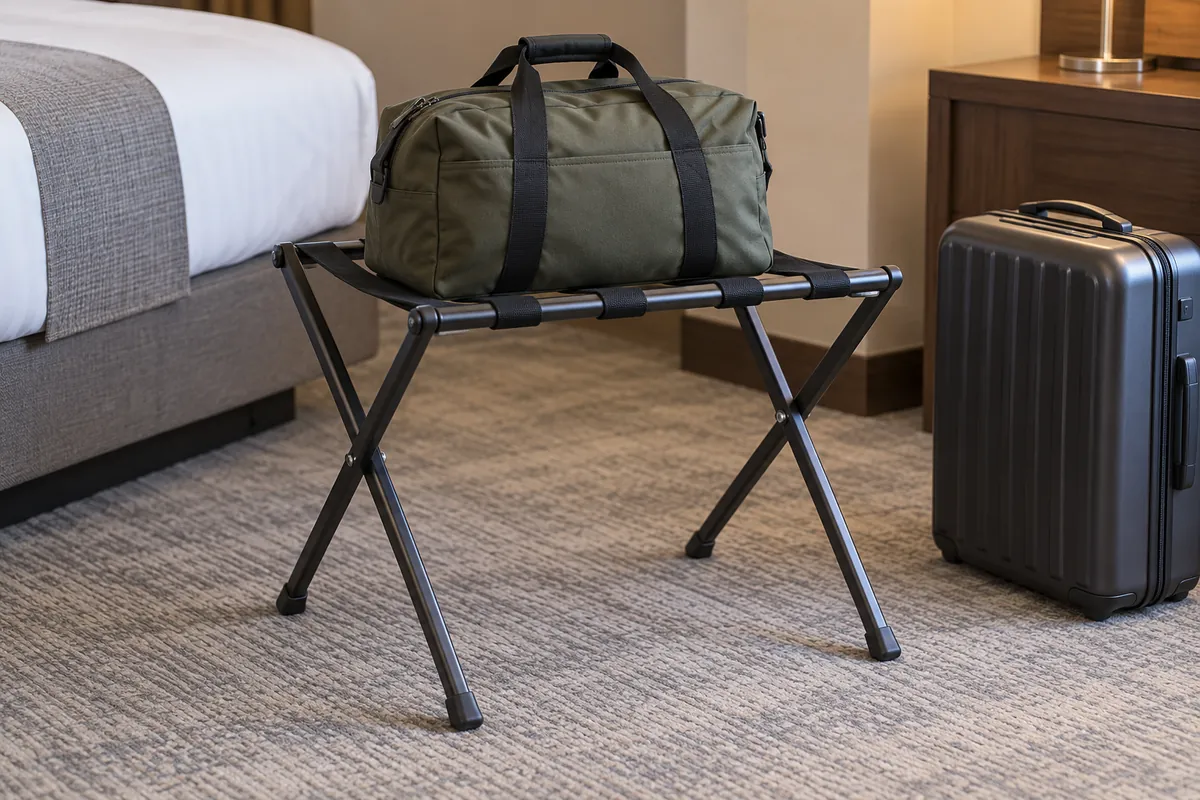
A soft bag’s base can flex between support points, while a rigid suitcase shell may bridge a gap but rest unevenly if its feet, wheels or molded edges contact the straps differently. Neither outcome can be predicted from strap count alone. Buyers should assess the actual base shape and the way the item is placed and removed.
For soft bags, check the base panel and how its contents may change its shape. Observe whether the bag sags noticeably into a clear opening, leans, twists or shifts when it is set down and lifted. Do not assume that a light-looking empty tote represents a loaded travel bag; use a representative item or a sample with an agreed, documented test condition.
For hard-shell suitcases, look at the base width, corner radii, wheels or feet, and molded ridges. A rigid case can span straps, but a narrow contact line or raised feature may concentrate contact differently from a flat sample board. Confirm the intended orientation and whether guests are expected to place the case flat on its broad face. Do not imply that every suitcase will fit every rack.
| Bag family | Sample-fit observation | Questions to record |
|---|---|---|
| Small soft tote | Base flex, sag between supports, sideways shift | Is the base supported at the expected contact points? Does handling change its position? |
| Soft weekender | Longer flexible base and variable contents | Does the loaded shape remain stable while set down and removed? |
| Rigid carry-on | Shell width, corners, feet or wheels | Does the base bridge the support layout without rocking on a protrusion? |
| Larger suitcase | Wider footprint and different center of mass | Is the approved placement consistent with the rack’s intended use and verified capacity? |
These checks describe fit observation, not a capacity test. A commercial load limit must come from an agreed product specification and suitable verification. The buyer should not infer a rated capacity from one bag remaining in place during a brief sample review.
How should a buyer compare strap layouts?
Compare layouts using the same bag set, placement, observations and drawing revision. A strap-count comparison without those controls can be misleading: a design with fewer wider straps may leave different openings than a design with more narrow straps, and the frame footprint may also differ.
Create a simple sample matrix before approval. Include one small flexible bag, one representative soft weekender and one rigid suitcase base if those types fall within the product’s intended assortment. Record whether each item rests as intended, whether it shifts during normal placement and removal, and whether contact occurs at the designed support surfaces. Note any limitations rather than turning the observations into an unsupported universal claim.
| Comparison point | Layout A | Layout B | Buyer decision |
|---|---|---|---|
| Bag types checked | List the same sample items | List the same sample items | Keep the test set constant |
| Usable strap width | Record measured dimension | Record measured dimension | Compare bearing surfaces, not catalog wording |
| Largest clear opening | Record on drawing and sample | Record on drawing and sample | Assess against the actual flexible base |
| Rigid-base contact | Note feet, corners and bridge points | Note feet, corners and bridge points | Check for rocking or unintended contact |
| Sample behavior | Record sag, shift and placement notes | Record sag, shift and placement notes | Approve against written project criteria |
| Revision identity | Drawing and sample code | Drawing and sample code | Link approval to one controlled revision |
The useful output is not necessarily a winner based on strap count. It is a record of which layout meets the buyer’s assortment and room-use requirements, with any accepted limitations stated. If an assortment changes later, revisit the fit matrix rather than assuming the previous approval covers a new base shape.
What frame and strap details should be reviewed at the interface?
The strap-to-frame attachment is part of the support layout. The buyer should check that the drawing and sample show how each strap is retained, how the strap lies across the rails and whether attachment details create uneven bearing surfaces or snag points. This is a design review, not a substitute for qualified structural testing.
Record the attachment position and construction on the controlled drawing. Check that both ends of the strap are located consistently and that the finished strap is not twisted or unevenly tensioned. Review visible edges and contact areas for finish or assembly conditions that could damage the strap or luggage. The acceptance criteria should be agreed with the supplier for the particular construction; do not invent a universal stitch, fastener or webbing requirement without a product specification.
The metal frame also affects how support is delivered. Confirm that the open frame sits as intended on a level floor, that the folding joints operate through the agreed range, and that the rack’s support rails correspond to the sample and drawing. If the product folds for shipping, inspect the folded configuration and the way straps behave during folding. A satisfactory open layout does not automatically confirm the packed or folded arrangement.
What should be included in a luggage rack sample approval?
An approval should identify the tested bag types, product revision and observed support behavior. Keep the process repeatable enough that a later production sample can be compared to the approved construction. The sample review should not be treated as proof of long-term durability, rated load or every possible user behavior.
Use a short record with these fields:
- Buyer project, product code and drawing revision.
- Opened and folded rack dimensions relevant to the project.
- Strap count, usable width, clear gaps and attachment positions.
- Representative bag type, base dimensions, orientation and agreed contents or condition.
- Observations during placement, brief stationary support and removal: sag, shift, tilt or contact points.
- Agreed disposition: accepted, revise, or hold for further evaluation.
- Any separate capacity, durability or packaging verification required by the buyer.
Use photographs from consistent views to document sample geometry and placement. Photographs can show an observable arrangement, but they cannot establish material identity, hidden joint quality or a rated load. If capacity or durability is commercially important, specify the verification method, conditions, acceptance criteria and responsible party separately. Do not treat a simple tabletop demonstration as a formal test.
Which supplier questions clarify the specification?
Ask questions that turn a broad product description into inspectable requirements. An importer can share the intended bag-size range, guest-room context, drawing and packaging expectations, then ask the supplier to identify assumptions that need approval. Do not treat a supplier’s standard model dimensions as proof that the product suits the buyer’s assortment.
Useful RFQ questions include. The RFQ can also call out luggage rack strap spacing as a controlled dimension set, rather than relying on a verbal description or a strap-count note:
- What are the opened and folded dimensions, and which drawing revision defines them?
- What are the usable widths of the support straps and the largest clear gaps between them?
- How are the strap ends retained, and what construction details should be fixed in the approved sample?
- Which representative soft bag and rigid suitcase bases should be included in the fit review?
- What observed sag, shift or rocking would require redesign under this project’s acceptance criteria?
- Is a separate load or durability verification required, and who will define and document it?
- How will changes to the frame, straps, attachment positions or materials be submitted for approval?
The questions help buyers compare a product against a defined use case without prescribing unsupported numbers. If the product requires a formal rated-capacity statement, make sure the test basis and intended claim are documented before purchase or labeling.
How can an OEM manufacturer support a layout review?
A custom metal hardware manufacturer can review the frame drawing, folding arrangement, strap interface and sample dimensions with the buyer, while the buyer defines the bag assortment and acceptance need. Metalworking knowledge can inform frame feasibility and assembly discussion; it does not establish that a particular supplier currently produces luggage racks or manufactures the textile straps.
Koitor Hardware’s approved profile supports custom metal bathroom and home-storage hardware from buyer drawings or physical samples. That adjacent capability can support a practical discussion about metal frame geometry, fabrication inputs and sample review, but it should not be represented as proof that Koitor currently manufactures hotel luggage stands or webbing components. Availability and project scope would need confirmation.
For adjacent home-storage hardware sourcing context, see Fabrico de ferragens para arrumação doméstica em regime de OEM. Buyers with a relevant drawing or sample can contacte a Koitor to discuss whether the metal structure fits the factory’s confirmed capabilities.
Perguntas frequentes
Is a luggage rack with more straps always better?
No. Strap count alone does not describe support. Compare usable widths, clear gaps, attachment layout and representative bag behavior against the intended assortment.
How do I decide the right gap between hotel luggage rack straps?
There is no single gap that suits every bag and stand. Mark the layout on the drawing, then observe representative soft and rigid bag bases on the sample under agreed conditions.
Should buyers test both soft bags and hard-shell suitcases?
If both are part of the target assortment, include representative examples of each. Their bases can interact differently with the support surfaces, so one sample type may not answer both fit questions.
Does a sample fit check prove the rack’s load capacity?
No. A fit observation helps assess placement and support geometry. A rated capacity needs a separately defined and suitable verification method with agreed conditions and acceptance criteria.
What should the supplier change if a small bag sags between straps?
Record the observed bag base, placement, clear opening and drawing revision, then discuss possible layout changes with the design owner and supplier. Do not assume that adding straps is the only solution or that it is suitable for every product.
Technical references
- Btray: stainless steel hotel luggage rack example
- Btray: steel hotel luggage rack example
- Hospitality luggage rack product selection range
- Reddit discussion: hotel-style luggage stand and a tote falling between straps (anecdotal problem signal only)
Discuss a Metal Storage Product Drawing
Share the intended use, controlled drawing and sample requirements so the metal structure and project scope can be reviewed without assuming an unconfirmed product capability.
OEM / MARCA PRÓPRIA
Transforme este guia de fornecimento num resumo do produto
Indique o produto pretendido, as dimensões, o acabamento, a quantidade a encomendar e os requisitos de embalagem. A sua equipa receberá uma análise prática da viabilidade de fabrico antes da apresentação do orçamento.
 English
 Español
 Português
 Français
 Deutsch
 العربية