

A service sheet can only explain how to remove a molly bolt after it names which molly-style sleeve was packed and which removal path its supplier documents. Molly anchors are designed to stay in the wall. Once the sleeve has expanded behind the board, it does not simply back out, and the sheet has to say what the user should do with it.
The common paths are short: leave the sleeve in place and cover it, sink the flange slightly below the surface and patch, or follow an extraction method the supplier specifically documents. Which one applies is a product fact. It cannot be decided from a video of a different anchor.
This guide is for importers, distributors and private-label teams whose towel bars, shelves, hooks and storage accessories ship with molly-style anchors. Koitor Hardware is a family-owned China OEM manufacturer of custom metal bathroom and home storage hardware. The guide covers the removal section of a service sheet. It does not claim that Koitor manufactures molly anchors.
Choosing between anchor types is covered by the live toggle bolt vs molly bolt comparison, which already notes that removal depends on the exact anchor design. Toggle removal is a different family with its own guide, how to remove a toggle bolt. This page deals only with molly-style sleeves.
What does how to remove a molly bolt depend on?
It depends on the sleeve family that was packed and the path the supplier documents for it. A molly-style anchor is a slotted metal sleeve with a flange at the front and a threaded section at the back. When the screw is tightened, the sleeve legs fold and press against the back of the board.
That expansion is permanent. Removing the screw does not pull the legs flat again, so the sleeve stays in the hole. Readers who expect it to come out like a wood screw end up pulling at the flange and tearing the face paper, which leaves a bigger repair than the anchor ever needed.
Forum questions about this task repeat the same few problems. The sleeve spins in the hole when the screw is turned. The flange is painted over. The user cannot tell whether to pull, push or cut. Each of those is easier to answer when the sheet says which molly family is in the wall.
For a brand, the decision is whether a listing can promise easy removal or relocation. With molly anchors, an honest promise usually describes removing the accessory, not the anchor. The sheet should make that distinction clear so the listing does not imply the wall will look untouched.
Start the removal section with identification: the sleeve family name from the packing list, a photo of the packed part, and the screw head type. If the supplier states the sleeve length or the board thickness range, include it; otherwise leave the field named and blank.
Then state the documented path. If the supplier says the sleeve is abandon-in-place, write that first. If the supplier documents an extraction method, copy it exactly and do not extend it to other sleeves. If the supplier says nothing, default to leave or sink and patch.
Why does an expanded molly sleeve come out differently from a toggle?
A toggle wing is a separate part that can drop away when the screw is removed. A molly sleeve is a single part that has been deformed in place. That difference drives every removal decision, and the sheet should explain it in a sentence so readers stop treating the two as interchangeable.
Screw-set sleeves
Screw-set mollies are pushed or tapped into a drilled hole, then the screw is tightened to draw the back of the sleeve forward and fold the legs. Many have small teeth under the flange to stop the sleeve spinning during setting. After setting, the screw can be removed and reinserted without losing the sleeve.
That is why these anchors are often described as allowing the accessory to be taken off and put back. Whether the sleeve should be reused for a new accessory is a separate question. The sheet should say what the supplier documents and avoid implying the anchor can be moved to a new hole.
Drive-type and pointed sleeves
Drive-type mollies have a pointed tip and are hammered through the board without a pilot hole, then set with the screw or a setting tool. Their legs expand the same way. Because they were driven rather than inserted into a drilled hole, the opening around the flange can be ragged.
For removal, that ragged edge matters. Pulling the flange on a driven sleeve tends to lift a larger area of face paper. Suppliers that document a path for this type usually favor leaving it or sinking it, but the sheet must copy the supplier’s wording rather than assume.
Sleeves that were set with a setting tool
Some programs pack a setting tool so the sleeve can be expanded before the accessory is hung. The tool does not change the removal path. Once expanded, the sleeve behaves like any other molly, and the tool should not be presented as a removal tool unless the supplier says so.
When the sleeve spins
A sleeve that spins while the screw turns has usually lost its grip at the flange teeth, often because the hole was oversized or the board is crumbling. Supplier advice for this condition varies. Some suggest holding the flange with a tool while turning; others advise abandoning the sleeve. The sheet should repeat only the documented advice.
Leave and cover versus sink and patch
Leave and cover means the sleeve stays exactly as set, with its flange at the surface, and the new accessory or a cover plate goes over it. This is the least disruptive path, but it only works when something will cover the flange or when a visible flange is acceptable.
Sink and patch means the flange is pressed slightly below the surface so filler can cover it. The method for doing that, such as a light tap with a punch, belongs to the supplier’s documentation. The sheet should not describe how far to sink it, because that depends on the board and the finish.
A supplier-documented extraction is the third option and the least common. If a supplier publishes one, the sheet can copy it word for word and add the supplier’s name, so readers do not apply it to a different sleeve.
Inspecting the hole after removal
Once the accessory is off, the sheet can ask the user to look at the board around the flange. Crumbled gypsum, a lifted face paper or a crack running away from the hole are signs the original anchor was overloaded or set in damaged board. That is useful information for the next fixing, not a reason to reuse the hole.

What should a molly removal service sheet list?
The removal section needs a small set of fields in a fixed order: identification, documented path, spinning-sleeve note, reuse statement, patch pointer and exclusions. The order matters because a reader who identifies the wrong family should stop before they reach the steps.
The table is a working template. It has no hole sizes, sleeve lengths or loads, because those values belong to the supplier’s data for a named part, not to a general sheet.
| Campo | What to write | Source |
|---|---|---|
| Sleeve family | Screw-set, drive-type, or other molly-style sleeve, using the supplier’s name | Packing list and supplier drawing |
| Visual ID | Photo of the packed sleeve and screw, showing flange and legs | Supplier sheet or factory sample |
| Documented path | Leave and cover, sink and patch, or supplier-documented extraction | Supplier install or service sheet |
| Spinning-sleeve note | Only the handling advice the supplier gives | Supplier sheet; blank if not stated |
| Screw reuse | Whether the same screw and sleeve may take the accessory back | Supplier sheet; default not documented |
| Patch pointer | Reference to normal gypsum-board finishing practice | General finishing reference |
| Exclusions | Ceilings, overhead loads, grab bars and safety-critical fixings | Brand policy |
Keep the steps short
A complete path for a screw-set sleeve that is being abandoned can be three lines: remove the screw, set the flange slightly below the surface as the supplier describes, and patch. Anything longer usually means the sheet has started describing a different anchor or a repair technique outside its scope.
Name the tools the supplier names
If the supplier documents a punch, a setting tool or a specific driver, list it. Do not add cutters, rotary tools or pliers that the supplier does not mention. Each extra tool implies a method, and the sheet becomes responsible for that method.
Version the section with the kit
Anchor bags change between production runs more often than accessories do. If a run switches from molly sleeves to plastic plugs or toggles, the removal path becomes wrong. Use the same part number on the sheet and in the hardware kit packing inspection checklist so the two are checked together.
Should the sheet cover patching and refitting?
It should point to patching and say whether refitting is documented, but it should not become a drywall repair course. A removed molly leaves either a flange at the surface or a recess after sinking, and both need normal finishing work before painting.
Gypsum board finishing has its own published practice. ASTM’s specification for application and finishing of gypsum board is the reference most contractors recognize, and finishing products carry their own directions. The hardware sheet can point there without naming a compound or promising an invisible repair.
The board itself also matters. The ASTM gypsum board specification covers the panels most molly anchors are sold for. If the supplier’s data lists a board thickness range, the removal sheet can repeat it as an identification aid, because a sleeve set in the wrong board may behave differently on removal.
For refitting, separate three cases. Refitting the same accessory on the same screw-set sleeve is possible only if the supplier documents it. Installing the accessory in a new spot uses a new anchor and a first-hang sheet. Reusing the old hole with a larger anchor is a selection question the removal sheet should not answer.
What the user should expect
Describe the expected result honestly. “The sleeve stays in the wall; expect to patch the hole or recess” is accurate for most molly anchors. “Removes cleanly” or “no damage” is not, and those words tend to come back as complaints and returns.
Painted-over flanges
Older installations often have the flange painted into the wall surface. Scoring the paint around the flange before working on it reduces peeling, and many finishing guides mention it. The sheet can include that note as general practice without turning it into a product claim.
Rental and hospitality programs
Property teams often ask whether accessories can be moved at turnover. With molly anchors, the accessory can usually be removed, and the sleeve is left or sunk and patched. The sheet can say exactly that and leave lease or refurbishment policy to the property owner.
Removing several accessories at once
Bathroom refurbishments often take down a towel bar, a robe hook and a shelf in one visit. If each accessory used a different anchor, the user needs a separate path for each. A sheet that lists all packed anchors by accessory, with a photo, saves a maintenance team from applying the molly path to a toggle two feet away.
Where should other anchor questions go?
Molly removal sits between selection, first hang and other anchor families. Each has its own document, and the removal sheet stays accurate by pointing to them rather than repeating them.
Selection belongs on the toggle bolt vs molly bolt comparison. If a reader is deciding whether to use a molly or a toggle for the new position, the removal sheet should send them there in one line.
Toggle anchors come out differently because the wing is a separate part. The toggle bolt removal guide covers spring-wing, retained and self-drilling toggles. A kit that packs toggles needs that path, not a molly sequence with the name changed.
Plastic expansion plugs and self-drilling threaded anchors are different again. They do not expand behind the board the way a metal sleeve does, and their removal paths reflect that. The molly section should name them as not this family and stop.
Moving an accessory from anchors to a stud is covered in the towel bar anchor kit drywall versus stud buyer guide. That is a fixing-scope decision for the new position, not part of taking the molly out.
Ceilings and safety-critical fixings
Overhead fixings, grab bars and anything that supports a person are outside a general accessory service sheet. The sheet should state these exclusions in one line and give no steps. Those installations have their own product instructions and, often, code requirements.
Hidden services
If a user is tempted to cut or drill out a stuck sleeve, hidden cables and pipes become the main risk. The sheet should keep to hand-tool steps unless the supplier documents otherwise, and recommend checking for services before any cutting tool is used near the hole.
What must a molly removal sheet not print?
The risky lines in removal sheets are usually short and borrowed. They often come from content describing a different anchor or a different wall. Check the section against this list before release.
- “Pull the anchor straight out” or any universal removal trick for every sleeve.
- A promise that the sleeve can be reused for a new accessory without supplier data.
- Hole sizes, sleeve lengths, board ranges or load values not found in the supplier’s documentation.
- “No damage,” “clean removal” or similar wall-condition promises.
- Toggle-wing or plastic-plug steps under a molly heading.
- Any ceiling, overhead or grab-bar removal or reinstall step.
- A claim that Koitor manufactures a molly anchor unless a current packing list and quote confirm it.
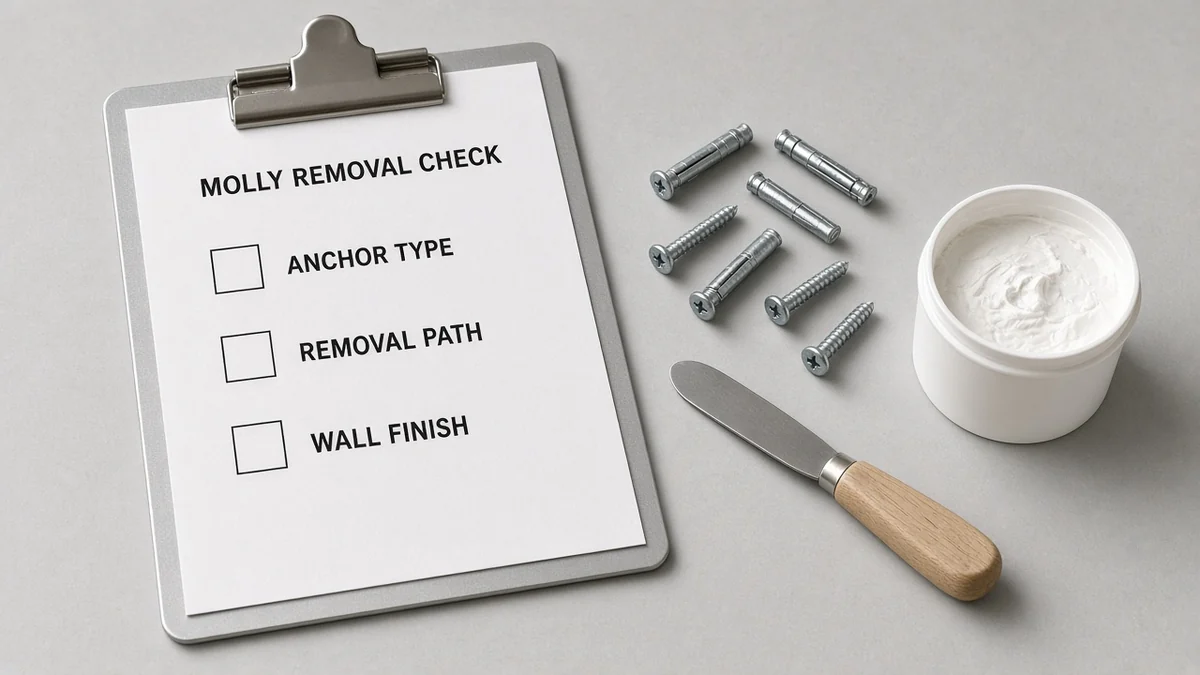
After the list check, read the section with the packed sleeve in hand. Each line should describe what that sleeve does. If a line only makes sense for a toggle or a plug, it does not belong.
Translation consistency
Molly anchors are called hollow wall anchors, cavity anchors or sleeve anchors in different markets, and some of those names also cover other designs. Fix the family with a photo in the source sheet and keep that photo in every language version so the identification survives translation.
Who approves the wording
The brand approves the sheet and the supplier confirms the anchor data. Koitor can check whether the removal wording and the packed sleeve match and flag missing fields. Claims about the wall, reuse or loads stay with the brand and the supplier.
Returns and warranty records
Distributors handling returns of accessories that were wall-mounted with molly anchors sometimes receive complaints about wall damage. A removal sheet that states the expected patching makes those cases easier to handle, because the user was told in advance. Keep a copy of the sheet version that shipped with each production lot for that reason.
When to rewrite
If the removal section was written before anyone confirmed which anchor ships, rewrite it from the packing list. Identification, documented path, reuse, patch pointer and exclusions cover nearly every molly program in a few short paragraphs.
Frequently asked questions about molly bolt removal
Can a molly bolt be pulled out of drywall?
Usually not without tearing the board. The expanded legs are wider than the hole. Most documented paths leave the sleeve in place or sink it slightly and patch, unless the supplier documents an extraction method for that sleeve.
How do I remove a molly bolt from drywall when the sleeve spins?
A spinning sleeve has lost its grip at the flange. Follow the supplier’s handling advice if it exists. If not, the safer sheet wording is to abandon the sleeve in place and patch rather than force it.
Can I reuse a molly anchor?
The screw can often be removed and refitted in a screw-set sleeve, which is why the accessory can come off and go back. Moving the sleeve to a new hole is not normally possible. The sheet should state the supplier’s reuse position or say it is not documented.
Is removing a molly the same as removing a toggle?
No. A toggle wing drops away or is retained by a collar; a molly sleeve is deformed in place. The removal paths are different, and the sheet should not mix them.
Do I need to patch after removing a molly?
In most cases, yes. The flange or the recess left after sinking needs normal finishing. The sheet should point to standard finishing practice and avoid promising an invisible result.
What if I do not know whether my anchor is a molly or a toggle?
Look at the surface. A molly usually shows a round metal flange around the screw, close to the wall. A spring toggle shows only the screw head under the accessory and a larger hole once removed. If you still cannot tell, treat the anchor as abandon-in-place and patch.
Can the accessory go back on the same molly anchors?
If the sleeves are screw-set types in good board and the supplier documents refitting, the same accessory can often be refitted on the same screws. The sheet should say so only when the supplier does, and recommend a first-hang review if the board around the flange is damaged.
Does Koitor make molly anchors?
This guide does not claim that. Koitor makes custom metal bathroom and home storage hardware and reviews install and service wording for fixing kits packed with it. The specific anchor in a program is confirmed on the packing list and quote.
Trabalhe com a Koitor Hardware
Review a molly anchor removal sheet
Send the packed-anchor drawing or supplier sheet, the accessory being removed and the wall condition. We can review the removal wording and the named sleeve family. We will not issue a reuse promise, a load rating or an undamaged-wall claim.
OEM / MARCA PRÓPRIA
Transforme este guia de fornecimento num resumo do produto
Indique o produto pretendido, as dimensões, o acabamento, a quantidade a encomendar e os requisitos de embalagem. A sua equipa receberá uma análise prática da viabilidade de fabrico antes da apresentação do orçamento.


 English
 Español
 Português
 Français
 Deutsch
 العربية