
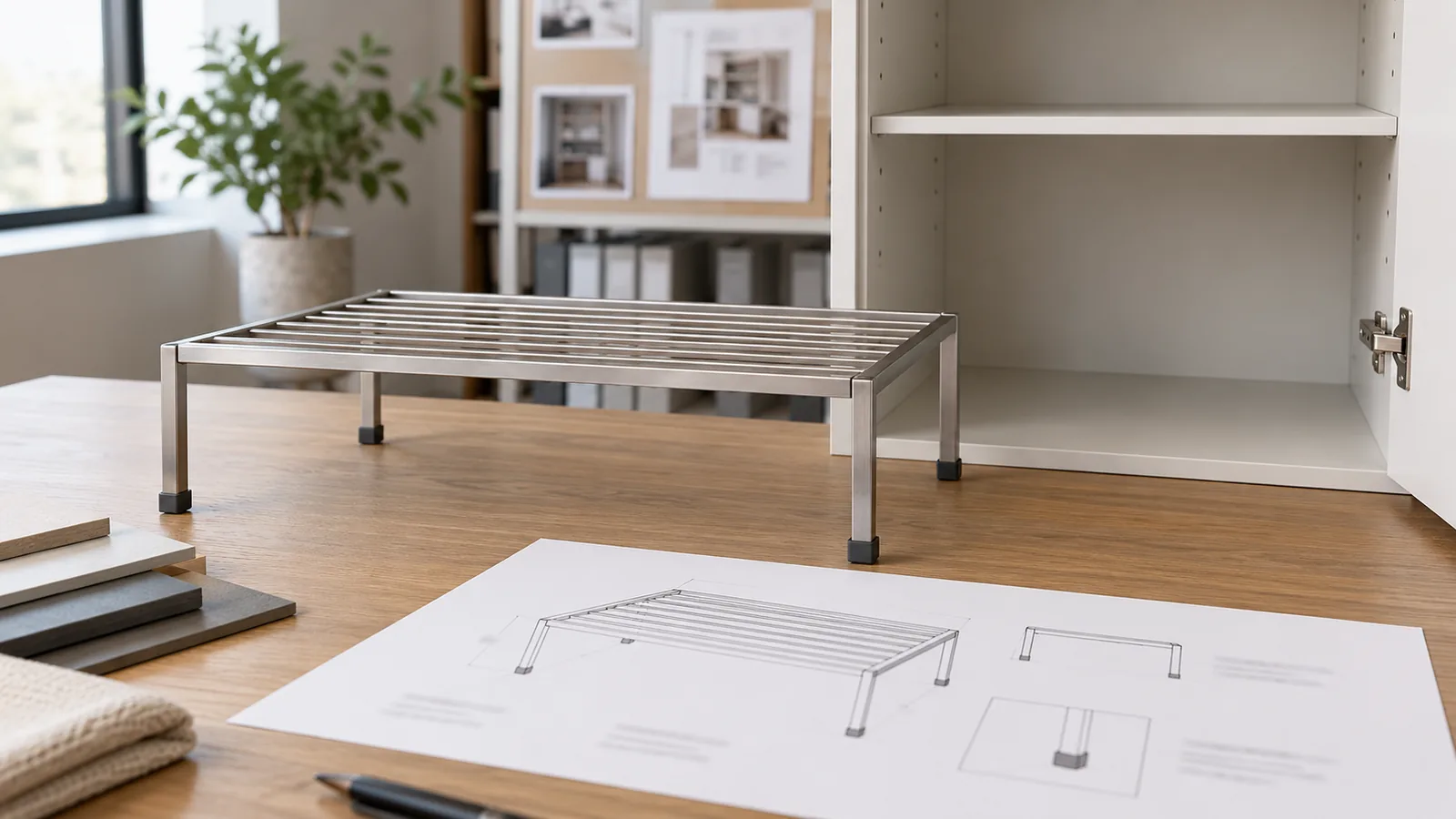
A metal cabinet shelf riser should be specified against a real cabinet envelope, the objects buyers want to store above and below it, and the surface where its feet rest. A product can fit inside a cabinet yet fail at the door opening, leave unusable space underneath, or rock because the contact points do not suit the shelf surface. Importers should therefore approve width, depth, height, usable clearances, foot locations and finish on a representative sample before making a fit or stability claim. This guide covers freestanding risers placed on an existing shelf; it does not cover suspended under-shelf baskets, panel-mounted shelf pins or cabinet construction.
What does a cabinet riser need to fit?
The product must fit two different spaces: the cabinet’s internal envelope and its access opening. A riser may be narrower than the cabinet interior but still be difficult to insert through a face frame, hinge projection or narrow door opening. Measure where the product must pass, not only where it will sit after installation.
Record the cabinet’s usable width, depth and height at the intended location. Note any front frame, hinge arm, door shelf, shelf lip, vertical partition, plumbing line or other obstruction. Cabinets are not always perfectly square, and the back wall or shelf can be uneven. If several cabinet models will be sold with the same riser, record the smallest and largest intended fit conditions and decide whether a single product configuration can serve them.
Then compare those conditions with the riser’s outside dimensions and functional geometry. The overall footprint does not tell the whole story. The feet may extend beyond the shelf surface, an upper rail may reduce the usable top area, or a wide front beam may block access to the lower level. The buyer should identify the actual supporting points, top surface boundary and accessible space below.
Cabinet door closure is part of fit. A riser that sits inside the cabinet may still interfere with a hinged door, inner door shelf or frame. Check the full door movement after placing the sample in its intended position. A listing photograph cannot show whether the door clears the riser or whether the riser itself can be carried through the opening without being tilted.
An existing retail category such as Yamazaki’s riser collection can help buyers recognize common freestanding product forms. A category page does not prove that a particular size will fit a buyer’s cabinet, or that its geometry is appropriate for a private-label item. Use it as assortment context only.
How should buyers specify a metal cabinet shelf riser?
Use a dimension and use-case table rather than the single word “fits.” Each value needs a measurement point, an intended condition and an approval method. A first RFQ may use preliminary ranges, but clearly mark which dimensions still need to be fixed after sample review.
| Requirement | What the buyer should record | Why it affects approval |
|---|---|---|
| Cabinet width and depth | Measurement locations at the front, middle and back, plus fixed obstructions | A taper or hinge can reduce the usable envelope |
| Access opening | Clear width and height with the door in its intended open position | The product must enter and be removed, not merely sit inside |
| Existing shelf | Surface material, lip or edge, level condition and intended contact area | Feet interact with the actual support surface |
| Riser footprint | Outside width/depth and location of each foot, rail or support | The outer frame may fit while a foot overhangs |
| Usable top area | Clear dimensions between rails or edges | Nominal shelf size can overstate the area available for objects |
| Lower access | Height and opening below the riser, including the object meant to pass through | Storage space can exist but be inaccessible |
| Intended contents | Representative object footprints and handling direction | A fit test should reflect the buyer’s actual assortment |
| Configuration | Fixed, adjustable, stackable or multi-piece, if offered | Every allowed setup creates a separate fit condition |
| Finish and contact | Visible surfaces, edges and any specified protective component | Surface contact and appearance can change with finish or added pads |
| Revision and claims | Riser drawing, sample identity, approved cabinet/model scope and packaging text | Changes and public compatibility claims must remain traceable |
Define which dimensions are critical to function. A foot that must remain on the shelf, a clear opening needed for a container, and the overall cosmetic width may need different measurement methods and tolerances. Do not add one generic tolerance to every feature without considering how it is made and used. If the riser has adjustable width, record both boundary settings and the locking or retention method as applicable.
Measure lower clearance as usable access, not just vertical space. The object must pass through the opening, reach its intended position and be removable without contacting an adjacent divider or cabinet wall. A tall riser may create more vertical room above while reducing the height available below. The best option depends on the target items, so state the intended use instead of maximizing one dimension in isolation.
How should the feet contact the existing shelf?
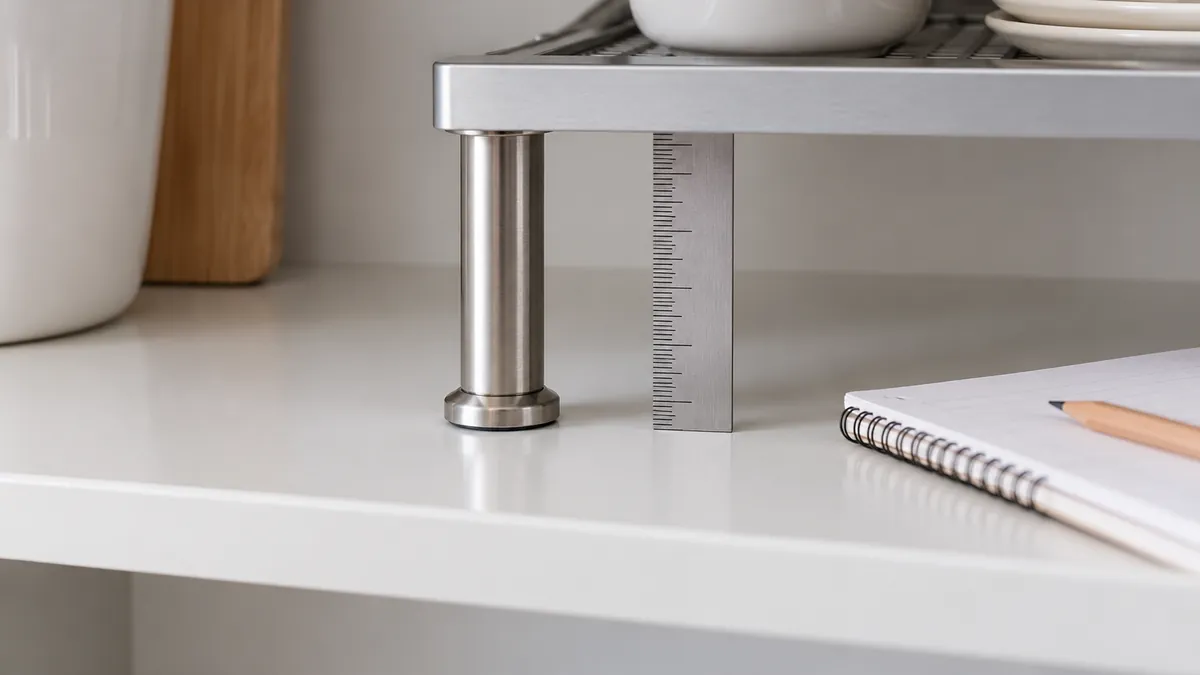
Foot contact is a separate interface from the riser’s top shelf. Record the number and location of contact points, their approximate bearing area, the base shape and the surface they touch. A support that is centered on a flat panel may behave differently on a narrow shelf, a raised edge, a textured coating, glass, laminate or a shelf with a small bow. The buyer should not assume that the same design behaves identically on every surface.
Check whether every intended foot rests on the support surface in the approved position. Look for overhang, rocking, visible gaps, a foot partly on a shelf lip, or a frame that twists when gently repositioned. If a buyer needs a flat-foot requirement, specify how it will be observed. If a protective pad or cap is included, identify its material and attachment in the specification and check the actual component on the sample. A label such as “non-slip” requires a defined surface, condition and test method; appearance alone does not establish friction or long-term retention.
Do not use a cabinet riser sample to make a universal load claim. Stability depends on the riser geometry, foot spread, the cabinet shelf, the placement and distribution of contents, and the buyer’s operating conditions. If load performance is important, set a controlled test plan and acceptance criteria with the responsible product engineer or testing provider. Identify whether the test is a static load, movement, impact or another method, and state what the result does and does not support. No generic test should be invented from a quick hand press.
How can buyers check upper and lower clearance on a sample?
A representative sample check should answer whether the intended items can be stored and accessed in the approved cabinet configuration. Prepare the cabinet or a dimensionally representative fixture, the riser sample, and the objects or mockups that define the buyer’s use case. A drawing review can identify obvious conflicts, but it cannot fully show whether a container can be moved past a rail or whether the riser feels awkward to load.
Check the fit in a consistent sequence:
- Confirm cabinet identity. Record the cabinet opening, inside dimensions, shelf location, door hardware and any fixed obstruction.
- Place the riser. Use the intended orientation and configuration. Confirm that all feet or support rails sit within the permitted shelf area.
- Check the lower level. Pass the representative item through the access opening, place it where intended, and remove it along the expected path. Record interference or blocked access.
- Check the upper level. Place the intended items on top and confirm the usable top area, rail clearance and handling space.
- Close and reopen the door. Check the full movement for interference with the riser or items.
- Observe contact and rocking. Note the surface, foot contact points, any gap or movement, and whether the sample changed position during the agreed handling.
- Record conditions. Photograph the setup if permitted and record the cabinet, riser drawing, sample revision, contents, reviewer and result.
The same dimensions can lead to a different decision when the use case changes. A short mug may fit below a riser that blocks a tall bottle. A wide pan may use the top surface but prevent the cabinet door from closing. The buyer should decide which items define the commercial use case before reviewing the sample. If several use cases matter, record them separately and determine which are must-pass conditions.
Separate “fits” from “works as intended.” The item might fit but be hard to reach, the available top area might not suit its footprint, or the riser might leave a small unsupported edge. Record the observed condition rather than reducing the result to a binary label. If the buyer changes the cabinet, riser dimensions, foot cap, finish or intended contents after approval, decide whether another check is needed.
What should the RFQ and packaging state?
A supplier needs a drawing or clear reference, dimensions, material and finish direction, quantity assumptions, packaging requirements and a sample decision plan. If the design is still being developed, identify the open points instead of treating a concept image as final engineering. Ask the supplier to flag dimensions or joints that may need adjustment for manufacturing or finishing, then review any proposed change against the buyer’s fit matrix.
A useful request should state:
- the cabinet family, target-market dimensions and access constraints being supported;
- the riser’s outside dimensions and critical measurement points;
- the required top area and lower clearance based on representative contents;
- the specified foot locations, contact shape and any separate pad or cap;
- the surface finish, visible faces, edges and cosmetic acceptance reference;
- whether the design is fixed-width, adjustable, stackable or supplied as multiple pieces;
- the sample configuration, cabinet or fixture, intended items and approval owner;
- whether fasteners, pads, assembly instructions or protective materials are included;
- carton protection, unit identification, model or cabinet fit claims, and revision marking;
- how a material, dimension, foot component, finish or packaging change will be communicated.
Packaging and claims must agree with the approved configuration. If a riser is sold for a defined cabinet range, ensure the carton, product page and instruction diagram use the same dimensions and exclusions that were checked. Do not make a broad fit claim based only on one cabinet sample. If the buyer uses the word “universal,” define its cabinet range and test boundary so that it does not imply an unsupported fit across all cabinets.
Retail product wording can be a useful prompt, not a test report. For example, a product listing may call out feet as non-slip, but that statement does not establish the method, surface or duration used to substantiate it. In a private-label program, buyers should specify the evidence and claim review they require instead of copying wording from another product page.
How can an OEM partner support this adjacent product?
A metal manufacturer can review whether a proposed drawing or physical sample is practical to form, join, finish, assemble and pack. That discussion can help identify dimensions that need clarification, surfaces that require protection, or packaging choices that should be included in the sample stage. It does not establish the cabinet fit or performance of the final product; those decisions depend on the buyer’s defined use conditions and sample review.
Koitor Hardware is a family-owned custom metal hardware factory with confirmed work in bathroom and home-storage hardware, including drawing- or sample-based development and flexible small-batch OEM production. A current cabinet shelf-riser SKU, foot supplier, non-slip performance or load rating is not confirmed. Buyers exploring adjacent assortment options can review Koitor’s custom kitchen storage rack manufacturing page e o OEM home-storage hardware page for the broader product category. Those pages do not promise that a riser is in current production.
For an initial conversation, share cabinet dimensions, the intended items above and below, a preliminary drawing or physical sample, desired finish, target quantity and packaging expectations. Then ask what information the sample needs to prove and who will record the approval. A clear separation between manufacturing review and buyer fit approval helps avoid implying that a supplier’s drawing review alone confirms end-use compatibility.
Buyer checklist before a sample release
Treat each metal cabinet shelf riser model and cabinet condition as a separate approval row. A concise fit record should connect the buyer’s drawing, physical sample, intended items and public fit claim.
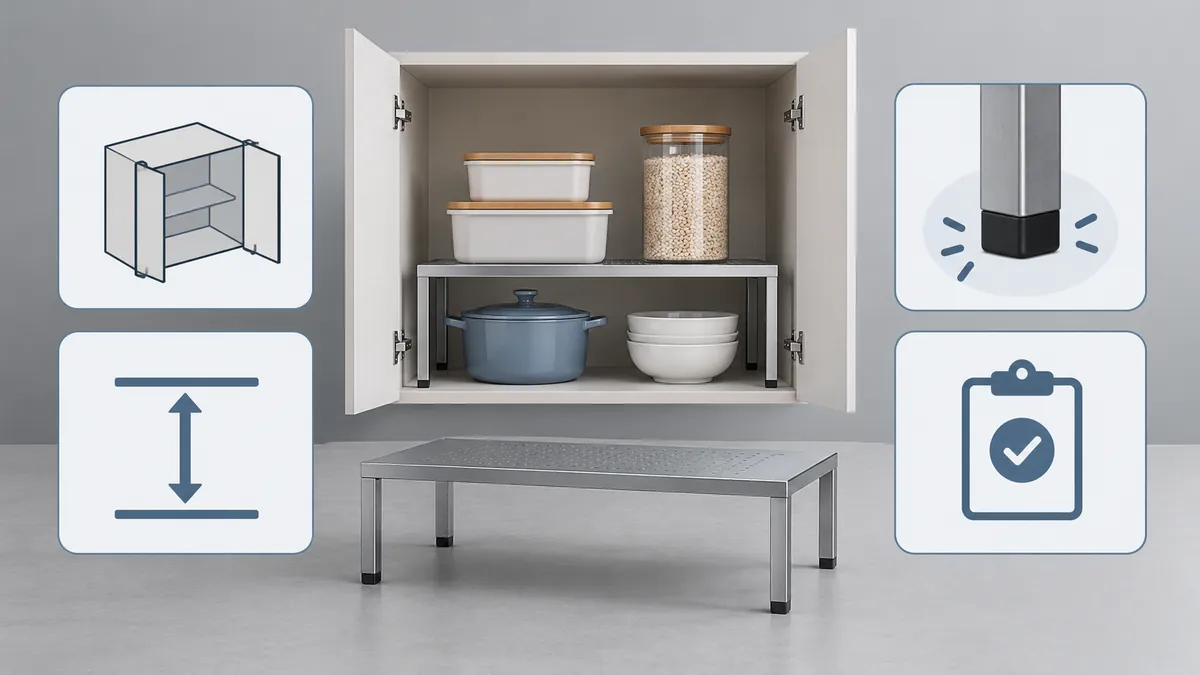
- [ ] Are the cabinet opening and internal dimensions recorded at the intended location?
- [ ] Have hinge, frame, shelf lip, door shelf and other obstructions been included?
- [ ] Does the riser fit through the opening as well as inside the cabinet?
- [ ] Are upper usable area and lower accessible clearance specified separately?
- [ ] Are representative objects identified for both levels?
- [ ] Do all feet or support points rest within the approved shelf surface?
- [ ] Are any pads or caps part of the actual production configuration?
- [ ] Were the cabinet door and intended handling path checked?
- [ ] Does the approval record identify sample, drawing revision, cabinet and reviewer?
- [ ] Do carton, instructions and online claims match the tested configuration?
- [ ] Is there a change-review step for different dimensions, feet, finish, surface or packaging?
Perguntas frequentes
Is a cabinet shelf riser the same as an under-shelf basket?
No. A freestanding riser rests on an existing shelf and adds a raised surface. An under-shelf basket hangs from or attaches beneath a parent shelf. The support interface, assembly and clearance questions are different, so one product’s approval does not transfer to the other.
Can one riser fit every cabinet?
Not without a clearly defined range and supporting evidence. Cabinet openings, hinges, shelf depths, internal obstructions and door hardware vary. A “universal” claim should identify the cabinet boundaries and conditions that were checked.
Do rubber feet prove that a riser will not slide?
No. A foot material or appearance does not by itself demonstrate friction or performance on every surface. Define the actual pad, shelf surface, condition and test method if slip resistance is a buyer requirement, and keep any claim within the resulting evidence.
Should buyers specify a load rating?
Only when the intended use requires one and the buyer can define the test setup and acceptance criteria. A load value without the riser configuration, support surface, load placement and test method is incomplete. Do not infer a rating from wire thickness, material appearance or one informal sample demonstration.
Discuss a Cabinet Riser Drawing or Sample
Share the cabinet envelope, target items, preliminary drawing or physical sample, finish and packaging requirements with Koitor Hardware to discuss the metal part and sample-development questions. Cabinet fit and performance claims still require buyer-defined checks.
OEM / MARCA PRÓPRIA
Transforme este guia de fornecimento num resumo do produto
Indique o produto pretendido, as dimensões, o acabamento, a quantidade a encomendar e os requisitos de embalagem. A sua equipa receberá uma análise prática da viabilidade de fabrico antes da apresentação do orçamento.

 English
 Español
 Português
 Français
 Deutsch
 العربية