
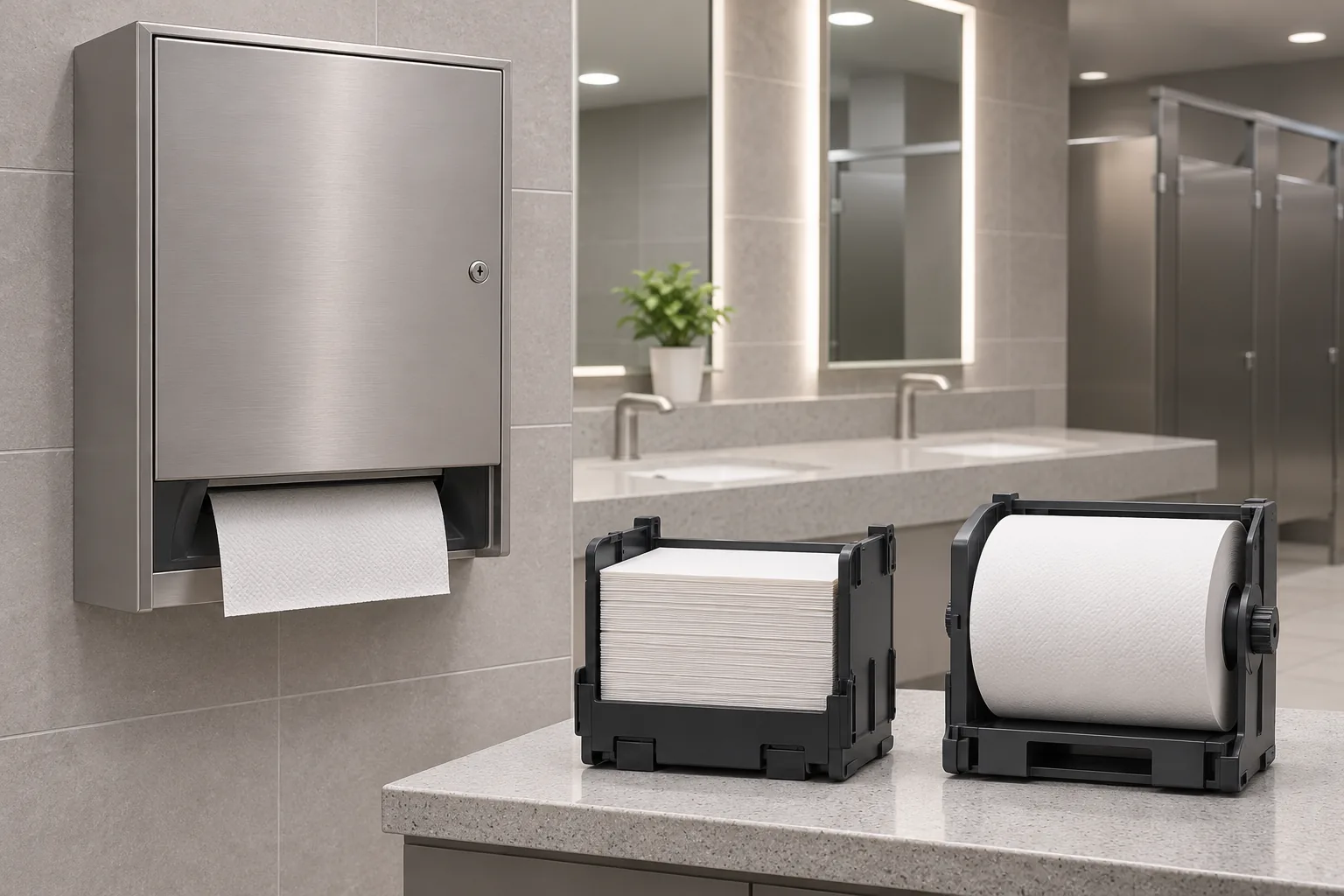
A paper towel dispenser replacement module can be a useful way to retain a cabinet, but “convertible” does not mean every module fits every cabinet in the product family. Buyers should identify the installed dispenser and its generation, choose a manufacturer-supported direct replacement or retrofit route, and confirm every required adapter, angle, screw, template and service component before ordering.
This guide is for commercial washroom distributors, project buyers, facility teams and service-parts importers. It separates a replacement module from a retrofit kit and from a complete dispenser replacement. Manufacturer documents cited below describe specific systems; they do not establish cross-brand compatibility. Koitor’s current paper-towel mechanism or dispenser-module capability is not confirmed, so this article does not imply Koitor makes the mechanisms shown.
Paper towel dispenser replacement module: identify the retained cabinet
The first question is not “Which roll module should we buy?” It is “What exact cabinet is installed, and which components does the proposed change retain?” Record the manufacturer, model or series, product label, serial or date information if available, current towel format, mounting arrangement and any visible internal identification. Photograph the outside, open cabinet, existing module, mounting points and any labels. Do not disassemble a unit unless the maker or qualified service provider directs it.
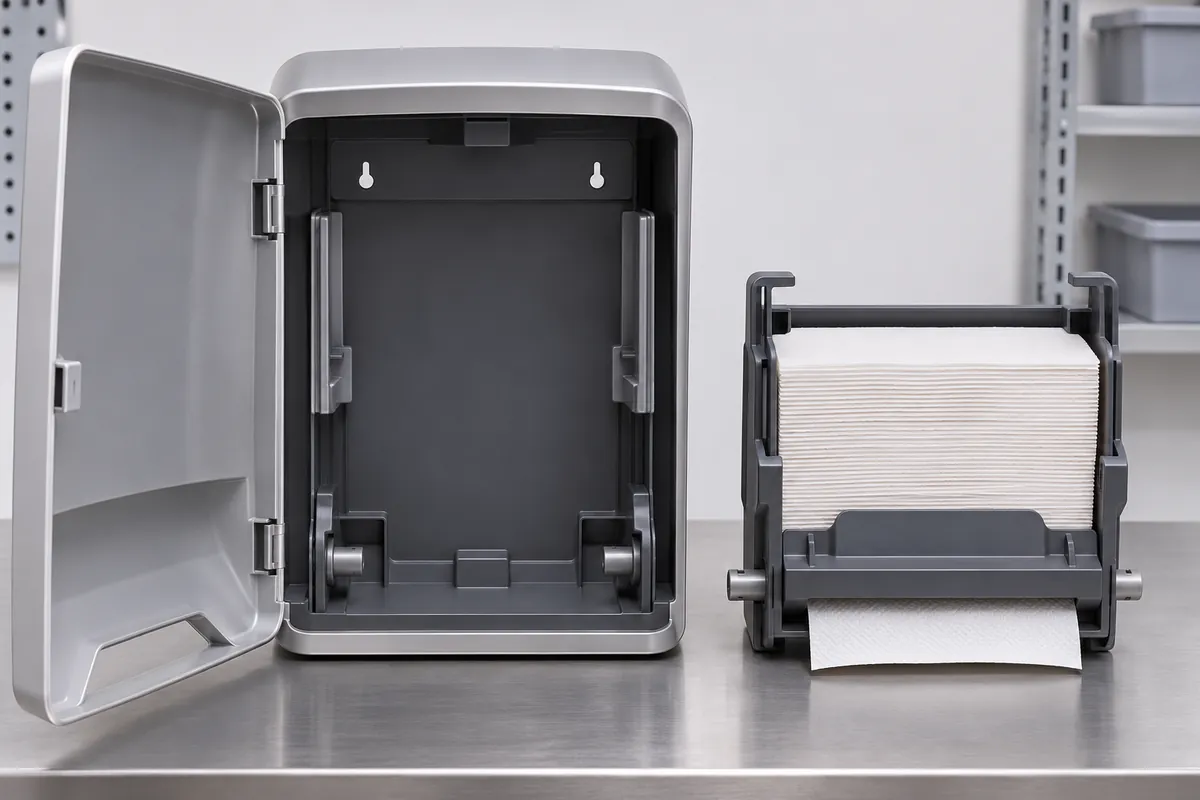
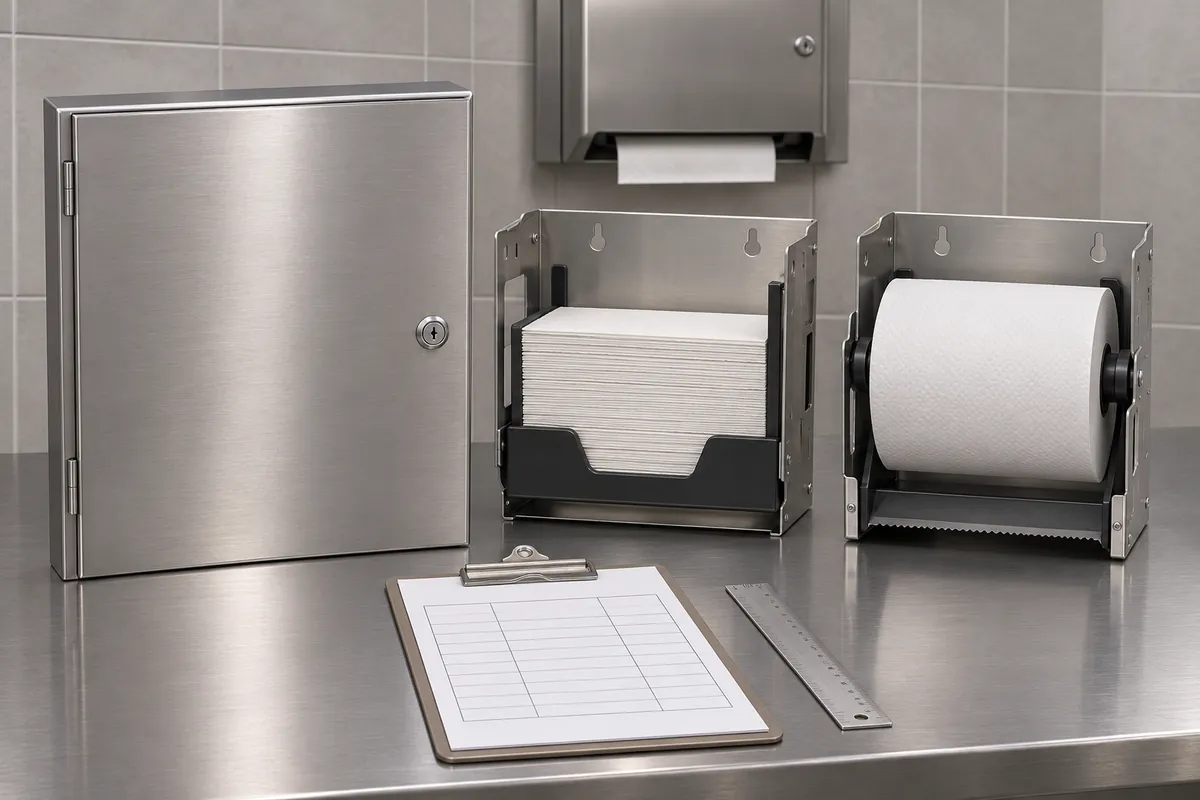
Distinguish the cabinet shell from the removable module, door, lock, chute, guide, mounting angle and service parts. A product family may include several towel formats and module configurations. A brochure that calls a family convertible may refer to a defined kit or specific cabinet revision. It is not proof that all modules can be swapped directly. Ask the maker to name the retained cabinet model and the compatible module or kit.
Identify how the dispenser is currently loaded and operated. It may hold folded towels, a mechanical roll or an automatic roll system, but these terms should be confirmed against the manufacturer’s product identification. Record whether the buyer wants to retain the same towel format, switch formats, change a service routine or replace a damaged part. Each objective may have a different supported route.
If a label is absent, collect clear photographs and dimensions as identification evidence, then send them to the manufacturer or authorized service provider. Dimensions can narrow the search, but they do not reveal every internal bracket, sensor, lock or revision. A cabinet with a replaced door or modified mounting can differ from its original specification. Keep the result as “provisional identification” until the system owner confirms it.
Record the cabinet’s current condition separately from its model. Note missing screws, damaged door, bent interior parts, corrosion, binding, altered holes or non-original accessories. Do not diagnose the cause from appearance alone. A proposed conversion may not resolve a damaged enclosure or an incompatible mounting point. The buyer should ask whether the condition changes the approved retrofit route.
A useful identification record links the nameplate or product label, full exterior view, inside view, existing module and supplier’s confirmation. Capture which part is retained and which is replaced. Include document title, revision or date where shown. This prevents a quote from relying on the phrase “same series” without specifying the actual configuration.
Choose between direct replacement, approved retrofit and full unit
There are three broad procurement paths. A direct replacement module replaces an existing module with the same supported format and interface. A maker-approved retrofit kit adapts a retained cabinet to a different module or operating format. A complete unit replacement changes the cabinet and associated parts. The buyer should compare the applicable route in the current instructions for the exact installed model.
A direct replacement is often the clearest path when the current cabinet and module are identified, the maker lists the part as a replacement, and the buyer wants to preserve the existing format. Confirm whether the replacement includes only the module or also a pump, feed mechanism, cutting component, guide, fasteners or other parts. Part names vary across manufacturers, so ask for the itemized parts list.
A retrofit is more than selecting a module that fits inside the cabinet. The kit may include specific brackets, angles, screws, templates, guides or other transition parts. Bobrick’s product-specific instructions for the 3974-350, for example, document a 3974-85 retrofit kit with named components for a defined installation. That is evidence that some conversions have kit dependencies; it does not establish a general kit rule or authorize the same method on another cabinet.
A full unit replacement may be appropriate when the existing shell is damaged, cannot be identified, lacks a maker-supported conversion, or the project wants a different capacity, appearance or service approach. It can also change mounting, wall interface, door clearance and finish coordination. The buyer should compare the whole product and project scope instead of assuming that a new module is always less expensive or easier.
For each route, ask the manufacturer to state the exact base cabinet, module, kit and document revision. If it is a direct replacement, ask whether any additional parts are mandatory. If it is a retrofit, ask which parts in the kit are required, which parts remain, what installation procedure applies, and whether any versions are excluded. If it is a new cabinet, confirm mounting template, overall envelope, utilities if any, and items sold separately.
Do not rely on a reseller’s catalog title or a product-family page alone. A product family may include folded, pull-roll and automatic modules while each module has named compatible cabinets. A current brochure can describe options without confirming every combination. Find the detailed instruction sheet or parts document for the exact cabinet and module, then request written maker confirmation for any ambiguous version.
The buyer should compare options on total scope: module, kit, any retained components, field labor, cabinet replacement, removal, downtime, refill compatibility and the facility’s approval process. Prices and labor vary, so the article does not claim that one route is universally cheaper. Record the assumptions from each quote and identify omissions before comparing totals.
Verify cabinet generation, module code and included conversion parts
Generation or revision is a common source of uncertainty in replacement work. Record any model suffix, date code, serial range, label revision or visible geometry that the manufacturer requests. If multiple generations have similar names, ask which identifying data differentiates them. Do not use a search result date or reseller comment as a universal change boundary.
Research documents for Bobrick provide a specific example. A compiled instruction and parts document revised December 2025 describes a named 3974-350 retrofit using a 3974-85 kit and lists separate components. A technical data sheet for the 3974-350 has an earlier revision and warns that designs may change. A June 2026 brochure identifies several modules within a product family. These references support checking current, model-specific documents; they do not prove that every older cabinet accepts each module.
Ask the manufacturer to confirm whether the current part number supersedes the old code and whether the replacement is compatible with the retained cabinet revision. If the manufacturer recommends a retrofit kit, obtain its full part number, included items and instruction sheet. If an adapter or template is omitted from the quotation, clarify whether the buyer must source it separately.
For each package, verify the order unit and contents. Is the offer one module, a pair, a kit, a full dispenser, or a module plus hardware? Are screws and angles included? Is a key, pump or sensor included? Is the trim or cover part of the module? A product photo may show components that are not included. Request a bill of materials or packing list that corresponds to the quoted SKU.
If the installed unit has been modified, the maker may need additional evidence. Send photographs of prior repairs, non-standard holes, replacement parts and interior supports. Mark which parts are believed original and which are unknown. Do not assume that a kit remains suitable if the cabinet has been altered. Obtain a disposition from the system owner before purchasing.
A service-parts importer can maintain a compatibility matrix with cabinet code, module code, kit code, generation notes, included parts and source revision. The matrix should make exceptions visible. If a manufacturer changes a code or issues an updated document, flag affected listings and open orders for review. Keep the older record for traceability, but do not present it as current without checking.
Separate towel format, mechanism and service requirements
A format change can involve more than the shape of the module. Folded towel and roll systems handle consumables differently and may involve different guides, rolls, feed paths, cutting parts or service routines. Ask the manufacturer what change the proposed module makes and which consumables are compatible. Do not assume that the same towel stock, refill method or maintenance procedure will remain suitable.
The maker’s product instructions define the unit-specific service steps. A buyer should request the current instructions and determine who is responsible for installation and service. This guide does not instruct staff to modify a dispenser, handle electrical parts or service an automatic mechanism. If the system includes powered components, sensors or a control, the qualified service provider should confirm the safe procedure and required parts.
Clarify whether the module is mechanical or automatic, and what the terms mean in the maker’s documentation. Do not infer power requirements, sensor operation or user behavior from a product name. If a project has electrical or accessibility requirements, the responsible designer and equipment provider should evaluate the exact product and installation. Avoid compliance claims without current product and project evidence.
Review refill availability separately. A module conversion may change towel size, roll diameter, core, fold, ply or other consumable parameters. Ask the dispenser maker which refill specifications it lists, how those are identified and whether the facility’s preferred towel is accepted. The paper supplier should confirm its product data. Do not assume the module supports any format because it physically fits.
A change in dispensing format can also affect stocking and service. Record refill codes, carton quantities, lead time, replenishment locations and inventory on hand. If old stock becomes unusable, estimate that only from facility records and supplier terms. Do not claim a waste reduction or labor saving without measured evidence. The buyer may still consider those factors as scenario inputs.
Ask whether any old module or components are returned, retained as spares, recycled or discarded. That is a facility and supplier scope question. If a conversion kit uses parts that remain in the cabinet, label them clearly in the installation and service record. A future technician should be able to distinguish the updated module from the original shell and know which source document governs it.
If the project has multiple cabinet models, group the survey by model and configuration rather than treating every washroom as identical. A hotel, school, office or public facility can contain different installation vintages. A one-site pilot may help reveal an identification issue, but a single approved cabinet does not establish fit for all locations. Repeat the maker confirmation for each distinct model or generation.
Check physical interfaces and the scope of service
A module must fit the cabinet’s intended internal support and leave the door, lock, feed path and access points operating as designed. Request a dimensioned drawing showing the relevant interface, mounting points, envelope and any required kit parts. Ask which dimensions are controlling and whether there are excluded cabinet versions. Do not compare modules by external width or visual form alone.
The installed cabinet may have limited access or a site-specific mounting condition. Record wall position, adjacent fixtures, open-door clearance, counter or mirror interference, and who has authority to remove the unit. The system provider or qualified contractor should confirm field work. Do not instruct a buyer to drill new holes, cut a cabinet or alter a mount without maker approval.
Ask whether any module change affects locking, security, refill access or maintenance access. Use the product documentation; do not assume a new module preserves the prior lock or key. Record whether keys and service tools are included. If a dispenser is part of a controlled facility system, the facility owner should approve the access arrangement.
For automatic dispensers, determine which components the manufacturer requires for the chosen format: module, power source, sensor, control, wiring harness, battery, transformer or other parts. Do not assume compatibility between generations. Keep electrical responsibilities with the qualified product supplier or service professional. The procurement document should list what is included and what is supplied separately.
For mechanical dispensers, confirm the feed path and any required roller, guide, cutter or lever parts. The maker should identify the proper parts for the towel format and model. A module photographed outside the cabinet may not show the complete interface. Ask for the parts diagram and installation instructions, and retain them with the order.
If the buyer wants to keep the original cover or door, confirm that it is listed to remain with the proposed module. A module may fit behind the cover but still interfere with clearance, latch, window or service access. This must be checked against the maker’s drawing or an approved sample. A physical trial should be performed only by an authorized party and according to the product instructions.
Prepare a conversion RFQ that makes the route auditable
A good RFQ describes the installed condition and requested result, then asks the supplier to identify the correct supported route. Include model and revision evidence, photos, existing format, desired format, modules to retain, quantities, site count, service responsibilities and refill assumptions. Ask the supplier to list every module, kit and accessory line separately.
| RFQ field | Buyer input | Supplier confirmation |
|---|---|---|
| Installed unit | Maker, series, full model, suffix and label photos | Confirmed cabinet identification and document source |
| Existing configuration | Towel format, module code, visible modifications | Current module/revision identification |
| Requested route | Direct replacement, approved conversion or full unit | Exact supported route and compatibility statement |
| Conversion parts | Retained door, shell, mount, lock, guides or other components | Full kit code, contents and separately ordered items |
| New format | Folded, roll or other maker-defined format | Refill specification and current compatible codes |
| Interfaces | Module envelope, support points and access clearance | Dimensioned drawing and installation instructions |
| Scope | Quantity, sites, labor, removal and service owner | Itemized quote, exclusions and responsibilities |
| Evidence | Photos, labels, site list and current parts record | Maker confirmation, revision and any unresolved limitations |
Ask the supplier to distinguish an official maker statement from an inference based on dimensions or photographs. If it cannot confirm a cabinet generation, pause the quote and identify what evidence is required. If the system has been modified, ask whether the manufacturer will review the condition.
Keep one approved record per cabinet configuration. The record should include the selected route, exact model and module codes, kit contents, compatible refill, documentation revision, sample or pilot status and change owner. Avoid one generic instruction for every cabinet in the building if the survey identifies multiple versions.
Before release, reconcile the quote against the approved route. Confirm unit count, case quantity, required kit, mounting material, installation responsibility, lead time, refill stock and any return conditions. Do not release a module-only purchase when the maker’s instructions require additional parts. If the buyer intentionally accepts an exception, record who approved it and why.
Sample, pilot and reorder controls
A sample or pilot should be used to answer a specific question: does the maker-confirmed module match the identified cabinet and requested format? Does the kit contain the listed components? Is the appearance acceptable? Does the maker or qualified service provider confirm the intended operation? The buyer should not use a pilot to improvise a retrofit that the manufacturer has not approved.
Tag the sample with the cabinet model, module, kit, supplier, revision and source document. Photograph the part number and all included components before the sample is separated from its packaging. Keep the instruction sheet with it. If the sample is missing an adapter or screw, record the gap rather than assuming it was not required.
If the supplier proposes a substitute module, compare it as a new option. Require a written compatibility statement for the retained cabinet and confirm whether a different kit, refill or service routine applies. A similar housing shape or matching brand name does not establish that the model interfaces are identical.
For a multi-site project, pilot one representative cabinet from each distinct model or generation. A pilot on one version does not prove compatibility across different cabinets. Record the exact site or unit label and whether the cabinet was original or modified. Have the responsible facility team approve any service or appearance change before scaling.
Reorder controls should preserve the approved cabinet-to-module relationship. The distributor’s SKU record can include the manufacturer’s part number, kit requirements, compatible cabinet models, exclusions, refill references and last verification date. If a product family is revised, check the manufacturer’s current document and update the record deliberately.
When a defect or mismatch appears, stop and document it. Compare the received module and included kit with the approved quote and parts list. Capture the cabinet identifier and interface without modifying the unit. Contact the supplier or manufacturer for a disposition. Do not trim, bend or add parts based on an improvised fit.
Perguntas frequentes
Does “convertible dispenser” mean any module fits the cabinet?
No. The term may refer to a product family or specific supported combinations. Confirm the exact retained cabinet, module code and any conversion kit.
Can a buyer keep the existing cabinet and change from folded to roll towels?
Only if the manufacturer documents a compatible route for that cabinet version. Some systems use a specific kit; others may require a different module or complete unit.
Is a retrofit kit always included with a replacement module?
No. Check the quote and maker’s parts list. Identify each kit component and whether it is sold separately.
Can a distributor confirm fit from photographs?
Photos can support identification but may not show internal supports or revisions. Obtain a model-specific maker confirmation before releasing the order.
Does an automatic module use the same parts as a mechanical module?
Do not assume so. Confirm the current system configuration, included components and service responsibility with the maker or qualified provider.
Technical references
- Bobrick 3974 instructions and parts document — a specific maker-documented retrofit kit and component list.
- Bobrick 3974-350 technical data sheet — model-specific configuration context; verify current revisions.
- Bobrick June 2026 dispenser brochure — examples of folded, pull-roll and automatic module options.
- Bobrick 3944 instructions — model-specific folded module information.
- Koitor OEM manufacturing information — verified metal-hardware sourcing scope; no dispenser mechanism capability is implied.
For verified metal-component projects, see Koitor’s OEM manufacturing information. Dispenser manufacturers should confirm paper towel dispenser replacement module compatibility, kit scope and service requirements.
Discuss a Metal Hardware Specification
Share a controlled drawing, finish reference and sample requirements for a project review. The dispenser manufacturer or qualified service provider should confirm paper towel dispenser replacement module fit and conversion scope.
OEM / MARCA PRÓPRIA
Transforme este guia de fornecimento num resumo do produto
Indique o produto pretendido, as dimensões, o acabamento, a quantidade a encomendar e os requisitos de embalagem. A sua equipa receberá uma análise prática da viabilidade de fabrico antes da apresentação do orçamento.


 English
 Español
 Português
 Français
 Deutsch
 العربية