
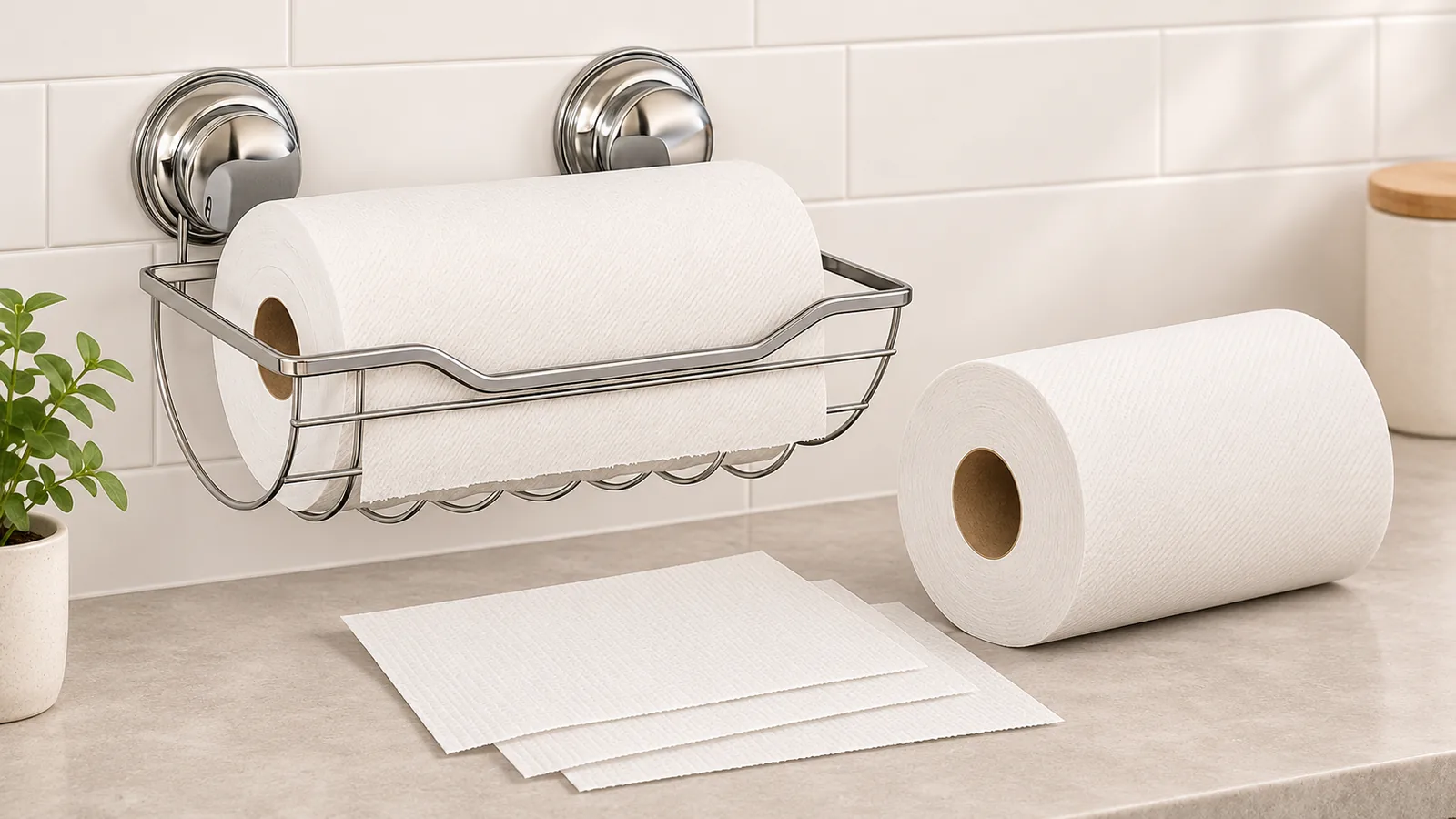
Paper towel roll sizes do not reduce to one standard diameter or one sheet count. For a holder or refill program, separate the roll’s axial width, outside diameter and core opening from the dimensions of an individual sheet, the number of sheets per roll and the number of rolls in a pack. Those measurements describe different objects. A buyer should match the holder to the intended refill by recording the exact physical dimensions and pack configuration, then checking the real roll in the proposed holder instead of treating a marketing name or sheet count as a fit specification.
This distinction matters when a distributor selects a holder for a retail assortment, a product team evaluates a dispenser envelope, or a buyer compares refill suppliers. A roll may have the same sheet count as another roll and still differ in outside diameter, width or core. Likewise, a large-looking roll does not reveal how many sheets it contains. The dimensions should be kept attached to the named product and source because there is no single universal value that describes every paper towel roll.
What Do Paper Towel Roll Sizes Actually Describe?
Paper towel roll sizes can refer to at least three different layers of product information: the finished roll, an individual sheet, or the selling and shipping pack. A product page may show fields from more than one layer. Before copying a number into a holder drawing or assortment spreadsheet, label what the number measures.
For the roll itself, record the axial width or height, the outside diameter, and the core opening when the core matters to the holder’s spindle or support. Axial width is measured along the roll axis, from one end face to the other. Outside diameter is the distance across the wound roll. Core diameter refers to the opening through the central tube, where a core is present. The holder may have a spindle, side supports, end caps, or a cradle, and each construction interacts with a different part of the roll.
For the towel sheet, record its actual sheet width and length, plus the stated number of sheets per roll. Sheet dimensions describe the unfolded paper. They do not directly specify the diameter of the finished roll because roll diameter also depends on the amount of paper, thickness, winding tension, core size, and winding structure. Do not infer a roll’s outside diameter from sheet count alone.
For the commercial pack, distinguish the dimensions or quantities of an individual roll, a retail pack, a case, and a shipping carton. “Rolls per pack” is a count. “Case dimensions” describe a package. Neither field should be placed in a bare “roll size” column without a label. If a supplier publishes a packaged “each” dimension, preserve the supplier’s field name until the buyer confirms whether it means the product or its package.
A useful data model looks like this:
| Layer | Fields to capture | What the fields help answer |
|---|---|---|
| Finished roll | Axial width, outside diameter, core opening | Will the roll physically fit the holder or spindle? |
| Individual sheet | Sheet width, sheet length, sheets per roll | What paper format and stated sheet quantity are offered? |
| Retail pack | Rolls per pack, packaged dimensions, pack identifier | What does the buyer order and display? |
| Case or shipment | Units per case, outer carton dimensions, gross/net data if supplied | How is the assortment packed and handled? |
These fields should remain separate in a product database. If a value is not published or has not been measured, mark it unknown rather than filling it from a similar SKU. A blank cell with a source note is more useful than a precise-looking number assigned to the wrong object.
How Do You Measure a Roll for a Holder?
Start with the holder’s actual support design.
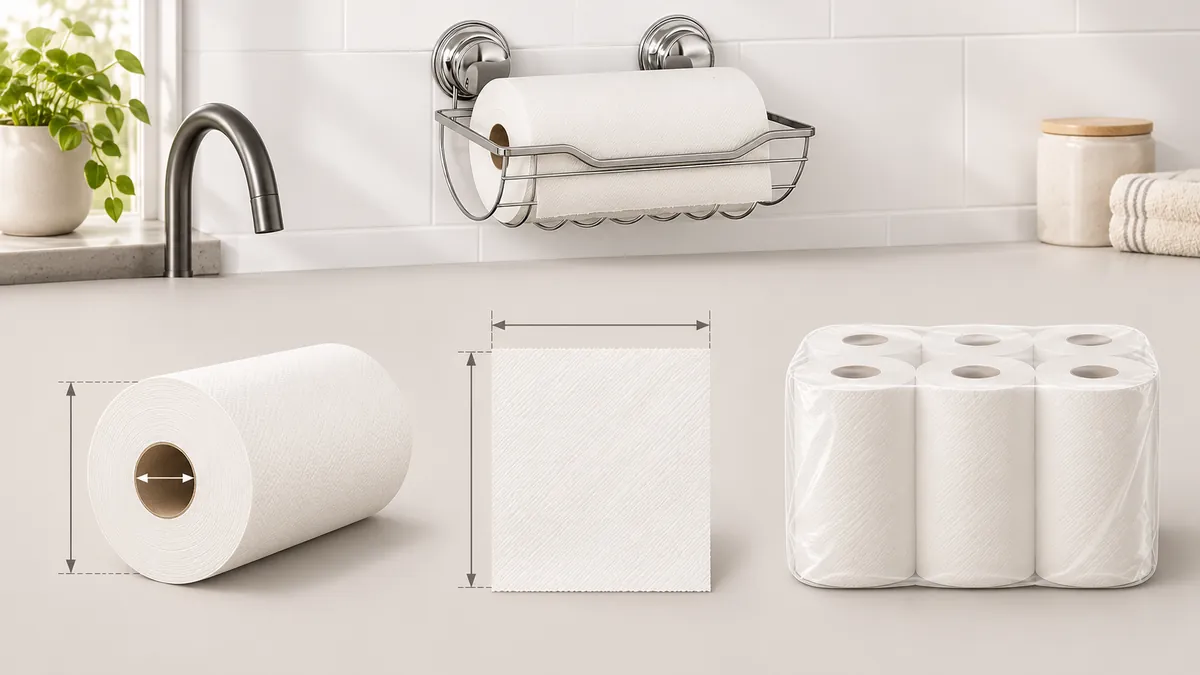
A spindle holder may require a clear core opening and a maximum roll width. A spindle holder may require a clear core opening and a maximum roll width. A side-supported holder may rely on end clearance and the overall width. A cradle-style design may support the roll’s outside diameter without using its core in the same way. Those are different interfaces, so the buyer should not assume that a core dimension is decisive for every holder.
Measure or obtain the roll’s outside diameter at the widest cross-section, the axial width, and the core opening if the holder uses it. State whether the roll is full, partly used, compressed, or out of package. A partly used roll is smaller and can turn differently from a full roll; it is not a substitute for confirming the maximum refill envelope. A packaged product measurement is also not a bare-roll measurement.
If using supplier data, preserve the SKU and the exact field label. If a supplier lists “unit dimensions,” ask whether the unit is the bare roll, a wrapped roll, or another selling unit. Do not silently rename a product page’s package dimensions as roll diameter. If a mechanical drawing or holder specification needs a maximum envelope, identify that as a holder-side clearance requirement and compare it to the actual refill, rather than misrepresenting it as an industry-wide paper size.
A simple fit record can include:
- Holder type and the part of the roll it supports.
- Intended refill manufacturer and SKU.
- Maximum roll outside diameter.
- Maximum axial width.
- Minimum core opening when a spindle or insert depends on it.
- Any wrapper or band that remains during use.
- Whether the confirmation uses an actual sample or supplier-published data.
- The holder revision and the refill revision checked together.
The purpose is to prevent a dimension from losing its meaning between the retailer’s product listing, the buyer’s assortment file and the hardware drawing. For example, “4.9 inches” is incomplete without saying whether the value is a roll diameter and which SKU it belongs to. “128 sheets” is a quantity, not a diameter. Put field names beside the numbers everywhere they are reused.
For buyers developing a holder, the existing custom home-storage hardware manufacturing page describes the commercial scope. The holder-specific measurement and clearance discussion belongs with the relevant existing holder article; this guide focuses on keeping refill data fields distinct.
Do Sheet Dimensions Predict the Roll Diameter?
Sheet dimensions and roll diameter are related only through the finished roll construction and amount of paper. A sheet’s width and length identify the unfolded format. The number of sheets gives a stated count. Neither one alone provides a guaranteed outside diameter.
A buyer may calculate a nominal paper area to compare two clearly specified products, but the arithmetic must not be presented as a roll measurement. For example, if a product explicitly reports 128 sheets and a unit sheet size of 11 by 8.78 inches, the simple nominal sheet-area multiplication is 128 × 11 × 8.78 square inches. That calculation describes an arithmetic total based on the named sheet dimensions and count. It does not tell the buyer how tightly the paper is wound, what the core diameter is, or whether the roll will clear a holder.
Even a correct sheet count can hide differences. One product may use full sheets; another may use a reduced or perforated format. A supplier may label sheet dimensions by “height” and “length,” while another uses “width” and “length.” Preserve the source terminology and units, then define how the product is oriented if the data will be used to design a holder. Do not normalize supplier labels into your own field names until you know what was measured.
The perforation length is another distinct value. It may be the length of one sheet along the web, but it should not be confused with the roll’s circumference. Paper is layered around a core; the outer circumference changes as the radius changes. The roll is also compressed and wound. A rough geometric model could estimate a relationship only if the paper thickness, core, winding density and measurement conditions were known, but a retail buyer should use a real measurement or supplier specification rather than imply that a simple count-to-diameter formula is authoritative.
This is why an assortment comparison should show multiple columns instead of one “size” column. A practical worksheet might include SKU, country or market, roll width, outside diameter, core diameter, sheet format, sheets per roll, rolls per pack, source field label and retrieval date. If the source omits a field, record “not stated.” Do not borrow a measurement from an older product, another country, or another SKU without a documented reason.
What Do Current Product Examples Show?
Named manufacturer examples illustrate why product fields need labels. They are examples of individual SKUs, not a universal U.S. size range, a recommendation, or an endorsement.
The current U.S. Scott 41482 listing reports a 4.9-inch roll diameter, 128 sheets per roll and a unit sheet size of 11 by 8.78 inches. Those figures answer three different questions: approximate physical roll diameter, stated quantity, and stated dimensions of one sheet. The diameter can be compared with a holder envelope; sheet size can help describe the paper format; and sheet count can describe quantity. None should replace the others. Keep the manufacturer and SKU beside the data because these values are product-specific. The source’s “unit” field should retain the supplier’s naming unless a buyer confirms precisely what the field represents.
A Papernet product page for SKU 413865 gives an international example with 48 sheets, sheet dimensions of 23.5 by 23.8 centimeters, an 11-centimeter roll diameter and a 3.8-centimeter core diameter. A separate Papernet product PDF for SKU 402406 lists 309 sheets, sheet dimensions of 23.4 by 22.3 centimeters, a 16.8-centimeter roll diameter and a 5.1-centimeter core diameter. These are two individually named manufacturer products. Their measurements should not be used to claim that all U.S. rolls, all kitchen rolls, or all commercial rolls fall within the same range.
A comparison table should keep each supplier field attached to its own row:
| Named product example | Sheets per roll | Stated sheet dimensions | Stated roll diameter | Stated core diameter |
|---|---|---|---|---|
| Scott 41482, current U.S. listing | 128 | 11 × 8.78 in | 4.9 in | Not stated in the cited fields |
| Papernet 413865, product page | 48 | 23.5 × 23.8 cm | 11 cm | 3.8 cm |
| Papernet 402406, product PDF | 309 | 23.4 × 22.3 cm | 16.8 cm | 5.1 cm |
Sources: Kimberly-Clark Professional Scott 41482, Papernet 413865, e Papernet 402406 product PDF. The examples were recorded from the cited product materials on November 24, 2026. The date identifies the research retrieval, not a claim about when a manufacturer last updated its site.
The table does not establish a standard, typical range, capacity, absorbency comparison, compatibility, or preference between products. A buyer should follow each supplier’s terminology, units and stated SKU. If a source page changes, the field should be checked again before a catalog, product page or engineering drawing is finalized.
If a buyer needs a unit conversion, convert the same physical measurement and retain both original and converted values with a clear label. Do not mix inches from one manufacturer with centimeters from another and then round away the underlying differences. Any rounding should be appropriate to the purpose; a quotation comparison is not a manufacturing tolerance specification.
Why Do Roll Count and Pack Quantity Need Separate Fields?
Sheets per roll and rolls per pack are not interchangeable quantities. A 12-roll pack might contain rolls with a different sheet count or sheet format than a pack from another supplier. The number of rolls in a case may also differ from the number offered to a retail customer. These pack levels can coexist in one catalog, so a buyer should name each unit of measure.
Use a hierarchy such as individual roll → retail pack → case → shipping carton. For each level, identify the quantity of the preceding unit, dimensions if supplied, and the supplier’s item number. If case dimensions include outer packaging, do not copy them into a field intended for the roll. If the product page distinguishes “each,” “pack,” and “case,” preserve those words in the source notes and confirm them before using the data for holder design or freight planning.
A small data table can make those distinctions explicit:
| Field name | Example type | Buyer interpretation |
|---|---|---|
| Sheets per roll | Count | Paper units stated for one roll |
| Rolls per retail pack | Count | Number of rolls sold together |
| Retail pack dimensions | Length × width × height | Outer size of the retail pack |
| Units per case | Count | Number of retail units in one case |
| Case dimensions | Length × width × height | Outer size of the shipping case |
Do not infer paper consumption, coverage, absorbency, or customer value from sheet count alone. Sheet construction, size, ply, perforation and product claims are separate attributes. This article does not compare absorbency or make claims about paper quality. It only explains how to preserve size and quantity fields so the buyer does not confuse them.
For a holder assortment, pack count usually matters to the retailer’s order and shelf planning, while outside diameter, width and core opening matter to physical fit. Those decisions can be related but should remain separate in the product record. A buyer may need both datasets: holder compatibility fields for the product team and pack fields for procurement or distribution. Combining them into a single dimension can cause a buyer to approve a refill quantity while missing a physical fit constraint.
How Should a Buyer Compare Refills Across Suppliers?
A reliable comparison begins with a matching basis. Confirm that each row refers to an individual roll, not a multi-roll package, and that the data is current for the exact SKU and target market. Then compare the physical roll dimensions, the individual sheet format, and the order quantity in separate groups.
Use this sequence:
- Identify the selling unit. Record the SKU, supplier, market and whether the unit is a roll, a retail pack or a case.
- Capture physical roll fields. Record axial width, outside diameter and core diameter only when each is stated or measured.
- Capture paper fields. Record sheet dimensions and sheets per roll, preserving the supplier’s labels and units.
- Capture pack fields. Record rolls per pack, units per case and package dimensions in a separate section.
- Flag missing data. Use “not stated” or “not measured,” not a value copied from a nearby product.
- Check the holder. Compare the actual refill envelope with the holder’s support and clearance requirements.
- Keep evidence. Save the product page or specification with retrieval date and product revision where available.
- Confirm with a sample when needed. Use the exact refill and holder version if the decision depends on clearance or movement.
This workflow avoids a common spreadsheet problem: a column called “roll size” that alternates between sheet length, package diameter and the number of rolls. When a buyer exports the catalog, those unlabelled values may look comparable even when they do not represent the same unit. Data normalization should make meaning clearer, not erase the distinction between a supplier’s named fields.
A useful comparison record also identifies whether the roll is wrapped, whether a band or packaging sleeve remains in place, and which holder component contacts the roll. Those details can matter for the sample check, but they do not create a new paper standard. If the supplier cannot supply a core measurement, the buyer can request clarification rather than assume the holder’s spindle fits. If the chosen holder does not use the core, the core may be informational rather than a controlling interface dimension.
Which Holder Requirements Should Be Checked Before Approval?
The holder drawing should identify its own usable envelope and support concept. A roll’s maximum outside diameter is one input. Axial clearance and core support may also matter. The buyer should avoid applying a single “standard paper towel roll” assumption across unrelated suppliers, formats and markets.
Before approving a product, ask which refill family or exact SKU the holder is meant to accommodate. If the product is intended for several refills, document the tested or source-backed boundary instead of using an undefined promise such as “fits all standard rolls.” Check that the selected holder model and the selected refill are the same versions referenced in the approval record. A sample that differs from a production drawing or a product whose package was changed can invalidate an earlier clearance comparison.
For a custom holder, distinguish consumer-facing compatibility language from manufacturing tolerances. A product development team may set a maximum refill diameter and width for design evaluation, but this guide does not supply universal engineering allowances. The required clearance depends on the holder design, how it supports the roll, how the roll is loaded, the intended refill and any approved product requirements. The manufacturer and product owner must agree those values from the actual project inputs.
This guide also does not recommend that a user modify a holder, spindle or roll to force a fit. An unexpected mismatch should be resolved against the drawing, product listing and sample. The sourcing record should identify which party is responsible for the refill specification and which party approves the holder interface. This is particularly useful when an importer sources paper and metal hardware from different suppliers.
What Should Buyers Avoid When Reading a Size Chart?
Do not treat all dimensions as if they belonged to the same object. A sheet length is not a roll diameter. A case length is not a roll width. A sheet count is not a circumference. A pack count is not a core measurement. If a product listing does not explain a field, preserve its label and ask the supplier to define it before using the value in an engineering decision.
Do not compare products by title alone. “Kitchen roll,” “jumbo roll,” “hardwound,” and other marketing descriptions can refer to different product contexts. The research examples above are named products and should remain tied to their own source and SKU. An older or discontinued listing should not be presented as current merely because a search result still shows it. When the SKU or page cannot be verified, keep it out of a current comparison table.
Do not state a universal size range from a few examples. Three products cannot define all household and commercial formats. Countries, product systems, holder styles, and supplier conventions differ. Even when two dimensions are given in the same unit, they may have been measured on different packaging states or with different field definitions. The buyer should state the intended use and exact item before drawing conclusions.
Do not turn an arithmetic estimate into product evidence. Multiplying sheet width, sheet length and count can provide a nominal area calculation when all three fields are specified. It cannot determine the roll’s outer diameter, thickness, winding density, or fit. A calculation should state its assumptions and preserve its units. If the input is a marketing count with no sheet specification, the calculation is not available.
Finally, do not infer holder capacity, paper performance, durability or customer preference from size alone. These questions require their own product evidence. The role of this size guide is to make physical and commercial fields readable and comparable without inventing missing specifications.
How Can an OEM Hardware Team Use This Information?
An OEM or product development team can use refill dimensions to clarify the interface between a paper product and a holder, but the paper supplier remains responsible for the paper product’s own specification. The hardware team should work from a named refill, an approved envelope, or a clearly documented range. It should not treat a generic web article as a replacement for a drawing or sample approval.
For a bathroom or kitchen paper holder, the product team can identify which part of the roll is supported and what maximum envelope is relevant. It can then communicate the target refill and compare a sample with the holder prototype or approved product. If the design is customized, include photographs or a drawing that identifies the holder, the roll contact points and the relevant measurements. The actual project determines which materials, finish, structure, packaging and production options are within scope.
Koitor Hardware is a family-owned custom metal hardware factory serving bathroom and home-storage projects. For a confirmed hardware project, the buyer can discuss drawings, samples, finish expectations, packaging requirements and order assumptions with the team. This is a project communication path, not evidence that Koitor manufactures paper towels or controls a paper supplier’s roll specifications. Paper product data and hardware specifications should be approved by their respective owners.
When an importer is comparing paper refills with a new holder, the RFQ can include a product link or sample, exact SKU and target market. When the buyer is comparing holder suppliers, the holder drawing should specify the refill interface that must be reviewed. A supplier’s confirmation should identify what evidence was used: a named data sheet, a physical sample, a drawing or another project document. That record helps prevent a later substitution from being assumed equivalent without review.
Buyer Checklist for a Paper Towel Holder Refill
Before approving a holder or refill comparison, capture:
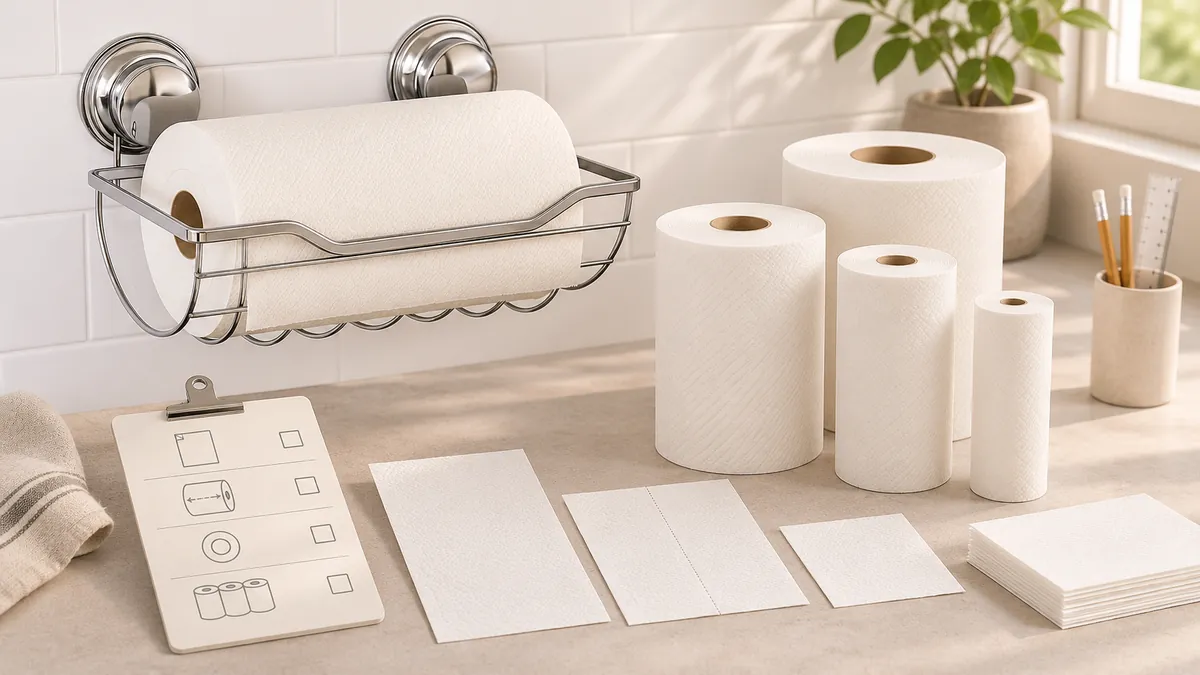
- Paper supplier and exact SKU.
- Market and the source date for the product data.
- Whether the listed unit is a bare roll, retail pack, case or shipping carton.
- Roll outside diameter and axial width, each with its field label and unit.
- Core opening if the holder depends on the core.
- Sheet dimensions and the supplier’s chosen width/length labels.
- Sheets per roll.
- Rolls per retail pack and units per case.
- Packaging dimensions in separate fields.
- Holder support type and relevant clearances.
- Actual sample or product source used for confirmation.
- Holder drawing or version and the refill revision reviewed.
- Data fields that remain unknown.
- Which supplier owns the paper specification and which team approves the hardware interface.
A checklist should make unknowns visible. It should not add guessed values to satisfy a spreadsheet template. If the buyer needs tolerance, minimum clearance, pack weight or another performance field, ask for the actual supplier or project specification. No universal tolerance or maximum capacity is supplied here.
For the separate holder operating-position question, see the Koitor guide to OEM home-storage hardware manufacturing page, e paper towel holder height guide.
Perguntas frequentes
Are paper towel roll sizes standardized?
There is no one number in the cited examples that describes every paper towel roll. Suppliers publish different combinations of roll width, outside diameter, core opening, sheet dimensions and pack quantity. A buyer should compare the exact SKU and market and avoid turning selected product examples into an industry-wide standard.
Does the number of sheets tell me the roll diameter?
No. Sheet count is one quantity field. Outside diameter also depends on the roll construction, the paper and winding configuration, and the core. Use a stated or measured outside diameter for holder-fit review.
Is sheet size the same as roll size?
No. Sheet size describes the unfolded paper format. Roll size describes the wound product, including dimensions such as axial width, outside diameter and, when applicable, core opening. Keep those fields in separate columns.
Do all paper towel holders use the core opening?
No. Holder designs differ. Some use a spindle or other core support; others support the roll in another way. Identify the actual holder interface before deciding whether the core dimension controls fit.
Can I compare inches and centimeters?
Yes, if each value measures the same field and you preserve the original supplier value. Convert a physical measurement transparently and avoid rounding away a fit-relevant difference. Do not combine unrelated fields simply because they share a unit.
What should I do when a product listing omits a dimension?
Record the dimension as “not stated” and ask the supplier or measure the exact sample if the decision depends on it. Do not copy a number from a similar SKU or an older product.
Can a size chart prove that a roll fits a custom holder?
A chart can support a comparison if it defines the same dimensions and refers to the right SKU. For a holder approval, compare the relevant dimensions with the holder design and confirm the intended refill or envelope. The chart alone does not replace the project drawing or sample review.
How should a buyer specify a holder for several refill products?
List the exact refills or define an approved physical envelope, including the dimensions and support points that matter to the holder. Keep the source, market and pack unit attached to each refill record, and review the fit of representative products before making a broad compatibility claim.
Trabalhe com a Koitor Hardware
Developing a Custom Paper Holder or Storage Hardware Product?
Send Koitor the holder drawing, target refill SKU or sample, finish requirement and packaging plan. The team can discuss the verified hardware scope and project inputs for a custom bathroom or home-storage product.
OEM / MARCA PRÓPRIA
Transforme este guia de fornecimento num resumo do produto
Indique o produto pretendido, as dimensões, o acabamento, a quantidade a encomendar e os requisitos de embalagem. A sua equipa receberá uma análise prática da viabilidade de fabrico antes da apresentação do orçamento.


 English
 Español
 Português
 Français
 Deutsch
 العربية