

Zip tie sizes are not described by length alone. A buyer should read the total length, strap width and thickness, head dimensions, and the maker’s minimum and maximum bundle diameter as separate product fields. The tie’s head and tail engagement affect the usable loop, so length divided by pi is not a guaranteed bundle diameter. The manufacturer’s stated range belongs to that exact design. Minimum tensile strength is a force rating, not a dimension or an approved hanging load for a rack, product or package.
This distinction matters when a buyer chooses a tie to bundle components, restrain a retail pack-out or pass through a small opening. A tie can be long enough yet too wide for the opening; a head can interfere with clearance; and a stated minimum tensile force does not establish that the tie is suitable for suspending a product. Compare the named product’s fields with the actual bundle path and packaging requirements, then review the packed sample.
What Does a Zip Tie Size Include?
A zip tie or cable tie combines a strap with a locking head. Product data can include the total length, strap width, thickness, head length or width, a usable bundle-diameter range and minimum tensile strength. These values describe different dimensions or performance attributes and should not be collapsed into one “size” number.
| Product field | What it describes | Buyer use |
|---|---|---|
| Total length | Overall tie length as defined by the maker | Identifies the product length, not a guaranteed circular loop diameter |
| Strap width | Width of the strap | Checks openings, contact footprint and part routing |
| Strap thickness | Thickness of the strap where the maker reports it | Adds geometric detail for clearance or product comparison |
| Head envelope | Locking-head dimensions stated by the maker | Checks passage, placement and clearance |
| Bundle range | Maker-stated minimum and maximum bundle diameter | Compares the product with the specified bundle geometry |
| Minimum tensile strength | Force value stated for the exact product | A product specification, not an application load rating |
The exact field definitions and units should be preserved from the supplier. A buyer should record the manufacturer and part number beside the values. If a listing omits a field, mark it “not stated” instead of borrowing it from a related tie.
A cable tie’s length is not the diameter of the circle it can form around a bundle. The tail passes into the locking head, the head occupies space, the strap has thickness and the actual bundle may not be circular. The maker’s published bundle range accounts for the specific design definition. Do not calculate a guaranteed usable diameter by dividing length by pi.
Which Dimensions Matter for Fit?
Start with the actual route the tie must follow. If the strap passes through a slot, the strap width and thickness may matter. If the head must pass through an opening or sit next to a component, the head’s envelope and orientation matter. If the tie wraps around a bundle, compare the bundle’s actual shape with the maker-stated range rather than assuming that length alone defines fit.
A tie applied around a non-circular bundle does not necessarily create a circular loop. The strap follows the surfaces and gaps that it contacts. A practical comparison therefore identifies the path around the bundle and the location of the head. If the tie is part of a retail package, determine where its head and strap touch the product, finish, inner pack and carton.
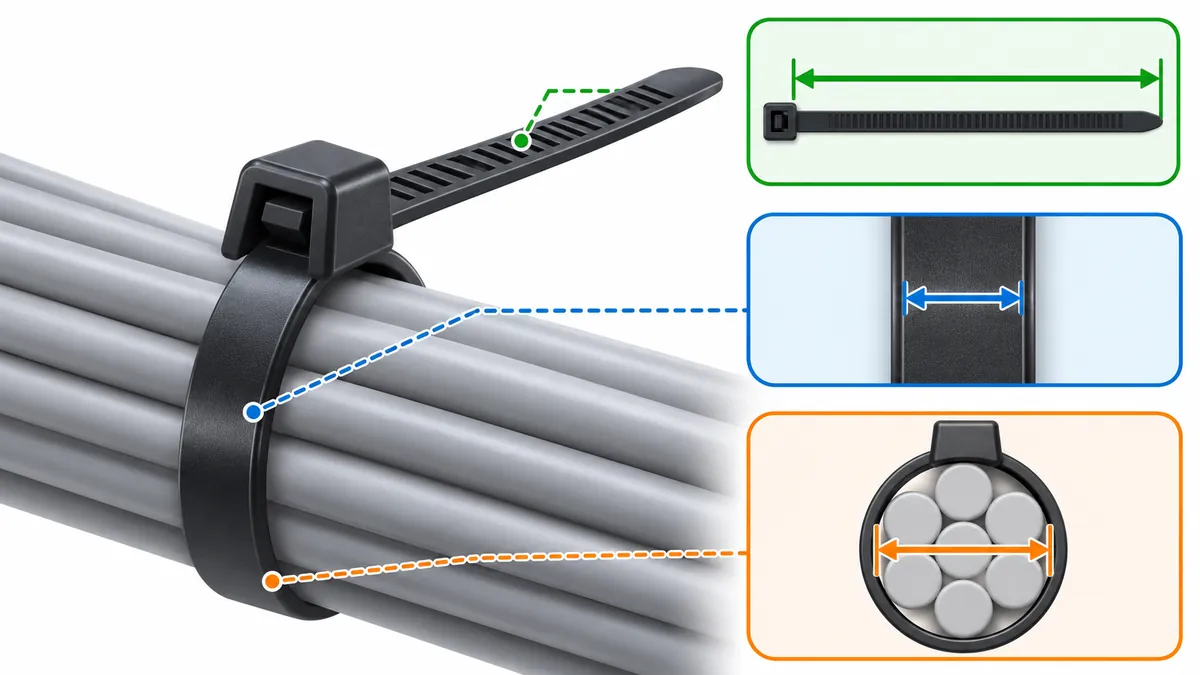
A product-fit record can list:
- Bundle shape and the outer path the tie will follow.
- Any slot, aperture or channel the strap must pass through.
- Strap width and thickness.
- Head dimensions and its planned position.
- Minimum and maximum bundle range from the exact maker listing.
- Product finish and any package surface that may contact the tie.
- Tie part number and source document.
- Sample or pack-out revision used for review.
This is a product communication checklist, not a design instruction for tightening, tension or load. The application owner should follow the specific maker directions and project requirements. A tie that physically fits an opening may still be inappropriate if the head or strap contacts a sensitive surface or distorts the package.
Why Is Length Not the Same as Bundle Diameter?
Overall length includes more than the section that forms a loop around the bundle. The tail must engage with the locking head, and the head itself has geometry. Manufacturers may define and report a bundle range for the product instead of expecting users to infer one from length. The bundle’s shape also affects the route.
For a quick geometry illustration, imagine a strap following around three flat sides of a rectangular bundle, with a locking head located beside one corner. The path length around the sides is not the same as the bundle’s circular diameter. The head and tail overlap or engage as part of the closure. If the buyer divides overall length by pi, that assumes a circular path with no head or engagement allowance; those assumptions are not guaranteed by the listing.
A different bundle shape can change which surfaces the strap contacts. A tie wrapped around a pair of tubes, a retail carton or a mixed-shape hardware kit follows different geometry. The maximum range listed by the maker is a product field; it does not automatically approve the tie for any of these applications. The buyer still needs the exact product and pack-out context.
If a tie must pass through a slot and then around a bundle, two distinct checks are involved. The slot is a local passage constraint. The bundle range concerns the maker’s stated wrap capacity. Passing one check does not establish the other. Keep the head orientation in the drawing or sample photo so the reviewer can see whether it interferes with a nearby wall or package edge.
What Do Two Named Tie Examples Show?
Two HellermannTyton products illustrate why similar length values do not make ties equivalent. The manufacturer listing for part 111-01601 reports a 305 mm length, 4.6 mm strap width, 1.2 mm thickness, 1.5–80 mm bundle range, a 7 mm head length, a 7.8 mm head width and 225 N minimum tensile strength. The named 111-02496 listing reports a 307 mm length, 12.7 mm strap width, a 9.5–82.5 mm bundle range, a 19.81 mm head width and 535 N minimum tensile strength. Those are product-specific published values.
| Named product | Stated length | Strap width | Stated bundle range | Stated minimum tensile strength |
|---|---|---|---|---|
| HellermannTyton 111-01601 | 305 mm | 4.6 mm | 1.5–80 mm | 225 N |
| HellermannTyton 111-02496 | 307 mm | 12.7 mm | 9.5–82.5 mm | 535 N |
Sources: HellermannTyton 111-01601 e HellermannTyton 111-02496. The two listed lengths are close, but the products differ in width, bundle range, head geometry and other construction or material fields. That is not a controlled test of any single variable and does not show that width caused a particular strength value. Do not use these examples as universal tie dimensions or substitute products.
The values remain in the manufacturer’s stated metric units. Do not recompute a precise-looking conversion from a rounded imperial field if the maker’s metric value is already published. Keep the original part numbers and source beside the row. A product page can change; the examples represent the retrieved data for the named entries and should be rechecked before a purchasing decision.
Is Tensile Strength a Dimension or a Load Rating?
No. Minimum tensile strength is a force value associated with the specified product and test context. It is not a dimension like width or length. It does not automatically become a permitted hanging load, a rated restraint for a metal rack, or an approval for a specific packaged product.
A buyer should avoid turning a manufacturer’s tensile specification into a simple “safe weight” claim. The load path, application, installation, environment and design requirements are not supplied by the tie’s length table alone. This article does not provide a tie-strength calculation, safety factor or lifting instruction. Do not use a cable tie as a lifting device based on a catalog force number.
For a hardware pack-out, the tie may be intended to keep grouped parts together or control how a package is arranged. That does not mean the tie carries the product’s structural load. A sample review should verify what the tie is actually asked to do and which surfaces it contacts. If the package uses the tie for a retention or handling function, the responsible packaging designer should define the requirements and select the appropriate evidence.
The maker’s material and product fields should remain attached to its strength value. Do not combine the number from one tie with the size or material description of another tie. Do not assume two products with similar lengths share the same strength, material, temperature rating or regulatory status. The named examples above demonstrate separate fields, not a universal relationship.
How Should Buyers Choose a Tie for Hardware Packaging?
A buyer reviewing a tie in a hardware package should state the purpose before choosing the size. Is the tie grouping accessories, keeping a component in a kit, holding a package arrangement during handling, or performing another defined function? The answer affects which product fields and project checks matter. Avoid treating every tie that “fits around” the part as an approved packaging choice.
For a metal bathroom or home-storage product, the buyer should check whether the tie touches a finished surface, a wire, an edge or an accessory. A snug wrap could press against product geometry, but this article does not predict deformation or finish damage. It directs the buyer to review the actual sample and packaging arrangement. If the tie is removed by the end user, the package designer should also describe the intended opening method and avoid any unverified user-safety promises.
Koitor’s bathroom hardware packaging guide covers broader package planning. For an e-commerce pack-out context, see the existing Amazon FBA hardware packaging article. Other existing internal links discuss unrelated cable-device airflow or shower-caddy mounting questions and should not be used as proof for tie capacity. The relevant packaging owner is the right place for restraint, protection and carton-level questions.
What Should a Buyer Record in a Size Comparison?
Use a supplier comparison sheet that keeps both measurement and application fields. A practical table might include:
| Record field | What to enter |
|---|---|
| Supplier and part number | Exact named item |
| Total length | Value and unit exactly as supplied |
| Strap width and thickness | Separate fields where published |
| Head envelope | Published head dimensions and orientation |
| Bundle range | Maker-defined minimum and maximum |
| Strength field | Exact name, value, unit and source |
| Material | Supplier-stated product field |
| Intended function | Buyer-defined use in the pack-out |
| Interface | Slot, route, bundle or other geometry |
| Contact surfaces | Product, finish, inner pack or carton |
| Source and date | Page or specification and retrieval date |
| Approval record | Project owner and reviewed sample revision |
If two suppliers use different field names, keep the original names and add an explanatory normalized field rather than overwriting the source. A field such as “head width” may be useful, but only if the value is genuinely the width the supplier defines. Keep unknown values unknown.
A measurement should match its object and unit. Millimeters for length and width, Newtons for force, and a diameter range for bundles are not interchangeable data. A comparison table makes it easier to spot an incomplete quotation, but it does not itself approve a product.
How Should the Two Product Records Be Interpreted?
The product comparison shows why the measured fields should be read together. The 111-01601 listing supplies a relatively narrow strap and a stated thickness and head envelope; the 111-02496 listing supplies a much wider strap and a different head width. Their published bundle ranges overlap in part, but the overlap does not create product equivalence. A buyer still needs the specific part construction and intended route.
The minimum tensile values also differ, but the examples vary in multiple product attributes and are not a controlled test. The numbers do not support a conclusion that width caused the force value, that one tie is better for every task, or that either value is an approved application load. This article preserves the manufacturer’s labels and part numbers instead of trying to build a general formula from two catalog rows.
A buyer can use the data as a reminder to separate questions:
- Will the strap fit the intended passage?
- Will the head clear the nearby structure?
- Does the bundle fall within the named product’s published range?
- What is the tie being asked to do in the package?
- Which exact product field supports the conclusion?
These questions lead to a real comparison without claiming that one product can replace another. For a project decision, compare the released specification with the supplier’s current product information and the actual sample. If a field is missing, ask the manufacturer or leave it unresolved rather than deriving it from another product.
What Mistakes Should Buyers Avoid?
Do not divide tie length by pi to claim a guaranteed bundle diameter. The locking head and tail engagement are part of the product, and the bundle may not be circular.
Do not compare only total length. Width, thickness, head envelope and bundle range can influence fit or routing.
Do not call tensile strength a dimension or use it as an approved hanging load. It is a force field tied to a named product and context.
Do not assume a manufacturer’s range applies to every geometry. Compare the actual bundle and product definition.
Do not infer material or regulatory compliance from a product’s appearance or nearby catalog row. Confirm the exact manufacturer fields.
Do not transfer specifications between products that have similar lengths. The two named examples differ in multiple attributes and are not a controlled comparison.
Do not assume that physical fit establishes packaging approval. Review the actual finish, contact location, function and pack-out.
Do not use cable-tie data to design electrical, lifting, vehicle or medical applications in this article. Those contexts are outside scope.
What If the Package or Product Changes?
Recheck the tie when the bundle, routing slot, head position, product finish or inner package changes. The earlier sample may no longer represent the path or contact surface. Record the tie part number and package revision together so a buyer can tell which combination was reviewed.
If a buyer switches supplier, compare the new product data against the same fields rather than matching only the nominal length. A replacement with a similar label may have another head envelope, strap width, bundle range or material. The correct approval depends on the project’s purpose and actual package, not the similarity of the names.
Buyer Checklist for Zip Tie Sizes
- Exact supplier and part number.
- Overall length and units.
- Strap width and thickness where stated.
- Head length, width or envelope where stated.
- Manufacturer’s bundle range.
- Strength field named as the manufacturer presents it.
- Tie material and other relevant product fields.
- Actual bundle shape and route.
- Opening or slot dimensions if the strap or head must pass through them.
- Product finish and contact locations.
- Defined packaging purpose.
- Sample and package revision used for review.
- Maker instructions and any buyer approval required.

How Should a Buyer Compare Similar Lengths?
The two HellermannTyton T50I product data e WSI product data illustrate why total length alone is not a complete cable-tie specification. Their listed lengths are close, while the maker reports different strap widths, head dimensions, bundle ranges and other product fields. These are examples of two named products, not a controlled strength comparison: construction and materials differ, and the published minimum tensile values are not an application load rating.
For a hardware pack-out, first describe what the tie must route around and where the locking head must sit. Then check maker-defined usable bundle range, total length, strap width, thickness and head envelope against the actual path, slot and finish-contact limits. A loop that can close around a bundle may still leave a head that cannot pass through an opening or may place the tie against an unapproved visible surface. Record the selected product code and source revision so a later substitute is compared field by field. Do not choose solely by a similar advertised length or infer that a wider strap is always the correct solution.
For related kit-packaging and private-label planning, see Koitor’s packaging insert design guide, e private-label bathroom accessory guide.
Perguntas frequentes
How are zip tie sizes measured?
Read the manufacturer’s fields for length, strap width and thickness, head dimensions and bundle range. Keep each value and unit attached to the exact part number.
Is zip tie length the same as bundle diameter?
No. The head, tail engagement and the path around the bundle affect usable capacity. Use the maker-stated bundle range for the exact product.
Can I calculate bundle diameter by dividing length by pi?
No. That simple calculation assumes an ideal circular loop and omits the product’s head and engagement geometry. It is not a guaranteed bundle range.
What is minimum tensile strength?
It is a force field reported for the named product, not a dimension. It does not automatically authorize a tie to suspend or carry a product.
Can two zip ties with similar lengths be substitutes?
Not based on length alone. Compare the complete specifications, head, width, bundle range, material and application, then obtain project approval.
Does a wider tie always have greater tensile strength?
The two named examples are not a controlled comparison and have other design differences. Do not derive a universal strength rule from them.
Can a zip tie damage a metal hardware finish?
This article does not predict a result. Review the actual tie, contact points, product finish and packed sample for the intended application.
What should I check if a tie must pass through a slot?
Check the strap and head dimensions against the opening and orientation, and separately compare the bundle range with the actual path. A pass-through fit does not prove the complete package is approved.
Document who reviewed the new combination, what source they used, and whether the prior approval still applies.
Keep this approval linked to the exact source.
now.
Trabalhe com a Koitor Hardware
Reviewing a Hardware Pack-Out or Component Kit?
Share the product drawing or sample, tie specification, pack-out purpose and packaging requirements. Koitor can discuss the confirmed bathroom and home-storage hardware scope and the project inputs needed for packaging review.
OEM / MARCA PRÓPRIA
Transforme este guia de fornecimento num resumo do produto
Indique o produto pretendido, as dimensões, o acabamento, a quantidade a encomendar e os requisitos de embalagem. A sua equipa receberá uma análise prática da viabilidade de fabrico antes da apresentação do orçamento.


 English
 Español
 Português
 Français
 Deutsch
 العربية