
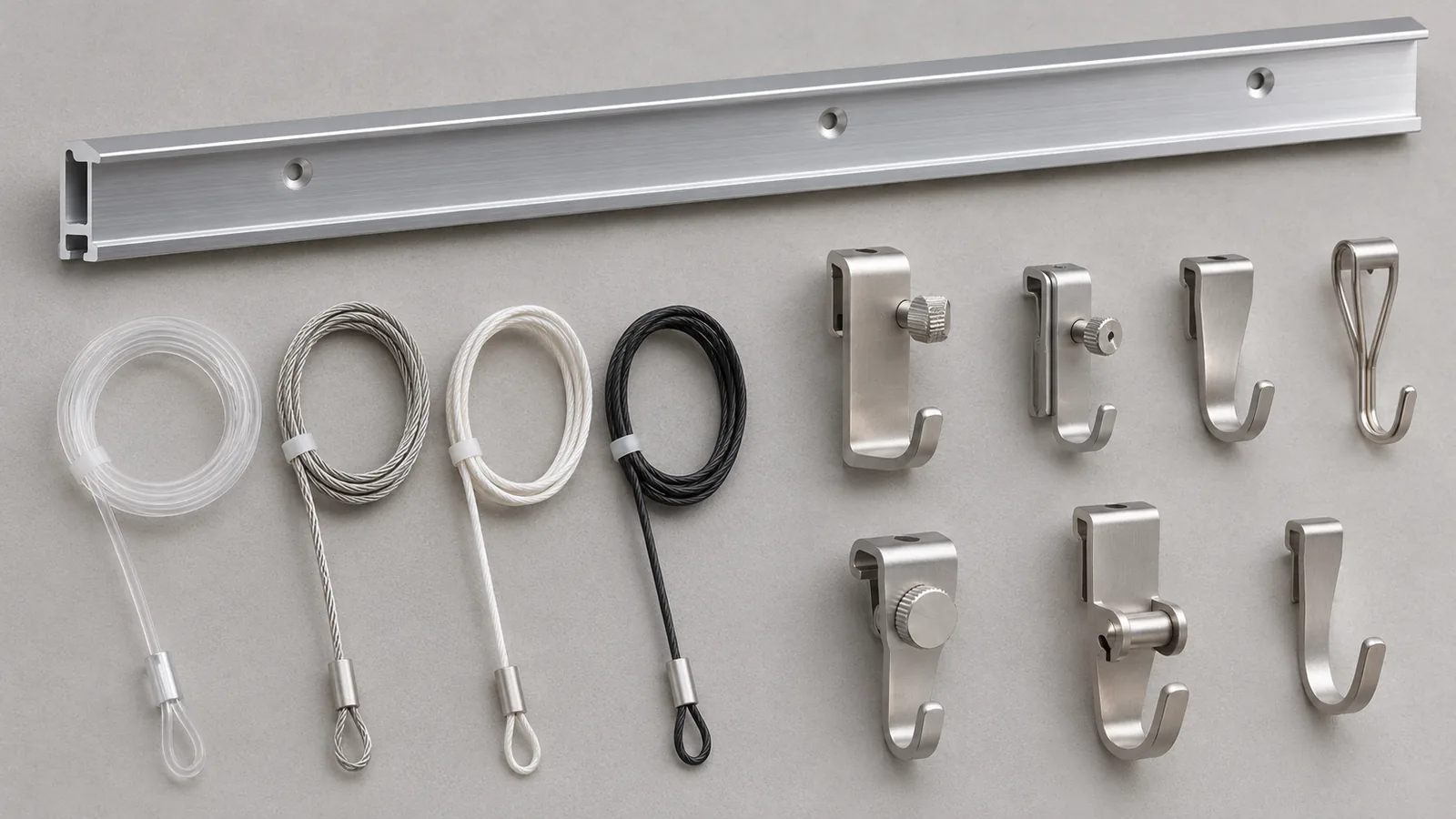
A distributor should evaluate picture hanging rail hook cord compatibility as a documented relationship among a named rail, its cord end, the cord itself and the selected hook. A component that appears to fit another part does not establish that the manufacturer supports that combination or that the complete arrangement has a particular load rating. Before ordering, name each component and revision, record supported combinations and exclusions, and obtain evidence from the responsible system supplier. This guide covers indoor assortment planning and specification; it does not provide installation instructions, structural calculations or safety ratings.
Why Is “Picture-Hanging Hardware” Not One Compatibility Question?
The phrase “picture-hanging hardware” can refer to a rail fixed to a wall, a cord or cable, an end fitting that engages the rail, an adjustable hook, and the picture-frame attachment. These parts connect at different interfaces. A retailer may group them together in one category, but the assortment decision must preserve their individual identities.
A rail interface question asks whether a named end fitting is intended to engage a named rail profile. A cord question asks whether the line and fitting belong to a supported combination. A hook question asks whether the hook is intended for that cord construction and size. The frame-side question may depend on a separate attachment or the way the displayed item is prepared. Evidence for one connection does not automatically validate the next.
This distinction matters when a distributor creates starter kits or replacement parts. A kit can include a rail, two cords and adjustable hooks, or it can contain only a replacement hook. Product pages often use broad terms such as “picture hook” or “gallery wire,” even though those terms do not uniquely identify a part. A SKU may also have finish or length variants that do not affect the mechanical interface, while another seemingly minor revision may change it. The buyer must ask the supplier which details define compatibility.
| Interface | Identity to record | Question to resolve |
|---|---|---|
| Rail to cord end | Rail supplier/model/revision and end-fitting identity | Is this end fitting supported for this rail? |
| Cord end to cord | Fitting model and cord construction/size | Is the fitting made for this actual line? |
| Cord to hook | Cord identity and hook model | Does the supplier document this pairing? |
| Hook to display item | Hook design and intended frame attachment | What does the system supplier support? |
| Complete arrangement | Full component list and application | Who owns complete-system claims and evidence? |
The table is a procurement prompt, not an engineering analysis. A buyer should not infer a safe working load, allowable combination or installation method from a parts photograph. Ask the product system’s responsible supplier for current documentation and follow its instructions.
Which Rail Family Is the Buyer Actually Selling?
Start with a named rail. Do not begin by selecting a hook based on a photograph or a generic rail category. Profiles can look similar in a retail image while having different internal shapes, engagement features or required end fittings. A channel that visually resembles another may still be designed for its own cord carrier.
Record the rail maker, product family, model number, revision and any market-specific variant. If the supplier uses a family with several profile options, clarify which one the buyer will sell. Ask whether the rail is supplied as a complete kit or sold separately and whether a particular cord end is included. The importer should retain a product sheet, technical drawing or compatibility document that names the combination.
Manufacturer support pages show why this matters. Artiteq’s FAQ distinguishes compatibility between a hanging wire and a rail from compatibility between a hook and a wire family. STAS’s FAQ likewise frames selection around named rail types and specified cord/hook combinations. Those manufacturer statements apply to their own systems; they do not establish cross-brand interchangeability or certify any proposed mixed set. Consult the suppliers’ current instructions directly: Artiteq FAQ e STAS FAQ.
A rail listed by one supplier can be compatible with several components within that supplier’s documented family. That does not mean every component carrying a similar name is interchangeable. A private-label buyer should request the current compatibility matrix and understand whether it covers the exact rail revision being quoted. If the manufacturer changes a profile or end fitting, determine whether older accessories remain in the supported range and whether product listings need revision.
In a distributor catalog, show the rail family separately from generic accessories. If the product set is cross-branded, the buyer should identify the source of every component and ask each responsible manufacturer to confirm its part’s role. The buyer’s procurement record should state whether the supplier has approved the whole combination or only individual parts.
How Should the Buyer Match the Cord End and Rail?

The rail-to-cord interface should be matched through the rail manufacturer’s stated compatibility information. The buyer should record the exact end-fitting model and the exact rail model, then preserve the source document or written confirmation. A physical fit observation is useful for identification, but it is not a substitute for technical support from the responsible supplier.
The sample review should answer factual questions: Does the named component belong to the intended supplier family? Is it the same revision as the quoted part? Does the supplied cord end engage the rail according to its instructions? Are any adapters, caps or additional parts required? If an end fitting is sold separately from the cord, is it included in the quote and kit? These checks prevent an importer from assuming a complete system includes parts that are actually optional.
Do not alter an end fitting, enlarge a rail groove, add an unapproved retainer or make another modification to force a match. The assembly may then differ from the product the manufacturer evaluated. If the proposed combination is not listed, ask the responsible system supplier to review it. A distributor can document a compatibility request, but should not convert an unverified experiment into a sales claim.
A useful record includes a photo of the rail label and end fitting alongside the part numbers, but photographs should not show confidential customer information or substitute for controlled product identity. Keep a sample ID and quote revision so that the evidence is traceable. If the supplier responds that the parts are compatible only under certain conditions, preserve those conditions in internal product data and customer-facing instructions where relevant.
What if the cord appears to fit the rail?
Appearance and engagement alone do not establish the supplier’s support for the combination. A cord end may enter a rail but could be a different system, revision or intended use. Record the observation as a physical fit observation and obtain documentation from the manufacturer before marketing it as compatible.
Does one rail family have only one cord option?
Not necessarily. A supplier may offer different cord materials, lengths or end fittings for a family. The buyer should not assume a universal set; check the current product matrix and note any model-specific distinctions.
How Should a Hook Be Matched to a Cord?
The hook and cord interface is separate from the rail and cord-end interface. A hook that can slide onto a line or seems to grip it does not prove that the manufacturer approves the pairing. The cord’s construction, outside size and shape, along with the hook’s adjustment mechanism, may define which combinations the system supplier supports.
Ask for the exact cord identity and the exact hook model. Confirm whether the hook is designed for a particular cord or a defined set of lines, and whether the supplier provides a current compatibility chart. If the accessory has a locking or adjustment feature, follow the product instructions; do not recommend tying knots, adding clamps or modifying the hook unless the manufacturer explicitly supports that method.
An adjustable hook can be marketed for convenience, but that description does not equal a load rating. A hook that moves along a cord when unloaded may behave differently under a particular display setup; a buyer cannot infer system performance from manual movement or a demonstration. Any load claim must come from current evidence for the complete combination and specified conditions from the responsible supplier.
Product images can also create misleading assumptions. A cord may appear to be a wire, a textile line or a polymer-coated cable. The label “wire” may not describe all underlying construction details. The importer should use the supplier’s component code and published description, and should ask for clarification if the part is changed or another source is proposed.
When a range includes several hook shapes, assign each a role only when supported by its product documentation. Avoid implying that one hook will fit every picture frame, line or installation. The frame attachment and the wall-mounted rail may be separate systems, and the intended application and instructions matter.
What Should a Distributor’s Combination Matrix Contain?
A matrix prevents the sales team from treating all components as one undifferentiated category. Use one row per documented combination, and keep unsupported or unreviewed combinations out of the “compatible” field.
| Matrix field | Example of a suitable record |
|---|---|
| Rail supplier/model | Exact product family and revision supplied by the maker |
| End fitting | Part code and whether it comes with the cord |
| Cord | Supplier identity, product code and declared construction/size |
| Hook | Exact model code and any adjustment family |
| Supported combination | Supplier-stated pairing and source document date |
| Exclusions | Explicitly listed incompatible or unreviewed parts |
| Included pieces | Components contained in the quoted kit or package |
| Evidence owner | Manufacturer or system supplier responsible for compatibility |
| Substitution control | Person who approves a changed supplier or part |
| Customer wording | Bounded description consistent with documented support |
| Open questions | Missing revision, evidence or part responsibility |
The matrix should distinguish “supplier approved,” “physically observed” and “not reviewed.” Those statuses are not interchangeable. A set that has been laid out on a table may be physically identifiable without having been evaluated as a complete system. Likewise, a compatibility statement about a hook and cord does not necessarily address the cord-end and rail.
If a supplier gives a compatibility list, retain the version and date. A webpage can change, and product references can be discontinued or replaced. The importer should know how it will update its product database, replacement-parts guide and distributor catalog when that happens. For high-volume ranges, assign a person or role to monitor changes instead of relying on an old screenshot.
Do not multiply a manufacturer’s component-level statement into a complete-system guarantee. If the responsible manufacturer has a stated load capacity or a specific application instruction, reproduce it only when the exact combination and conditions match and the supplier permits that use. This article does not provide capacity values or engineering calculations.
How Should Buyers Compare Quotes Without Mixing Configurations?
Ask every supplier to quote the same part family, cord length, end fitting, hook, finish, package quantity and instructions. Without a common bill of materials, prices may describe different sets. One quote may include a rail adapter and a hook, while another covers only a cord. A comparison sheet should therefore list each component and whether it is included.
Clarify which supplier owns the compatibility statement. If a distributor combines products from different manufacturers, request evidence from the party responsible for the complete combination. Do not assume that two suppliers’ independent product descriptions can be combined into one approval. The component maker may support its item only when used with a particular rail or cord.
Price comparison should include replacement availability, packaging identifiers and how the customer will distinguish rail families. The lowest line-item cost may omit an essential end fitting or refer to a different hook. A quote that identifies part codes, revisions and exceptions is easier to evaluate than one using broad labels.
Ask each bidder to state what changes would require reapproval. These may include a different rail profile, cord construction, end fitting source, hook adjustment design, material or product instruction. Do not assume a visually similar replacement can be substituted without review. A product change can affect an interface even if the rest of the assortment remains the same.
When a buyer is developing a private-label kit, freeze the approved bill of materials and package contents. Link the drawing, compatibility source and customer-facing claim to the same revision. That allows a category manager to handle reorders and supplier changes without silently expanding the compatibility promise.
How Should Substitutions and Reorders Be Controlled?

Treat a substitution as a controlled change. If a rail, cord end, cord or hook becomes unavailable, request the alternative part code and a current compatibility statement. Ask whether the change affects the other components, packaging, installation instructions or sales claims. Record who reviewed the change and whether samples were examined.
A replacement component from another supplier can be appropriate in some situations, but the buyer must not assume it is approved because the dimensions look similar. The system supplier’s evidence and responsibility matter. If the product is sold under a private label, define who authorizes the substitution and who must update technical records.
A reorder should reference the original configuration and revisions. If the buyer expects the same assortment, compare the new quote and product identifiers with the approved record. Verify that the supplier is not substituting a revised cord end or hook without explanation. If the new version differs, evaluate whether the compatibility matrix and package materials need updating.
Distributors should also plan for obsolete parts. If a rail family is discontinued, identify which replacement accessories remain supported and which combinations require technical confirmation. Do not make compatibility claims based on a superseded PDF or a dealer’s informal note if the manufacturer has published a newer product matrix.
Which Product Claims Need Separate Evidence?
Claims about compatibility, capacity, safety and installation are distinct. A component that engages a rail is not automatically suitable for every application or load. Adding two cords does not justify doubling a component rating. A supplier’s statement for one model cannot be transferred to a different cord or hook.
The distributor should maintain a claims register that connects each customer-facing phrase to a source and product revision. Examples include “compatible with rail family X,” “includes hook Y,” or “adjustable on cord type Z.” The source should be a current supplier document or written confirmation for the named parts. If the source does not address a claim, remove or qualify the claim rather than extrapolating.
Do not call a system “safe,” “secure,” “heavy duty,” “universal” or suitable for a specific weight without relevant evidence. The article does not evaluate wall or ceiling anchors, installation substrates, building conditions or overhead use. The responsible project parties must consult the manufacturer’s instructions and qualified professionals for site selection, installation and application decisions.
If product instructions are included in a kit, ensure they match its exact rail, cord-end and hook combination. A card printed for an earlier version can create confusion even when some parts look similar. Include a revision or product identifier and define how the buyer controls language changes.
How Do Packaging and SKU Design Reduce Assortment Confusion?
The external package should identify the parts actually inside and distinguish variants with different interfaces. A generic picture-rail accessory image may not be enough if multiple rail families or hook types are sold. Clear model codes, a component list and a bounded compatibility statement help wholesale buyers allocate stock and answer customer questions.
Use a kit identifier that resolves to the bill of materials. If a package contains a rail end fitting, cord and hook, list them. If the hook is sold separately, say so. Avoid photographs that show optional parts without labeling them; the product image should correspond to the supplied package or clearly identify optional items.
For e-commerce, maintain consistent data across title, bullet points, comparison charts, image alt text and downloadable instructions. A phrase such as “fits picture rails” should be replaced by a precise, evidence-backed scope when only a named family is supported. If the compatibility evidence changes, update the product record across all relevant channels.
At reorder, inspect carton labels, part identity and inclusion against the approved SKU. This is a configuration check, not proof of system performance. Packaging helps prevent assortment errors but cannot compensate for missing compatibility documentation.
What Is the Responsible Role of a Metal OEM Supplier?
A metal OEM supplier may be relevant to a buyer that needs a custom metal hook, bracket or other component. That supplier can review drawings, samples, finish expectations and production requirements within its confirmed capabilities. It should not be presented as the engineer or certifier of a complete picture-hanging system unless that responsibility and supporting evidence are explicitly established.
Koitor Hardware is a family-owned custom metal hardware manufacturer specializing in bathroom and home storage hardware. Its production experience may support conversations about metal-part drawings, forming, finishing, assembly, packaging and flexible small-batch OEM development. That general background does not confirm that Koitor currently manufactures picture rails, cord systems, self-locking grippers, swaged cable assemblies or a certified hanging system.
When a distributor asks Koitor to review a metal part, share the drawing or physical sample, intended interface, surface requirements, quantity and any purchased components. Clarify who supplies the cord, end fitting and hook and who owns a system-level compatibility claim. The supplier should confirm its scope before the buyer describes it as a product offering.
This division of responsibility improves sourcing clarity. The metal part supplier addresses the part it makes. The system supplier provides the compatibility information it controls. The distributor maintains the assortment and marketing record. The buyer avoids implying that a component drawing alone approves the complete set.
The buyer should record picture hanging rail hook cord compatibility against the named sample and revision rather than a generic product label.
Keep the picture hanging rail hook cord compatibility decision limited to the references actually reviewed and the approved configuration.
Buyer Checklist Before Requesting a Quotation
- Identify the exact rail supplier, model and revision.
- Name the cord end that engages the rail and confirm whether it is included.
- Record the cord product code and supplier-declared construction or size.
- Select the exact hook model and obtain its supported cord combinations.
- Preserve current compatibility documentation and its revision date.
- Separate documented approval from physical-fit observation.
- List included and excluded kit components.
- Identify the supplier responsible for complete-system statements.
- Define whether any load, safety or installation claim needs separate qualified evidence.
- Provide the target assortment, pack quantity, finish, label and instruction needs.
- Define substitution approval and revalidation responsibilities.
- Tie every customer-facing compatibility statement to the approved BOM and evidence.
Perguntas frequentes
Does a hook that fits over a cord prove compatibility?
No. It only shows a physical interaction under that observation. The buyer should verify that the responsible manufacturer supports the exact cord and hook combination.
Can components from two brands be mixed?
Do not assume so. Obtain current confirmation from the supplier responsible for the combination and preserve its stated conditions and exclusions.
Does a cord end that enters a rail prove the complete system is approved?
No. It addresses at most one interface. The hook/cord pairing and full configuration need their own supporting evidence.
If two cords are used, can the buyer double the system rating?
No. Do not calculate a system rating from the number of lines or parts. Use only the responsible manufacturer’s documented rating for the exact arrangement and conditions.
What should a distributor do when a component is discontinued?
Ask the manufacturer for a currently supported replacement, review the entire affected combination, and update the SKU record, instructions and claims before substitution.
Can Koitor supply a complete picture-hanging system?
No current complete-system capability is established by this guide. Koitor can review a documented metal-part requirement within its confirmed production scope; rails, cords and specialized fittings must be separately confirmed.
Trabalhe com a Koitor Hardware
For a metal component or custom hardware drawing, share the intended interface, current sample, finish requirement and target quantity. Koitor can assess whether the metal-part scope matches its confirmed capabilities and identify questions about separately sourced components.
Discuss a Custom Metal Hardware Requirement
Send a drawing or sample and identify the part, interface, quantity and evidence you need.
OEM / MARCA PRÓPRIA
Transforme este guia de fornecimento num resumo do produto
Indique o produto pretendido, as dimensões, o acabamento, a quantidade a encomendar e os requisitos de embalagem. A sua equipa receberá uma análise prática da viabilidade de fabrico antes da apresentação do orçamento.


 English
 Español
 Português
 Français
 Deutsch
 العربية