

The polycarbonate vs PETG comparison should begin with the actual sheet or component being quoted. Polycarbonate (PC) and PETG are different thermoplastic materials, and PETG is a glycol-modified copolyester. Both can appear in clear sheet products and fabricated parts, but the family names alone do not establish impact performance, chemical compatibility, heat behavior, fabrication suitability or the finished part’s safety. A useful polycarbonate vs PETG decision therefore ties a named material and revision to a defined component and use case.
A buyer should identify the exact grade, thickness, form, surface treatment, process and intended application before comparing supplier data. A published number may describe one grade and test specimen; it is not automatically a guaranteed property for another sheet, formed cover, machined part or completed assembly.
This guide provides a sourcing framework for comparing PC and PETG without relying on universal rankings. It does not certify a machine guard, define a safety requirement, or recommend a sheet for an unspecified design. The actual product owner and material supplier must confirm any performance or regulatory requirement.
What are polycarbonate and PETG?
Polycarbonate is a thermoplastic family built around carbonate linkages; PETG is a glycol-modified copolyester related to polyethylene terephthalate. The names identify different polymer families, but both are available in grades and forms that require product-specific information.
Eastman’s copolyester overview explains the broad copolyester category and how modification can change polyester material families. A PETG request should still identify the actual manufacturer and grade; the term alone does not identify every formulation. Similarly, PC is a broad material name, not a full specification for a sheet or component.
The product form affects which comparison is useful. An extruded sheet may be used as a panel, cover or fabricated component, while another grade may be supplied as a rod, tube or molded shape. A downstream converter may cut, bend, machine, form or join the stock. The buyer needs to know which operations are included and which dimensions or surface attributes are controlled.
Piedmont Plastics’ PC versus PETG article introduces the comparison and explicitly notes that technical information may vary. Its listed values are not adopted here as universal limits. Eagle Plastics’ comparison of clear sheet materials gives supplier context about sheet, rod and tube forms, but broad application and performance claims should remain tied to the named grade and the supplier’s conditions.
| Pergunta do comprador | Polycarbonate (PC) | PETG | What the buyer should verify |
|---|---|---|---|
| Material family | Polycarbonate thermoplastic | Glycol-modified copolyester family | Exact manufacturer and grade |
| Product form | Sheet, rod, tube or finished component depending on supplier | Sheet or other supplier-specific product form | Stock form, thickness and process |
| Fabrication | Depends on grade, thickness, tools and method | Depends on grade, thickness, tools and method | Converter guidance and part drawing |
| Dados relativos ao desempenho | Grade- and test-specific | Grade- and test-specific | Method, specimen, conditions and value type |
| Application limits | Must be stated for the selected sheet/component | Must be stated for the selected sheet/component | Actual use, exposure and approval criteria |
This table is an inquiry aid, not a performance chart. It intentionally does not rank impact, temperature, price, chemical resistance or safety because those depend on the precise material and design.
Why is the sheet grade and thickness important?
A family name and nominal thickness do not fully identify a sheet product. The buyer should state the grade or manufacturer product code, thickness, dimensions, surface, color or clarity requirements, tolerance and any required certificate or test evidence.
Sheet thickness can affect forming and assembly geometry. If a panel is bent, fastened, bonded or inserted into a frame, the drawing should identify the shape, edge conditions, mounting details and fit. A substitution that changes thickness or process may change clearance and interface behavior. The material family name does not make two different sheet designs equivalent.
The grade may also specify features that matter to the project, such as surface coating, UV protection, tint, texture or an intended processing method. Do not assume that every PC sheet is coated or every PETG sheet has the same surface. Ask the supplier which grade is offered and what the data sheet states. If the component is a finished cover rather than raw sheet, identify the converter and the final part number.
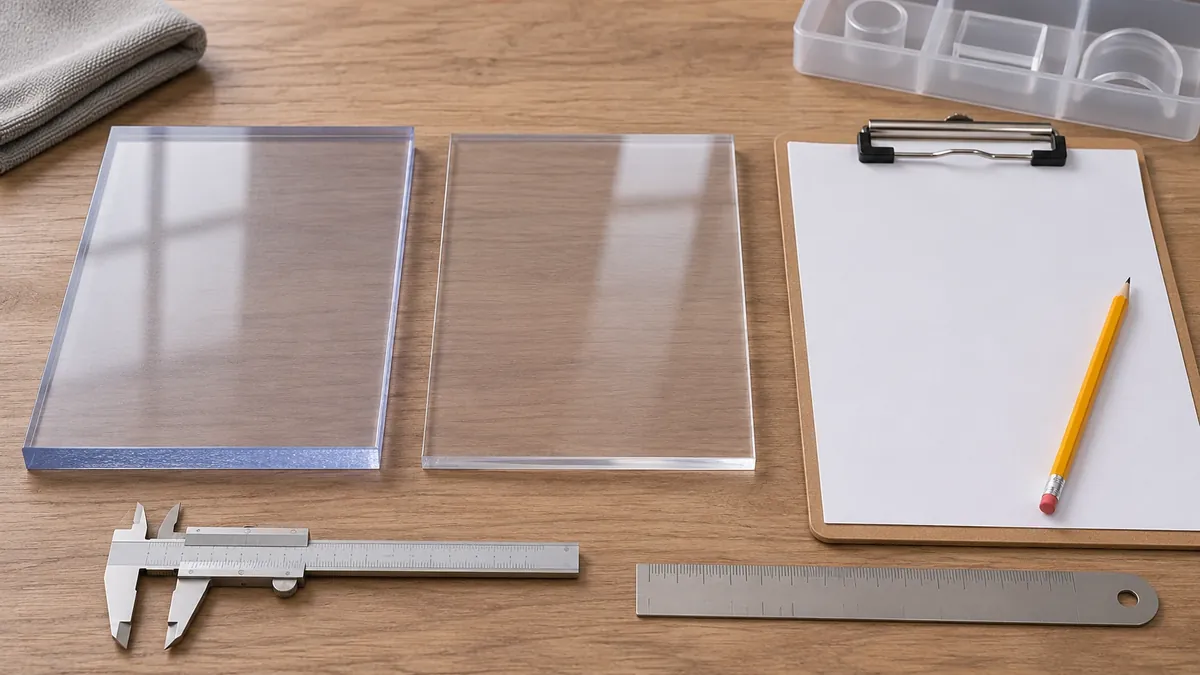
A clear sample is not enough to establish hidden grade or performance. It can help review appearance, fit and visible defects, but it does not verify the resin or test values by itself. Request the supplier’s document for the exact material and connect it to the sample lot. If the buyer needs traceability, state that requirement before the quote.
How do processing and fabrication affect the choice?
Processing can change the form, dimensions and evaluation needs of a material. A sheet may be cut, drilled, routed, bent, thermoformed, machined or assembled with other parts. The suitability of a process depends on the exact grade, thickness, geometry, tooling and supplier instructions. Buyers should not assume that a generic statement about PC or PETG applies to every converter or finished component.
For a simple panel, the RFQ may focus on dimensions, edges, surface and mounting interfaces. For a formed cover, the design may need to control bend locations, radii, formed features and final fit. For a fastened guard or window, the interface, fastener placement and clearance must be identified by the responsible designer. This article does not supply safe-guard calculations or minimum thickness.
A prototype also has limits. A cut sample can demonstrate color and approximate fit, while a formed sample may provide better evidence about shape. Neither automatically proves the final production grade, process repeatability or performance under a specified exposure. Identify what the sample was intended to validate and which production differences remain.
If a supplier proposes a change from PC to PETG or from PETG to PC, ask whether the change also affects thickness, coating, fabrication route, tolerances, color or supplier. Separate the material change from any geometry or process change in the review. The product owner should identify which evidence is needed for the actual requirement before approving the alternate.

Does polycarbonate always have higher impact performance?
A material-family label alone cannot establish which candidate will perform better in a particular impact condition. Some supplier comparisons report higher impact values for specific PC grades than for specific PETG grades, but those results belong to the tested grades, methods, thicknesses and specimen conditions. Do not transfer the result to every product.
If impact resistance is a design requirement, define the actual event, part geometry, temperature, support conditions and acceptable outcome with the responsible product or safety engineer. Ask the supplier for data that addresses that requirement and whether the material data applies to the finished component. A general comparison article cannot qualify a machine guard or safety panel.
Other considerations may change the choice. The project may need clarity, fabrication behavior, chemical exposure, surface protection, availability or cost. These should be treated as separate requirements rather than compressed into one label such as “stronger.” A candidate that meets one criterion may not meet another; the design team must weigh the documented trade-offs.
Chemical compatibility should be checked for the actual cleaner, adhesive, lubricant or other exposure, at the stated concentration and conditions. A generic material family does not prove compatibility with every chemical. Likewise, outdoor or UV use should be supported by the exact grade or surface treatment data. Avoid broad statements that all standard PC or PETG behaves a certain way outside.
How should buyers compare supplier data?
Compare data only when the source identifies the exact grade and a relevant form, method and condition. A numerical value in a sales article, generic data page or quotation may not be a guaranteed result for the offered sheet. Record whether a value is typical, minimum, tested or otherwise qualified.
For each property, capture:
- Manufacturer and exact grade or product code.
- Product form, thickness and process history.
- Test method, specimen geometry, units and orientation.
- Temperature, conditioning and exposure conditions.
- Whether the result describes resin, stock sheet or a finished part.
- Value type and any stated limitation.
- Document revision, date and link to the quoted material.
- Whether the buyer’s requirement is directly addressed.
If one supplier reports a property and another does not, do not fill the blank using a different grade’s data. Ask whether the supplier can provide comparable evidence. If two values differ, first check the method, sample thickness, grade, conditioning and test definitions. An apparent gap may reflect a scope difference rather than a material-family difference.
The acceptance method should match the requirement. A dimensional inspection can verify specified measurements but not a hidden resin identity. A material certificate may identify a grade but not certify the finished assembly. A sample test can address only the test setup and conditions used. Keep each conclusion tied to the evidence that supports it.
What should buyers include in an RFQ?
An RFQ should define the application, sheet or component form, dimensions, material identity and evidence needed. If the design has not selected PC or PETG, identify the required function and ask the supplier to propose a grade with technical documentation. A preliminary suggestion is not automatic design approval.
Incluir:
- Part drawing or sample reference and revision.
- Material family and exact grade if already specified.
- Sheet thickness, dimensions, tolerances and surface requirements.
- Fabrication steps such as cutting, bending, drilling or forming.
- Mounting details, clearances, edge treatment and mating components.
- Actual use conditions and relevant exposure.
- Required optical, impact, chemical or other evidence defined by the product owner.
- Supplier documentation, traceability and change notification.
- Quantity, packaging and responsibility for tooling or conversion.
- Any allowed alternate and the person who approves it.
Ask the supplier to list the exact product code and any assumptions. If a substitute is proposed, request a comparison showing changes in material, thickness, surface, process and dimensions. Keep the original specification and deviation record together.
Sample and production approval
At sample review, write down what was accepted: the exact part number, material code, drawing revision, process stage and inspection results. If the sample was cut from sheet but production will be formed, identify that difference. If a coating or surface film is absent on the sample, record the open question. Do not describe a sample as production-approved unless it represents the production scope the buyer intends to accept.
For repeat orders, compare the current offer with the previously approved grade, sheet form, dimensions, process and supplier. If a source or product code changes, request a cross-reference and review the relevant differences. A previous approval should not be stretched to cover a new thickness, surface treatment or design without checking whether the evidence remains applicable.
Lista de verificação do comprador
- [ ] Identify the exact PC or PETG grade and supplier code.
- [ ] State sheet or component form, thickness and dimensions.
- [ ] Define fabrication, surface and mounting requirements.
- [ ] Describe the actual application and exposures.
- [ ] Match performance evidence to grade, test method and conditions.
- [ ] Clarify which prototype differences remain before production.
- [ ] Record required certificates or traceability documents.
- [ ] Review changes to grade, thickness, process, surface or source.
- [ ] Do not infer safety qualification from a material-family comparison.
This checklist helps structure purchasing clarification; it does not qualify a protective panel or select material for an unspecified design.
Build a fair comparison before approving the change
A practical comparison table should separate the material question from the part question. Record the current material and proposed material in adjacent columns, then add fields for grade, thickness, supplier designation, color or clarity, surface condition, forming route, machining operations, joining method and intended service environment. This prevents a quote from being compared on a family name while hiding a change in thickness, forming route or finish.
For each requirement, write the question the evidence must answer. If the part must remain clear after forming, request evidence for the exact formed geometry and process, not only a flat sheet brochure. If a cover must fit around a metal frame, specify the interface dimensions, allowable movement, fastening method and cosmetic gap. If cleaning chemicals or repeated cleaning matter, identify the actual agents and exposure pattern for the product owner to evaluate. Avoid substituting a generic “chemical resistant” statement for a named exposure and acceptance criterion.
The supplier’s response should identify the tested or documented specimen. Capture its grade, thickness, conditioning, specimen geometry, test method and source document revision where available. A test result for a different thickness may help frame a discussion, but it does not establish the performance of the proposed part. Likewise, a sample observation is useful for appearance, assembly and manufacturability, but it does not replace the evidence required for a defined safety or service requirement.
Use a controlled sample and change record
When the material choice affects an enclosure, window, tray, cover or other component connected to metal hardware, mark the approved sample with a traceable part number and revision. Record the material declaration, supplier code, thickness and any forming or finishing step that matters to the appearance or fit. Keep photographs and measurement records tied to the same sample identifier. The objective is not to claim that every component needs an elaborate laboratory program; it is to make later purchasing and incoming inspection refer to the same approved configuration.
Before mass production, agree which changes require notification and reapproval. Examples include a different resin grade, a substitute sheet source, a gauge change, a revised forming temperature or tooling route, a changed surface treatment, or a supplier change for a bonded or joined component. These changes can affect fit, appearance, processing window or evidence applicability. Whether they are acceptable depends on the part and its requirement, so the buyer should define the trigger with the product owner rather than assume every substitution is equivalent.
At receiving, checks should match the purchase specification. A visual review can identify scratches, haze, color variation, chips or obvious forming defects, but it cannot prove a polymer identity or establish impact performance. Dimensional checks can confirm selected critical dimensions against the drawing, while documentation review can confirm that the supplier’s declared grade and revision match the approved record. If identity or performance is critical, specify an appropriate verification method with a qualified lab or responsible technical team; do not treat appearance as a proxy for a hidden property.
Resolve cost and lead-time differences transparently
A unit-price comparison is meaningful only when the quoted scope is aligned. Ask whether both offers include the same grade, thickness, blank size, cut or formed geometry, protective film, machining, edge finishing, packaging, inspection and documentation. Different sheet yields, tooling assumptions or processing steps may change the quoted cost. A lower price may reflect a different scope or specification, and the material name alone does not explain the difference.
For a small trial order, clarify whether sample or setup costs are separate, which tooling is included, whether the quotation assumes a stock sheet size, and what quantity the price applies to. Ask which lead-time events start the schedule: drawing approval, material confirmation, sample sign-off, tooling completion or purchase-order release. These questions expose practical differences without inventing a universal cost ranking between PC and PETG.
Document the decision in a short approval note: selected grade and form, evidence reviewed, open limitations, approved sample revision, supplier and change-control triggers. That note gives purchasing, engineering and quality teams one shared basis for later reorders. If the evidence does not answer a critical requirement, keep that requirement open and seek the needed technical review rather than allowing a material comparison article or generic data sheet to serve as product approval. The same discipline makes a later polycarbonate vs PETG review easier to interpret: reviewers can see whether a new quote changes only the material, or also changes the thickness, process, supplier or finished geometry.
Plan the review around the part’s use
Before requesting quotations, decide which stakeholder owns each unresolved question. Product engineering should define the functional requirement and critical interfaces. The material supplier should identify the grade and provide applicable documentation. The fabricator should confirm whether the intended sheet can be cut, formed, machined or joined in the proposed geometry. Quality should identify what can be verified at incoming inspection and what requires supplier documentation or a separate technical evaluation. Procurement can then compare equivalent commercial scopes rather than trying to resolve technical ambiguity from price alone.
This division of responsibility matters when the plastic part is only one element in a larger assembly. A panel may be bought from one source, formed by another supplier and attached to a metal frame by a third party. The final owner should identify who controls the specification and who approves substitutions. If an assembly drawing lists only a generic material family, each supplier may reasonably interpret it differently. Adding the supplier designation, nominal thickness, tolerance, finish, revision and approval sample reference makes the purchase description more actionable.
For projects with multiple colors or sizes, confirm that the evidence and sample decision cover the variants actually being ordered. A result for one grade, color, thickness or processing route should not silently be applied to every variation. Keep a simple matrix linking each part number to its material code, drawing revision, approved sample and evidence file. When a variant shares the same construction, document the reason for grouping it; when it differs in a relevant way, request separate confirmation.
The goal is a defensible purchasing decision, not a universal ranking. The polycarbonate vs PETG choice should remain open when the intended exposure, service conditions or acceptance criteria are not defined. In that case, clarify the requirement first, then ask the responsible supplier or technical specialist for evidence that addresses the actual part. This protects the buyer from treating a broad comparison as approval for an unspecified design.
How does this comparison relate to custom metal hardware?
Clear plastic sheet or components may be assembled with metal brackets, frames or storage hardware, but their presence does not establish who supplies the polymer or whether the finished product meets an impact or safety requirement. Define the interface between the metal and plastic parts, and identify which supplier owns each component and its documentation.
Koitor Hardware’s verified profile supports drawing- and sample-based discussion of custom metal bathroom and home-storage products. It does not establish sheet-plastic fabrication, PC or PETG supply, or safety testing. For a metal assembly that uses a plastic panel or cover, share the drawing, exact panel grade and thickness, mounting interface and unresolved requirement. The OEM home-storage hardware overview provides the relevant context for the metal assembly; sheet selection and component performance require supplier evidence and product-owner approval.
Discuss a Custom Metal and Sheet Interface
Share the metal drawing or sample, exact sheet or component identity, mounting details and unresolved specification question. Koitor can discuss the custom metal hardware context and clarify information needed for a project-specific quotation.
OEM / MARCA PRÓPRIA
Transforme este guia de fornecimento num resumo do produto
Indique o produto pretendido, as dimensões, o acabamento, a quantidade a encomendar e os requisitos de embalagem. A sua equipa receberá uma análise prática da viabilidade de fabrico antes da apresentação do orçamento.



 English
 Español
 Português
 Français
 Deutsch
 العربية