
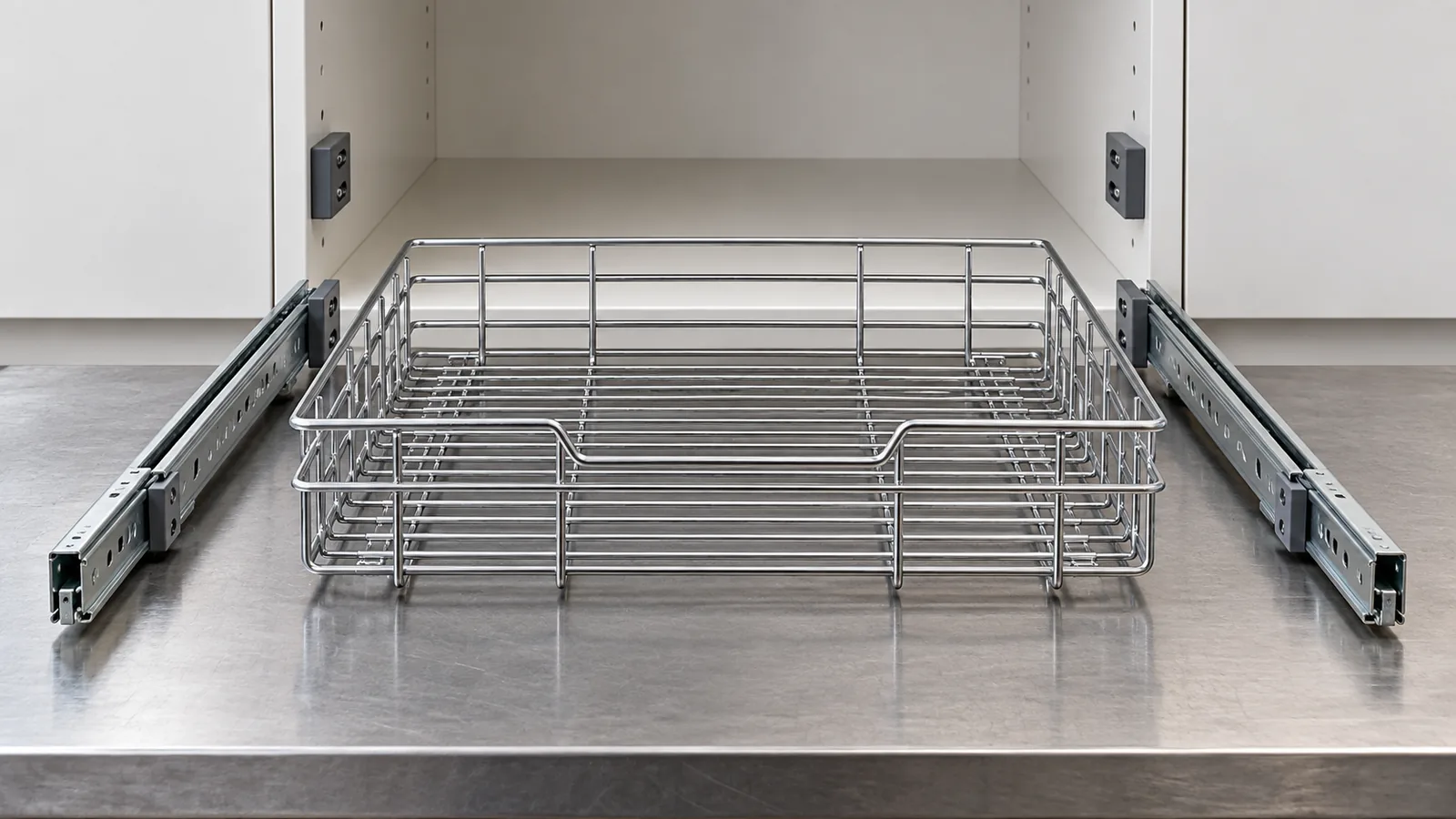
A pull-out wire basket should be specified as a complete cabinet-to-runner-to-basket interface, not as a nominal cabinet-width label. Buyers should record the finished opening, left and right runner positions, spacer stack, basket outside width, and the conditions under which travel and retrieval are accepted. There is no universal clearance that fits every cabinet, runner, and basket combination. Buyers searching the exact phrase “pull out wire basket cabinet rail width tolerance” should treat it as a system-level question answered with the actual drawing and sample, not as a universal rule.
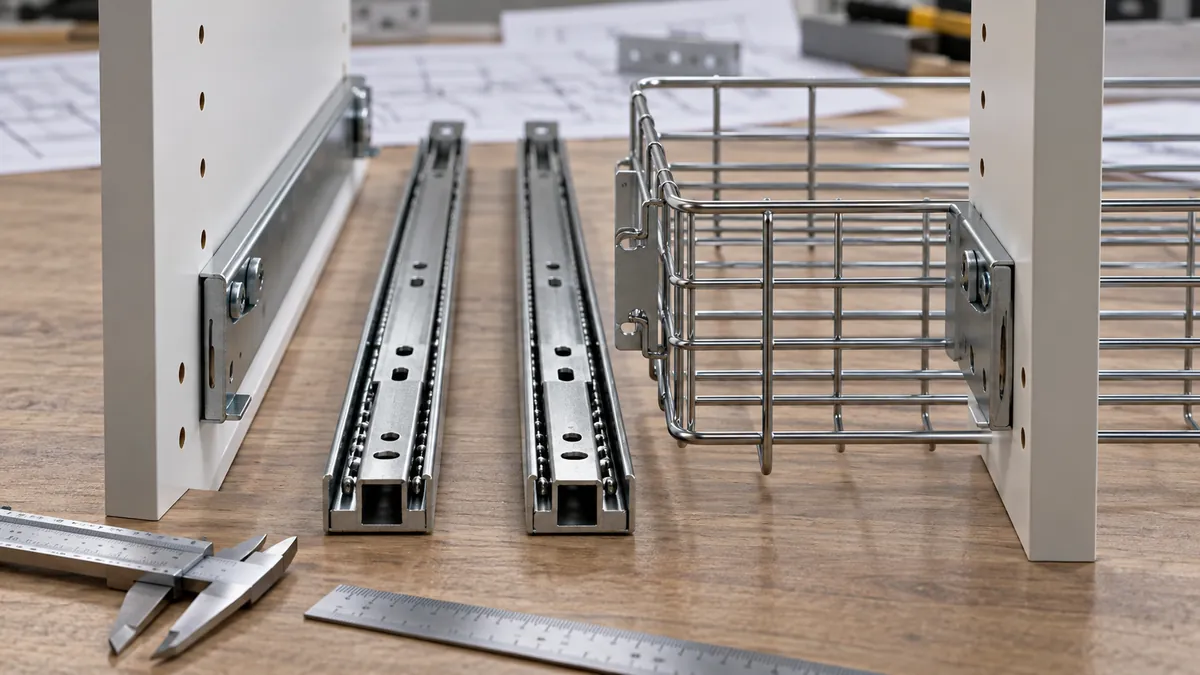
For related category context, see the Hardware de armazenamento doméstico OEM and this guia do comprador relacionado.
Why does a nominal cabinet width fail to define basket fit?
A cabinet’s advertised width is usually an outside or nominal size. The usable opening is reduced by side panels, face frames, hinges, liners, fasteners, and any local changes in the cabinet walls. Even two cabinets sold under the same nominal description can present different inside dimensions or surfaces. A sourcing brief should therefore identify the measurement datums and the actual cabinet configuration used for review, rather than assuming a label is a manufacturing dimension.
The pull-out assembly adds another stack of dimensions. A buyer must distinguish the clear inside width from the runner-to-runner space, any mounting brackets or spacers, and the wire basket’s finished outside width. The runners may be specified by a hardware vendor, while the basket is fabricated separately. If the stack is not shown in one controlled drawing, each party can meet its own dimension and still deliver an assembly that binds.
A useful first question is whether the basket is intended for a face-frame cabinet, a frameless cabinet, or a specific cabinet sample. The side-wall reference plane and runner setback can differ. State the door opening, hinge intrusion, shelf or floor position, and whether the basket must be removed for cleaning or restocking. These conditions define the fit problem better than the phrase standard cabinet.
Do not translate a single successful installation into a universal compatibility promise. One sample demonstrates only the cabinet, hardware, mounting positions, and basket revision used in that review. If the product listing will name a fit range, the buyer should define representative boundary conditions and verify them with the actual parts before approving that claim.
Which dimensions should the RFQ and drawing control?
Begin with the cabinet opening at several heights and depths, not one width measured at the front. Note whether the side panels are parallel and where the runner screws can be placed. Record the obstruction envelope for hinges, door frames, plumbing, and adjacent shelves. If the basket runs below a fixed shelf, capture the vertical clearance and the path required to insert the assembled unit.
Next, dimension each runner from a common cabinet datum. Record left-right spacing, height, setback, and any intentional offsets. Identify the mounting face, fastener access, spacer thickness, and whether the runner components are included in the same supply scope. Mark any bought-in slide as a specified interface rather than implying the wire-basket manufacturer also makes the mechanism.
Dimension the basket at the finished condition that matters to fit. Include its widest exterior points, front rim, wire ends, weld projections, handle or pull area, and any coating buildup that could affect a narrow interface. Clarify whether the drawing gives inside storage dimensions or outside installation dimensions. A basket that holds the intended articles but will not pass the opening is not a fit success.
Separate nominal dimensions from acceptance limits. The buyer should state which dimensions are critical to assembly, which are reference-only, and how each will be measured. Tolerance choices need to reflect the actual runner design, cabinet variation, process capability evidence, and intended fit range. Avoid copying an unrelated product’s clearance value; it may not apply to a different slide or basket form.
| Control point | What to record | Por que é importante |
|---|---|---|
| Cabinet opening | Usable width, height, depth, datums and obstructions | Nominal outside size does not define install space |
| Runner pair | Type, position, spacing, level and setback | Alignment affects racking and travel |
| Spacer stack | Part, orientation, thickness and source | Changes the effective interface |
| Basket | Finished outside envelope and protrusions | Must pass the opening and clear neighboring parts |
| Acceptance setup | Cabinet revision, fasteners, travel and sample condition | Makes approval repeatable |
How do the runner, spacer, and basket stack affect motion?
A pull-out unit is a paired system. If the runners are not level, parallel, or installed at matching setbacks, the basket can rack as it moves. The symptom may look like a basket-width problem even when the basket itself is dimensionally consistent. A sample review should inspect both sides together and note whether fastener locations or cabinet-wall variation change the relationship after tightening.
Spacers are not cosmetic filler. Their thickness and location set the runner’s distance from the cabinet wall and may compensate for a frame, obstruction, or bracket geometry. Record the exact spacer part and orientation on the drawing or bill of materials. If the spacer is changed between sample and bulk production, repeat the fit review; an apparently minor substitution can alter the usable width or runner alignment.
Observe the full travel, not just the first movement. Check whether the basket starts smoothly, remains level, reaches the intended extension, and returns without catching a cabinet edge or adjacent object. Check the stop or retention behavior only when it is part of the chosen hardware system. Do not infer travel performance from a static photograph or a basket positioned halfway out.
The loaded condition matters because contents can shift and change how a user pulls the basket. Buyers should define a representative, project-specific loading arrangement and the intended evaluation method. This is not the same as claiming a tested capacity. Record the contents or surrogate, placement, number of open-close cycles if agreed, and any acceptance observation; do not publish an unverified load rating. In this context, “pull out wire basket cabinet rail width tolerance” is a shorthand for a documented design-and-sample decision, not a preset engineering value.
What should a buyer compare before locking the interface?
The simplest comparison is between a basket dimension treated alone and a system dimension controlled across cabinet, runner, spacer, and basket. The first can work when the hardware and cabinet are fixed and documented. The second is safer when more than one party supplies components, when the buyer targets a fit range, or when the cabinet sample is expected to vary.
For a single cabinet program, a physical cabinet or a carefully dimensioned mock-up can expose real obstructions that a drawing misses. For a broader range, request the buyer’s boundary cabinet conditions and define which are included. The answer is not automatically a more generous clearance: excessive side gaps can reduce stability, expose the slide, or make the basket look poorly fitted. The acceptable interface must be evaluated for appearance and use together.
For an adjacent-category development project, clearly identify the status of each component. The metal basket may be custom fabricated while the slide is a separately sourced item. The buyer should confirm who owns slide selection, compatibility documentation, assembly instructions, and field replacement. Koitor’s public home-storage and basket pages provide category context, but do not establish that a specific pull-out system or runner model is a current Koitor catalog offering.
A quote comparison should use a shared technical basis. Ask suppliers to identify assumed clear width, basket outside width, runner type, spacer stack, finish, packaging, and what is excluded. If one quote assumes the buyer supplies a runner while another includes hardware, comparing only unit price hides a scope difference. An interface schedule makes the technical and commercial assumptions visible before sample authorization.
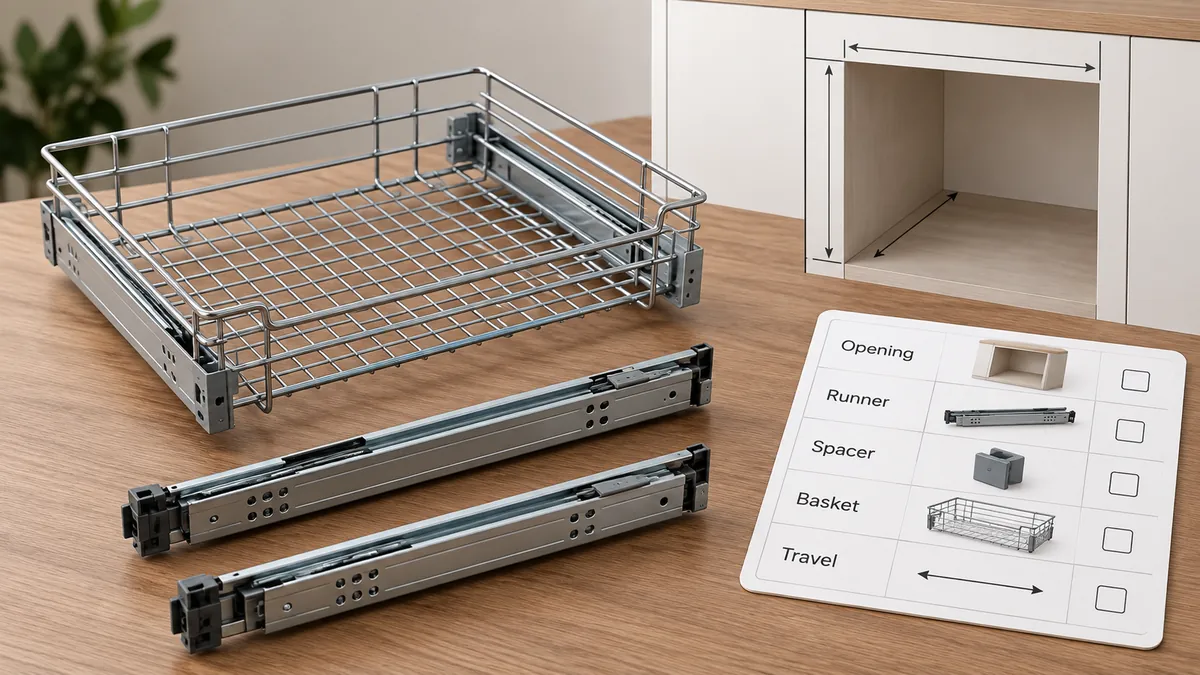
How should the sample be approved and controlled into repeat orders?
Approve an identified sample against a dated drawing and an installation record. Capture the cabinet model or mock-up revision, opening measurements, runner positions, spacer parts, basket dimensions, fasteners, finish, and assembly sequence. Record who supplied each component. If the sample uses substitute hardware, mark that status prominently and specify what must be replaced or revalidated before production release.
Run the agreed fit review with the cabinet door and obstructions in their real positions. Install the paired runners using the specified datums, then insert and remove the basket. Check for side contact, skew, uneven reveal, catching at the opening, and obstruction through the intended travel. Repeat after tightening fasteners because mounting can pull a rail out of alignment. Take photos from both sides and the front to make the acceptance record reproducible.
Define the difference between a cosmetic observation and a functional rejection. A buyer might accept a small appearance variation but reject rubbing, incomplete travel, or a basket that cannot be removed as intended. Those criteria should be agreed before samples arrive. Avoid vague instructions such as fits well; convert them into observable checks that a second reviewer can repeat.
For repeat orders, tie any approved change to a recheck decision. A cabinet-source change, runner revision, spacer substitution, basket-width change, finish change, or revised packaging insert can alter the assembly or its perceived fit. Not every change requires a full new development cycle, but the buyer and supplier should identify which dimensions and movements need targeted confirmation before the next shipment. The phrase “pull out wire basket cabinet rail width tolerance” should therefore remain tied to the approved configuration and its inspection record.
What are the limits of a dimension-only specification?
Dimensions are necessary but do not fully describe friction, slide quality, installation skill, cabinet-wall strength, or user behavior. A set of measurements cannot guarantee smooth motion across unreviewed cabinets or assure that a bought-in runner meets a load requirement. Where those factors matter, the buyer must identify the responsible component owner and use an agreed evaluation protocol.
Material and finish should be described in the product specification using project-approved facts. A finish layer can affect a tight interface, but the size and location of that effect depend on process and geometry. Do not add a generic coating allowance without knowing the actual construction. Review finished samples and critical contact areas after all finishing steps rather than relying only on a pre-finish measurement.
Packaging should preserve the approved geometry and protect exposed finish during transit. Separate the basket from rails or protect contact points if the pack configuration allows parts to rub. Include assembly instructions and hardware identification where the product requires them. A good sample fit can still be undermined if transit damage distorts a rail or basket corner before the retailer receives the unit.
Koitor’s relevant expertise is metal basket fabrication, drawing-based customization, sample development, finishing, assembly, and packaging discussion. Specific runner manufacture, a particular pull-out basket SKU, numerical tolerance commitments, and load-test results are not established by this guide. Confirm those project-specific facts before treating them as supplier capabilities or product claims.
Lista de verificação para aprovação do comprador
Use the checklist as a controlled drawing review, not as a substitute for a sample. Attach photos of the installed rails, the measurement setup, and the basket at fully closed and fully extended positions. Note any unusual feel, contact, or visible misalignment and identify the part that caused it. This record helps both parties distinguish a cabinet limitation from a basket or slide issue when a repeat order or new cabinet variant is proposed.
- Identify the exact cabinet or representative mock-up and record the usable opening at more than one location.
- Show the left and right runner datums, height, setback, spacing, fasteners and spacer stack on one controlled drawing.
- Measure the basket’s finished outer envelope, including rim, weld projections, handles and any finish-sensitive contact points.
- Define the intended insertion, removal, open travel, door condition and agreed representative content arrangement.
- Approve a dated sample record and state which changes trigger a targeted fit recheck before repeat orders.
Perguntas frequentes
Is cabinet nominal width enough to select a pull-out basket?
No. Buyers need the actual usable interior opening, obstructions, runner position and basket’s finished outer dimensions. A nominal label is an initial clue, not a complete interface specification.
Should basket width equal the space between runners?
Not automatically. The correct relationship depends on the slide and attachment geometry. Record the runner interface and basket width together, then verify insertion, alignment and travel on the project sample.
Can one sample approve a full cabinet-width range?
Only if the sample plan covers representative boundary conditions and the buyer agrees what range the evidence supports. Otherwise approval applies to the documented cabinet and setup only.
Who should specify the slide runners?
The buyer should name the party responsible for selecting and documenting the runner. A basket supplier may fabricate the metal basket while the slide is a separately sourced interface component.
Does this guide confirm Koitor makes pull-out runners?
No. It explains buyer-side metal basket and interface questions. Current production of this exact product and runner mechanism must be confirmed separately for a specific project.
Planear uma especificação do produto pronta para o comprador
Share your drawing, product range and sample requirements so the project team can review the relevant manufacturing questions.
OEM / MARCA PRÓPRIA
Transforme este guia de fornecimento num resumo do produto
Indique o produto pretendido, as dimensões, o acabamento, a quantidade a encomendar e os requisitos de embalagem. A sua equipa receberá uma análise prática da viabilidade de fabrico antes da apresentação do orçamento.
 English
  Español
  Português
  Français
  Deutsch
  العربية