
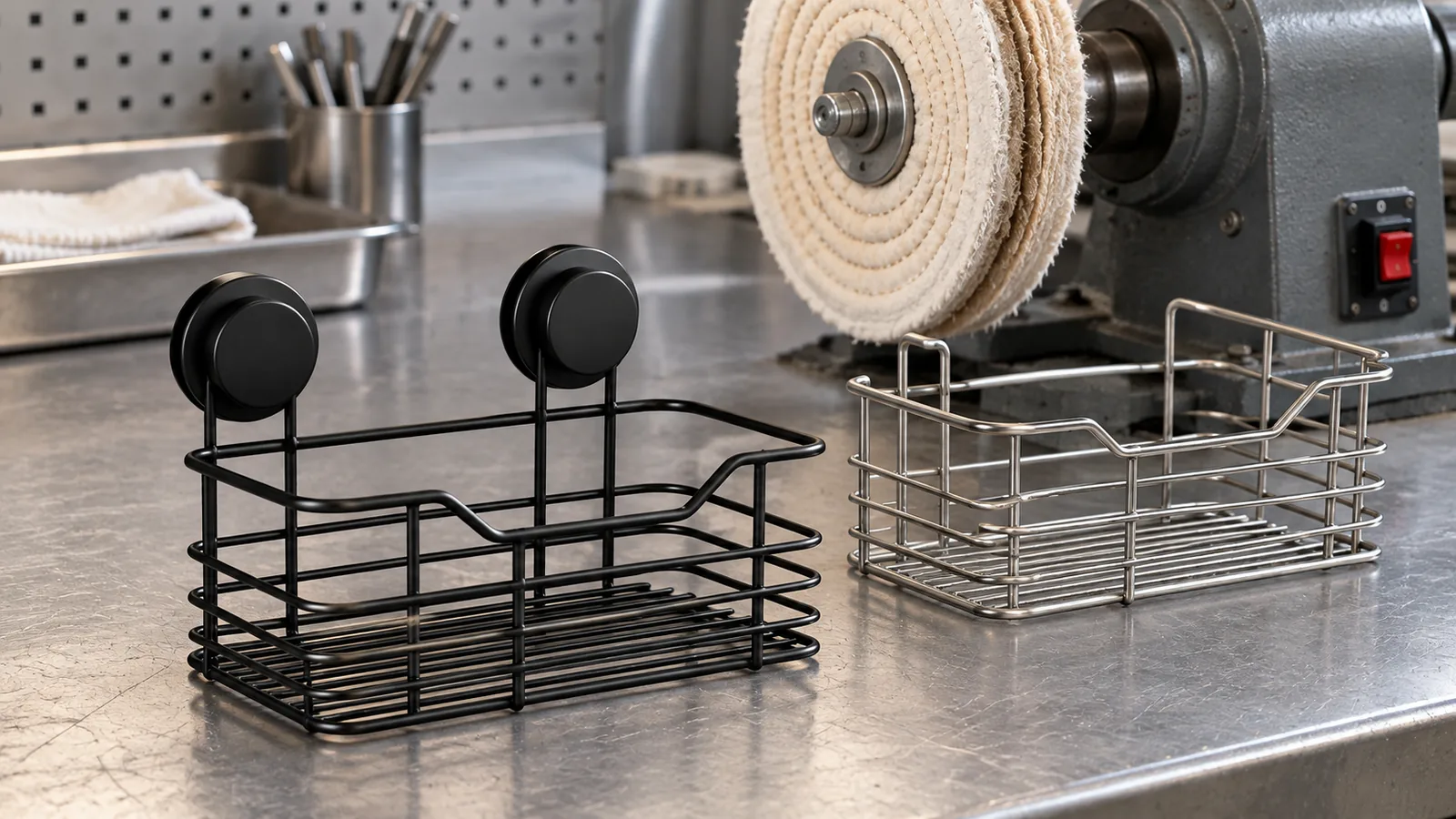
For a buyer evaluating polishing stitched loose cotton sisal buffing wheels for a coated bathroom rack, the first question is what surface condition the wheel must create—not which wheel looks most aggressive. Wheel construction, abrasive compound, starting surface, contact path and cleaning between stages work as one system. Define the desired pre-coating appearance on a representative part, then ask the finishing supplier to document the proposed route and its limits.
The purpose of this guide is a sourcing decision, not a machine recommendation or a claim that every coated basket needs buffing. Some products need only weld cleanup or a controlled surface-preparation step; others may need a more deliberate cosmetic polish. The coating supplier’s approved pretreatment and finish specification should govern the final route.
A buffing wheel carries compound to the work surface and influences how that compound contacts the part. It may refine a prior scratch pattern or develop lustre, but it should not be treated as a substitute for correcting deep scratches, poor weld geometry or inconsistent forming.
The result depends on the complete setup: incoming material and finish, wheel construction, compound identity, machine and mounting, work support, operator or automation path, cleaning, and the next process. MKTech’s technical handbook describes the compound–wheel–workpiece combination as a system and distinguishes cutting from colouring functions. That distinction matters for a wire basket: a cutting stage may refine a prepared surface, while a colouring stage is intended to develop brightness. The latter is not a colored coating. On a three-dimensional rack, access and support also matter: an operator must reach the target surface without pressing a thin wire into a fixture, polishing one face longer than the neighboring face, or rounding a profile that should stay crisp. Those are sample-approval questions about geometry and handling, not reasons to assume a particular wheel will solve every visible mark.
For a product that will be powder coated, do not assume a bright pre-coating surface is automatically better. The coating system may require a different surface profile and pretreatment. A polished appearance is a visual attribute; cleanliness and suitability for the selected coating route are separate checks.
How do stitched cloth, loose cotton and sisal differ?
The wheel family changes firmness and how readily the face follows a contour. Use the comparison as a shortlist for supplier discussion, not as a universal ranking: actual wheel constructions and compound systems vary by manufacturer.
| Wheel construction | Typical contact behavior | Possible use in a hardware route | Buyer caution |
|---|---|---|---|
| Stitched cloth | More restrained face than a loose-leaf wheel | Controlled cutting or a broad, stable contact path where the stage is appropriate | Local dwell can mark or heat an edge; stitch pattern alone does not define the result |
| Loose-leaf cotton cloth | More compliant and able to follow contours | Light finishing or colouring on compatible geometry | Can wrap around projections or soften a defined edge if contact is not controlled |
| Sisal or cloth/sisal | Comparatively firm; sisal constructions can retain compound differently | A cutting stage on a suitable, prepared metal surface | Not automatically a final-colour choice; construction and compound compatibility matter |
The MKTech handbook explains that stitching restrains cloth plies, while looser constructions conform more readily; it also notes that sisal and cloth/sisal behavior depends on construction. Formax likewise cautions that compounds suited to cloth wheels may not work as well on sisal because the weave and compound retention differ. Those references support asking for a wheel-and-compound proposal; they do not establish a specific setting or result for Koitor’s products.
A stitched loose cotton sisal wheel description may refer to a specific hybrid or supplier-defined construction. Ask for the actual wheel specification or product sheet instead of assuming the name fixes firmness, abrasive action or a finish grade.
What should the RFQ specify?
Give the supplier enough information to match the process to the part, then ask what evidence will demonstrate that the approved sample represents the intended production route.
Incluir:
- Product drawing and revision, base material as confirmed by the responsible supplier, finish system, and the exact areas that need cosmetic attention.
- Starting condition, including prior grinding or weld cleanup, visible scratch families, burrs, edges, radii, recesses and wire intersections.
- Wheel manufacturer and identifier, construction, diameter and width, mounting arrangement, and the machine instructions or marked operating limits that apply.
- Compound manufacturer, product identifier, declared duty (cutting, cut-and-colour, or colouring), delivery form, and the supplier’s guidance for that wheel and substrate.
- Intended contact path and work support, especially at thin wire, basket corners, joints and projecting ends.
- Cleaning method after buffing, handling controls before coating, and the coating supplier’s required pretreatment.
- Sample identification, acceptance photographs or appearance references, inspection lighting, and the party responsible for approving any process change.
Do not invent a universal speed, pressure, grit, tolerance or wheel-life number. Those depend on the equipment, attachment, wheel marking, workpiece and process specification. The machinery and wheel supplier should confirm safe operating conditions for the actual setup. Keep the working zone guarded and follow the relevant equipment and wheel instructions. For the buyer, the practical record is the approved source document or written supplier instruction tied to the exact wheel and machine—not a setting copied from a different wheel diameter, workpiece, or production line. If the proposed polishing stitched loose cotton sisal buffing wheels are changed after sample approval, capture the new identifier and ask whether the contact behavior or cleaning handoff requires a new comparison.
How should buyers compare a proposed wheel route?
Compare options against the same part, incoming condition and finish target. If one sample is polished from a smoother starting surface and another receives a different cleaning step, the buyer cannot attribute the visible difference to the wheel alone.
A useful trial record names each controlled input, then documents the surface before and after the stage. Photograph the same locations—such as a straight wire, bend, weld-adjacent area and basket corner—using consistent lighting and orientation. Note whether the sample is a flat coupon or a complete basket; a coupon can help isolate appearance but cannot show access or edge behavior on the full shape.
Ask the supplier to state what the trial demonstrates and what it does not. A visual comparison may support an appearance decision. It is not, by itself, proof of coating adhesion, corrosion resistance, service life or production consistency. For a fair comparison, keep the drawing revision, base material description, pre-polish condition, inspection lighting and coating lot or system identity constant where the supplier can document them. Change one meaningful input at a time when the project allows it, and note any unavoidable difference. This makes it easier to separate wheel effects from a different weld cleanup, compound carrier, pretreatment or coating application. A trial should answer the buyer’s specific question and should not be presented as a general production capability statement.
Why does cleaning matter before coating?
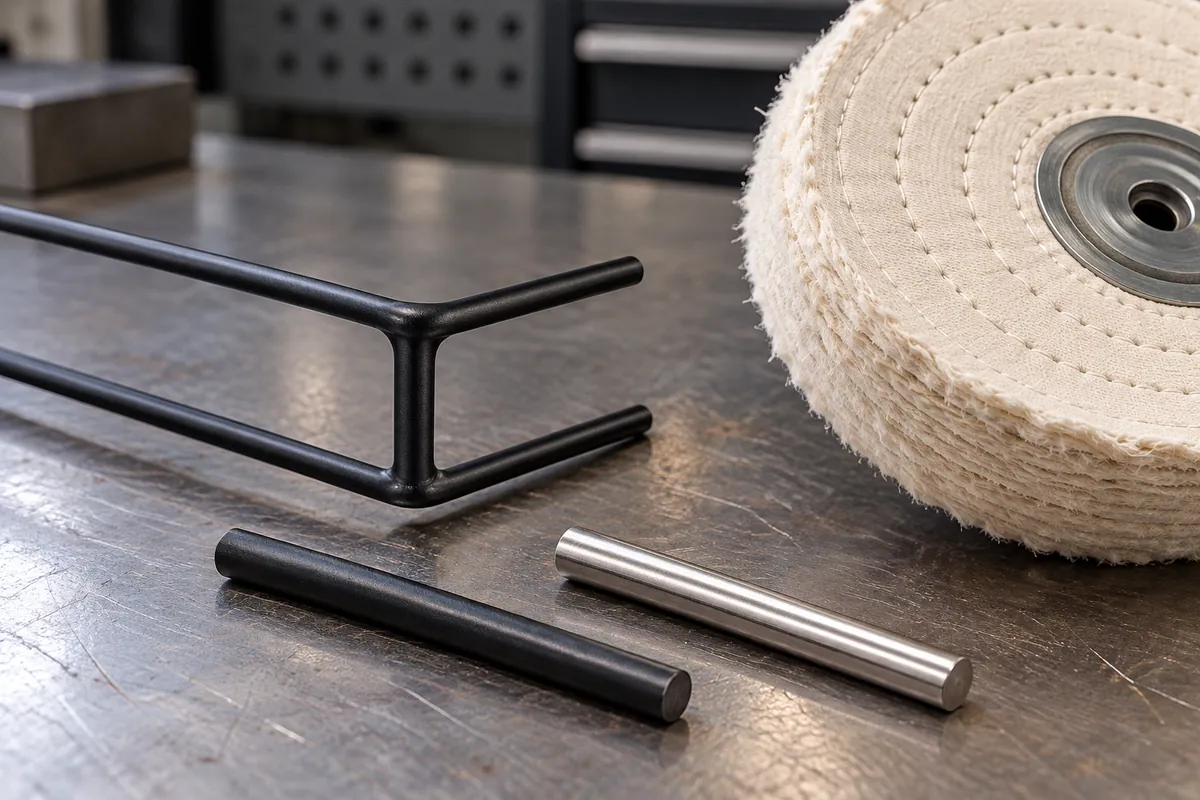
Buffing can leave compound carrier, abrasive debris and metal fines on the part, including at seams and intersections. A surface that looks bright may still need cleaning and the coating system’s specified pretreatment.
IGP’s technical information on metal pretreatment states that contaminants such as oils, grease and particles can impair powder-layer adhesion and describes their removal and rinsing as part of pretreatment. This is why the buyer should get the finishing supplier’s written requirements for the actual substrate and coating system. Do not add a home-made cleaning step or assume that a buffing compound is compatible with every downstream treatment.
For a bathroom rack, include the hard-to-reach locations in the review: wire crossings, tight bends, hooks, seams and enclosed corners. Ask the supplier how residue is detected or controlled there and what evidence is retained. The inspection method should match the project specification; a bright surface under one light is not a cleanliness test.
What should a representative sample review include?
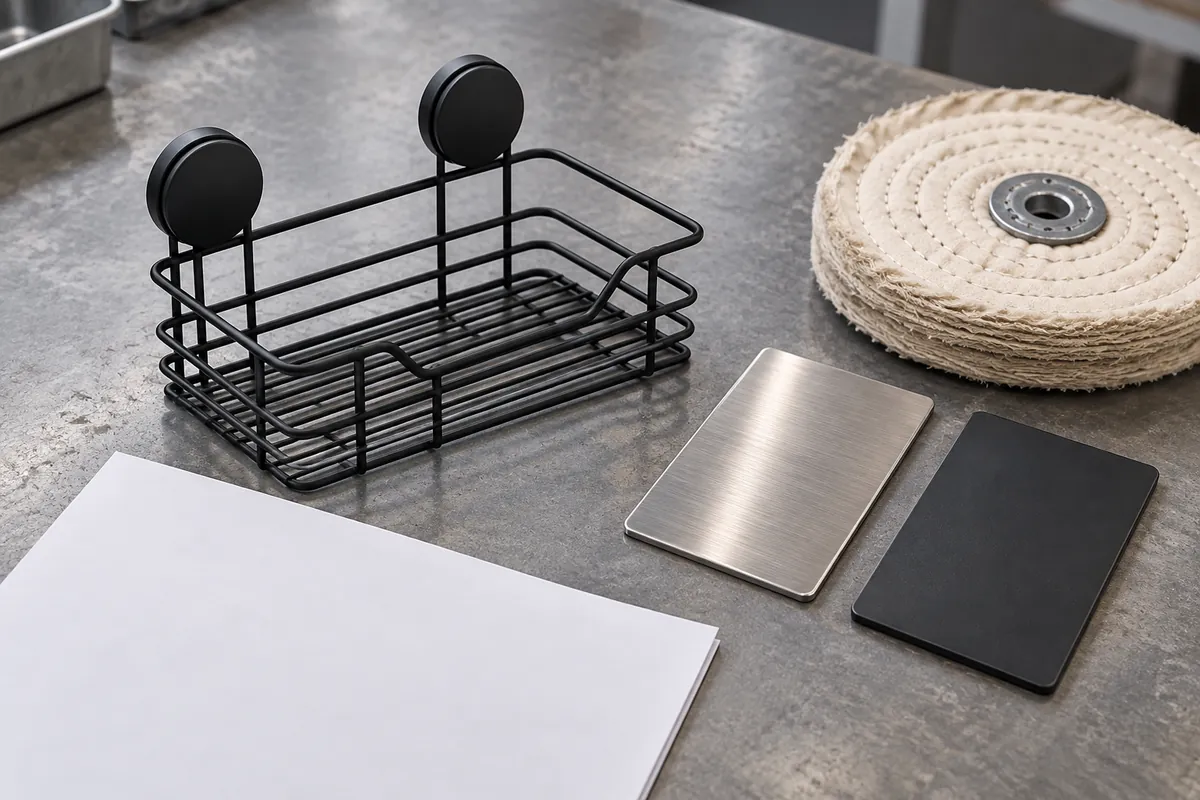
Review a production-intent sample made with the proposed wheel, compound, cleaning and subsequent coating route—or clearly label the stages that have not yet been completed. A sample should reflect the actual geometry that challenges the process, not only a convenient flat area.
Use a short approval sequence:
- Confirm drawing, material description, wheel and compound identifiers, and sample revision.
- Agree which surface areas and appearance conditions are being evaluated.
- Inspect the straight runs, bends, weld-adjacent zones, edges and recesses that appear in the finished assortment.
- Compare the pre-buff and post-buff samples under the same lighting and viewing angle; record remaining marks, lines, edge rounding, discoloration or residue without assuming the cause.
- Confirm the cleaning and pretreatment handoff with the coating supplier, then inspect the coated sample against the approved visual reference.
- Record the accepted process description and identify changes that require renewed review, such as wheel construction, compound, starting material, geometry or cleaning route.
A single successful sample does not establish every size, shape or batch. Define the sample scope and the production controls separately. If the supplier proposes a different wheel or compound, ask whether the change affects the appearance target, contamination risk or downstream coating approval. For the accepted sample, preserve a labeled physical reference or controlled photographs that show the same critical faces and lighting angle. Record the product revision and route at the same time; otherwise a future buyer may compare a new production lot to an image made under a different stage or coating condition. When an assembly has several basket sizes, sample the geometry that is hardest to access and identify which simpler variants are represented by that approval.
Which sourcing mistakes create rework?
The most common avoidable gaps are specification gaps, not a lack of a more expensive wheel.
- Selecting by compound color or a broad label such as “fine” without the supplier’s product identity and declared duty.
- Asking a colouring stage to remove a deeper scratch that should have been resolved earlier.
- Comparing samples made from different starting conditions or with different cleaning steps.
- Polishing every surface even when the coating route does not require that appearance.
- Approving a flat coupon while ignoring bends, weld-adjacent areas and wire intersections.
- Treating a bright sample as evidence of coating adhesion or durability.
- Changing the wheel or compound after approval without assessing whether the validated appearance and cleaning route still apply.
When an issue appears, preserve the sample and identify its revision, process stage and location. “The finish looks inconsistent” is a starting observation; it is not yet a root cause. The supplier should compare the inputs and contact path before changing pressure, compound amount or wheel type.
How can an OEM supplier support the decision?
A specialized metal hardware manufacturer can review the buyer’s drawing or physical sample, discuss practical polishing access, and coordinate the intended appearance with forming, welding, finishing and packaging requirements. Koitor’s approved scope includes metal forming, welding, grinding, polishing, powder coating, assembly and sample development, but a buyer should confirm the specific material, equipment route and finishing responsibility for each project.
For custom bathroom and home storage hardware, share the product revision, finish target, sample photographs, difficult-to-reach features and any coating supplier requirements together. The OEM home storage hardware page describes Koitor’s relevant sourcing scope. Ask which parts of the proposed polishing route are confirmed and which depend on a specialist finishing supplier. When discussing polishing stitched loose cotton sisal buffing wheels, the useful OEM handoff is a controlled part sample plus a wheel/compound identity and a clear description of the required surface before coating. This keeps the conversation tied to a buyer decision instead of an unsupported promise about gloss, adhesion or product life.
Perguntas frequentes
Do stitched wheels always give a better finish than loose cotton wheels?
No. Construction changes contact behavior, but the useful choice depends on the starting surface, geometry, compound, desired stage and inspection criteria. Approve the proposed combination on representative parts.
Does sisal mean a coarse or low-quality finish?
Not by itself. Sisal is commonly used in firmer cutting constructions, but wheel design and compound matter. Do not infer finish quality from the fiber name alone.
Should every powder-coated bathroom rack be polished first?
No. Buffing may be appropriate for a defined surface issue, but the coating supplier’s specified preparation and the product’s appearance target determine whether it belongs in the route.
Can a bright sample prove that the coating will adhere?
No. Brightness is not proof of cleanliness or coating suitability. Confirm cleaning and pretreatment requirements with the responsible coating supplier, then evaluate the specified coating evidence separately.
What should be recorded if the wheel or compound changes?
Record the old and new identifiers, the reason for the change, the affected geometry and the repeat-sample checks needed. Reapprove the relevant appearance and cleaning handoff before treating the route as unchanged.
Referências técnicas:
- MKTech Handbook: Polishing Compounds and Buffing Wheels
- Formax Manufacturing: Sisal and Cloth Buffing Wheel Bar Compounds
- IGP: Technical Information TI100 — Pretreatment of Metals
Review a metal hardware finishing question
Share the product drawing or sample, surface-finish target and coating supplier requirements so the proposed process can be reviewed against the actual geometry.
OEM / MARCA PRÓPRIA
Transforme este guia de fornecimento num resumo do produto
Indique o produto pretendido, as dimensões, o acabamento, a quantidade a encomendar e os requisitos de embalagem. A sua equipa receberá uma análise prática da viabilidade de fabrico antes da apresentação do orçamento.
 English
  Español
  Português
  Français
  Deutsch
  العربية