

A replacement inner bin should be matched to the retained shell or carrier, its exact parent model, the service-part reference and any production-era boundary stated by the manufacturer. Nominal litre capacity or a similar outside shape is not enough to establish compatibility. Buyers need to confirm the bucket’s dimensions, support points, handle or rim interface, and whether related parts such as a liner holder or bottom protection are included. If the parent model or age is uncertain, hold the order for identification instead of assuming a fit from capacity alone.
What does “inner bin” include in a service-parts order?
Product descriptions use several overlapping terms: inner bucket, insert, liner bucket, waste container, carrier or replacement bin. A buyer should define which component is being replaced and which parts remain installed. The outer shell, pull-out frame, lid, pedal linkage, bag holder, handle, base protection and inner bucket may be separate items. The word “bin” can refer to the complete product or only the removable container.
The replacement decision in this article is narrow: identify a named service bucket for an installed parent assembly. It is not a guide to bag retention, lid clearance, pedal adjustment or waste-bin mechanism repair. A buyer should preserve those separate topics in their existing product records and use them only when relevant to the actual service request.
The first question is: what exact product is still in service? Use a label, model number, purchase record, original drawing, manufacturer catalogue or service-part cross-reference. Record the parent model and any version, order number or production-era information. If an old product has no visible label, collect dimensions and photos for the maker or authorized service supplier, but do not treat visual similarity as a final compatibility determination.
Manufacturers illustrate why parent identity matters. Hideaway Bins lists a named 20-litre bucket, dimensions, compatible systems and an explicit exclusion for some pre-2004 installations. That cutoff belongs to the specific listed product; it does not apply to every manufacturer or every inner bucket. See Hideaway Bins’ replacement bucket page and follow the current compatibility notes for the exact unit.
Hailo’s product information shows another useful distinction: a consumer-facing order reference can differ from a spare-part reference, while the bucket is associated with named parent systems. WESCO’s product pages identify specific inner buckets and compatible product lists, sometimes with associated parts shown separately. These examples show why buyers should preserve manufacturer references and supply scope, not assume every maker uses the same numbering scheme or compatibility rule. See the respective Hailo inner bin listing e WESCO Baseboy insert listing.
Why do model and production era matter?
Product families evolve. A manufacturer may revise an outer shell, mounting bracket, lid, insert shape or service reference while retaining a similar marketing name. An older installation can have different dimensions or attachment points from a later one. Some makers explicitly list excluded production periods or route buyers with uncertain product age to customer support. That boundary is specific to the cited model and should not be generalized.
Production-era information can come from the label, serial code, order documentation, invoice, original catalogue, or physical design detail identified by the manufacturer. Ask which evidence the service supplier accepts. If the parent date cannot be confirmed and the maker lists a cutoff, keep the order on hold until the parent assembly is identified. A measured bucket can help narrow a match, but it should not override a manufacturer’s explicit exclusion.
| Identification field | O que fotografar | Por que é importante |
|---|---|---|
| Parent model | Full name, SKU, model code or service-system reference | Compatibility attaches to a specific assembly |
| Production era | Date, serial range or maker-defined cutoff | Revisions may change the bucket or shell interface |
| Service part | Spare-part number and quantity supplied | Ordering reference can differ from parent product reference |
| Retained shell | Dimensions, support ledge, rim and attachment points | Defines the installed mating geometry |
| Bucket | Overall dimensions, top profile, handle and bottom features | Helps check the candidate part against the named model |
| Exclusions | Incompatible model or period noted by the manufacturer | Prevents an unsupported “fits all” claim |
If a distributor maintains a service-parts catalogue, create a parent-to-bucket matrix. Each row should identify accepted parent models, known exclusions, the current service part, reference source and date last checked. Include an unresolved state for units whose label or production age is missing. That is more reliable than a single description such as “20 L replacement bin,” which may match several visually similar but incompatible families.
The matrix also helps customer service ask targeted questions. Instead of asking only “what capacity do you need?”, request the shell brand/model, any product label, overall bucket dimensions, top rim profile, support points and approximate purchase period. If the manufacturer says that age cannot be established from a photo, route the request to the maker instead of promising interchangeability.
How should buyers check the physical interface?
After confirming the model, compare the actual interface points. Capacity is a volume description; it does not define every external dimension. Two buckets can share a nominal capacity and differ in taper, top shape, handle clearance, bottom foot, lip, wall thickness or support location. A service bucket may also be supplied in a particular material and color that is not interchangeable with a similarly sized item from another product family.
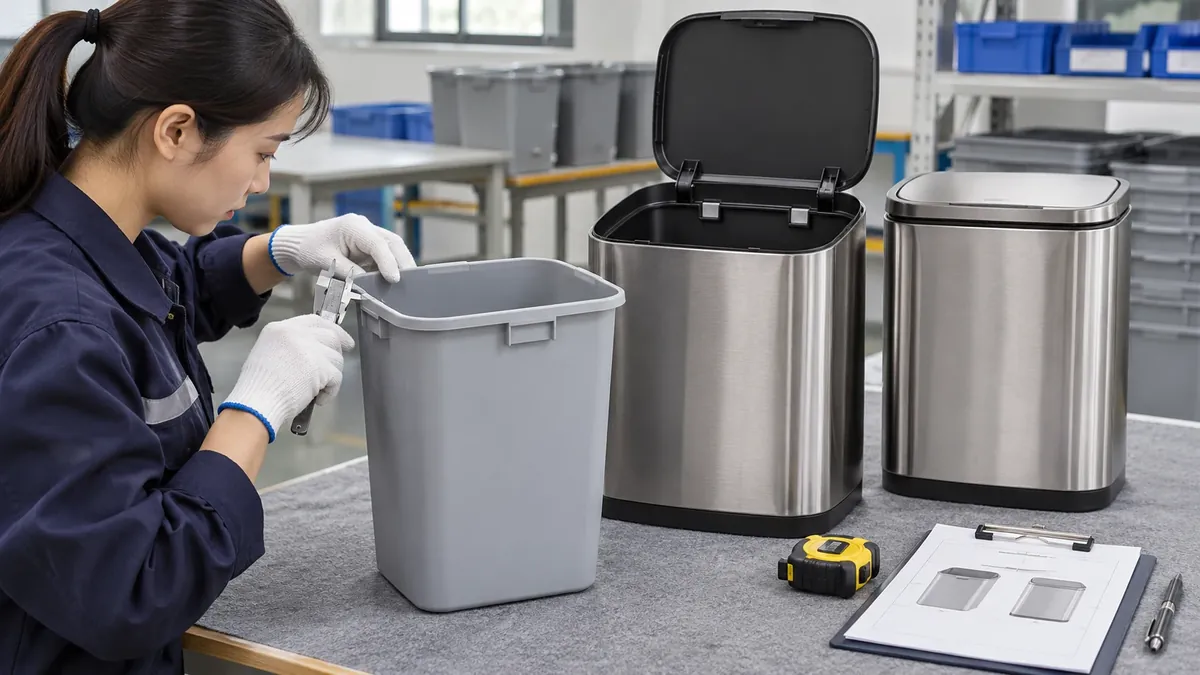
Measure the retained shell and existing bucket without forcing or modifying parts. Record height, width and depth at defined points, including any taper. Note the shape of the top rim, the position of handles, the direction a bucket enters, the support ledge and any locating feature. If the bucket is designed to sit in a moving frame, document the frame’s limits and the clear path required for removal. Do not cut, drill, heat or trim a replacement unless the manufacturer explicitly approves that modification.
| Interface check | Record | Do not infer |
|---|---|---|
| Outer envelope | Dimensions at top, middle and base | Same volume means same size |
| Taper | Direction and approximate profile from the drawing/sample | Similar silhouette guarantees seating |
| Rim | Lip shape, flange and contact surface | A matching top diameter proves retention |
| Handle | Position, clearance and intended grip | Presence of a handle proves loaded carrying approval |
| Bottom | Feet, recess, pad or protection and its supply status | A separate bottom part is included automatically |
| Shell support | Ledge, carrier or insert contact locations | A bucket can fit without correct support |
| Service path | Direction and clearance for removal | A bucket fits when the shell is empty, therefore service is easy |
Use a physical comparison or controlled drawing review when the supplier permits it. An empty fit sample can show whether a candidate seats and clears the shell in the checked arrangement. It does not prove performance, durability, odor control, food-contact status, material safety or compatibility with another model. Those claims must be supported by the responsible maker’s product documentation.
If the shell itself is damaged, a new bucket may not resolve the service issue. A bent frame, worn lid, broken pedal or deformed support can affect operation even when the bucket is correct. Keep the part request specific and route unrelated repairs to the relevant product owner. Do not claim that replacing an inner bucket restores a complete waste-bin mechanism.
How should service references and supplied scope be controlled?
Manufacturers can use one number for the complete product and another for a replacement component. A service bucket might be listed under a spare-part reference, associated with a parent product reference, or offered in a kit with additional pieces. A distributor should copy the references from current official documentation and state the quantity supplied. If a bottom protector, liner holder or lid is an optional or separate item, list it clearly.
Use a service cross-reference with these fields:
- Parent product name and exact model reference.
- Known production date, serial boundary or model revision.
- Replacement bucket/service-part number.
- Accepted parent models and documented exclusions.
- Supplied quantity and any included accessory.
- Material and dimensions as documented for that specific part.
- Source URL or manufacturer document version and date reviewed.
- Fit sample, measurement record and unresolved questions.
The product pages demonstrate why scope should stay specific. Hideaway’s listing names compatible systems and a pre-2004 exclusion for its unit. Hailo’s page distinguishes its order reference from a spare-part reference and names parent Multi-Box systems. WESCO’s page identifies a metal bucket for particular Baseboy products and shows bottom protection as separately relevant. None of these examples means every manufacturer has the same age cutoff, part numbering, accessory policy or material. Do not reuse one maker’s compatibility data for another brand.
The exact reference should appear on the quotation, invoice, service-parts database and replacement label. If a manufacturer supersedes a part number, keep the old-to-new mapping and the effective parent models. A superseded reference is not automatically interchangeable with every earlier item unless the manufacturer says so. If the new part changes geometry or accessory scope, update photos and customer instructions.
How should a buyer build a replacement approval workflow?
First identify the parent model. Second verify that the requested replacement is listed for that parent and production era. Third compare the key interface dimensions and supply scope. Fourth obtain a physical sample or manufacturer-confirmed drawing when the parent remains in service and the risk warrants it. Fifth record acceptance, exclusions and the source of compatibility evidence.
If the buyer cannot complete a stage, record the status as “unresolved” or “hold.” Do not promote an unconfirmed part as universal. The matrix should distinguish an accepted match, a rejected match and a candidate needing more information. A rejected match should retain the evidence, such as a named model exclusion or incompatible support interface, so that customer service does not re-open the same assumption later.
For a product launch, establish the service part at the same time as the original SKU. Retain the parent assembly drawing, bucket dimensions, service reference, accessory list, packaging and supplier contact path. This prevents a distributor from trying to identify a replacement only after the outer shell has been sold for several years. If the manufacturer provides a production-era limitation, add it to the service record in customer-readable language.
For an installed base inherited from another distributor, segment the population by identifiable model and era. Do not combine all “20-litre” or “double bin” products into a single replacement listing. If some units cannot be identified, state the limitation and provide a process for submitting a model label or dimensions. A clear escalation path is better than an overbroad compatibility promise that creates returns or field-service confusion.
\1
Ordering by capacity alone. Nominal litres do not identify the top rim, taper, support points or model. Match the parent assembly and part reference.
Assuming similar appearance means compatibility. A replacement may look close but have different height, lip, handle or bottom geometry. Check the exact maker’s list and interface.
Ignoring production era. An explicit manufacturer exclusion must be preserved for that product. Do not generalize or omit it from the service listing.
Confusing the sales SKU with the spare-part reference. Record both and identify the parent product so the buyer orders the correct service item.
Assuming accessories are included. A liner holder, bottom protector, lid or other service part may be separate. Request a parts list.
Using a physical fit as a blanket compatibility approval. A fit check covers only the dimensions and condition tested. It does not verify all parent models or product claims.
Replacing the bucket to fix a different mechanism problem. Pedal, lid, frame or bag-retention issues may have separate owners. Keep the service request scoped.
Claiming a branded replacement without authorization. A compatible part must be documented and accurately described; do not imply it is an original branded component unless that is true.
\1
Koitor Hardware is a family-owned custom metal hardware factory focused on bathroom and home storage hardware. The approved company facts support discussion of defined metal shell, frame or storage components, along with bending, welding, finishing, basic assembly and drawing or sample review. The research does not establish Koitor’s manufacture of plastic inner buckets, branded replacement parts or a complete third-party waste-bin system. Buyers should confirm actual component scope before requesting a quotation.
For a metal frame or shell project, provide the parent assembly, replacement interface, material and finish, drawing revision, quantity and packaging. Identify whether the bucket and other accessories come from a different supplier. If a replacement is intended for a branded installed base, supply the manufacturer’s compatibility information and define whether the project is a custom component, an authorized service part or a separate product. Do not ask a metal supplier to infer brand compatibility from a sample alone.
Small-batch customization may be useful for an approved metal component trial. MOQ can start from 100 pieces depending on product and scope. Samples usually take five to seven working days after details are confirmed; bulk production usually takes four to six weeks depending on product, quantity, finish and packaging. These are planning references, not a promise that Koitor can supply the complete bucket or replace a named manufacturer’s service part.
The buyer’s request should state which supplier owns the final compatibility decision. If the specialist bucket maker approves the insert but the metal shell is custom, both parties should review the same dimensions and revision. If the complete system remains with another manufacturer, maintain that manufacturer’s model and service instructions in the customer record. A defined interface review helps avoid unsupported replacement claims.

Buyer checklist before ordering a replacement inner bin
- Parent shell or complete product maker and exact model.
- Product label, order record, serial reference or production date.
- Manufacturer-defined production-era exclusions.
- Correct service-part reference and any separate sales/reference number.
- Bucket dimensions at top, middle and base, plus taper and rim details.
- Handle, support, bottom and locating interfaces.
- Confirmed parent compatibility and excluded models.
- Included quantity and separate accessories such as protector or liner holder.
- Fit sample or maker-confirmed drawing for the retained assembly.
- Clear unresolved/hold route when the parent cannot be identified.
- Customer-facing wording that accurately states compatible models.
- Service database revision, evidence source and last review date.
Manage uncertain installed-base requests without overpromising
Service inquiries often arrive with incomplete information: a customer has a damaged bucket, no label, an old invoice or a photograph showing only the front of the shell. Create a short identification form that asks for all sides of the parent product, any label or serial code, the approximate purchase date, the bucket dimensions, the rim profile and the support arrangement. The purpose is to gather clues for the manufacturer or authorized distributor, not to promise a match based on one image.
If the product has a model-age exclusion, route uncertain cases to the maker. Do not use a capacity or broad product family to override that exclusion. Record the outcome with the source, date and exact parent model. If the maker cannot identify the unit, keep the request unresolved and tell the customer what additional evidence is needed. This prevents the service team from converting an incomplete identification into an accepted cross-reference.
Keep separate rows for products that share a bucket reference but have different parent families, if the manufacturer documents them as compatible. Conversely, if one replacement reference serves multiple families, retain each parent association rather than replacing them with a generic “universal” label. The table should be precise enough that a future operator can see why the match was accepted.
Returns can provide useful evidence, but one returned part does not prove a widespread compatibility problem. Record the exact product, supplier, parent revision and observed interface. If repeated discrepancies emerge, ask the maker to review the population and the service listing. Do not generalize a single customer’s experience into a claim that all older products are incompatible.
A replacement service record should also identify the replacement itself. If a supplier changes material, dimensions, handle position, color or accessories, update the catalogue and confirm which parent units remain approved. If a product is discontinued, state whether the maker offers an alternate part or no direct replacement. A discontinued SKU should not be silently mapped to the nearest item without written compatibility evidence.
A service-part listing should also state whether the replacement is offered by the original system maker, an authorized channel or a separate compatible-parts supplier. Those descriptions carry different commercial meaning. Use “compatible with” only when the cross-reference is documented, and do not call a third-party item an original part. Keep logos and parent product names factual and limited to the compatibility statement supported by the source.
Perguntas frequentes
Can two replacement inner bins with the same litre capacity interchange?
Not necessarily. Capacity does not define the full outer geometry or support interface. Confirm the retained shell model, top rim, taper, height, bottom features and maker compatibility list.
Why does production year matter for an inner bucket?
A manufacturer may revise the shell or bucket over time and may list a production-era exclusion for a specific replacement. Follow the exact maker’s stated boundary and do not apply one product’s cutoff to other brands.
Are product number and spare-part number always the same?
No. Manufacturers may use separate references for a parent product, service part or kit. Record both where available and match the service part to the exact parent system.
Does a replacement bucket include a liner holder or bottom protector?
Not automatically. Check the current parts list and product page for the named replacement. Accessories can be separate or product-specific.
Can a bucket that fits the shell be called compatible?
A fit check supports only the checked unit and condition. Compatibility should be based on the manufacturer’s stated model list, documented interface, or approved service confirmation. Do not extrapolate a one-off fit to an entire installed base.
Does Koitor make branded replacement inner buckets?
That capability is not established by the available company facts. Koitor’s approved scope supports discussion of defined metal hardware components. Buyers should confirm the actual product and supplier responsibility before making a replacement claim.
Trabalhe com a Koitor Hardware
Review a Defined Metal Shell or Frame Scope
Share the retained assembly, metal component drawing, model and production-era evidence, finish, quantity and packaging. Identify any specialist bucket or service-part supplier so compatibility and supply responsibilities remain clear.
OEM / MARCA PRÓPRIA
Transforme este guia de fornecimento num resumo do produto
Indique o produto pretendido, as dimensões, o acabamento, a quantidade a encomendar e os requisitos de embalagem. A sua equipa receberá uma análise prática da viabilidade de fabrico antes da apresentação do orçamento.
 English
 Español
 Português
 Français
 Deutsch
 العربية