
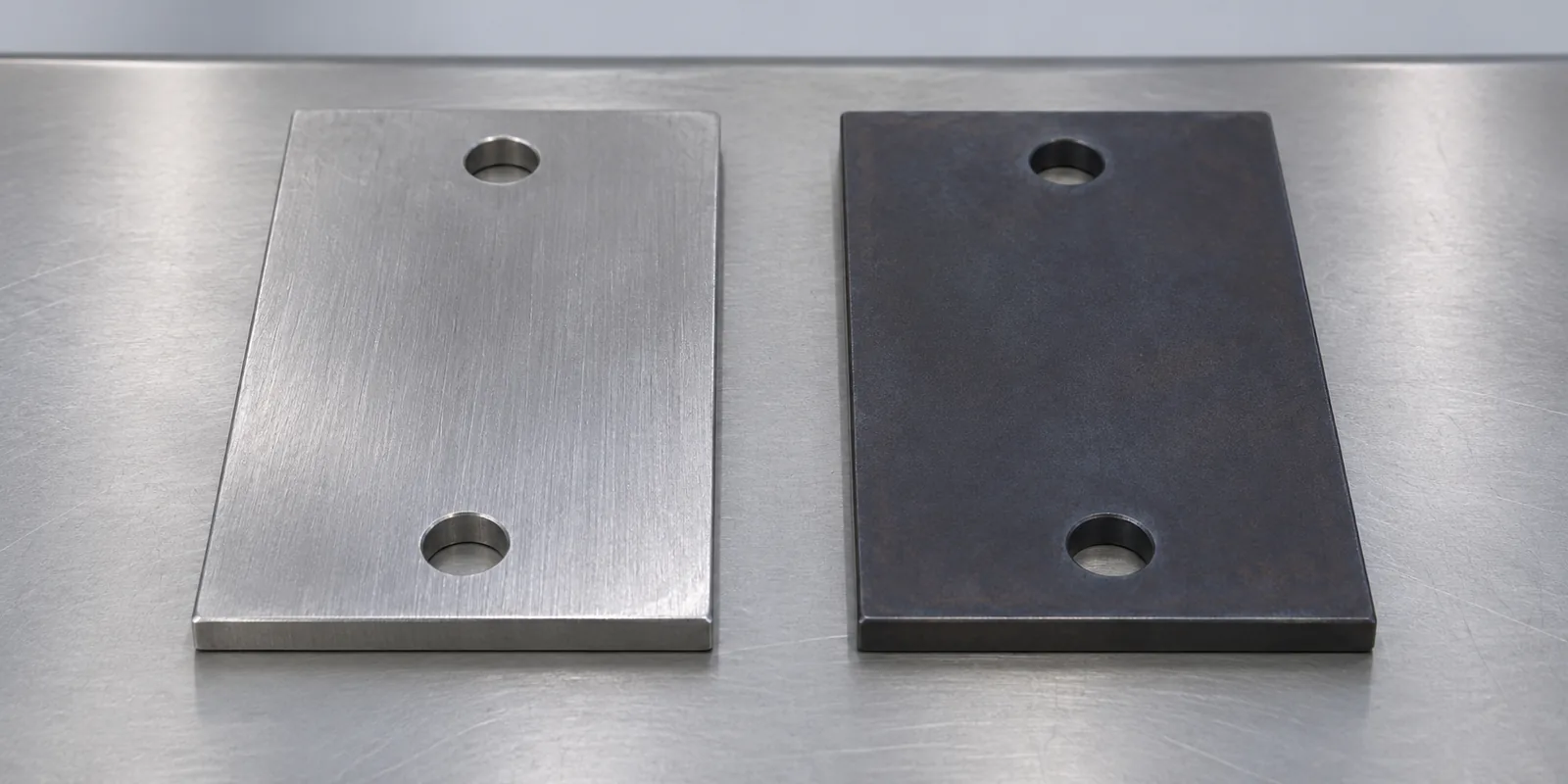
Rust converter vs rust remover is a comparison of two different treatment intentions: a remover is intended to take corrosion products off a surface, while a converter changes rust into another layer that remains as part of the treatment. Product chemistry and instructions vary, and neither process restores metal already lost to corrosion. For a buyer reviewing a rework proposal on a bathroom or home-storage component, the first questions are what material remains, what the next finish requires, and what evidence supports acceptance. A darkened surface or a visually clean spot alone does not establish that a part is sound or ready for coating.
The distinction matters because the words describe different endpoints. A removal route aims to take corrosion products away; a conversion route aims to react with rust and leave a transformed layer. The buyer should not choose between labels based only on appearance, convenience, or a supplier’s shorthand. Identify the actual product and process, the metal condition, the part function, and the next manufacturing step. This article explains how to interpret those distinctions without prescribing a chemical application or approving a corroded component for use.
What does a rust converter vs rust remover comparison tell a buyer?
The comparison tells a buyer to ask what is intended to remain after treatment. A rust remover is generally intended to remove corrosion products. A rust converter is intended to transform rust into another surface layer. The supplier’s actual formulation and instructions govern the product-specific process; the category name alone does not supply a treatment procedure or acceptance criterion.
For a metal accessory, a buyer may encounter corrosion on an exposed steel feature, a welded joint, an unfinished edge, or a returned sample. The first decision is diagnostic: is the visible condition corrosion, a stain, transferred material, or another surface defect? A label on a proposed treatment does not answer that. Ask the responsible supplier to identify the observed condition and the evidence behind that identification before authorizing rework.
Then separate the treatment objective from the part’s acceptance. Removing visible corrosion products does not put missing steel back. Conversion does not establish the remaining section, fit, load suitability, coating adhesion, or service life. A treated sample may look different while still requiring dimensional, functional, cosmetic, or coating review. If corrosion has affected a critical feature, the buyer may need an engineering disposition rather than a cosmetic clean-up discussion.
The distinction is useful when a supplier response says only “we will remove the rust” or “we will apply converter.” Ask what the named process is intended to do, what layer or residue may remain, and what comes next. The source explanation from Zerust’s corrosion FAQ supports the bounded difference between removal and conversion. Its product-specific statements do not establish a universal chemistry, guaranteed prevention, color-based diagnosis, or automatic approval for bare metal or paint.
| Review question | Removal intention | Conversion intention | Buyer still needs to confirm |
|---|---|---|---|
| What is the intended action? | Take corrosion products off the surface | Change rust into another layer that remains | Exact product and documented process scope |
| What may remain afterward? | A surface from which removed products are absent, with the base metal condition still to assess | A transformed layer and any product-specific residue | What the actual treatment leaves on this part |
| Does it restore lost metal? | No | No | Remaining section, dimensions and functional disposition |
| Does it approve the next coating? | No | No | Finish supplier or process owner confirmation |
| Does appearance prove acceptance? | No | No | Required inspection method and criteria |
The table is a decision aid, not a process specification. It avoids claiming that every rust remover or converter behaves identically. A buyer needs the exact product documentation, substrate and next-step requirements before comparing proposals.
How should buyers distinguish surface appearance from metal condition?
Surface appearance is an observation; metal condition and part acceptance require a defined assessment. A brighter surface does not establish that corrosion damage was shallow, and a dark surface does not prove that a conversion layer is intact or acceptable. The buyer should document what was seen and ask which measurement or inspection addresses the relevant product risk.
Start with the part’s role. A superficial blemish on a nonfunctional hidden face has a different commercial consequence from corrosion at a mounting interface, threaded feature, welded joint, thin wall, or visible finish surface. Do not use the same disposition for every location. Mark the affected area on the drawing or sample photograph, note whether the part is raw, finished, or assembled, and identify any adjacent material such as an adhesive pad or plastic insert that may also be exposed to rework.
Next, separate four statements that are often conflated:
- Visual observation: what the inspector can see under the agreed conditions.
- Material loss: whether the base metal or a critical dimension has been reduced.
- Treatment result: what the chosen product was intended to remove or transform.
- Product acceptance: whether the part still meets the approved drawing, function, finish and order requirements.
One statement does not automatically prove the next. A surface treatment record can help establish which product and operation were used, but it does not by itself measure lost material. A photograph can show appearance, but it does not establish section thickness. A coating check can address a coating requirement, but it does not certify every structural or service condition. The buyer should ask for evidence matched to the question rather than treating a single “pass” note as universal approval.
Consider a hypothetical coated steel basket support returned with visible orange-brown marks near a joint. The buyer should not jump directly to a converter because the color looks like rust. First identify whether the mark is corrosion, contamination, coating damage, or a combination. If the joint or wall thickness may be affected, route that question to the responsible engineering or quality owner. If the concern is appearance only, define the approved cosmetic boundary and finish process separately. If conversion is proposed, confirm whether the remaining layer is compatible with the next finish according to the responsible finish supplier.

What must be confirmed before approving a treatment proposal?
Before approving rework, confirm the exact product, intended operation, affected substrate, remaining-surface expectation, next process, and decision owner. If any of these is missing, the proposal is not yet a complete basis for acceptance. This is a documentation and scope check, not a recommendation to apply a particular chemical.
Ask the supplier to identify the commercial product and provide the current documents relevant to the proposed use. Preserve the product maker’s wording rather than translating a short shop-floor description into a broader compatibility claim. If the process includes removal, conversion, rinsing, drying, coating, or another follow-on step, the responsible supplier should identify what is actually planned and which instructions govern it. This article does not provide concentrations, dwell times, chemical mixtures, handling steps, or disposal advice.
A buyer can use this request structure:
- Part and revision: Which drawing, sample, lot and revision are affected?
- Observed condition: Where is the condition, and what evidence supports the diagnosis?
- Product identity: What exact commercial product is proposed, and who makes it?
- Treatment intention: Is the objective removal, conversion, or another defined rework action?
- Substrate scope: Which metal, coating, joint, insert or adjacent material will be exposed?
- Expected endpoint: What is intended to remain after treatment?
- Next process: Will the surface be coated, assembled, packed or accepted as finished?
- Acceptance evidence: Which agreed check addresses appearance, dimensions, function or finish?
- Approval owner: Which party is responsible for chemical, coating, engineering and order acceptance?
The buyer does not need to demand proprietary chemistry when a product identity and maker-approved application statement answer the project question. Conversely, a generic product family may not be enough when a coating or adhesive depends on the exact formulation. Use the least intrusive documentation that resolves the actual risk, and escalate if the product maker’s scope is unclear.
For a sample review, record the before and after condition under comparable observation conditions and identify what the photos can demonstrate. Do not label a visual comparison as a corrosion test, material restoration, or coating-adhesion result unless a suitable method was actually used and the result is documented. If a part’s function or critical dimensions are in question, a cosmetic rework sample cannot close that engineering issue by itself.
How should the buyer interpret the layer that remains?
The remaining layer must be evaluated against the next operation and the product’s actual specification. A converted layer may be part of the treatment; a removal process may leave a different surface condition. The buyer should ask the process owner and finish supplier what surface state is required, rather than assume that either result is universally ready for paint, plating, bonding or assembly.
This matters because the finished product is a system of substrate, joint geometry, preparation, coating, assembly and environment. A surface condition that is acceptable for one subsequent process may not be acceptable for another. The exact requirement depends on product instructions, project specification and responsible process owners. An article-level comparison cannot replace those documents.
Use a simple “before / operation / remaining condition / next decision” record. It helps prevent the treatment label from becoming the acceptance criterion:
| Record field | Example of a useful entry | Avoid writing |
|---|---|---|
| Before | Corrosion-like marks at the outside face of a named steel bracket | “Rusty” with no location or context |
| Operation | Named supplier product and controlled revision | “Cleaned” if the method is unknown |
| Remaining condition | Observed surface and any layer stated by the product/process owner | “Good as new” |
| Next decision | Finish review, dimensional disposition, or cosmetic acceptance by the named owner | “Ready” without a requirement or approver |
This record is especially useful when a part passes through multiple suppliers. The hardware factory may own the part geometry and assembly; a chemical supplier may own product instructions; a coating supplier may own finish compatibility; and the buyer may own final acceptance criteria. Assigning each question to a responsible party avoids silently transferring one supplier’s claim to another.
If the part is made from aluminum or another material where “rust” is being used loosely, correct the terminology before approving a rust-specific treatment. Corrosion appearance and chemistry differ by material, so a steel-focused product should not be assumed appropriate. The buyer can use Koitor’s broader Informações sobre o fabrico de acessórios personalizados para casas de banho to discuss product construction and project scope; that page is not a substitute for a corrosion-treatment instruction or materials assessment.
What mistakes make corrosion rework decisions unreliable?
The most serious mistake is using the treatment name as proof that the part is restored. Neither removal nor conversion replaces missing metal, establishes remaining strength, or waives a drawing requirement. A second mistake is treating color as a complete diagnosis or acceptance test.
Other common interpretation errors include:
- Approving rework before identifying the condition. A stain, transferred material and corrosion may look similar in a photograph but call for different review paths.
- Ignoring location. A mark at a critical joint or mounting point may require a different disposition from a mark on a nonfunctional hidden face.
- Assuming a converter leaves no layer. Conversion is intended to change rust into another layer; the actual product and endpoint must be confirmed.
- Assuming a remover leaves a coating-ready surface. The product category does not prove compatibility with the next finish or adhesive.
- Equating visible cleanup with dimension recovery. Treatment does not rebuild a corroded wall or restore a lost edge.
- Applying an approval to a different substrate. A process approved for one metal, finish or component may not apply to another.
- Using a supplier’s generic color description as evidence. Color alone cannot establish the process, material state or remaining-layer properties.
- Skipping revision control. A changed product, treatment instruction, finish or part revision can invalidate an earlier review.
- Mixing process and end-user care. A factory rework method should not become a consumer cleaning recommendation without separate review.
- Treating a sample photo as a performance test. Photography documents appearance, not structural condition or future corrosion behavior.
To make review actionable, close each item with one of three outcomes: accept the defined cosmetic condition against an agreed criterion; hold pending a specific technical document or inspection; or reject/replace the part because a critical requirement cannot be demonstrated. The labels are not universal dispositions; they are a way to state what evidence is still needed. Avoid indefinite “looks okay” comments that leave process ownership unresolved.
How can an OEM supplier support the review?
A custom metal hardware OEM can help identify the part revision, construction, finish, affected feature and manufacturing owner. Koitor Hardware is a family-owned custom metal hardware factory focused on bathroom and home-storage products. Its role is to discuss the hardware drawing or sample, component boundaries, approved product configuration and project communication within confirmed capabilities. This does not imply a chemical laboratory, corrosion-treatment service, or a guarantee that a reworked part is acceptable.
For a small-batch OEM project, the buyer can send a drawing or physical sample, mark the observed location, identify the lot and revision, and attach the proposed supplier product documentation. The conversation can then separate metal-product questions from chemical and coating questions. If the treatment affects a visible face or fit-critical feature, include the acceptance condition before requesting a sample or production disposition.
When a proposed rework changes a finish, surface appearance or assembly interface, preserve the approved revision and samples so that later orders can be compared with the same scope. Do not assume that a changed product can be treated as equivalent because the label sounds similar. Record who approved the change and which downstream supplier confirmed the relevant surface requirement.
MOQ, sample timing, finish availability and production schedules depend on the actual product, quantity and project details. They must be confirmed for each inquiry; a general corrosion article cannot promise a production outcome. Buyers can review OEM home-storage hardware information or contacte a Koitor with the drawing, sample and scoped question. The contact request should state whether the issue concerns geometry, finish, appearance, or an external chemical product so the right owner can respond.
How should a buyer close an unresolved rework decision?
An unresolved decision should name the missing evidence, the person who can provide it and the next review point. “Need more information” is difficult to act on unless it says whether the gap concerns diagnosis, product identity, metal condition, finish compatibility or order acceptance. A buyer can record each item separately and avoid asking one supplier to answer questions outside its responsibility.
For example, a chemical product maker may confirm what a named product is intended to do, while a coating supplier addresses whether its finish system has an applicable preparation requirement. The hardware supplier can identify the part revision, metal feature and stage where the proposal would be used. The buyer or quality owner then determines whether the resulting evidence meets the order’s acceptance criteria. This division is practical even when one organization coordinates the responses.
If evidence arrives in stages, do not treat an early reply as full approval. A statement that a product is a rust converter answers a terminology question; it does not automatically answer whether the treated sample is dimensionally acceptable, whether a later coating can proceed, or whether a damaged feature remains functional. A clear record can mark one question “answered” while keeping the others open. This is more precise than applying a single pass/fail label to a multi-part issue.
When the issue is limited to a cosmetic face, the buyer may define a visual acceptance boundary using an approved sample or drawing note. When the location affects a joint, mounting feature or fit, the review may need a separate measurement or engineering disposition. The method should match the consequence and should be agreed before rework. Do not invent a numeric tolerance, inspection frequency or chemical procedure from a generic comparison article.
The most reliable rust converter vs rust remover decision therefore begins with the desired endpoint and ends with a named acceptance owner. Keep the proposed treatment, evidence and product revision together. If the substrate, coating, product formula or rework sequence changes, reopen only the affected scope and preserve the prior record for traceability.
Buyer checklist before approving corrosion rework
- Identify the part, lot, drawing revision and affected location.
- Record the observed condition without assuming the diagnosis from color alone.
- Distinguish corrosion products from missing base metal or dimensional change.
- Obtain the exact commercial product identity and current supplier instructions.
- State whether the proposed objective is removal, conversion or another defined operation.
- Confirm every exposed material, coating, joint and adjacent component.
- Ask what is intended to remain after treatment and what process follows.
- Assign chemical, coating, engineering and buyer acceptance questions to named owners.
- Define evidence for appearance, dimensions, function and finish separately.
- Preserve sample, process, drawing and product revisions with the decision.

Perguntas frequentes
Does a rust converter remove rust?
Its intended action is to convert rust into another layer rather than simply remove the corrosion products. Actual product behavior and instructions vary, so confirm the named product and process scope.
Does a rust remover restore corroded metal?
No. A removal process does not replace metal lost to corrosion. Affected dimensions or functional features need their own engineering or quality disposition.
Does a dark surface prove that conversion worked?
No. Appearance alone does not establish the product used, the treatment result, remaining metal condition or acceptance for a later finish.
Can a treated surface be painted or coated immediately?
The article cannot establish that. Confirm the exact treatment product, surface and next finish requirement with the responsible product or coating supplier.
Is rust converter suitable for every metal accessory?
No universal conclusion follows from the category name. Identify the substrate, condition, product instructions and intended operation before approval.
Trabalhe com a Koitor Hardware
Review a Corrosion-Rework Question
Share the part drawing or sample, affected location, finish and proposed process documents. Koitor can discuss the metal hardware scope; the chemical and coating suppliers should confirm their product-specific instructions.
OEM / MARCA PRÓPRIA
Transforme este guia de fornecimento num resumo do produto
Indique o produto pretendido, as dimensões, o acabamento, a quantidade a encomendar e os requisitos de embalagem. A sua equipa receberá uma análise prática da viabilidade de fabrico antes da apresentação do orçamento.
 English
 Español
 Português
 Français
 Deutsch
 العربية