
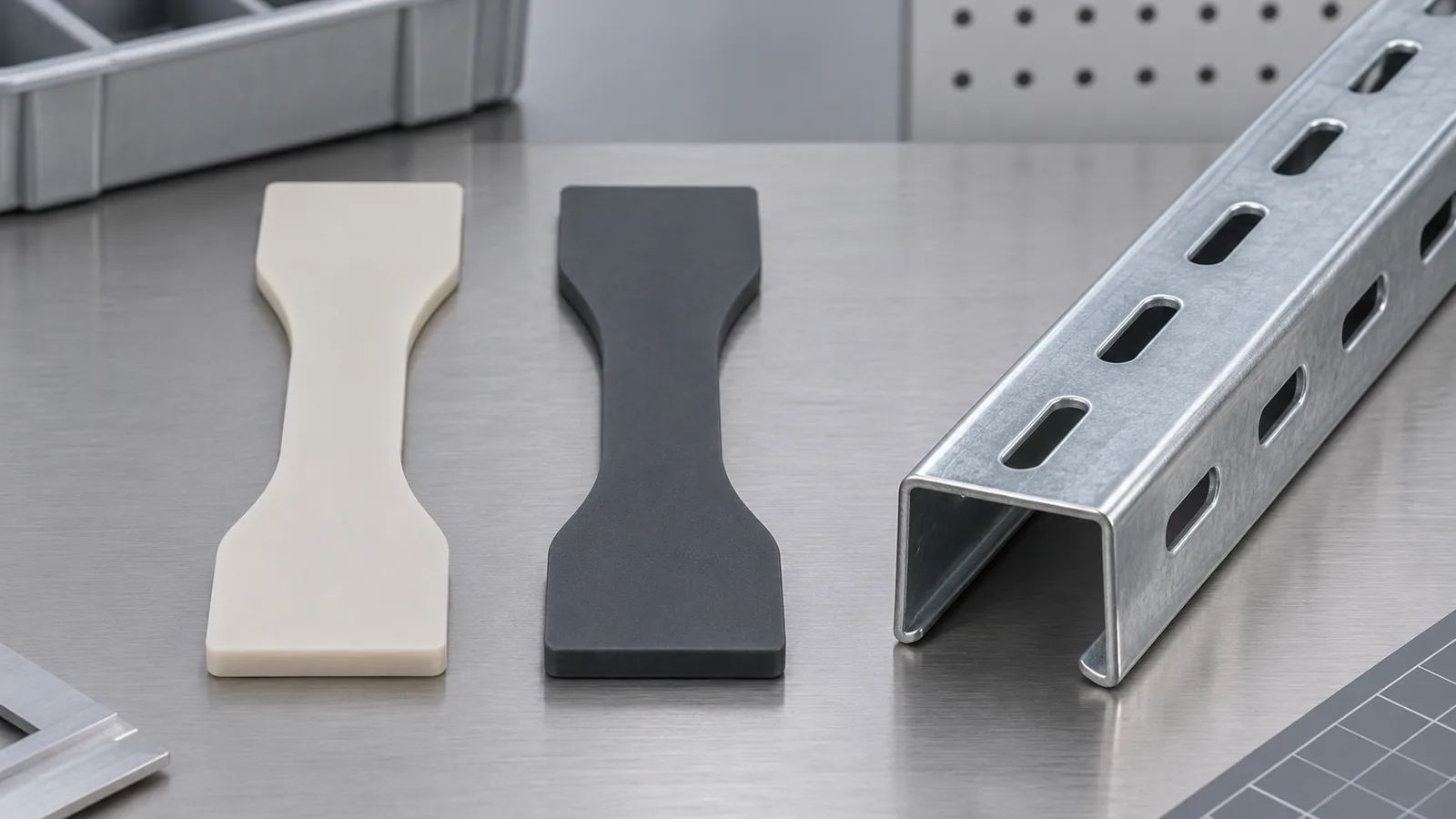
Silicone vs neoprene is a comparison between two elastomer families that should be separated into thermal exposure, mechanical demand, contacting media and finished-part construction. Silicone is often considered when a broad thermal-flexibility requirement is prominent; neoprene, also known as chloroprene rubber (CR), is often considered for mechanical tear or abrasion-oriented applications. These are starting points from a material comparison, not guarantees for every grade or component. The correct choice depends on the exact compound, geometry, exposure and evidence for the part being purchased.
For an importer specifying a rubber foot, spacer, pad or seal on bathroom or home-storage hardware, a family name does not answer every application question. Write down the temperature history that matters, whether the part is pulled, rubbed or compressed, what it touches, and how it is attached. Then ask which supplier document applies to that actual construction. Neither silicone nor neoprene is automatically stronger, longer-lasting or universally more suitable.
What problem does a silicone vs neoprene decision help buyers solve?
The comparison helps a buyer interpret a proposed rubber material without letting one attractive property stand in for the whole component requirement. A supplier may mention thermal suitability, flexibility, tear resistance or a familiar compound name. Those words describe different evidence questions. Buyers need to identify which attribute is relevant to the product and which claim still needs proof.
Imagine a hypothetical metal storage accessory with a soft pad at the contact point. The part might sit close to a warm appliance, rub against a surface during repositioning, remain compressed while the product is loaded, and contact household cleaners during care. A thermal question does not settle abrasion. A pad that withstands a particular temperature statement does not automatically fit or retain on a metal feature. A sample that resists a short pull does not establish a different temperature exposure.
The useful decision is therefore not “Which rubber is best?” It is “Which requirements must this exact pad satisfy, and what evidence covers each one?” This reframing keeps the comparison relevant to a buyer while avoiding unsupported product claims. It also prevents a supplier’s short quotation description from being mistaken for a complete engineering specification.
The broad material-family distinction is supported by the manufacturer comparison from Timco Rubber: the source presents silicone as a family often considered for thermal flexibility and neoprene as an option associated with mechanical tear or abrasion applications. This article uses that qualitative direction only. It does not repeat numerical service ranges, infer fire resistance, rank oil compatibility, or claim a finished-part winner. The source’s observations are not a Koitor test, specification or production result.
What do the material names establish, and what remains unknown?
Silicone rubber and chloroprene rubber are different material families. “Neoprene” commonly names chloroprene rubber. Each family can include different grades and formulations, and the finished part includes more than the polymer name: thickness, shape, cure, attachment, surface and compression all affect the assembly.
The name alone does not tell the buyer the exact commercial compound, its additives, its verified service conditions, or its behavior when bonded to a particular metal finish. It does not provide an exact minimum or maximum temperature, a universal tear value, a life expectancy, or compatibility with every cleaner. Such details require a source that identifies the actual material and the method or conditions behind the claim.
This separation is important for substitution. If a buyer requests a different material family, the decision can affect how a part forms, contacts a surface, deforms under load or attaches to a metal component. The change may be technically reasonable, but it should be compared against the intended function and the approved sample or drawing. A new name on a quotation is not proof that the replacement preserves the old part’s performance.
| Decision dimension | Silicone family question | Neoprene / CR family question | What the buyer must still verify |
|---|---|---|---|
| Thermal exposure | Is thermal flexibility the main screening need? | Does the proposed grade cover the defined temperature history? | Actual compound, time, temperature, part geometry and evidence scope |
| Tearing or abrasion | What mechanical contact or edge damage is possible? | Is the cited mechanical tendency relevant to this shape and use? | Test method, specimen construction, contact pressure and supplier evidence |
| Compression and retention | Does the part remain compressed or need to stay attached? | Does the compound and interface suit the stated assembly? | Geometry, attachment, fit, compression and revision record |
| Contacting media | Which cleaners, oils or other substances actually touch the part? | Does the evidence address the named substance and conditions? | Exact product identity and supplier instructions; no inference from color |
| Produto acabado | What does the pad do in the metal assembly? | Is the proposed component the same size and function as the approved sample? | Drawing, sample, interface and acceptance decision |
This is not a scorecard. It does not assign points or establish that one family wins if two requirements compete. It makes the unanswered fields visible before a buyer approves a component. If a particular property is essential, the buyer should decide how it will be verified and which party is responsible for supplying the supporting evidence.
How should buyers separate thermal and mechanical requirements?
Start with the environment and the failure mode, not the material label. A brief requirement statement should identify what the part experiences and what change would make the product unacceptable. “Flexible” is not a complete acceptance criterion. It may refer to handling, compression, bending, sealing or recovery after deformation, which are not the same observation.
For thermal exposure, describe the actual use pattern where known. Is heat continuous, occasional, brief or associated with a particular location in the product? Does the component cool between exposures? Is the temperature measured at the rubber itself or only at a nearby appliance? If those details are unknown, state the uncertainty and ask whether the supplier’s document covers the closest defined condition. Do not invent a temperature band from a generic family chart.
For mechanical demand, identify the direction and kind of contact. A pad may experience shear as a product slides, local pressure at a narrow edge, abrasion from repeated movement, or compression while supporting a stationary load. A seal may be squeezed differently from an exposed bumper. A rubber foot may detach because of its interface even when the bulk material remains intact. These examples describe possible mechanisms, not recorded Koitor failures or measured incidence.
Then check whether the evidence is about a raw compound, a test coupon or the completed part. A material sheet can describe one named material, but the buyer may need to understand if its stated method applies to the part geometry and attachment. A visual sample review can establish shape, color and fit; it cannot prove an unmeasured thermal history or abrasion lifetime. Conversely, a general family description can guide questions but cannot substitute for the sample or project’s acceptance criteria.
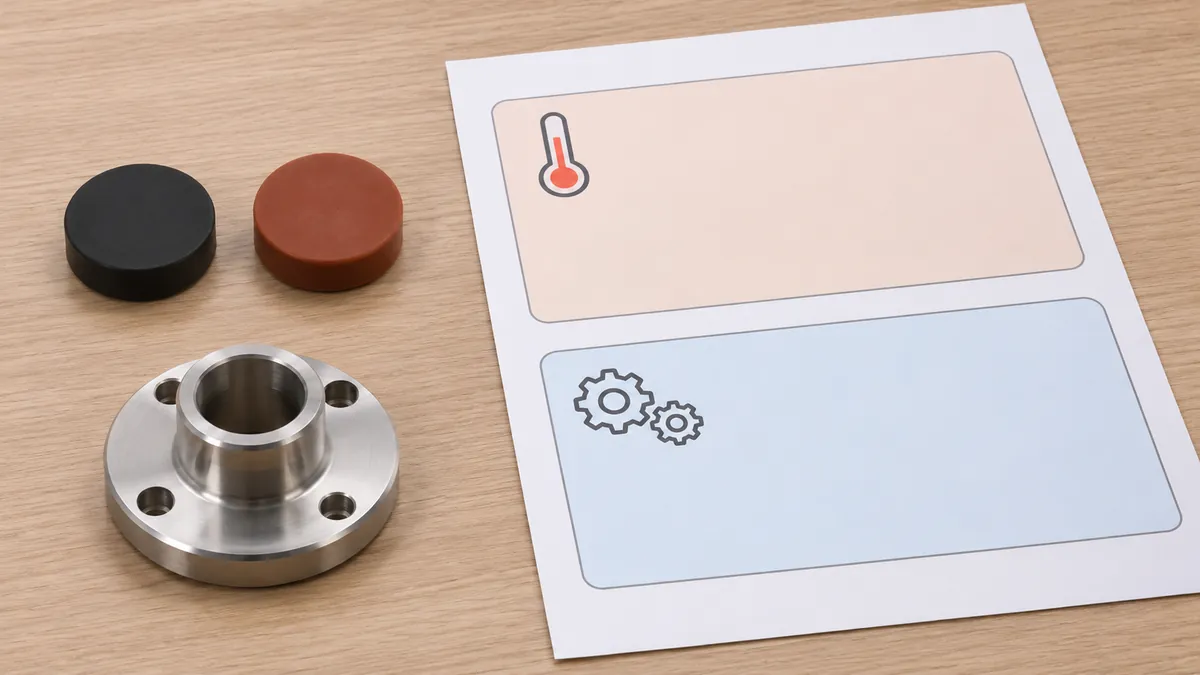
For a hypothetical mounting pad, the buyer can create a two-axis summary: thermal exposure on one axis and mechanical contact on the other. Under each, write the actual condition or state “not defined.” The matrix should not imply that one family is approved for a quadrant. Instead, it shows whether a supplier proposal answers both important questions or only one. If the pad has a separate retention feature or adhesive, record that interface in its own row.
This method is useful even when a buyer cannot disclose confidential product details. The buyer can define a bounded test or service condition without sharing a customer name, proprietary drawing or unrelated commercial information. Keep the exact evidence request proportionate to the product risk and make the responsible supplier clear. No outside article can make a component approval decision on behalf of the buyer’s engineering and quality teams.
When reviewing two offers, use the same evidence questions for both. First compare the component description: do both offers refer to the same foot, pad, seal or bumper? Next compare the compound identification: is each supplier naming a family only, or a more specific material? Then compare the condition behind each property statement. If one document describes a material coupon under a stated method and another describes a finished component under different conditions, list those scopes side by side rather than ranking the numbers. Finally, record the buyer decision: equivalent for the defined requirement, more evidence needed, or a new sample and approval required. This four-step note makes the silicone vs neoprene comparison useful in procurement review without turning it into a technical certification. It also gives the supplier a clear opportunity to identify what is known and what remains outside the quotation. A concise record can prevent an informal material substitution from being carried into a later reorder with no revision history.
Keep the original sample label and any supplier response with the quotation record. If a document is replaced, note its revision date and whether the named compound changed. This simple traceability step helps a buyer compare a later reorder with the approved scope, even when no new performance testing is requested.
What should a sourcing specification and sample review contain?
A buyer-ready specification makes the part identifiable and the decision repeatable. It can be short, provided it connects the compound, geometry, function and evidence to one revision. Avoid a list of broad adjectives that could be interpreted differently by the buyer and supplier.
Before requesting a quotation or approving a sample, record:
- Component function: foot, bumper, spacer, seal, pad or other role, plus the metal part it serves.
- Material statement: silicone, neoprene/CR, or another proposed family; include a commercial grade or compound identifier only when the supplier provides one.
- Geometry and interface: dimensions, thickness, attachment method, contact surfaces and any feature that controls retention or fit.
- Thermal conditions: the intended location and exposure pattern, with known measurements and unknowns clearly separated.
- Mechanical conditions: compression, rubbing, shear, edge contact, repeated movement or another defined demand that matters to the component.
- Contact media: name cleaners, oils, water, cosmetics or other media only where they are part of the intended exposure; do not use “chemical resistant” as a substitute for a list.
- Evidence scope: identify whether documents describe the polymer family, the named compound, a test specimen, a molded part or the assembled product.
- Acceptance and change control: specify who reviews the sample, how an alternative is approved, and what happens if material, geometry, attachment or supplier changes.
At sample review, check dimensions, interface fit, visible quality and the intended assembly. Photograph the sample if that supports the project record, and tie observations to a date and revision. Keep test questions in a separate field: “visual match confirmed” must not be recorded as “thermal requirement passed.” If additional testing is warranted, define the responsible laboratory or supplier, the method, the acceptance criterion and the part under test before the work begins.
For buyers who need to distinguish material family selection from a specific mechanical property, Koitor’s shore-hardness guide for rubber hardware pads covers a separate measurement concept. For compression-dependent mounting interfaces, the rubber compression-set guide addresses a different property and buyer question. Neither page replaces an evidence review for this silicone-versus-neoprene comparison.
What mistakes make a material comparison misleading?
One frequent reasoning error is selecting the material with a favorable statement on the wrong dimension. A thermal advantage cannot answer an edge-tear question. A mechanical tendency cannot establish a temperature limit. A buyer should require the comparison to match the part’s most relevant exposure, not whichever property is easiest to describe.
Other mistakes include:
- Choosing a universal winner. The intended use, grade and part construction determine the decision. The comparison does not establish that silicone or neoprene is always superior.
- Transferring a test result between constructions. A sheet, coupon, bonded pad and molded foot may differ. Check the specimen and method before applying a document to a different assembly.
- Reading “flexible” as a specification. Flexibility has no single meaning unless the buyer states the condition and observation. It is not a substitute for a defined mechanical criterion.
- Treating a rubber family as an exact compound. A family label may not disclose formulation details needed to assess the exact use. Ask the material supplier for the identifiable product information it can provide.
- Ignoring the attachment. A pad can move or detach at the interface. Bulk material identity alone does not settle bond quality, retention geometry or assembly fit.
- Using a hand squeeze as a test. A quick touch cannot establish thermal suitability, abrasion life, chemical compatibility or compression performance.
- Assuming a technical sheet covers the intended use. The document may address a material sample under a specific condition. Read its scope and limitations rather than quoting a heading out of context.
- Changing material without recording a revision. A substitution should be visible in the drawing or approval record, with open questions resolved before production.
- Treating an image or color as material identification. Photographs and colors communicate appearance; they do not verify the polymer family or its compound.
When a quotation contains two competing offers, normalize the scope before comparing price. Ask both suppliers to address the same component geometry, finish, attachment, exposure questions, order quantity and packaging. If one supplier has provided a named compound and evidence while the other has only supplied a family name, note the difference instead of considering the offers technically identical. The buyer can then decide whether the extra information is required for the intended use.
Do not create a false sense of certainty by requesting “the strongest rubber.” Strength is not one property, and a product may prioritize fit, resilience, weathering, temperature, abrasion, sealing or another function. Use the actual failure mode to decide what evidence is important. Where the buyer does not know the conditions, the correct status is “requirement not yet defined,” not an invented assumption.
How can a metal hardware OEM support this review?
A metal hardware OEM can help clarify the interface between the rubber component and the metal product. Koitor Hardware is a family-owned custom metal hardware factory. Its approved role is to discuss the project drawing or sample, the metal geometry and how the specified component fits into the product-development conversation. That role does not imply that Koitor formulates silicone or neoprene, runs a rubber laboratory, or guarantees a finished part for an unverified exposure.
During small-batch product development, the buyer can share the product drawing, sample, target application and the specific material question. The supplier can identify whether the issue concerns the metal part, the mounting interface, a supplier-provided rubber component or the buyer’s evidence requirement. If the team is coordinating a bought-in item, name the party responsible for material documentation. A clear boundary prevents a metal supplier’s quote from being mistaken for independent proof about a compound made elsewhere.
An OEM review can also protect sample-to-production consistency. If a rubber pad changes thickness, profile, attachment or color, identify the change in the sample record. If the compound changes, request the supplier’s description and confirm whether the change needs additional approval. The change process can be defined without assuming that a substitute is unacceptable or automatically equivalent.
The commercial discussion should focus on confirmed product needs: drawing or sample, target quantity, finish, packaging, private-label requirements and sample approval. MOQ and timing depend on the product and project scope, so they should be confirmed for the actual quotation. Buyers should not interpret a general article as a factory promise or as a technical approval for every component.
For a relevant metal home-storage project, buyers can review Koitor’s OEM home-storage hardware manufacturing information and use the Página de contacto do Koitor to share the drawing or sample. Include the actual component function and the precise unanswered question so the response can be routed to the responsible project scope.
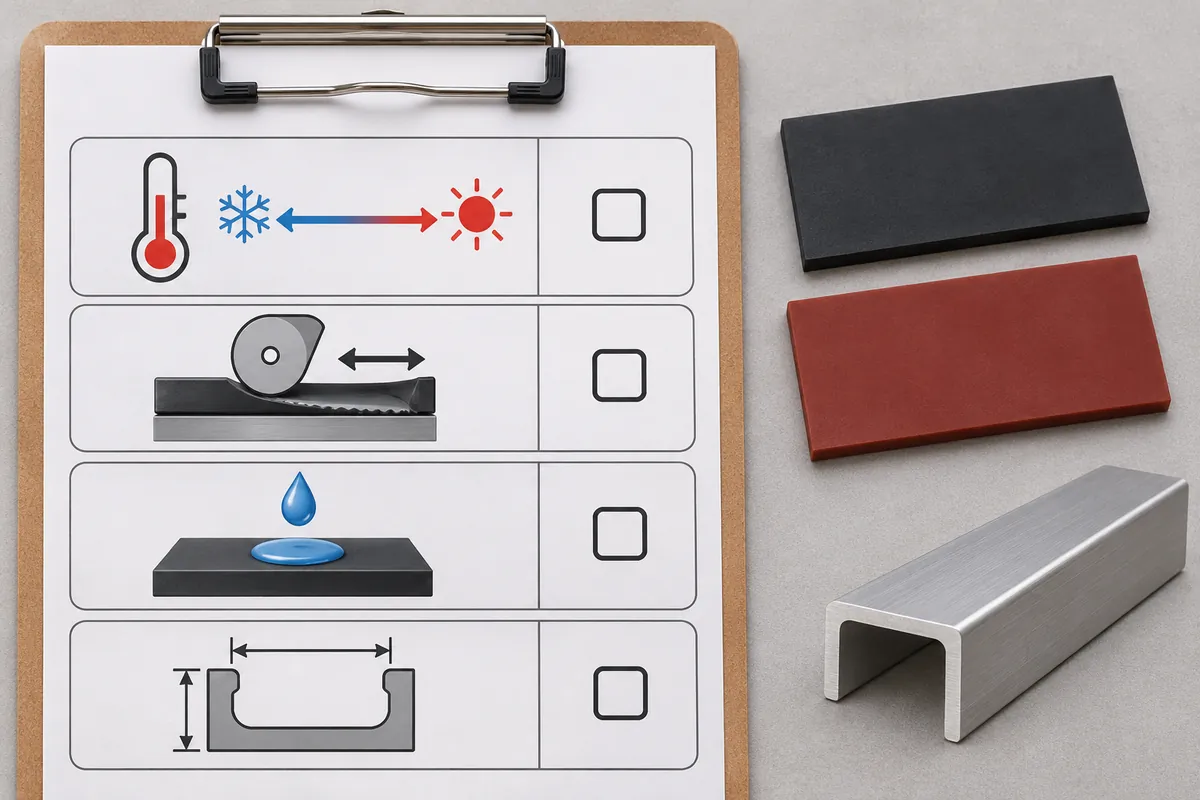
Buyer checklist before requesting a quotation
- Name the component’s role and the metal product it serves.
- Identify whether the proposal is silicone, neoprene/CR or another family.
- State the thermal exposure that matters, including unknown details.
- Describe relevant compression, rubbing, tear or abrasion demands.
- Name contact media instead of asking for generic chemical compatibility.
- Provide the drawing or sample revision, geometry and attachment method.
- Request evidence tied to the named compound and the finished part where available.
- Separate visual sample observations from technical performance approval.
- Record the party responsible for the compound document or any test request.
- Document the disposition before changing material or starting bulk production.
Perguntas frequentes
Is silicone always better than neoprene at higher temperatures?
No universal temperature conclusion follows from the family names. A specific grade and finished part need evidence that matches the actual temperature, duration and construction. Do not use a generic range as an automatic product approval.
Is neoprene always better for abrasion or tearing?
No. Neoprene is often considered for mechanical tear or abrasion-oriented requirements, but the exact compound, geometry, contact and method matter. A family-level tendency does not guarantee a proposed pad’s result.
Can a buyer use the same material for every pad in a product line?
Only after the buyer confirms that the pads share the same function, geometry, environment and acceptance needs. A visually similar part on another model may have a different contact point or thermal history.
Does a sample prove that a material substitution is acceptable?
A sample can support fit, appearance and assembly review. It does not automatically prove an unmeasured temperature, tear, abrasion or chemical requirement. Record which checks were actually completed and which remain open.
What is the first question to ask the supplier?
Ask which specific component and compound the proposal covers, then state the thermal and mechanical requirements separately. This makes it easier to see whether the available document answers the buyer’s real question.
Trabalhe com a Koitor Hardware
Discuss a Rubber Interface in Your Hardware Design
Share the metal drawing or sample, the component function, and the thermal or mechanical requirement you need to resolve. Koitor can review the hardware interface and project scope; the responsible compound supplier should confirm material-specific evidence.
OEM / MARCA PRÓPRIA
Transforme este guia de fornecimento num resumo do produto
Indique o produto pretendido, as dimensões, o acabamento, a quantidade a encomendar e os requisitos de embalagem. A sua equipa receberá uma análise prática da viabilidade de fabrico antes da apresentação do orçamento.
 English
 Español
 Português
 Français
 Deutsch
 العربية