
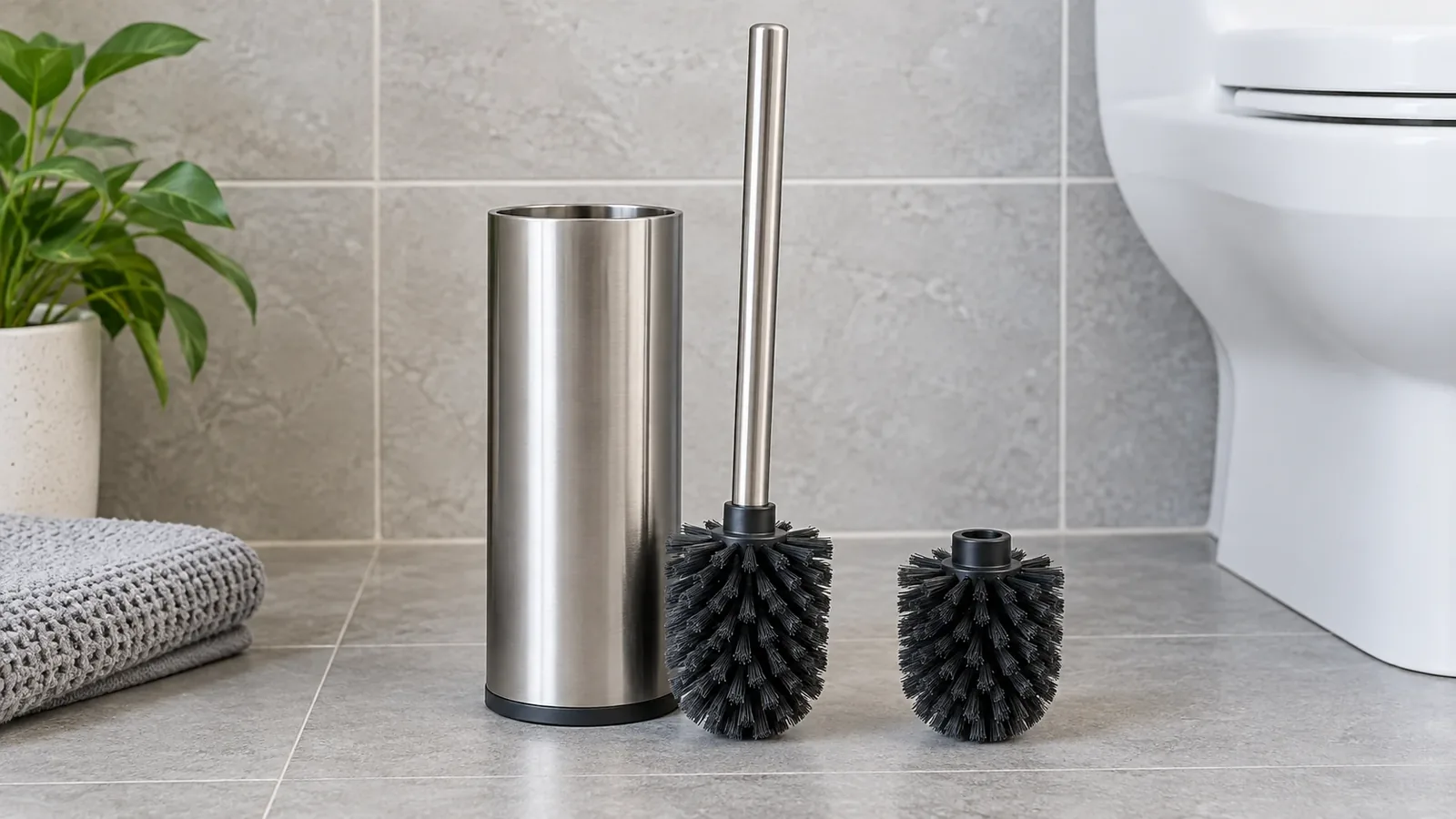
A toilet brush replacement head should be approved against the exact handle and holder model it is intended to serve. Importers should freeze the connection drawing, the head’s outside envelope, the holder clearance and the replacement part number as one product configuration. The word “universal” is not a substitute for an interface definition: brands can use different engagement features, thread forms, lengths and removal paths. Test the production-equivalent head with the named set, then control supplier and revision changes so a later spare remains compatible with the product already in customers’ homes.
This is a buyer-side specification guide for private-label bathroom sets and replacement-part programs. It does not assert that Koitor manufactures brush heads, plastic molding, or a current toilet-brush set. The metal holder, handle and brush head may come from different sources, so the buyer needs clear component responsibility and a verified assembly sample.
What does replacement-head compatibility mean in an importer program?
Compatibility is a relationship among specific parts, not a general property of a brush head. The buyer needs to know which head fits which handle, whether that assembly clears the holder, how the parts are joined and removed, and which production revisions the claim covers. A spare may attach to the handle yet still be too long, wide or angled for the holder. Conversely, a head can fit inside the vessel while its connection to the handle is loose or incomplete.
The customer-facing replacement promise should therefore name a model, product family or part number. If the spare is restricted to one set, state that restriction in the product data and instructions. If a buyer plans several related models, test each named combination rather than extrapolating from one successful sample. A shared brand or similar appearance does not establish the same connector geometry.
A Reddit user reported that a head marketed as “universal” did not fit the handle they already owned. That is a useful example of a compatibility problem to address, not proof of a widespread failure rate or of any universal industry standard. The buyer’s task is to replace ambiguous marketing language with measurable product references and a simple compatibility matrix.
| Interface or envelope | Buyer record | Release question |
|---|---|---|
| Head connector | Drawing, engagement form, key dimensions and revision | Does it attach to the named handle without rocking, cross-threading or forced assembly? |
| Handle | Length, interface feature and revision | Is the mating end controlled by the same drawing or supplier approval? |
| Brush-head envelope | Maximum diameter/width, length and angle | Does it enter and leave the holder with the intended clearance? |
| Holder | Opening, usable depth, interior shape and drain/liner arrangement | Does the assembled set stow without interference? |
| Spare part | Part number, supplier, revision and product-family match | Can purchasing and customer service identify the correct replacement later? |
Brabantia’s first-party material demonstrates why the part identity matters. Its ReNew replacement data sheet ties a replacement brush to a specific ReNew holder and identifies the replacement as its own part. A separate Profile replacement sheet limits that part to the named Profile set. These are brand-specific examples, not dimensions or designs to copy. They show how a buyer can make the product-family relationship explicit.
Which dimensions and details define the head-to-handle interface?
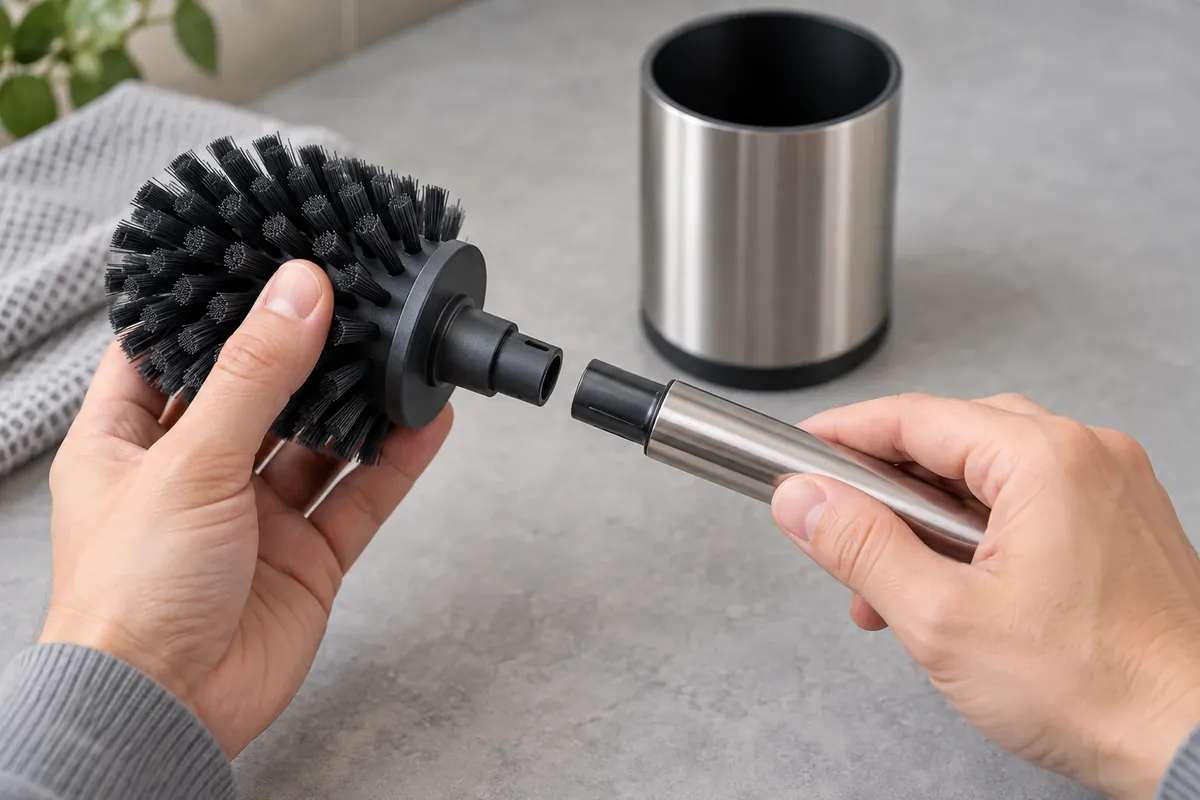
Begin with the mating drawing or a controlled physical reference from both component suppliers. Avoid relying on a verbal description such as “standard screw fitting,” “press fit” or “same as the previous one.” Those terms do not fully specify how far the parts engage, which surfaces locate them, how assembly is stopped, or what amount of rotation is expected.
For a threaded interface, identify the thread specification only when it is known and verified, along with nominal size, pitch, engagement length, lead-in, shoulder position and any rotation stop. Do not infer a thread standard from a photograph or consumer review. If the interface uses a snap, bayonet, clip, keyed socket, press fit or other geometry, show the relevant locking features and assembly path on a drawing. The fact that two parts can be pushed together once does not establish repeatable engagement over production.
Also show the surfaces that carry load or prevent rotation. A thread may draw two parts together while a shoulder sets the final axial position. A key or flat may control orientation. If the product relies on friction, specify the surfaces and the buyer’s acceptable insertion and removal experience. The exact criteria should come from the product program rather than an invented universal pull force.
A useful sample review records the initial gap, final seated position, any visible wobble, the amount of rotation required and whether the joint backs off during the buyer-defined use sequence. If the interface is replaceable by an end user, test assembly and disassembly using the intended instruction method. Note whether a user must hold the handle, twist the head, press a latch or use a tool. Do not assume maintenance is obvious from the shape.
Material interfaces can also change what the drawing needs to control. A metal handle connected to a molded plastic head may have different tolerances and component owners. If a metal insert is overmolded or captured in a polymer part, the buyer should identify who controls that insert and how its revision links to the head drawing. Koitor’s current plastic brush-head manufacture is unconfirmed; any molded part should be assigned to its actual supplier, with an approved component print and sample.
For an OEM program, keep the assembly data at a level that can be checked. Record which drawing controls the head, handle and mating feature; the critical dimensions; the acceptable visible gap or seated position; and the inspection method. If a supplier cannot share a complete proprietary design, agree on the interface dimensions and validation sample needed for the buyer’s approval. Protect confidential design files through the appropriate project controls.
How should the holder and complete set be checked?
Treat the holder as a second interface. Record the opening dimensions, interior depth, any removable liner or insert, the direction in which the handle is stored, and the clearance around the brush head. Some products store the head vertically; others use an angled or offset handle. The buyer should assess the exact combination because a replacement head may alter the width, length or center of the stored assembly even when the connection is unchanged.
Create a simple envelope drawing for the full assembly. Show the maximum head profile, head-to-handle angle, handle length, holder opening and intended resting position. Include the liner or other purchased component if it changes the usable space. A catalog image alone cannot establish clearances inside an opaque holder.
Test the full set in at least three states: head attached and stored; head removed from the handle; and the holder or liner removed for inspection if the design permits it. Observe whether the brush head catches on the opening, whether the handle rests in its intended position, and whether parts can be lifted out without striking the rim. These are fit observations, not claims about cleanliness or cleaning effectiveness.
If the holder has a liner, its ownership and revision should be recorded separately from the metal exterior. K244’s existing content is concerned with removable-liner containment and related holder behavior; this article stays focused on the spare head, its handle interface and model lifecycle. Avoid drifting into a general guide to toilet-brush cleaning, antimicrobial claims or toilet hygiene.
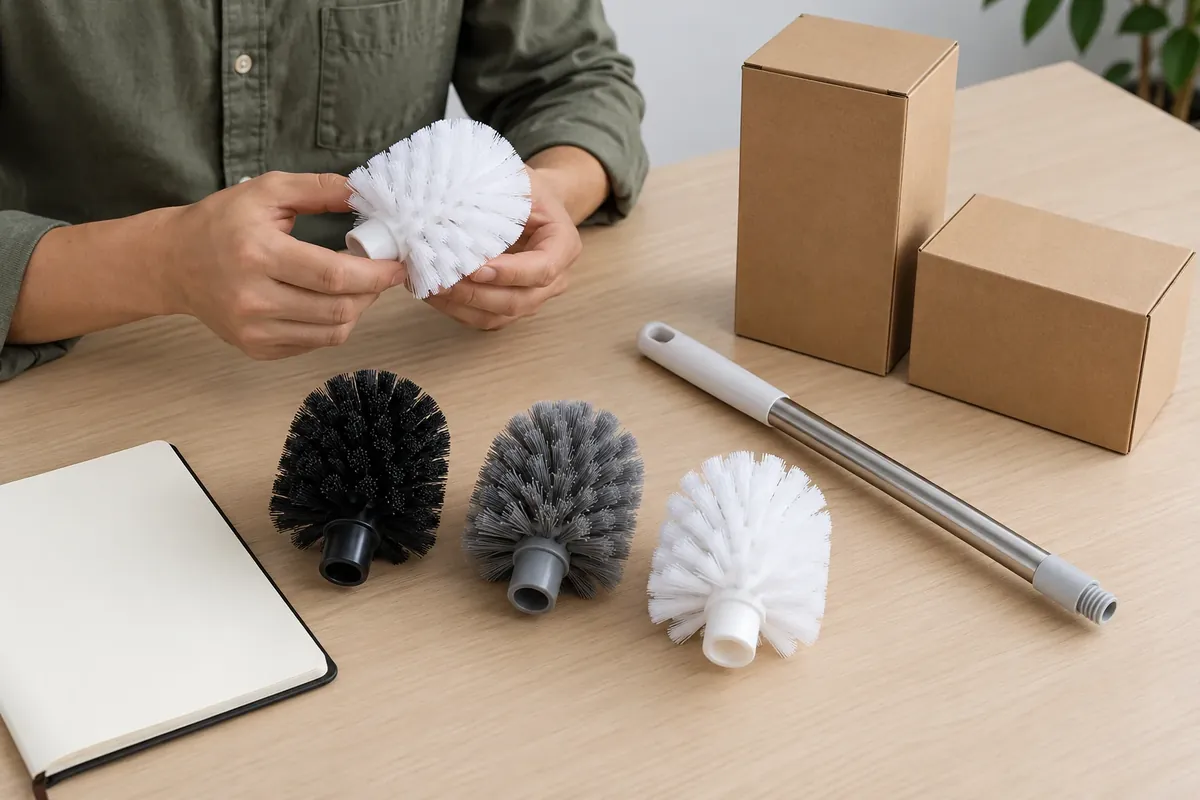
A buyer should also consider packaging and identification. A replacement sold alone needs enough product information to distinguish it from visually similar heads that use another connection. A replacement included with a starter set should be protected so the connector is not distorted or contaminated before assembly. If multiple spare part numbers share a carton, ensure that each is separated and labeled according to the buyer’s approved SKU plan. Do not use an invented QR code or mark on a conceptual image as evidence of traceability.
How can a buyer validate a replacement against the named set?
Use a production-equivalent sample set with controlled revisions. A useful acceptance process is more than a single “it fits” note:
- Confirm identity. Record the holder model, handle drawing and revision, head supplier, head part number and sample date.
- Inspect the interface before assembly. Check the visible mating features for damage, flash, burrs, deformation or contamination against the agreed criteria.
- Assemble the named pair. Follow the planned instructions and note how the joint engages, where it stops and whether the expected orientation is reached.
- Inspect the seated position. Record gap, engagement, alignment and any rocking that matters to the design.
- Repeat the intended service action. If the head is designed to be replaced by a user, repeat the defined attach/remove sequence. Do not invent a cycle-life claim from a few manual repetitions.
- Check the holder envelope. Store and remove the complete assembly in the intended orientation and observe opening, depth and contact clearances.
- Compare a reference spare. Use the currently approved head as the control when evaluating a new supplier lot or drawing revision.
- Document the result. Attach photographs, drawing references, part identifiers and any conditions or exceptions to the approval record.
The buyer should define acceptance before running the check. For example, specify which visual condition is acceptable, how parts should seat, whether the handle may rotate after assembly, and what constitutes a failed fit. If the product will be sold in more than one country or channel, ensure the customer-service part description points to the same model family used in the technical record.
A successful sample validates the tested configuration only. It does not prove that all production parts will match, that the head will fit another brand, or that future replacements will share the same interface. Use incoming inspection or supplier process controls where appropriate, then establish a change-notification rule for dimensions, tooling, polymer, supplier, finish, handle or holder. The buyer can decide what changes require a fresh sample approval.
How should component suppliers and revisions be controlled?
The commercial product may combine a fabricated metal holder, a handle, a molded brush head and a liner or insert. One supplier may provide the complete set; another may supply only the metal body while a separate vendor makes the head. In either arrangement, the importer should identify the responsible source for each interface and establish which party must notify the buyer before a change.
Maintain a bill of materials with a part number and revision for each controlled component. Link the head’s revision to its handle interface and to the holder envelope. If a supplier changes a mold cavity, resin, insert, thread feature, handle tube, liner or packaging, the change request should describe the affected drawing and sample. The buyer can then determine whether the interface and spare records still apply.
A practical revision-control table might include:
| Record | Minimum useful information |
|---|---|
| Product set | Buyer SKU, market, approved configuration and effective date |
| Brush head | Supplier, part number, drawing revision and interface definition |
| Handle | Supplier, material description, length and mating-end revision |
| Holder | Model, opening and storage-envelope drawing, liner/insert revision |
| Approved sample | Sample identifier, date, photos and recorded acceptance conditions |
| Replacement listing | Spare SKU, supported model family and effective revision |
| Change approval | Supplier notice, impact assessment, new sample decision and buyer sign-off |
Do not assume a part number is durable just because it appears on an old invoice. Ask whether the supplier uses the same identifier after a design, tool or material change. If a vendor’s internal number is reused or omitted, the buyer may need its own SKU and revision mapping. The purpose is to connect the replacement sold later to the exact approved set, not to create paperwork for its own sake. In the listing, describe the toilet brush replacement head as compatible only with the named, approved model family.
Where a component is bought in, request evidence from the responsible component supplier. A metal-holder manufacturer should not be presented as the maker of a replacement brush head unless the supply arrangement supports that statement. Koitor’s documented metal hardware fabrication and assembly coordination may be relevant to a holder project, but this article does not confirm a Koitor brush-head or toilet-brush set program.
What sourcing mistakes can break spare compatibility?
The most common avoidable mistake is assuming that “universal” describes a controlled interface. Ask the supplier which models and revisions are included, then test the named combinations. If the answer is not documented, narrow the claim rather than promising broader fit.
Another mistake is approving only the head-to-handle connection and ignoring the holder. A replacement can attach correctly but bind at the holder opening or sit at a different angle. Measure and test the complete set.
Buyers can also overlook the spare lifecycle. If the original product is sold with an undocumented head, the importer may later have no way to verify that an offered replacement is the correct one. Establish the part number, revision, supplier and model-family match before the product launches.
Finally, do not compare parts by color or brush silhouette alone. Similar visible shapes can conceal different connection details. A photograph may help identify a component but cannot prove pitch, engagement depth, fit tolerance, material or performance. Keep the approved physical reference and controlling drawing available to the teams that source, inspect and support the product.
Buyer checklist for the RFQ and sample record
- Name the starter-set model and the exact replacement-head use case.
- Identify the supplier responsible for the head, handle, holder and any liner.
- Request the interface drawing or a controlled interface specification.
- Record the connector type, locating features, engagement depth and relevant tolerances.
- Show head maximum envelope, handle length, holder opening and storage position.
- Define attach/remove steps if end-user replacement is part of the product.
- Test a production-equivalent head with the named handle and holder.
- Assign unique part numbers and revisions to all interface-critical components.
- State the model family each spare SKU supports and identify excluded variants.
- Define change notification, sample review and buyer sign-off triggers.
- Align the packaging, insert, instructions and spare listing with the released configuration.
- Keep claims limited to the models and evidence in the approved record.
For a wider bathroom storage project, buyers can review Koitor’s custom bathroom hardware manufacturing page and share the drawing, sample and expected component split before quotation. The site describes Koitor’s general metal hardware scope; exact toilet-brush and brush-head production must be confirmed rather than assumed.
Perguntas frequentes
Are toilet brush replacement heads universal?
No universal fit should be assumed. Head-to-handle interfaces and holder clearances vary by model. Use a named model or product family and verify the actual assembly.
What dimensions should an importer request?
Request the interface drawing, mating features, engagement length or seating definition, head envelope, handle length, holder opening and relevant tolerance. The supplier should identify the controlled revision.
Should the replacement head be tested inside the holder?
Yes, when the replacement is sold for a complete set. Check the assembled head, handle and holder as one configuration because a head can attach correctly but still interfere with storage or removal.
How can a buyer avoid incompatible spare stock?
Assign a unique spare SKU and revision, link it to the approved model family, retain a reference sample, and require change notice for the interface or head envelope.
Does a successful sample guarantee later production will fit?
It confirms the sample combination under the recorded conditions. It does not prove every later part or supplier revision will match; buyers should set appropriate production controls and change review.
Can an importer claim one replacement fits several brands?
Only if each named model and revision has been validated and the claim is supported by the relevant records. Similar appearance or connector descriptions are not enough.
Does the metal holder maker also make the brush head?
Not necessarily. The holder and replacement head may come from different suppliers. Identify component ownership in the RFQ, bill of materials and customer-facing product information.
Trabalhe com a Koitor Hardware
Share the target holder, handle and replacement-head references, interface drawing, expected supplier responsibilities and package plan. Koitor Hardware can discuss the metal holder scope and how it fits into a broader bathroom hardware project; the exact brush head and set supply must be confirmed for the specific program.
Discuss a Bathroom Hardware Drawing or Sample
Share the holder model, handle interface and component responsibility with Koitor Hardware to discuss the metal product scope. Replacement-head supply and compatibility need confirmation for each program.
OEM / MARCA PRÓPRIA
Transforme este guia de fornecimento num resumo do produto
Indique o produto pretendido, as dimensões, o acabamento, a quantidade a encomendar e os requisitos de embalagem. A sua equipa receberá uma análise prática da viabilidade de fabrico antes da apresentação do orçamento.

 English
 Español
 Português
 Français
 Deutsch
 العربية