
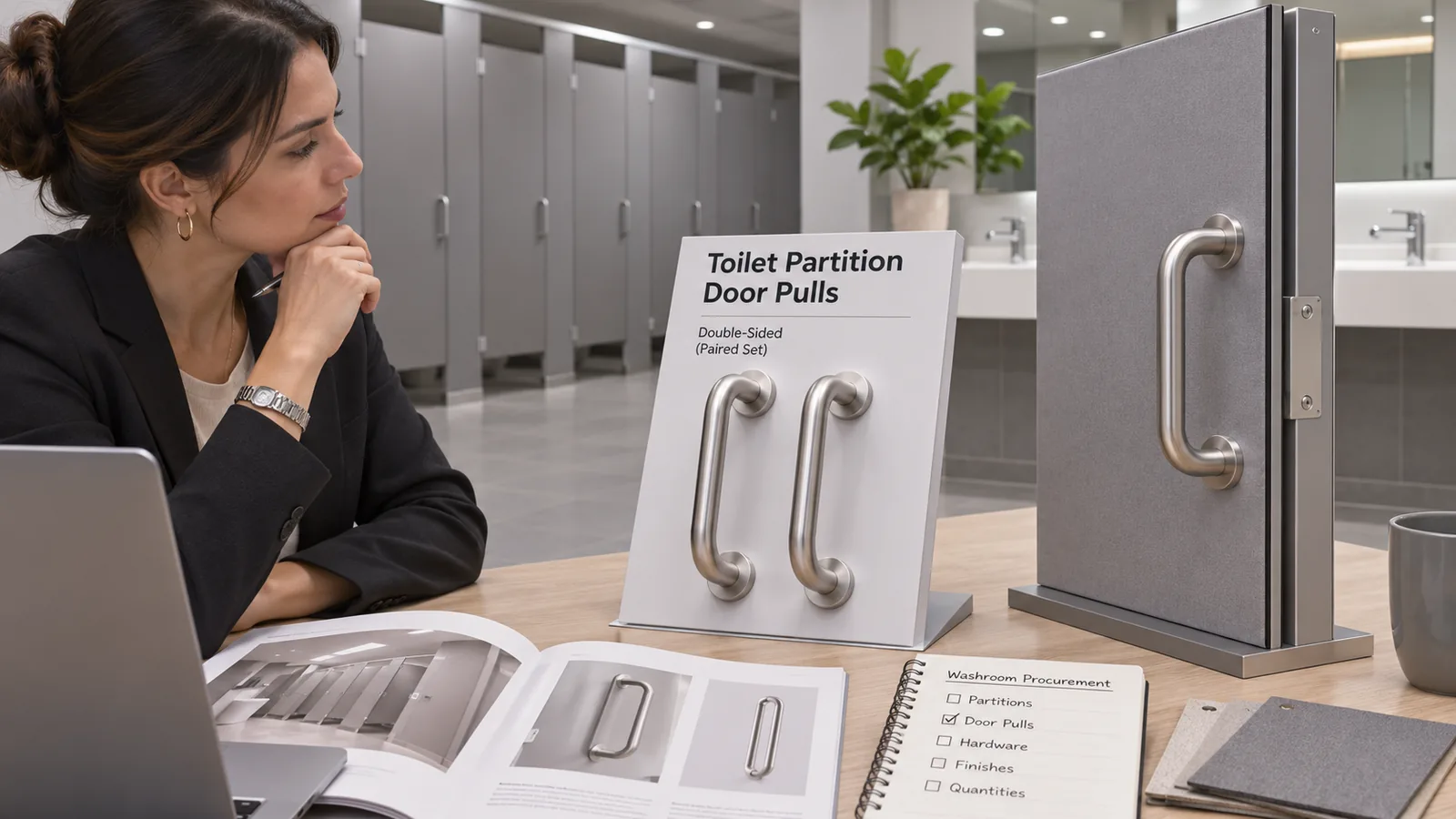
A toilet partition door pull is a small part with several buyer decisions behind it. A sourcing team may need to confirm the compartment type, door swing, door thickness, pull locations on the relevant faces, latch-side relationship, operability requirements, center spacing, projection, finish, fastener interface, and whether the order is a matched pair or a complete packet. A similar-looking handle is not proof of fit, and a product dimension alone does not establish code compliance.
This guide is for commercial-washroom distributors, project-specification buyers, partition contractors, facility teams, and replacement-hardware importers. It focuses on documenting the part and handing project requirements to the appropriate authority. It is not legal advice, an accessibility certification, or an installation guide. The US Access Board’s ADA Standards may apply to covered projects, but project scope, adopted requirements, local code, and interpretation must be confirmed by the responsible design or code professional.
Start with the project requirement and compartment type
Before looking for a handle, identify the project jurisdiction, the applicable code or standard edition, the compartment type, and the project reviewer. Accessible toilet compartments, ambulatory accessible compartments, standard compartments, and other configurations may have different requirements. Do not take an accessory requirement from one compartment type and apply it to every stall in a facility.
The Access Board’s ADA Standards state that specified accessible compartment doors require pulls on both sides near the latch and refer to operable-part requirements for hardware. Its Chapter 6 guidance explains the relevant toilet-room provisions. Those sources are authoritative for the cited US federal standard, but a product buyer should not assume they settle every project question. Adoption, scoping, exceptions, state or local rules, building type, and project specifications can change what applies. The architect, accessibility specialist, authority having jurisdiction, or other responsible professional must confirm the project’s obligations.
For a distributor, record the buyer’s cited requirement rather than interpreting it from a product title or search snippet. Ask for the applicable standard, section, edition, jurisdiction, and project detail. If the customer says “ADA pull,” that phrase alone is not a complete specification or compliance determination. Treat it as a request to identify and verify the applicable requirements.
Record door, latch, and pull location
A pull is selected in relation to the door and latch. Record which face or faces require a pull, the door swing and hand, latch location, and the manufacturer’s arrangement. The cited Access Board standard addresses pulls on both sides near the latch for specified accessible compartment doors. The project professional should confirm the exact interpretation and location for the project.
Capture door material and thickness using maker documentation or a clearly labeled measurement. Note whether the door is solid plastic, phenolic, metal, laminate, or another construction only when confirmed. The pull set may use through-fasteners, screws, inserts, or a maker-specific attachment arrangement. The buyer should not assume fastener length from the handle alone; thickness, hardware stack-up, and manufacturer parts determine that interface.
Photograph both door faces, the pull, latch, door edge, and surrounding clearance. Include the partition label or model if visible. Do not disassemble or modify the door to expose hidden fasteners unless the partition maker or qualified service professional directs the work. A photograph can help a supplier identify a candidate but cannot by itself confirm the concealed connection.
A replacement request should distinguish a pull handle from a latch, knob, or other operating hardware. The terms may be used loosely in facility maintenance requests. Ask what the user actually operates and whether the required item is a single pull, an inside/outside pair, a complete hardware set, or a replacement fastener packet.
Check operability with the appropriate reviewer
The ADA Standards include requirements for operable parts, including operation without tight grasping, pinching, or twisting of the wrist, and limits on operating force where applicable. A buyer should reference the current official text and require the responsible project professional to verify how it applies to a particular compartment and product. Do not claim a pull is compliant based on a photograph, its general shape, or one dimension.
The Access Board guidance helps explain the standard, but it does not replace a project review or establish certification of a specific handle. Product suppliers may describe a pull as accessible or ADA-compatible. Such language should be examined against the actual product documentation, project requirements, and applicable authority. Avoid repeating a claim as a verified fact unless the supplier provides appropriate evidence and the project’s qualified reviewer accepts it.
A practical sourcing handoff can ask the manufacturer or supplier to provide the relevant drawing, dimensions, material, mounting method, and any available documentation concerning the specified operability criteria. The buyer can record the evidence received without independently certifying the product. If test methods, force measurements, or accessibility documentation are required, request them explicitly and let the responsible professional determine sufficiency.
Keep the responsibilities clear: the buyer provides project requirements and the intended use; the supplier identifies the product and its documented properties; the partition maker confirms system compatibility; and the design or code authority determines project compliance. These are related but separate decisions.
Confirm center spacing, projection, clearance, and hole interface
A pull may be described by center-to-center spacing, overall length, projection, grip diameter, or mounting-hole pattern. Record each dimension that the maker or project specification uses. Do not confuse overall length with distance between fastener centers. A catalog may list several center distances for similar-looking pulls, and those parts may not interchange.
The door thickness and both-face hardware configuration also affect the fastener arrangement. Ask whether the pull is supplied as a pair, whether fasteners pass through the door, and which lengths or inserts are included. If there are separate interior and exterior pieces, verify that the parts are a matched set for the named door and latch arrangement. Do not substitute a screw based solely on thread appearance or an approximate length.
Clearance matters around the pull and latch. Record the available space, adjacent stop or bumper, door edge, and the user’s approach as shown in approved project drawings. A pull can fit the holes but interfere with another part or fail to meet the project’s required location. Any field alteration or relocation needs approval from the partition manufacturer and responsible project professional.
| Fit field | Buyer information to record |
|---|---|
| Project context | Jurisdiction, compartment type, standard/edition and reviewer |
| Partition system | Manufacturer, series, model and revision |
| Door | Material, thickness, swing, hand and edge configuration |
| Latch | Type, side and relationship to the pull |
| Pull placement | Required faces and documented location near latch |
| Dimensões | Center spacing, overall size, projection and clearance |
| Attachment | Through-fastener, insert or maker-defined mounting system |
| Kit scope | Single part, matched pair, fasteners, washers or full packet |
| Finish/material | Exact maker or supplier description |
| Comprovativo de aprovação | Drawing, parts list, project review and source date |
Match the pull to the partition maker’s hardware packet
Hadrian and Bobrick documentation show manufacturer-specific pull sets and complete door hardware packets. Robert Brooke’s catalog lists multiple pull center distances and material options. These examples establish that available components vary; they do not create a universal cross-brand interface. The buyer should use the installed partition model and its current parts information whenever possible.
Ask whether a pull is listed as the original component, a manufacturer-approved supersession, a supplier-matched replacement for named systems, or an unverified candidate. Request the exact code, drawing revision, models covered, fastener scope, and exclusions. A part that matches center spacing can still differ in projection, attachment, finish, clearance, or pair configuration.
If the original maker code is obsolete, ask the maker or qualified partition supplier for a documented successor. Preserve both the old code and new mapping so service teams can support installations that remain in the field. Do not market an alternate as original or universal if its status is supplier-matched or provisional.
Material and finish should be confirmed separately
Catalogs may list pulls in different materials and finishes. Similar color, weight, or surface appearance does not prove alloy, coating, plating, or corrosion properties. Use the exact supplier description and ask for the corresponding technical documentation if the project specifies a material or finish. Do not infer stainless grade from a magnet or from a polished appearance.
A finish substitution may affect appearance across other partition hardware, cleaning compatibility, or the buyer’s project specification. Confirm whether the pull’s screws, washers, and companion face are supplied in the same or an approved complementary finish. Record any approved sample and its code. A visual sample can support an appearance decision; it does not independently prove material grade or long-term performance.
Keep fit and finish approvals separate. A pull may fit the door yet fail to match the specified finish; a visually matching pull may not fit the existing hole pattern. Record both approvals and the sources supporting them.
Prepare a quote that compares complete scope
Quotes can be difficult to compare when one line includes a single pull and another includes both sides and fasteners. Normalize unit of sale, quantity, and package scope. Ask the supplier to itemize the interior and exterior pieces, through-bolts or screws, washers, inserts, finish, labels, and any other included components. State whether the quote covers one door or a set of doors.
For a larger project, translate the door schedule into a bill of hardware. Separate standard compartments from the specified accessible compartments and other types. Identify each door by location or schedule number. Link the pull code to the latch and door configuration, and keep the project requirement reference beside the part list. Do not assume that all doors use one handle configuration.
A sample can help compare grip form, finish, dimensions, and kit contents. Define what the sample is expected to verify. It does not, by itself, determine code compliance, prove operability, or confirm compatibility with every partition model. The project’s qualified reviewer must make those determinations using the needed evidence.
When asking for a quotation, request pricing by each unit and full set, sample availability, MOQ, lead time, packaging, and any replacement-part policy. Clarify whether the supplier sells the item alone or only as part of a latch/door packet. Ask how revisions or discontinued codes are communicated.
Distinguish the compliance file from the product cross-reference
A purchasing file should preserve both the reason a product was specified and the reason a particular part was selected. The project requirement record identifies the code provision, edition, compartment type, and reviewer. The product cross-reference identifies the manufacturer, model, drawing, dimensions, attachment, and named compatibility. These records answer different questions and should not be collapsed into a single note saying “approved.”
If the project reviewer later changes the interpretation or a different partition series is installed, the buyer can revisit the correct record without assuming that a prior fit approval settled the new compliance question. This distinction is useful for distributors serving multiple jurisdictions or customers with different project standards. Keep the source links stable, note when the official page was checked, and review regulations or standards again when a later project calls for them.
When a buyer supplies a requirement from an older specification, retain the quoted edition and ask whether the project authority still intends to use it. Do not silently replace it with a newer edition or decide that an older clause is inapplicable. The design professional or authority having jurisdiction makes that determination. The sourcing team should capture the decision and ensure the quotation describes the requested product scope accurately.
Build evidence and claims controls into the product record
Use a clear evidence status for each cross-reference:
- Original confirmed: the partition maker’s current parts information names the code.
- Manufacturer-approved supersession: the maker documents a replacement mapping and its coverage.
- Supplier-matched: the supplier gives specific model coverage and supporting interface evidence.
- Provisional candidate: similarity or partial measurements only; approval remains open.
Keep the source document, page or section, reviewer, and verification date with the SKU. State exclusions, including unknown revisions, different door thicknesses, unverified hole patterns, or alternate latch arrangements. If evidence supports only one named model, do not generalize the coverage to an entire brand or to all accessible compartments.
Claims about accessibility require additional care. A manufacturer’s product description, a supplier’s catalog label, or a fit sample does not automatically prove compliance. Avoid using “ADA compliant” in a buyer-facing listing unless the relevant claim is supported and accepted for the project by the responsible authority. A neutral listing can describe dimensions, material, included components, and named model compatibility while directing project compliance questions to the qualified reviewer.
Manage replacement inventory and reorders
Distributors may hold spare pulls, pairs, fasteners, and full door hardware packets. Separate these SKUs when their scope or compatibility differs. A single “partition pull” entry can lead to a shipment with one face only, the wrong fastener length, or an incompatible mounting pattern. Include system, door thickness range where documented, center spacing, finish, unit of sale, fastener scope, and confirmed models in the internal product record.
Base stock decisions on actual orders, service records, replacement demand, and project pipelines. Do not infer market demand from a single inquiry or search-volume figure. Keep project-specific items distinct from standard replacement stock, especially when finish or model revision differs.
At reorder, check supplier codes, drawing revision, fastener scope, material, finish, and model coverage. A quiet change to the package may affect a previous cross-reference. Keep past approvals for installed systems while identifying discontinued or superseded codes. If a replacement is changed, review the whole door packet rather than updating the pull line in isolation.
Track return causes such as wrong center spacing, wrong door thickness, missing second-side component, incomplete fastener set, finish mismatch, wrong model, or mistaken accessibility assumption. Use real service records to improve intake questions and catalog details. A single return identifies an issue to investigate but does not prove a general product defect.
Common buyer errors
Treating a generic “ADA pull” description as a complete specification. Ask for jurisdiction, applicable provision, compartment type, edition, and project review.
Measuring overall length instead of center spacing. Record both dimensions where relevant and use the maker’s drawing.
Ordering a single pull when both sides require components. Confirm the number of faces and whether the listing is one piece or a pair.
Ignoring the latch relationship. Verify the required position relative to the latch and the approved door arrangement.
Assuming a sample proves compliance. A sample helps answer defined fit or appearance questions; it is not a code determination.
Selecting fasteners from appearance. Confirm the maker’s packet and door construction with the supplier.
Calling an alternate original or universal. Keep original, approved supersession, supplier-matched, and provisional status distinct.
Mixing fit and accessibility review. Physical fit does not independently establish operability or code compliance.
What should the RFQ and approval record include?
Send the partition maker, series, model, revision, compartment type, project jurisdiction and cited requirement, door schedule, swing and hand, door thickness, latch location, required pull faces, center spacing, clearance, finish, and hardware packet expectation. Attach the relevant official or maker documentation and label any estimates.
| RFQ field | Supplier or reviewer response |
|---|---|
| Project rule | Confirm cited jurisdiction, edition, section and reviewer |
| Partition | Confirm maker, series, model and revision |
| Compartment | Identify type and project schedule reference |
| Door/latch | Confirm thickness, swing, hand, latch side and interface |
| Pull | Confirm faces, center spacing, projection and clearance |
| Kit | Itemize matched pieces and complete fastener scope |
| Evidence | Provide current drawing, parts list and model coverage |
| Compliance | Route project determination to responsible professional |
| Commercial | Quote piece/set, MOQ, sample, lead time and packaging |
| Change notice | State how revisions and supersessions are communicated |
Before approval, reconcile the buyer’s project schedule, supplier quotation, drawing, sample, and parts list. If any field remains unknown, keep the part provisional and ask for the missing evidence. Do not convert a dimension match into a compliance promise.

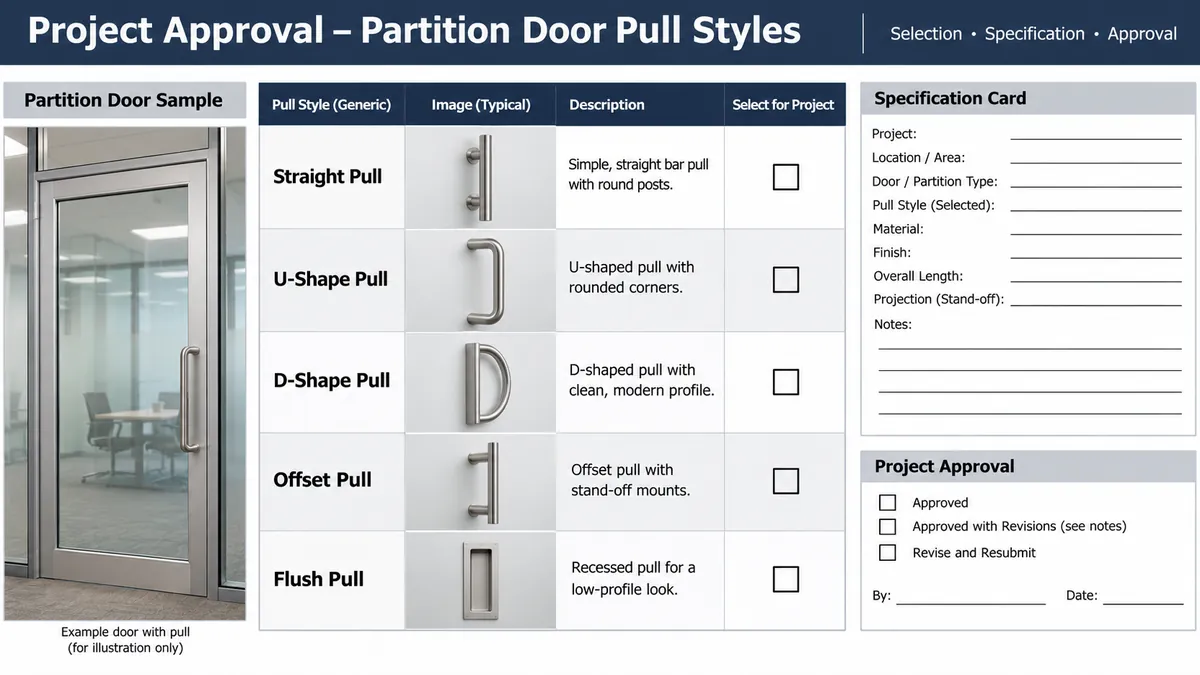
Buyer checklist for toilet partition door pull sourcing
- Identify project jurisdiction, compartment type, cited standard/edition, and reviewer.
- Record partition maker, series, model, and revision.
- Document door material, thickness, swing, hand, and latch location.
- Confirm pull requirements for each door face.
- Record center spacing separately from overall length and projection.
- Confirm clearance and location using approved project information.
- Verify the matched inside/outside pair and complete fastener packet.
- Request the current drawing and named model coverage.
- Keep material/finish approval separate from fit approval.
- Mark original, superseded, supplier-matched, or provisional status.
- Route accessibility and code determinations to the responsible professional.
- Recheck supplier codes and revisions at every reorder.
The goal is a traceable part selection and a correct compliance handoff. If the project requirement, door configuration, or attachment remains uncertain, obtain the responsible review before promising a match or placing an order.
Perguntas frequentes
Are toilet partition door pulls universal?
No. Center spacing, projection, mounting, finish, fasteners, door thickness, latch relationship, and partition series can differ. Confirm the named system.
Does a pull with the right center spacing meet ADA requirements?
Center spacing alone does not establish compliance. The full requirement, product evidence, compartment, project scope, and applicable interpretation must be reviewed by the responsible professional.
Does accessible compartment hardware always require pulls on both sides?
The cited US ADA provision addresses pulls on both sides near the latch for specified accessible toilet compartments. Confirm the current standard and project applicability with the responsible design or code authority.
Can a photo prove pull compatibility?
A photo can help identify a candidate but does not establish dimensions, concealed attachment, fastener scope, or compliance.
Can a distributor describe a product as ADA compliant?
Only when the claim is supported for the specific product and accepted under the applicable project requirements. A catalog label or visual sample alone is not sufficient evidence.
Does Koitor manufacture toilet-partition door pulls?
The approved company profile confirms metal bathroom and home-storage hardware, not toilet-partition pull sets or partition systems. This article makes no claim that Koitor supplies or installs them.
Technical references
- US Access Board ADA Standards — official standard text, including toilet-compartment door provisions and operable parts.
- US Access Board: Chapter 6, Toilet Rooms — official guidance on toilet-room requirements.
- Hadrian metal partition installation manual — maker-specific door hardware context.
- Bobrick DuraLine technical data — named system hardware details.
- Partitions and Stalls catalog — product-specific pull options and dimensions.
- Koitor OEM information — verified metal-hardware sourcing context.
Discuss Your Metal Hardware Requirements
Share a metal hardware drawing, sample, finish reference and interface requirements for a capability review. The partition manufacturer or qualified project professional should confirm toilet partition door pull fit, accessibility and code applicability.
OEM / MARCA PRÓPRIA
Transforme este guia de fornecimento num resumo do produto
Indique o produto pretendido, as dimensões, o acabamento, a quantidade a encomendar e os requisitos de embalagem. A sua equipa receberá uma análise prática da viabilidade de fabrico antes da apresentação do orçamento.


 English
 Español
 Português
 Français
 Deutsch
 العربية