
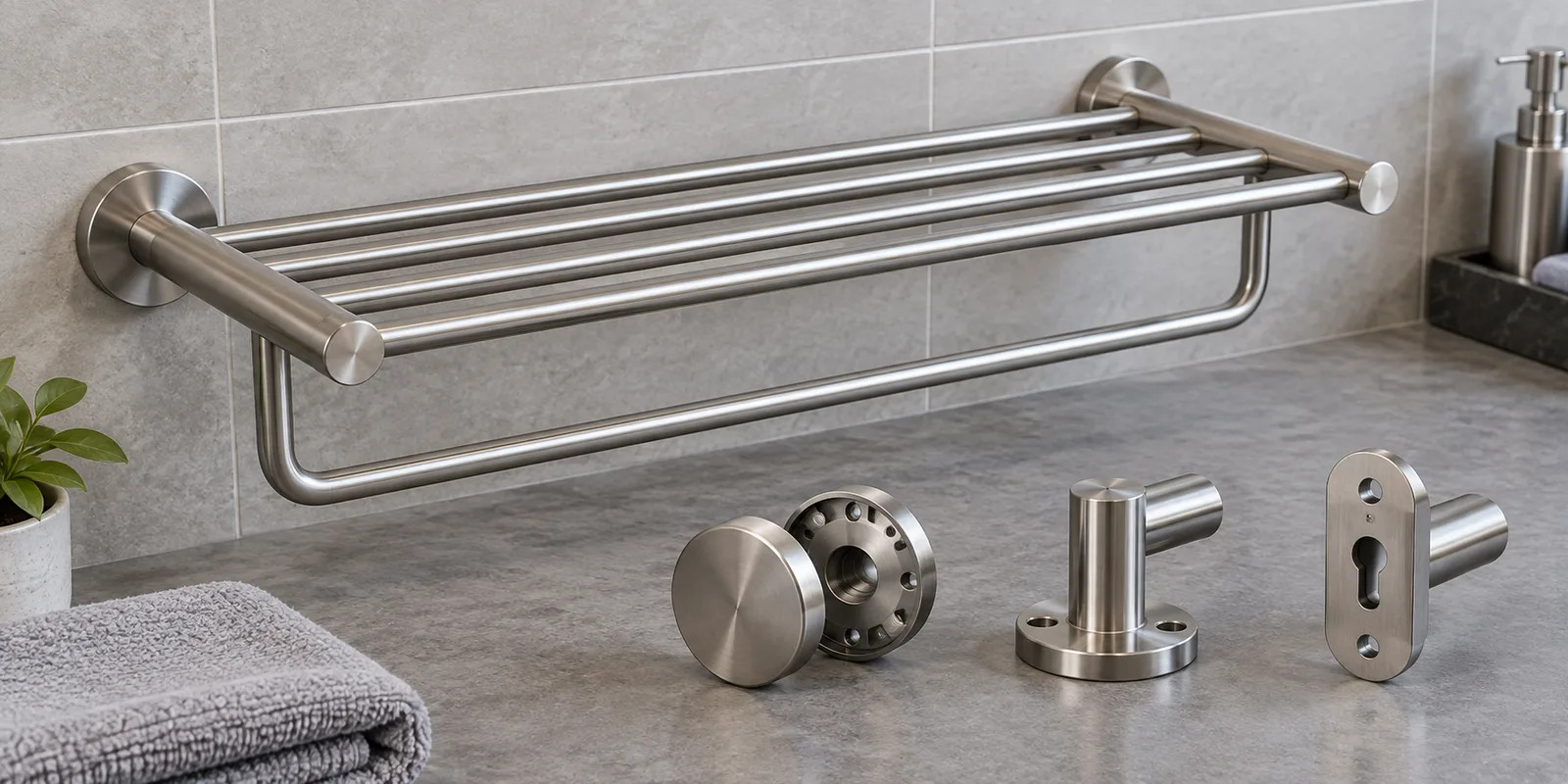
A reliable towel rack mounting bracket design must transfer the intended service load to the wall, keep the rack aligned, provide practical screw access and protect the visible finish during installation. Importers should evaluate the bracket, fasteners, mounting surface, rack structure and installation instructions as one system. Because walls and customer installation conditions vary, the final fixing method and any performance requirement should be confirmed for the target market before bulk production.
What functions must a towel rack mounting bracket perform?
A mounting bracket must locate the towel rack, resist movement during intended use, hide or organize fasteners where required, and allow installers to tighten the product without damaging it. A bracket that looks clean in a rendering may still be difficult to assemble or unsuitable for the intended wall.
The first function is load transfer. The bracket connects the towel bar, shelf or multi-tier frame to the fixing points. Joint geometry, material thickness, screw position and contact area all affect how movement reaches the wall. Exact load capacity cannot be assumed from appearance; it should be confirmed through project-specific design and testing.
The second function is alignment. A pair of brackets must hold the rack level and at the correct distance from the wall. Small differences in hole position, weld angle or bracket depth can become visible across a long towel rail.
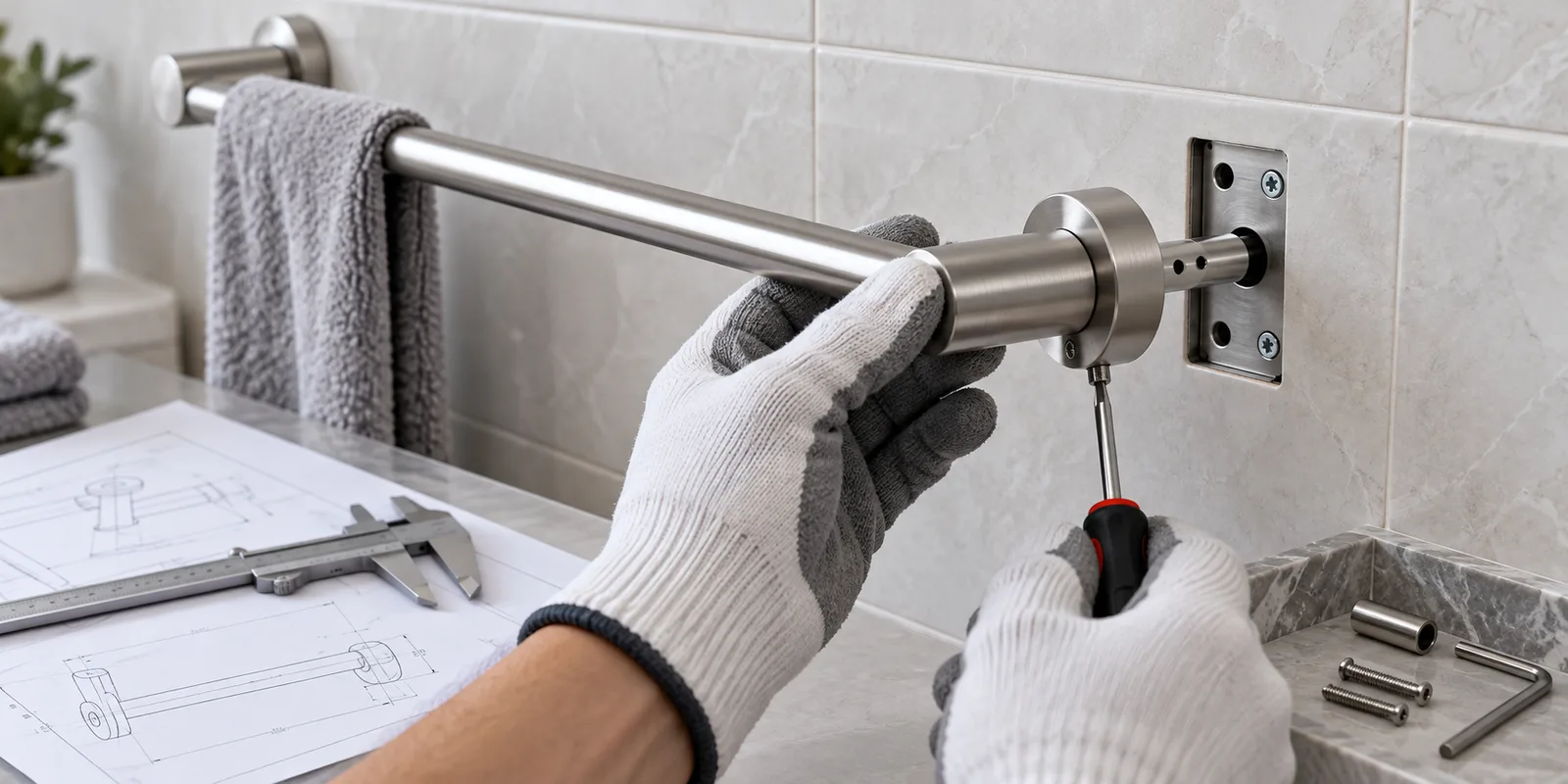
The third function is installation access. Installers need room for screwdrivers, hex keys or other supplied tools. A decorative cover may hide screws but also block access. The sequence should be tested using only the parts and instructions supplied in the retail package.
The fourth function is finish protection. Metal edges, set screws and sliding covers can scratch powder coating, plated surfaces or polished stainless steel. Contact points may need controlled clearance, protective pads or an assembly sequence that avoids scraping.
Buyers developing a custom structure can discuss these requirements with a custom bathroom towel rack manufacturer before approving appearance and packaging.
How should wall conditions influence towel rack fixing design?
Towel rack fixing design should begin with the expected wall types and installation responsibilities in the target market. A fastener suitable for one substrate may be inappropriate for another, so packaging and instructions must avoid implying universal suitability.
Common installation conditions may include solid masonry, concrete, timber framing, board walls, tile over a substrate or cabinet panels. The visible tile is not always the material carrying the load. Buyers should decide whether to supply general hardware, market-specific hardware or instructions requiring the installer to choose fixings for the actual wall.
Hole spacing affects how easily a bracket can find suitable support. Very close holes may concentrate force or be difficult to drill accurately. Very wide spacing can enlarge the bracket and decorative cover. Slot holes can provide adjustment but may permit movement if the fixing is not controlled.
Wall flatness also matters. A narrow bracket may rock on uneven tile or grout lines. A mounting plate with multiple contact points can improve positioning, but excessive contact area may reveal gaps on an uneven surface. Sample installation on representative surfaces helps expose this tradeoff.
Moisture around drilled holes should be considered in the market’s installation guidance. The hardware manufacturer should not invent building-code or waterproofing instructions. Importers need appropriate local review for wall preparation, sealing and fastener selection.
No-drill products require a different system review. Adhesive pads or suction components depend on surface condition, preparation, geometry and intended load. Buyers evaluating those products can review the verified no-drill bathroom accessories capability page.
Which mounting bracket structures should importers compare?
Importers should compare direct screw tabs, concealed mounting plates, keyhole slots and adjustable brackets according to appearance, installation tolerance, tooling, component count and service access. The best structure depends on product size, target wall and retail expectations.
| Bracket Structure | Main Advantage | Buyer Checks | Potential Tradeoff |
|---|---|---|---|
| Visible direct screw tab | Simple parts and direct access | Edge finish, hole position and visual acceptance | Fasteners remain visible |
| Concealed wall plate and cover | Clean installed appearance | Cover fit, set-screw access and anti-rotation | More components and assembly steps |
| Keyhole slot | Product can engage preinstalled screw heads | Slot dimensions, head compatibility and locking | May allow lift-off or movement without retention |
| Horizontal adjustment slot | Provides limited positioning correction | Adjustment range and tightening security | Can shift if installation is incomplete |
| Integrated welded bracket | Reduces separate bracket assembly | Weld angle, wall clearance and finish access | Alignment depends strongly on fabrication control |
Concealed systems often use a wall plate secured first, followed by the finished rack or decorative cover. Check how the second component is locked. A small set screw may be visually discreet but difficult to reach beneath a shelf or near a wall corner.
Keyhole systems need controlled screw-head dimensions and stand-off distance. If the screw sits too close to the wall, the bracket may not engage; too far away, the rack may move. The supplied hardware and instruction drawing must agree.
Integrated brackets simplify the bill of materials but make fabrication accuracy more visible. A bracket welded at a small angle can cause a long rack to twist or leave one end away from the wall. Fixtures and sample installation are therefore important.
How do dimensions and tolerances affect bathroom rack installation points?
Dimensions and tolerances affect whether paired mounting points align, whether covers fit and whether tools can reach the fasteners. Buyers should mark installation-critical features on the drawing instead of applying one tight tolerance to every dimension.
Important dimensions may include center-to-center hole spacing, bracket depth, plate width, slot length, cover clearance, set-screw location, distance between left and right brackets, wall stand-off and tool approach angle. For multi-tier racks, shelf alignment and frame squareness also influence mounting.
Use datums so measurements have a shared reference. A hole measured from an unfinished wire edge may vary differently from a hole measured from a formed bracket surface. The drawing should explain which features establish installed position.
Tolerance stack-up means several small variations combine in the assembly. A cover, wall plate, welded frame and set screw can each meet an individual dimension while the complete fit becomes tight. Assembly samples should use production-intent components and finish.
Coating or plating adds surface thickness and can reduce clearance. Threaded holes, sliding covers and fitted caps deserve finished-part checks. Masking or thread cleaning may be required according to the approved process.
A slotted hole can absorb some installation variation, but adjustment should not hide uncontrolled manufacturing. Define the intended slot purpose and confirm that the fastener can clamp securely across the full adjustment range.
How should a mounting bracket sample be installed and reviewed?
A mounting bracket sample should be installed from the retail package using the proposed instructions and tools. The review should record assembly time, unclear steps, fit, alignment, movement, finish damage and missing components.
- Confirm the revision. Match the rack, bracket, fasteners, instructions and packaging to the same approved sample version.
- Count all components. Record screws, anchors, plates, covers, caps, pads and tools.
- Select a representative surface. Use a wall condition relevant to the product review and suitable fixings chosen by a qualified party.
- Follow only the supplied instructions. Do not rely on factory knowledge that customers will not have.
- Record tool access. Check whether tightening can be completed without awkward angles or surface scratches.
- Check level and wall contact. Observe gaps, rocking, twist and cover alignment.
- Apply project-specific functional checks. Use methods and acceptance criteria agreed for the intended market.
- Remove and reinstall. Review service access, damaged finish and reusable components where relevant.
The sample review should separate bracket problems from wall-fixing problems. If an anchor rotates in a board wall, the cause may differ from a welded bracket that is out of square. Photographs and measurements should identify the exact interface.
Return consolidated feedback using numbered images and drawing references. If bracket geometry changes, update the drawing revision and repeat the installation. Do not approve a corrected loose component while the controlled drawing remains unchanged.
What common mounting design mistakes increase buyer risk?
Common mistakes include choosing fasteners before defining the wall, hiding screws without checking tool access, ignoring finished-part clearance and treating packaging hardware as a minor detail. These mistakes often appear late because the rack itself looks acceptable on an inspection table.
- The bracket drawing does not identify the wall-facing surface or installation datum.
- Left and right brackets can be confused but are not marked or explained.
- A set screw is positioned where a shelf blocks the tool.
- Decorative covers become loose after repeated handling.
- Slot dimensions do not match the supplied screw head.
- Powder coating closes a sliding clearance or fills a thread.
- Bracket edges touch and scratch the visible rack finish during assembly.
- The hardware bag omits one small tool or uses mixed fastener quantities.
- Instructions imply that supplied anchors fit every wall type.
- The carton allows heavy brackets or screws to strike finished surfaces.
Price-only comparisons can also hide different mounting systems. One quotation may include a concealed plate, cover, fasteners, tool and printed instruction, while another includes only a welded tab. Compare complete scope before judging unit price.
Do not wait until bulk inspection to test installation. The mounting system should be part of sample approval, packaging review and any pre-production confirmation.
What should a towel rack mounting bracket design checklist include?
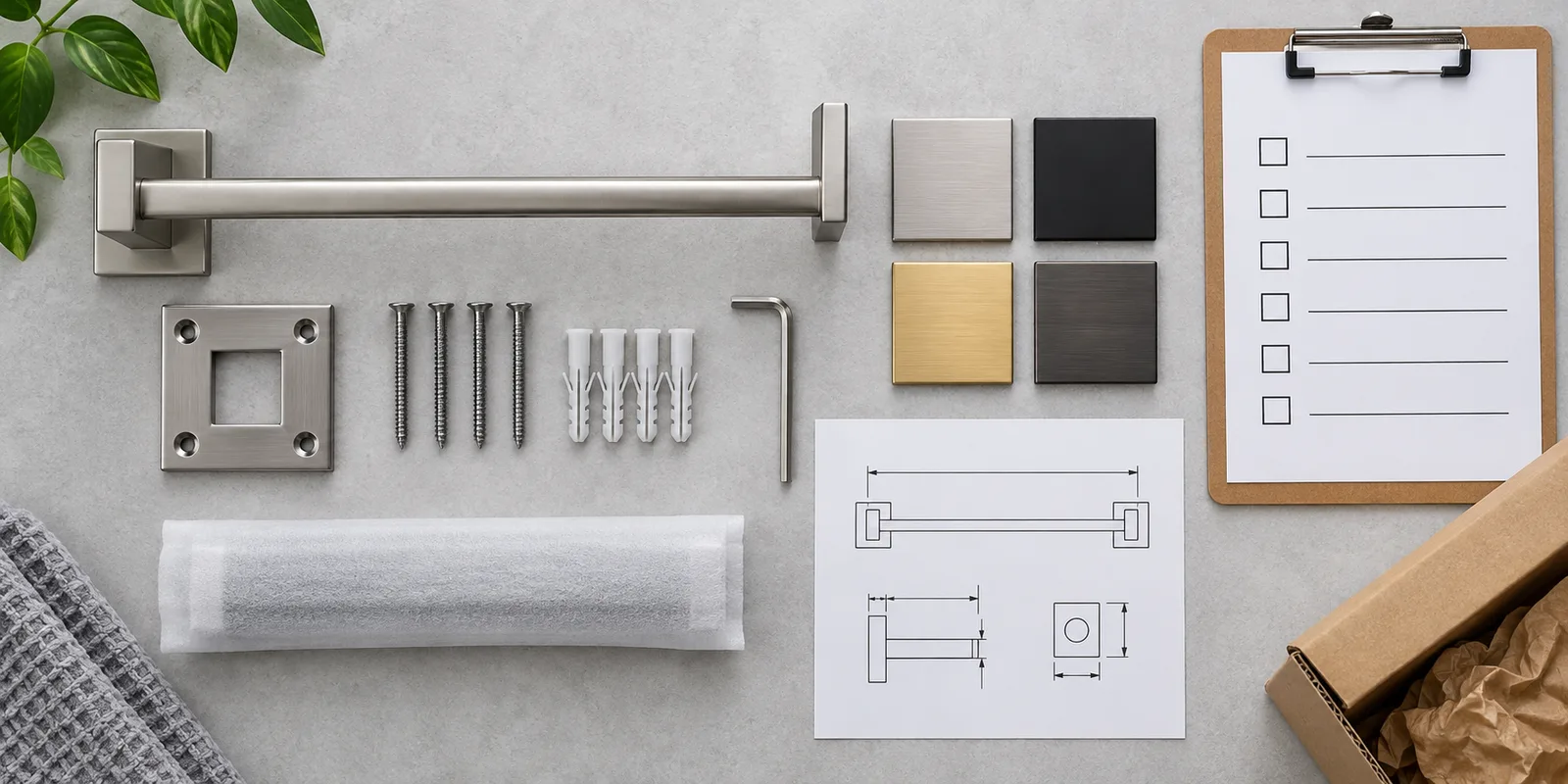
The buyer checklist should define the intended wall interface, critical dimensions, supplied components, finish and verification plan. It should travel with the RFQ so the China OEM manufacturer can identify missing information before quoting.
- Rack type, overall size and intended use.
- Expected mounting surfaces and markets.
- Bracket structure and visible appearance requirements.
- Hole pattern, slots, wall stand-off and critical datums.
- Rack-to-bracket locking or anti-rotation method.
- Fasteners, anchors, caps, pads and tools to be supplied.
- Local review responsibility for wall fixings and installation guidance.
- Material and surface finish for rack and bracket.
- Finished-part clearances, masking and thread checks.
- Installation sequence and tool-access requirement.
- Sample installation method and acceptance record.
- Hardware-bag label and instruction-sheet language.
- Packaging protection between metal components.
- MOQ, sample needs and expected order schedule.
Koitor Hardware can review towel rack drawings or physical samples, bracket manufacturability, welding points, finish and packaging before sample production. MOQ can start from 100 pieces depending on the product; samples usually take around 5-7 working days after confirmation. More buyer guidance is available through bathroom hardware sourcing resources.
Frequently asked questions about towel rack brackets
Should mounting screws be visible or concealed?
Either approach can work. Visible screws simplify access, while concealed plates can create a cleaner appearance but add parts and fit requirements. The decision should match retail positioning and installation capability.
Can one anchor type work for every bathroom wall?
No universal anchor should be assumed suitable for every substrate. Buyers need market-appropriate installation guidance and should define who selects fixings for the actual wall condition.
Why does a towel rack sit unevenly after installation?
Possible causes include wall unevenness, hole-position error, bracket angle, frame twist, cover interference or installation variation. Measurements should isolate the interface before corrective action is selected.
Do bracket tolerances change after powder coating?
The metal dimensions remain the basis, but coating adds material to fitted surfaces and threads. Finished samples should confirm sliding covers, slots, screws and contact clearances.
Should the mounting hardware be approved with the product sample?
Yes. The bracket, fasteners, tools, instructions and packaging should be reviewed as one supplied system because a missing or incompatible small part can prevent installation.
How can Koitor support custom bracket development?
Koitor Hardware can review drawings or samples, bracket forming, welding access, assembly sequence, finish protection and packaging for small-batch OEM projects. Buyers can contact Koitor with installation requirements for a project-specific discussion.
Trabalhe com a Koitor Hardware
Need a Practical Mounting Bracket for a Custom Towel Rack?
Send Koitor your rack drawing, wall-interface requirement, bracket sample, finish target, supplied hardware list and packaging idea. Our team can review manufacturability, assembly access and sample options before quotation.
OEM / MARCA PRÓPRIA
Transforme este guia de fornecimento num resumo do produto
Indique o produto pretendido, as dimensões, o acabamento, a quantidade a encomendar e os requisitos de embalagem. A sua equipa receberá uma análise prática da viabilidade de fabrico antes da apresentação do orçamento.
 English
  Español
  Português
  Français
  Deutsch
  العربية