

Types of bolts are best identified by several visible features together: head shape, neck or bearing geometry, shank form, thread arrangement, end shape, and the mating interface. A hex-head bolt, carriage bolt, flange bolt, square-head bolt, T-head bolt, U-bolt, hanger bolt, and stud may all be called “bolts,” but the family name alone does not specify the material grade, dimensions, thread, strength, coating, or approved use. Before ordering a replacement or specifying a component, compare the actual part and its connection with a controlled drawing or supplier specification.
For importers and product developers, identifying the fastener family is an early communication step. It helps teams describe the component accurately, but it does not establish that two parts are interchangeable or suitable for a load, substrate, or safety requirement. The bolt’s mating part, thread engagement, geometry, material, finish, and assembly design must also be confirmed.
How do buyers classify common types of bolts?
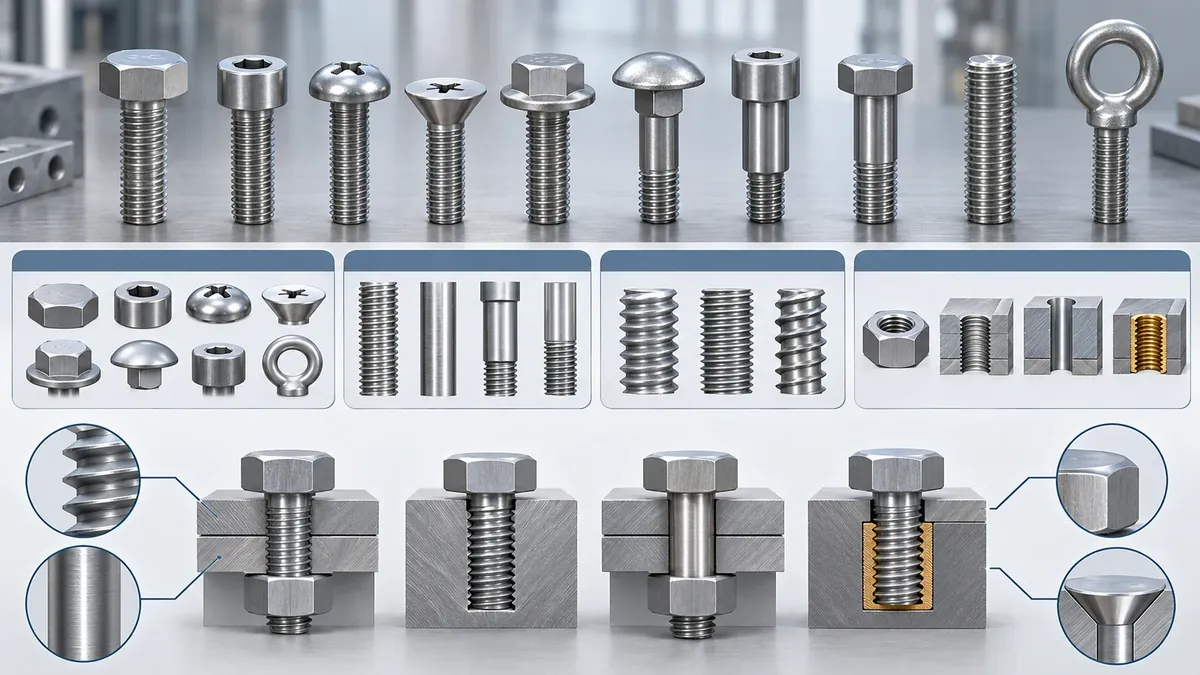
Buyers can classify common bolts by their shape and the interface they create. A useful first pass is to name the head or end form, note the shank and thread arrangement, then identify what the part mates with and how it is installed.
A hex-head bolt has a six-sided head that can be engaged by a suitable tool. A square-head bolt uses a four-sided head. A carriage bolt is typically recognized by its rounded head and a neck feature below the head that may interact with a matching opening or surface. A flange bolt has an integrated bearing flange under the head. A T-head bolt has a head form intended to engage a corresponding slot or track in the assembly. A U-bolt is formed into a U shape with threaded ends. A hanger bolt combines different end or thread features for its intended connection, while a stud may present threads at one or both ends or along its length depending on its design.
These are identification descriptions, not purchasing specifications. Designs vary, and terms may be used differently by catalogs or suppliers. An illustration or product page may show a familiar silhouette but omit dimensions, thread pitch, material, coating, or the mating interface. Use the drawing and supplier’s part description to resolve those details.
Fastener supplier Mudge Fasteners summarizes several common named families and visible features in its overview of common bolt types. Treat the page as a qualitative orientation source, not a mandatory standards chart or exhaustive classification. It does not provide the project-specific dimensions, load ratings, or acceptance limits for a buyer’s assembly.
Which visible features should be recorded?
Record enough features to distinguish the part from similar-looking alternatives. A clear description usually includes the head, the region under the head, shank shape, thread coverage and end, plus the geometry of the mating component.
| Identification feature | What to record | Why it matters for identification | O que isso não prova |
|---|---|---|---|
| Head shape | Hex, square, round, T-shaped, or another defined profile | Helps distinguish a visible family and tool access | Material grade, strength, or correct tool size |
| Under-head geometry | Neck, flange, washer face, or transition shape | May affect how the head seats or interfaces with the assembly | That the mating hole or slot is compatible |
| Shank | Smooth, partially threaded, bent, U-shaped, or other form | Clarifies the component geometry and connection style | A load rating or safe application |
| Thread region | Location, form, diameter, pitch, and length where specified | Helps confirm fit with the mating thread | That a different thread standard is compatible |
| End form | Point, blunt end, threaded end, or special feature | Helps distinguish installation and mating arrangements | A universal installation method |
| Material and finish | Specified designation and surface requirement | Keeps procurement aligned with the drawing or approved part | Corrosion life or regulatory compliance without evidence |
| Part identity | Supplier part number, revision, and drawing reference | Supports traceability and repeat ordering | That a visually similar item is equivalent |
A buyer does not need to derive a fastener standard from a photograph. The photograph can help discuss appearance, but thread pitch, dimensions, material, and specification should come from a drawing, controlled part record, or supplier documentation. If a replacement is being considered, compare the mating joint and installed geometry rather than matching only the head shape.
What distinguishes common bolt families?
Common bolt families differ in the physical features that support identification and in the interface they are intended to meet. Their names should help a buyer describe the part; they should not be treated as a performance ranking or a substitute for design verification.
A hex-head bolt has a six-sided external head. Buyers should confirm the head dimensions and tool access from the selected part data. The word “hex” identifies a shape, not the material strength or thread specification.
A square-head bolt has a square-shaped head. Its visible outline may help identify an existing component, but buyers still need the part drawing and mating details. Do not assume that a square head implies a particular material, historical application, or load capacity.
A carriage bolt commonly has a rounded head and a neck feature beneath it. That neck can be part of the way the component locates or interacts with a corresponding hole or opening. The exact neck form and dimensions should be verified for the part being purchased; a rounded head alone is not enough to confirm a match.
A flange bolt has a flange integrated beneath the head. The flange changes the bearing feature compared with a plain head, but does not automatically mean a washer can be omitted or that the connection meets a particular requirement. Follow the drawing and joint specification.
A T-head bolt has a crossbar-like head that may engage a slot or track designed for it. The receiving slot and orientation are part of the connection. A T-shaped outline without the correct track dimensions does not establish fit.
A U-bolt has a bent U-shaped body with threaded ends. The dimensions, bend, end spacing, thread, and matching saddle or clamp arrangement matter for identification. Do not infer the safe load or compatible pipe size from the family name or a generic image.
A hanger bolt uses different end or thread features to connect into a particular assembly. Catalog naming and exact forms can vary. Record both ends and identify the mating materials and parts instead of describing it only as “a double-ended screw.”
A stud is a rod-like threaded component whose end arrangement depends on its design. Some configurations have threads at both ends; others may be threaded over more of their length. The stud’s exact form, mating nuts or threaded holes, and specified material should be taken from the part documentation.
This overview is intentionally limited to recognition. It does not provide standard dimensions, torque, installation steps, load capacity, or suitability guidance. Those depend on the actual design and applicable fastener specification.
Several descriptors can apply to the same bolt at once. A part might have a hex head, an integrated flange, a partially threaded shank, and a particular thread specification. A buyer who records only “flange bolt” has identified one feature but has not fully identified the component. Conversely, an item called a stud or hanger bolt may require the buyer to describe the thread or end arrangement to distinguish it from other catalog parts. Treat each name as one field in a component description rather than as the entire part specification.
The same care is needed with terms that overlap or vary by supplier. A catalog may group components differently, use a trade name, or use a broad family label where a drawing uses a more exact description. If two suppliers use different names for visually similar parts, compare drawings and controlled dimensions rather than deciding that the items are equivalent from the words alone. If a term is unfamiliar, ask the supplier for a labeled drawing or datasheet and record the supplier’s exact part number.
Why does the mating interface matter as much as the bolt name?
The mating interface matters because a bolt is selected and used as part of a joint. The matching nut, threaded hole, slot, bracket, washer, surface, and assembly sequence determine whether the named part can fit the intended connection.
A hex bolt with the wrong thread may not mate with the nut or tapped hole. A carriage bolt whose neck does not match its receiving feature may rotate or sit incorrectly. A T-head bolt needs a compatible slot. A U-bolt’s spacing and shape must fit the part it surrounds, while the rest of the joint must be defined by its design. These examples are about identification and fit questions, not instructions or performance conclusions.
When identifying a full assembly, buyers should record the bolt together with the receiving component. If the item is used in a bathroom shelf, rack, bracket, or other hardware assembly, the correct part may depend on a custom plate, hole, tube, or mounting feature. The fastener type alone does not tell the supplier the required geometry.
The mating components also have their own names and specifications. The existing Koitor guides on nut types e washer types cover those component families separately. This bolt article does not replace those detailed owners or recommend a joint stack. Record the actual washer, nut, spacer, insert, or threaded feature shown in the design.
Does a bolt type tell you its grade or strength?
No. A bolt’s type describes a form or component family; grade, material, thread, coating, and mechanical requirements are separate specifications. A buyer should not infer strength from head shape, color, weight, apparent thickness, or a catalog family name.
A part drawing or supplier specification should identify the material or grade where required and the applicable dimensional and mechanical requirements. If the project calls for a particular standard, confirm its current applicability and the exact product scope with the responsible engineer or procurement authority. This guide does not assign a standard, material grade, strength class, torque, or safe load to any bolt family.
A single visual feature cannot prove whether a bolt is stainless steel, carbon steel, alloy steel, plated, heat treated, or made to a specific specification. A magnet, color, or surface finish is not sufficient evidence to establish all hidden material or performance characteristics. When traceability matters, ask for the documentation required by the purchase specification and confirm that it applies to the delivered part or lot.
A buyer should also distinguish a bolt’s material evidence from the performance of a completed assembly. Joint geometry, mating materials, thread engagement, installation, corrosion environment, and the part’s loading condition can all be relevant to the project decision. Do not use a generic bolt-type article to approve a safety-critical or load-bearing application.
How should importers specify a bolt for quotation?
Importers should specify the bolt by drawing, part number, mating interface, and required material or finish information rather than by a broad family label alone. Clear part identification reduces ambiguity when a supplier quotes, samples, or replaces a component.
A useful record can include:
- Controlled part number and drawing revision.
- Bolt family and clear views of the head, neck, shank, thread, and end.
- Dimensions and tolerances defined by the drawing or applicable part specification.
- Thread type, diameter, pitch, length, and threaded region where specified.
- Mating nut, hole, slot, plate, insert, or other connection feature.
- Material, grade, strength class, and finish only where the project has defined them.
- Quantity, packaging, labeling, and any lot or traceability requirements.
- The source of acceptance criteria and the person authorized to approve substitutions.
- A sample or reference part where useful, identified as approved or for comparison only.
A photograph can support a discussion but should not be the only controlled source if dimensions or material matter. If the existing part is available, record its markings and compare the part to the drawing. If the mark is missing or unreadable, do not guess the grade based on appearance. Ask the responsible specification owner to clarify the purchase requirement.
When the team is replacing a component from an existing assembly, capture the installed orientation before removing it if that is safe and permitted by the product instructions. Photograph both ends, the head, any under-head feature, and the mating part. Measure only with tools and methods appropriate to the part; an approximate hand measurement may help identify a candidate but should not become an acceptance dimension. Preserve removed samples with an identification label so that the buyer and supplier can discuss the same reference item.
During supplier comparison, keep commercial and technical decisions separate. A lower-priced component is not equivalent if the geometry, finish, traceability, or specified material differs. A higher price does not prove better fit or stronger performance either. First define what part is required, then review any supplier alternative with the design or quality owner authorized to approve the change.
When a supplier offers an apparent equivalent, compare the complete geometry and interface, not just the family name. Confirm whether the head profile, under-head feature, shank, thread, end, and mating parts all match. Then review material, finish, and any applicable performance requirement separately. A substitution should be approved by the person responsible for the product design or purchase specification.
How does bolt identification apply to bathroom and storage hardware?
Bolt identification can help a buyer discuss bought-in assembly components for bathroom and home-storage products, but it does not establish that a specific bolt is part of Koitor’s current catalog or every product. The actual product drawing and approved bill of materials determine which fasteners apply to a project.
A buyer developing a wall-mounted rack, storage basket, or bracket may need to coordinate a supplier-provided component with a mounting plate, threaded insert, or other assembly interface. The main question is whether the exact part matches the approved design and its material, finish, packaging, and installation requirements. A generic “hex bolt” or “carriage bolt” request can leave details unresolved.
At the quotation stage, share the drawing or sample and identify which components are fixed, which are open for review, and which must be supplied by another party. If the bolt is sourced separately, define who owns its specification and conformity evidence. If Koitor is asked to prepare or assemble a component in a custom hardware project, confirm the actual scope, availability, and responsibility before treating that as an established capability.
Koitor Hardware is a family-owned custom metal hardware factory focused on bathroom and home-storage hardware. Its approved profile supports drawing- and sample-based development and discussion of product structure, metal fabrication, finishing, assembly, and packaging preparation. It does not establish fastener manufacturing or a universal fastener testing service. Learn about the OEM home-storage hardware manufacturing process for the appropriate supplier context, then confirm component responsibilities for the specific project.
Frequently asked questions about types of bolts
Are bolts and screws the same?
The terms overlap in catalogs and everyday language, and the mating joint can matter more than a simplistic rule. The dedicated screw-versus-bolt guide should be used for that naming decision. This article focuses on recognizing common bolt-family geometry.
Is a hex bolt stronger than a carriage bolt?
Not based on the family name alone. Strength depends on the specified material, dimensions, manufacturing requirements, and application. Compare the controlled part data and approved design requirement rather than ranking shapes.
Does a flange bolt always replace a washer?
No. Whether a separate washer is required depends on the joint design and specification. An integrated flange is an identification feature, not automatic proof that a particular washer can be omitted.
Are T-head bolts interchangeable?
No. The head and receiving slot must be compatible, and the exact dimensions and specification must be checked. Similar appearance does not prove that two parts will fit or perform equivalently.
How can I identify an unmarked bolt?
Record its head, under-head geometry, shank, end, thread, dimensions, markings, and mating parts. Those observations can help identify candidate types, but they do not establish hidden grade or strength. Use a supplier drawing or qualified identification process when the specification requires certainty.
Does a bolt’s finish tell me its material?
No. A visible finish does not establish the complete material or grade. Use the required part documentation and traceability evidence.
What information should go on a bolt purchase order?
Reference the approved part number and revision, drawing, specified material or grade, thread and dimensions, finish, quantity, packaging, and any defined inspection or traceability requirements. The responsible specification owner should approve changes.
Buyer checklist before ordering a bolt
- [ ] Identify head, under-head feature, shank, thread region, and end form.
- [ ] Record the mating nut, threaded hole, slot, bracket, or other interface.
- [ ] Use the controlled part number, drawing, revision, and dimensions.
- [ ] Specify material, grade, thread, and finish from an approved source.
- [ ] Confirm the required documentation and traceability for the order.
- [ ] Keep family identification separate from strength or load approval.
- [ ] Review substitutions against the full joint and assembly.
- [ ] Identify the person authorized to approve a change.
- [ ] Confirm packaging and labeling needed for receiving and assembly.
- [ ] Do not use a photo or generic article as proof of hidden material or performance.
This checklist organizes a supplier conversation; it is not a bolt selection or joint-design calculation.

For repeat orders, store the approved part reference with the product revision, supplier code, and inspection requirements. If the supplier changes a source, coating, or dimensional feature, route the proposal through the project’s change-control process. A buyer should not rely on a historical email or an unmarked loose sample as the only evidence for a component that must remain consistent across purchase orders. Record supplier drawings and correspondence against the exact part number, and note whether the approved sample is a visual reference or a dimensionally controlled sample. If the purchase order references a standard or customer drawing, keep that reference visible in the order record. This makes later receiving questions easier to resolve without assuming that a similar-looking replacement is identical.
Need Help Reviewing a Hardware Assembly Drawing?
Share the drawing or sample, the actual component, its mating interface, and the project requirement you need clarified. Koitor can discuss the manufacturing context and confirm what project information is needed before quotation.
OEM / MARCA PRÓPRIA
Transforme este guia de fornecimento num resumo do produto
Indique o produto pretendido, as dimensões, o acabamento, a quantidade a encomendar e os requisitos de embalagem. A sua equipa receberá uma análise prática da viabilidade de fabrico antes da apresentação do orçamento.


 English
 Español
 Português
 Français
 Deutsch
 العربية