
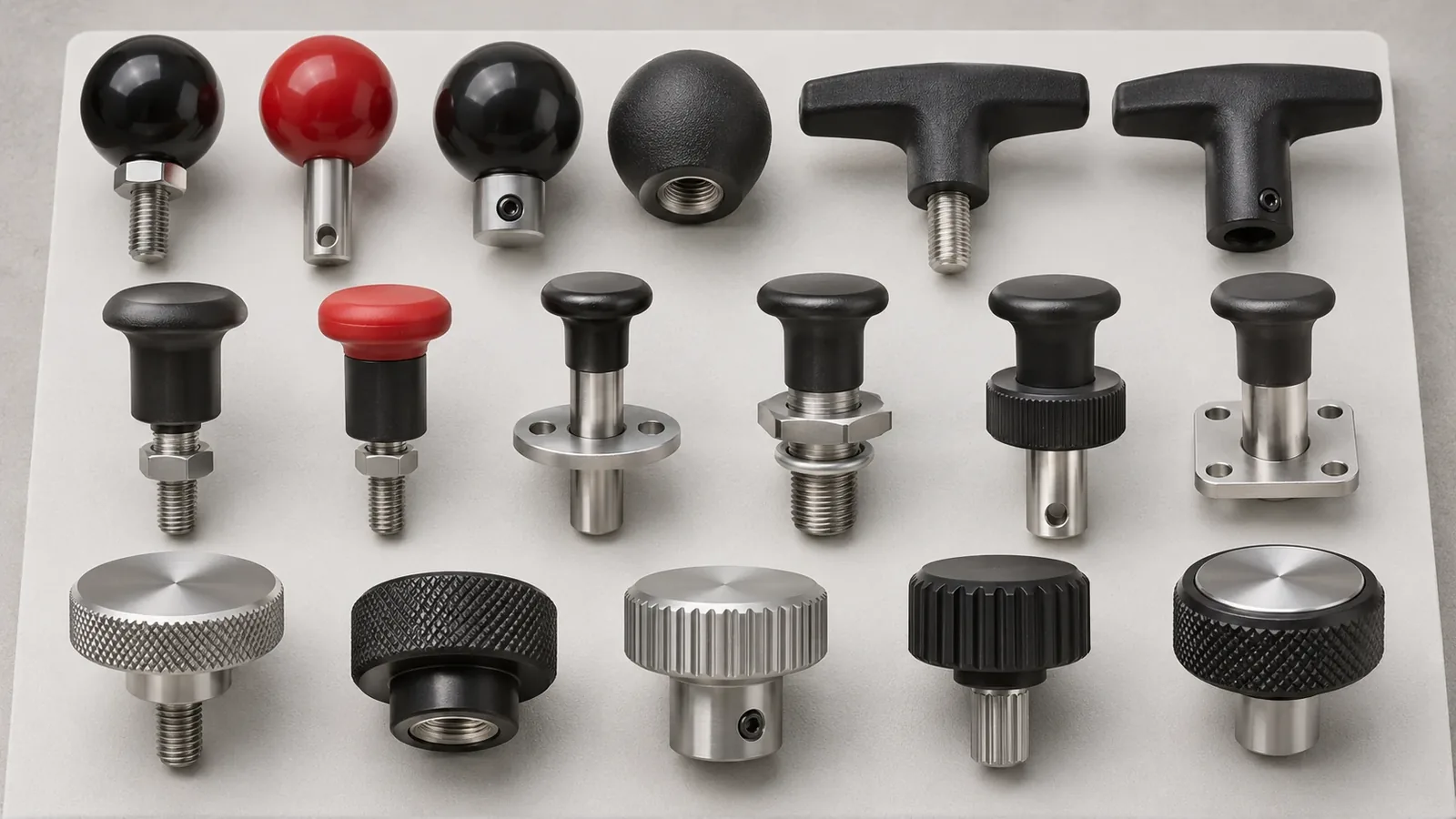
Knob labels can describe different attributes rather than exclusive product types. Push-pull describes an operating action; ball, prong or star, and T-handle describe grip shapes; a knurled rim describes a surface texture; and a tapped hole or threaded stud describes a mounting interface. One actual Monroe item is listed as Push/Pull, with Ball as its knob type and Tapped as its mounting. Choose by motion, hand-access envelope, and interface—not by assuming every label is an alternative to the others.
How Should Buyers Compare Types of Knobs?
The word “type” is often used for several distinct product attributes. A buyer may mean how the knob operates, what its grip looks like, how its surface feels, or how it attaches to a panel or shaft. These are separate classification axes. A product can therefore be a push-pull knob with a ball shape and a tapped mounting, all at once.
OneMonroe’s named Push/Pull knob MA-0100 illustrates this combination: the catalog lists its knob type as Ball and its mounting as Tapped. The example is evidence that operating action, grip form, and attachment can coexist as labels on one part. It is a specific catalog product; its dimensions and material do not establish a universal standard for ball knobs.
This distinction prevents a false choice. If a buyer asks, “Should we use a ball or push-pull knob?” the request may compare a shape with an action. The intended comparison should be clarified before a purchase. A ball shape can be used on a part whose function is to push or pull, depending on its design. A buyer may also want to compare a ball grip with a T-handle while holding the function and mounting constant.
Start with the job the knob performs. Does the user push and pull a control, turn an adjustment, clamp a part, move a sliding assembly, or grip a door or drawer front? Then specify the visible and tactile form separately. The final choice must also fit the mating interface and the available space.
Which Labels Describe Operating Action?
Push-pull describes a control that is operated by pushing or pulling along its intended movement. It does not specify the exact shape of the grip, the mounting method, the force required, or the function of the mechanism behind it. A knob that is called push-pull may use a ball-like grip or another shape.
Other descriptions may refer to turning, clamping, indexing, positioning, or another operation. Those terms should be confirmed against the component’s intended use and maker documentation. Do not infer that a general knob category is suitable for a door lock, a precision adjustment, or a load-bearing lever simply because it can be grasped.
The action matters because it defines how a user approaches the control and the direction in which it is expected to move. It can affect clearance in front of or around the part, the available hand space, and the relationship to nearby panels or components. These are design-review considerations, not quantified ergonomic claims.
A buyer should identify whether the action is continuous or limited, whether the control rotates or translates, and whether the knob remains in place or travels with a moving member. If the mechanism’s path is unknown, provide an assembly drawing or ask the design owner to clarify it before selecting a grip style.
Which Labels Describe Grip Shape or Texture?
Ball, prong or star, T-handle, and knurled-rim labels refer to forms or surface features intended to be grasped. OneMonroe’s article groups common knobs by these shapes, while its catalog shows that a named ball knob can also carry a push-pull action. JW Winco’s star-knob listings show another useful distinction: star-knob families may be offered with tapped bores or threaded studs. The shape name does not tell the buyer the mounting interface.
A ball knob has a rounded grip form. The label describes shape; it does not establish a universal comfort, torque, material, strength, or quality ranking.
A prong or star knob has projecting lobes or a star-like outline. It is a grip shape, but the exact geometry and attachment must come from the supplier’s product record. “Star” should not be used as a substitute for a precise dimensioned drawing.
A T-handle provides a crosswise grip form. That shape does not prove the user can apply a particular force or that the handle is suitable for a specific mechanism. Confirm the intended motion and available clearance.
A knurled rim has a textured edge or surface feature. Knurling describes texture, not a separate operating action or mounting type. The buyer should identify where the texture is located and which product family is intended.

| Attribute axis | Example labels | Pergunta do comprador |
|---|---|---|
| Operating action | Push-pull, turning, clamping | What movement or control does the user perform? |
| Grip shape | Ball, star/prong, T-handle | What form must the hand grasp, within the available space? |
| Surface texture | Knurled rim, smooth surface | What surface feature is specified on the selected model? |
| Interface de montagem | Tapped bore, threaded stud | How does the knob connect to the mating component? |
| Product context | Adjustment, cabinet, control | Which mechanism or use is actually in scope? |
The table sorts the terminology; it does not rank one shape above another or assign an unverified performance value.
What Does the Mounting Interface Tell the Buyer?
The mounting interface explains how the knob attaches to another component. A tapped bore has internal threads; a threaded stud projects from the knob and engages a mating feature. Other designs may use a different attachment. Confirm the exact construction from the maker’s drawing or part description.
A tapped mounting and a threaded stud are not simply different names for the same interface. They can require different mating parts, assembly order, access, and replacement components. A buyer selecting a knob for a panel or bracket should establish which side carries the thread and how it is secured. The thread size and length should be taken from the actual product specification, not inferred from a photo or shape name.
JW Winco’s star-knob category lists products with tapped bores and with threaded studs. That is evidence that a star grip family can include more than one mounting arrangement. It does not mean every star knob is offered with both arrangements or that the versions are interchangeable. Check the exact item and supplier data.
When a knob is a purchased component in a metal assembly, show the interface and the mating component on the drawing. Identify whether the fastener or stud is included, which party supplies it, and whether the buyer expects a washer, spacer, or other item. Do not assume those parts are included because a catalog photograph displays a complete assembly.
How Should Buyers Choose Among the Types of Knobs?
A practical selection starts with the mechanism and the user’s movement, then narrows the grip shape and interface. A buyer can work through four questions:
- What action does the mechanism require? Define push, pull, rotation, clamping, or another movement in the product context.
- What grip form is needed? Compare ball, star/prong, T-handle, or another maker-defined form without assuming a performance ranking.
- What surface feature is required? State a knurled or smooth region if the specification needs it, and identify the exact model.
- How does the part attach? Name tapped bore, threaded stud, or the actual alternative and provide its mating requirement.
This sequence helps prevent a buyer from choosing a shape before understanding whether it fits the operation. It also exposes missing information. If the action is known but the mounting is not, the item is not yet ready to order. If the interface is fixed but hand access is uncertain, compare candidate shapes in the actual envelope.
For a product-development review, use a drawing that shows the knob, surrounding structure, full movement, and any nearby cover or panel. A physical sample can help assess visual form and interface fit, but a hand-held impression is not a standardized ergonomic test. Avoid claims such as “more comfortable,” “higher torque,” or “better grip” without appropriate evidence for the product and users.
A buyer may also consider cleaning, appearance, assembly access, and replacement availability. Those factors should be stated as requirements and checked against the exact product. A knurled surface is not automatically easier to operate or clean; a ball is not automatically more comfortable; a T-handle does not prove greater output. Such conclusions depend on the design and use context.
How Should Buyers Compare Similar Catalog Listings?
Compare the same fields across products. A catalog may prominently display the grip shape while placing the mounting interface in a separate specification line. One item may be titled “star knob” but offered with a tapped bore; another may use a threaded stud. A product name alone may not show the complete construction.
| Comparison field | Listing A | Listing B | Confirm before purchase |
|---|---|---|---|
| Action | As stated by the maker | As stated by the maker | Does it match the mechanism? |
| Grip shape | Ball, star, T-handle, or other | Exact maker term | Is it the intended shape? |
| Texture | Smooth, knurled, or specified | Exact model description | Where is the texture? |
| Montagem | Tapped, stud, or other | Exact interface | Does it mate with the assembly? |
| Part identity | Maker and product number | Maker and product number | Are both tied to the same revision? |
If two listings appear similar, compare dimensions, thread, material, finish, and included parts. Do not assume one listing is a substitute for another because both use the word “star” or “ball.” If the supplier’s page omits a field, ask for the drawing or a written confirmation.
A replacement should match the existing interface and product requirement. If the original knob is damaged or unidentified, recover the bill of materials or contact the product supplier. Measuring a damaged item can give an inaccurate thread or shape description. Do not force a candidate knob onto a mating component to test fit.
Which Knob Questions Belong to Other Product Guides?
A knob on a cabinet door or drawer front raises placement, hole spacing, and hand-clearance questions. Those are distinct from the classification of operating action, grip geometry, texture, and mounting type discussed here. For cabinet applications, use Koitor’s cabinet knobs versus pulls guide and its cabinet knob placement and hole-layout guide.
Door-lock knobs are another product context. A lock mechanism, privacy function, latch, or access control is not interchangeable with an adjustment knob merely because both have a knob-shaped part. This article does not specify door hardware, locking functions, or security performance.
For an industrial adjustment or clamping part, use the selected maker’s technical data. A catalog category may provide dimensions and interface details, but it does not grant a universal torque rating or a safety determination. Keep the mechanism and its loads within the design owner’s reviewed scope.
What Should an OEM or Product Buyer Put in the Specification?
A useful request identifies the purchased item and its intended relationship to the assembly. State the control’s action, the required grip form or texture, mounting interface, dimensions and thread, material/finish needs, visible orientation, and quantity. Attach a drawing, assembly view, or sample reference that shows the mating part and access envelope.
If the buyer is still comparing types, mark the open attributes instead of choosing them implicitly. For example, the action may be fixed while both ball and T-handle shapes are under review. Or the grip may be fixed while the buyer has not decided between a tapped bore and stud. A quote should indicate which configuration is being priced and which component is included.
Ask the supplier to identify any proposal that differs from the requested interface. If a product listing offers multiple mountings, request the exact part number for the quoted one. Keep the same part number in the purchase order, receiving record, bill of materials, and service parts list. This prevents a later replacement from being selected by shape name alone.
Koitor Hardware is a family-owned custom metal bathroom and home-storage hardware factory. Buyers can provide drawings or physical samples to discuss metal product development, component interfaces, finish, assembly, and packaging. The company profile does not establish that Koitor manufactures molded plastic knobs, door locks, every third-party control, or a named supplier’s catalog component. Confirm which supplier owns the knob and what the custom metal assembly requires.
What Common Knob-Sourcing Errors Should Buyers Avoid?
Treating action and shape as alternatives. A push-pull knob may also have a ball grip; one item can satisfy multiple label axes.
Assuming shape identifies attachment. Ball or star does not say whether the mounting is tapped, studded, or another design.
Comparing product names but not part numbers. Catalog titles can omit dimensions, thread, material, or included hardware.
Assuming a visible texture proves a performance benefit. Knurling does not establish an ergonomic or torque value.
Applying cabinet placement advice to a different control. Cabinet pulls and adjustment knobs raise different layout questions. Use the relevant owner page.
Treating a door-lock part as a general control knob. Lock and latch functions require their own product specification.
Ignoring hand-access and movement envelope. A selected shape must fit the actual assembly and intended motion.
Assuming displayed hardware is included. Confirm whether a stud, screw, washer, or mating part is part of the quote.
Selecting a replacement from a damaged sample alone. Confirm the controlled part identity and interface before ordering.
Inferring strength or safety from a shape label. Those properties require product-specific design and evidence.
When more than one knob is considered, compare samples in the intended assembly position and keep the mounting interface constant where possible. A shape preference observed off the product may not reflect surrounding clearance or the actual operation. Record the assembly revision and candidate part numbers with the review.
How Should a Buyer Review a Physical Knob Sample?
Review a candidate sample in the intended assembly position where possible. Confirm the action, grip form, texture location, mounting interface, dimensions, and clearance against the current drawing. A knob held separately may feel or look acceptable but still collide with a panel, cover, or neighboring component when installed. Keep the part number and assembly revision beside the sample so a preference can be traced to the item actually reviewed.
For a comparative review, change one classification axis at a time when practical. A buyer might hold the mounting interface constant while comparing a ball and T-handle shape, or hold the grip shape constant while evaluating a tapped bore against a stud. If multiple attributes change together, the team may not know which difference affected the decision. This is a design comparison method, not a claim that one form performs better.
Record observable feedback in neutral terms: the part clears a named neighboring feature, the stud aligns with the mating hole, or the intended movement can be completed within the available envelope. Avoid treating a brief sample handling session as a quantified ergonomic, strength, or torque assessment. If such performance matters, the product owner should define an appropriate method and acceptance criterion with the responsible supplier.
How Should Product Records Distinguish Knob Options?
A product record can give each classification its own field: operating action, grip shape, surface texture, mounting interface, thread or attachment size, material, finish, and maker part number. This keeps a ball-shaped push-pull control distinct from a different mechanism that happens to use a ball grip. It also makes supplier quotes easier to compare because a buyer can see which characteristic changed between options.
If the catalog does not state one of the fields, ask for a drawing or written confirmation rather than inferring it from the photograph. Record whether the mounting hardware is included and which component provides the tapped feature or stud. When a part is replaced, compare the controlled interface and actual item identity before ordering. A concise, versioned component record reduces ambiguity without claiming a performance ranking for any shape.
Buyer Checklist Before Requesting a Knob Quotation
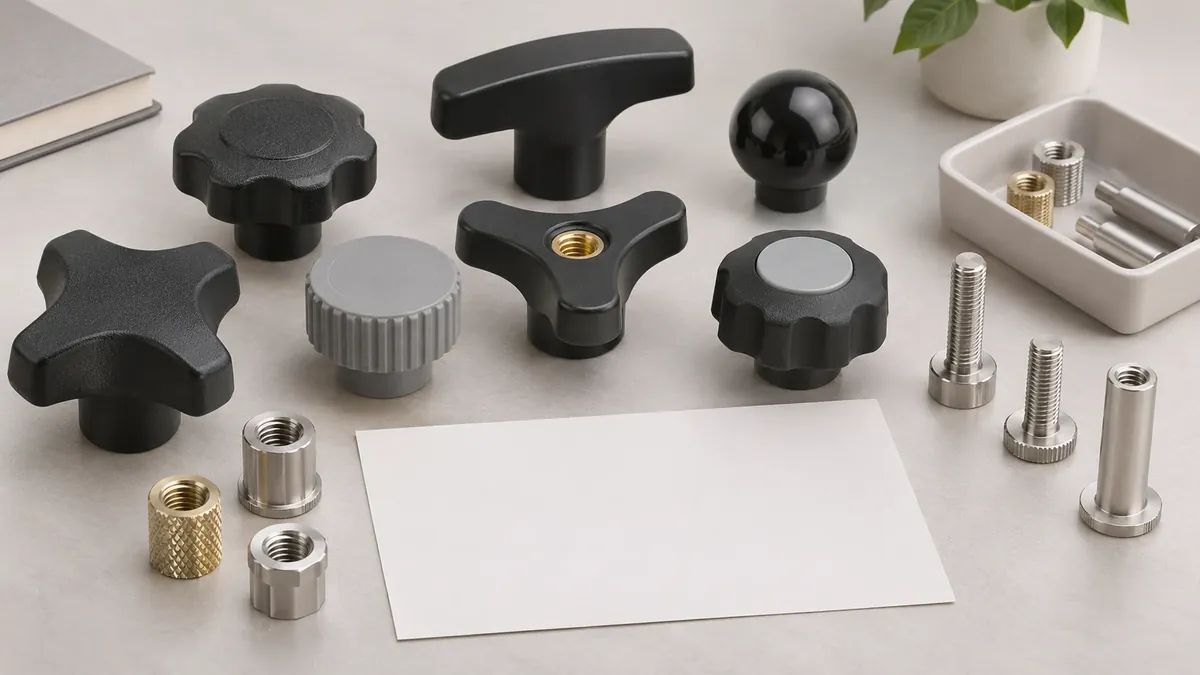
- What action does the mechanism require: push, pull, turning, clamping, or another movement?
- Which grip shape is needed: ball, star/prong, T-handle, or a named alternative?
- Is a knurled or other textured surface required, and where?
- Is mounting by tapped bore, threaded stud, or another defined interface?
- Are thread size, length, dimensions, and mating part shown on the drawing?
- Is the knob used on a cabinet front, an adjustment, a clamp, or another mechanism?
- Is the full movement and hand-access space visible in the assembly view?
- Are material, finish, color, and included hardware defined?
- Is the maker part number recorded for any catalog selection?
- Are unsupported claims about comfort, torque, or safety excluded from the specification?
If only one type label is available, identify which axis it describes and ask for the remaining fields. The requirement becomes easier to quote and inspect when action, shape, texture, and mounting are stated separately.
Perguntas frequentes
What are the common types of knobs?
Common grip descriptions include ball, prong or star, T-handle, and knurled-rim forms. Other labels describe operating action or mounting. The exact available types depend on the product maker.
Can a knob be both push-pull and ball type?
Yes. OneMonroe lists a specific Push/Pull knob with Ball as its knob type and Tapped as its mounting. The example shows that the labels describe different attributes.
Does a star knob always have a threaded stud?
No. JW Winco lists star-knob products with tapped bores and with threaded studs. Check the exact model and maker’s specifications.
Is a knurled knob always easier to grip?
This guide does not claim a universal ergonomic benefit. Knurling identifies a surface texture; suitability depends on the actual product, user, and application evidence.
Are cabinet knobs the same as adjustment knobs?
The broad shape term may overlap, but the product function and installation questions differ. Cabinet hole layout belongs to the specific cabinet hardware guides, while adjustment mechanisms require their own product instructions.
Fontes
- OneMonroe: 5 Common Types of Knobs
- OneMonroe: Push/Pull Ball Knob MA-0100
- JW Winco: Star Knobs
- Koitor: Cabinet Knobs vs Pulls
Trabalhe com a Koitor Hardware
Review a Custom Metal Hardware Interface
Share the assembly drawing or sample, operating motion, interface, finish, packaging needs and target quantity. Koitor Hardware can review the defined custom metal product scope; purchased knob specifications should be confirmed with their responsible maker.
OEM / MARCA PRÓPRIA
Transforme este guia de fornecimento num resumo do produto
Indique o produto pretendido, as dimensões, o acabamento, a quantidade a encomendar e os requisitos de embalagem. A sua equipa receberá uma análise prática da viabilidade de fabrico antes da apresentação do orçamento.


 English
 Español
 Português
 Français
 Deutsch
 العربية