

A useful wire display basket specification starts with the merchandise and the receiving retail fixture, then defines the basket around both. Give the supplier actual packaged-product dimensions, intended fill, installation interface, retrieval direction and sample acceptance criteria. Approve a production-intent basket with representative merchandise on the intended fixture before releasing the order. An outside dimension or a photograph alone does not establish usable space, interface compatibility or a suitable loaded configuration.
For importers and home-organization brands, this guide addresses a specific handoff: turning a merchandising idea into a basket brief that a supplier can quote and sample. It covers a basket or basket module, rather than engineering a complete store fixture. Koitor Hardware’s relevant background is custom metal storage hardware and drawing/sample development; retail-display fixture production and any particular fixture-system compatibility require separate project confirmation.
What merchandise and retail location must the brief define?
Define the actual products, packages and retail location before choosing the basket’s outside size. A basket that holds loose samples on a desk may work differently when filled with retail cartons on a crowded fixture.
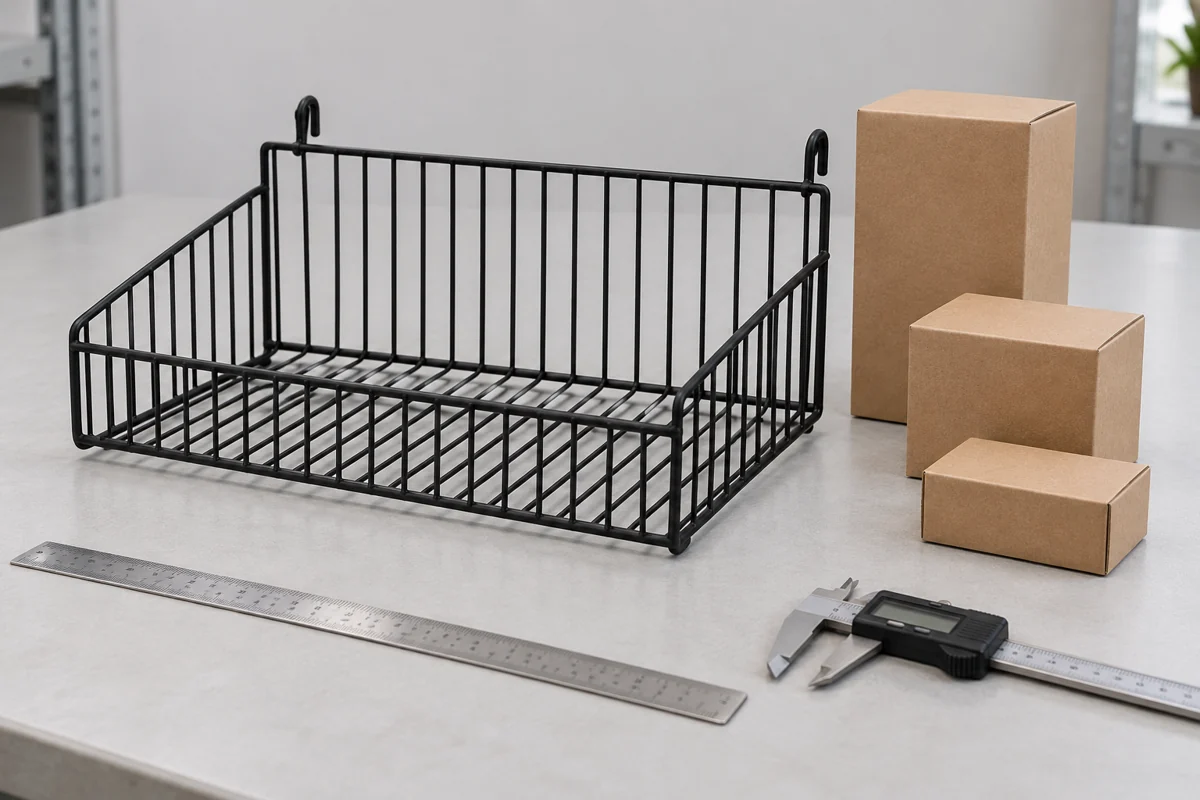
Start with the smallest and largest packages in the proposed assortment. Record their width, depth and height in the intended display orientation, including hanging tabs, folded seals and protruding handles. Use finished packaging where possible. A product drawing does not necessarily describe the retail pack that store staff will receive.
List product mass and proposed unit count separately. Identify whether units stand upright, lie flat or overlap. If the program mixes bathroom hooks, boxed tissue holders and small storage accessories, state which combinations belong together. Do not let a supplier assume that the same fill arrangement works for every SKU.
The display location also needs a description. Is the basket on a counter, attached to a grid panel, supported by a shelf or incorporated into another supplier’s fixture? Identify the retailer’s fixture owner and the person who can approve compatibility. Record the available width, projection and nearby obstructions without treating these measurements as approval of aisle or building requirements.
Include the viewing direction and the way customers approach the products. A tall front rail may retain a small package while obscuring its label. A shallow basket can improve visibility but leave less usable depth. Treat these as choices to review using actual merchandise, rather than assuming one geometry suits every category.
Public retail-fixture catalogs distinguish gridwall, slatwall and pegboard basket configurations. For example, Wire Display’s basket catalog separates these receiving systems and lists different basket geometries. That is a reason to name the interface in a brief; it does not establish compatibility between unrelated suppliers’ systems.
How should buyers describe usable space and product access?
Specify usable internal space and retrieval access alongside external dimensions. The welded rim, taper, front rail, dividers and attachment features can all change what fits inside the basket.
Use a simple merchandise layout showing the intended product orientation. Identify the number of packages across the basket and the intended rows behind them. Ask the supplier to show the usable envelope on the proposed drawing, including areas occupied by internal hardware or a divider. Avoid substituting an outside width for the clear space needed by the retail packs.
Clearances should follow the package and the buyer’s handling review. A carton that enters when tilted may still be difficult to remove once the basket above is installed. A flexible pouch can behave differently from a rigid box. Check the least convenient credible combination, rather than only the easiest SKU.
Wire spacing deserves a merchandise-based decision. Identify the smallest loose item or package feature that could enter an opening, tip between wires or catch during retrieval. Where a liner or insert is proposed, define its material, attachment, cleanability and replacement responsibility. An insert changes usable depth and may change the packing arrangement, so review it with the basket.
Describe how store staff replenish stock. State whether replenishment comes from the top, front or side and whether the basket remains installed. Ask whether labels and price information remain visible after normal refilling. This is a practical handling review, not a claim that a particular layout increases sales.
For removable dividers, record their intended positions and whether the basket can be used without them. A sample approved with three compartments should not silently become an undivided production unit. Photograph each approved merchandise layout and give it a revision identifier that can travel with the order.
What fixture interface and loaded configuration need approval?
Identify the receiving fixture by model and measured interface, then agree how the loaded assembly will be reviewed. A generic description such as “fits gridwall” leaves important conditions unresolved.
Provide the fixture manufacturer’s drawing, an authorized interface specification or a representative panel. Record relevant rail or wire geometry, attachment locations, insertion direction and available clearance. Ask the basket supplier to identify which dimensions control fit and which receiving-fixture assumptions still need confirmation. Keep the basket and fixture responsibilities explicit.
The proposed basket must also be considered with neighboring accessories. A hook can enter the panel correctly yet become difficult to remove once a shelf is placed above it. A sign holder can interfere with replenishment. Show the intended assembly location and check both installation and removal paths without relying on a single isolated product photograph.
Define the merchandise load by configuration. State unit mass, unit count and how items are arranged, including a credible uneven arrangement if relevant. Distinguish the basket’s own weight from the merchandise. The fixture supplier or responsible reviewer must confirm the receiving system’s suitability for the combined configuration.
Do not derive a load rating from wire diameter, product weight or a supplier’s unrelated basket model. Agree the sample setup, loading method, duration, observations and acceptance criteria with a qualified responsible party. If the project needs formal engineering or independent testing, identify that route before production; a purchasing checklist does not provide it.
The wire display basket specification should identify what the approval covers: one basket, a basket with its attachment kit, or the full installed display configuration. When a component changes, review whether the previous approval remains relevant. A finish change at the attachment area, a new bracket or a revised receiving panel may require another fit check.
Which construction and finish details should be controlled?
Control features that affect fit, handling and agreed appearance, rather than prescribing construction by appearance alone. Material, wire sizes, bends, joint locations and finish must be reviewed together for the proposed basket.
Separate structural features from decorative choices. Identify the perimeter rim, supporting wires, attachment features and any reinforcement on the drawing. Ask the supplier to explain proposed changes that alter clear space, product access or the interface. A hidden reinforcement can occupy the same space reserved for a retail carton.
For welded construction, record the joints that matter to assembly and appearance. Ask how a basket will be held during manufacture and which features will be checked after welding and finishing. The practical issue is repeatability against an approved drawing and sample, rather than assuming a process name proves finished-product performance.
Agree how exposed wire ends, corners and customer-contact areas will be assessed. Define the inspection method and acceptance reference with the supplier. Avoid vague instructions such as “perfect welding” or “no roughness,” which do not tell an inspector where to look or how to decide. Use marked photographs to identify the features requiring attention.
For finish approval, specify the agreed material and finish system, color reference and visible surfaces. Consider where retail packs rub against the basket, where baskets contact one another in transit and where attachment parts engage the fixture. A visually attractive sample is not evidence of coating adhesion, corrosion performance or suitability for every cleaning product.
Request project-specific evidence where performance matters. State the intended indoor environment and the retailer’s cleaning instructions or restrictions. Keep appearance approval separate from performance verification. If a supplier proposes another finish, review the effect on fit, merchandise contact and packing before treating it as an equivalent substitution.
Koitor can discuss drawing-based development, bending, welding, surface finishing and packaging for relevant custom metal storage projects. The custom metal storage basket page provides that broader manufacturing context. It does not establish a current retail-fixture product line or approval for a retailer’s proprietary system.
What should the RFQ and sample acceptance record contain?
Give every quoting supplier the same controlled brief and approve the sample against that brief. This makes differences in scope visible before unit prices are compared.
| Brief item | What the buyer supplies | What to confirm on the sample |
|---|---|---|
| Merchandise | Actual retail packs, dimensions, mass and intended fill | Usable fit, orientation and retrieval with representative products |
| Receiving fixture | Model, interface drawing or representative panel | Installation, engagement and removal in the intended location |
| Basket layout | Clear envelope, rails, dividers and access requirements | Critical dimensions and each approved merchandise arrangement |
| Loaded configuration | Unit count, arrangement and responsible review requirements | Agreed setup, observations and evidence within stated limits |
| Construction and finish | Controlled drawing, appearance references and acceptance method | Joints, exposed ends, contact areas and approved finish |
| Shipping configuration | Assembled or kit format, accessories and destination handling | Pack-out, protection, component count and usable assembly instructions |
Ask suppliers to list exclusions and assumptions. Clarify whether the quote includes dividers, liners, brackets, fasteners, label holders, protective packing and assembly instructions. Also identify who supplies the receiving fixture used for sampling. A lower price can reflect a different configuration rather than a better offer.
Use a production-intent sample when approving manufacturing details. If the sample uses temporary joining, a different finish or a manually adjusted attachment, record the difference and what must be confirmed later. Do not treat an appearance prototype as the final acceptance reference without reviewing those limits.
Before signing off, use this buyer checklist:
- Confirm the basket drawing, merchandise list and receiving-fixture revision.
- Check the smallest and largest representative packages in the intended orientation.
- Review installation, removal, retrieval and replenishment with adjacent accessories present.
- Record the agreed loaded configuration and its evidence requirements.
- Inspect the specified joints, exposed ends, contact areas and finish references.
- Count all accessories and confirm their part identifiers.
- Approve the packed configuration and note any unresolved sample deviations.
- Obtain written approval from the people responsible for merchandise, fixture compatibility and purchasing.
Retain measurements, photographs and acceptance decisions together. Record the supplier, sample date and drawing revision. If an issue is accepted conditionally, state the required correction and how it will be verified. An unanswered comment on an email chain should not become an assumed production approval.
How should pack-out and later changes stay aligned?
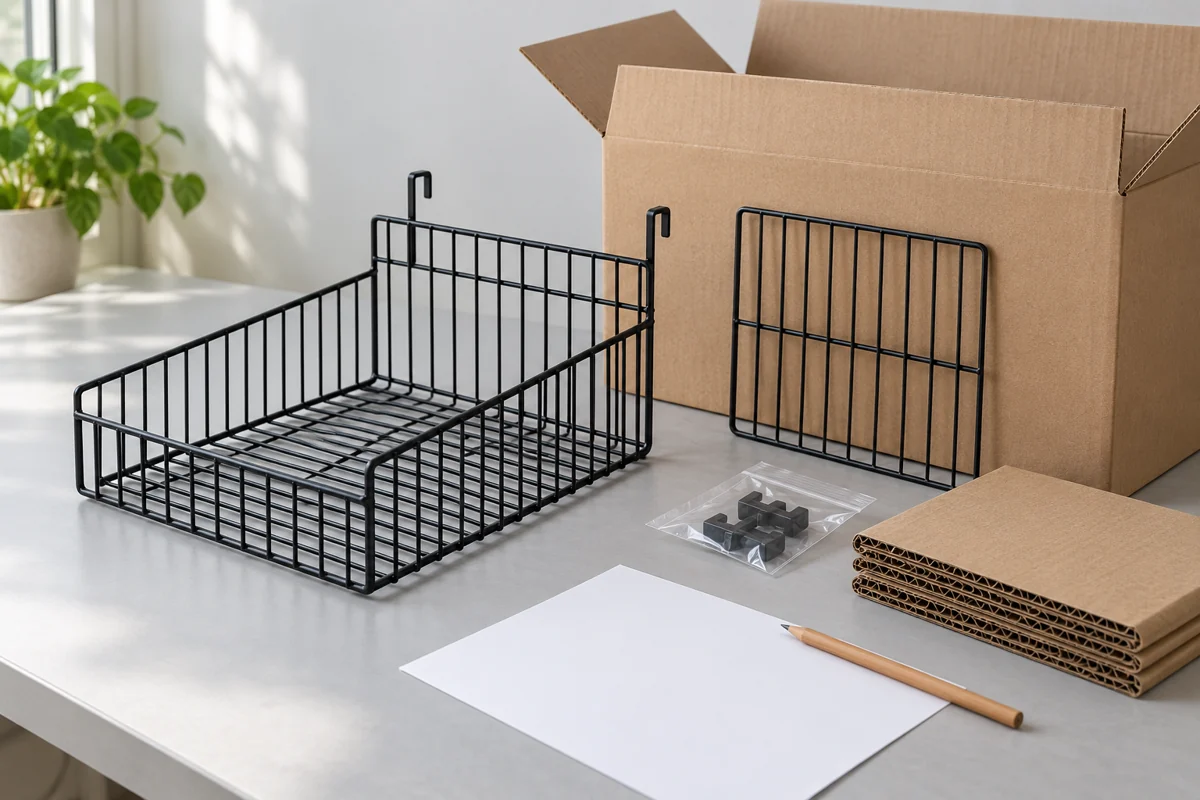
Approve shipping configuration with the same basket revision used for product and fixture review. Packing choices can change the kit received by the store and the work needed before installation.
Decide whether baskets ship assembled, nested or as a kit. For nesting, check separation, release and contact protection with the actual finish. Do not assume nested baskets will separate easily because unfinished prototypes did. For kits, verify that parts and instructions identify the approved assembly and that protective packing does not conceal small accessories.
Record where the basket must be protected from rubbing or deformation. Review the packed sample after representative handling agreed for the project. Any formal transit-testing requirement needs its own defined method and acceptance criteria; a neat carton photograph cannot establish shipping performance.
For reorders, compare the previous approved revision with any changed merchandise pack, divider, interface component, finish or shipping arrangement. Give the supplier a change summary and identify which checks must be repeated. Even when the basket remains identical, a taller product carton can change retrieval clearance or the intended display arrangement.
Keep the latest wire display basket specification with the purchase order and approved sample record. Store staff, merchandise teams and suppliers should be able to identify the same configuration. This is more useful than an informal promise to supply “the same basket as before.”
Frequently asked questions about retail display baskets
Can one basket fit every gridwall or slatwall system?
Do not assume that it can. Name the receiving system and verify the interface on an appropriate drawing or representative fixture. Catalog compatibility applies to the listed product and stated system; it does not prove compatibility for a custom basket or another supplier’s panel.
Is outside size enough for a quotation?
Outside size can support an initial discussion, but a comparable quotation needs usable space, merchandise, interface and supplied-part requirements. Include finish and packing scope as well. Otherwise suppliers may price materially different baskets against the same short description.
Does thicker wire establish a higher load rating?
Wire size alone cannot establish the performance of a complete loaded assembly. Geometry, joints, supports, attachments and the receiving fixture are also relevant. Ask the responsible supplier or reviewer for configuration-specific evidence and an agreed verification route rather than inferring a rating from one dimension.
Should the sample include real retail packaging?
Yes, use representative finished packages where available, especially for fit and access review. When final packaging is unavailable, record the substitute and its limits. Repeat affected checks once final pack dimensions and construction are confirmed.
Can Koitor quote a retail display basket project?
Send the basket drawing, merchandise information, receiving-fixture requirements and expected order quantity for a project-specific capability review. Koitor’s approved background covers custom bathroom and home storage metal hardware. Availability for the exact retail-display design, bought-in components and any engineering or test requirements must be confirmed before a quotation is relied upon.
Discuss Your Custom Metal Basket Brief
Send Koitor your drawing or sample, merchandise dimensions, receiving-fixture information, finish and packing requirements. The team can review whether the proposed basket fits its manufacturing scope and identify details needed before quotation.
OEM / MARCA PRÓPRIA
Transforme este guia de fornecimento num resumo do produto
Indique o produto pretendido, as dimensões, o acabamento, a quantidade a encomendar e os requisitos de embalagem. A sua equipa receberá uma análise prática da viabilidade de fabrico antes da apresentação do orçamento.
 English
 Español
 Português
 Français
 Deutsch
 العربية