
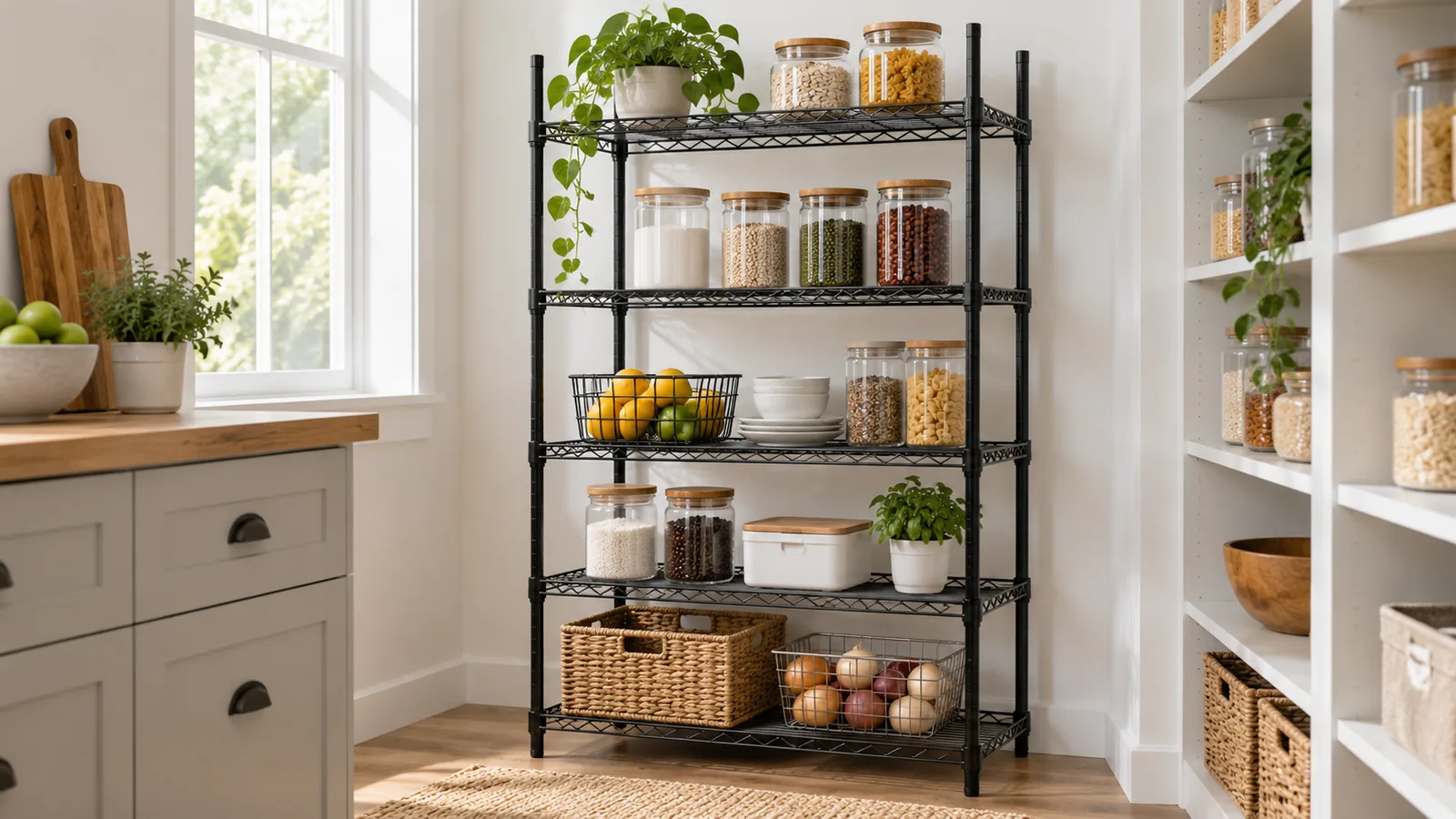
A wire pantry rack can appear straightforward in a product photo while the quoted units differ in shelf count, usable dimensions, adjustment hardware, feet, finish, included fasteners and carton contents. Importers should freeze those details before comparing prices or approving a sample. A “five-shelf rack” is not a complete specification if shelf spacing, clips, casters and the intended size range remain unclear.
This guide covers a complete freestanding metal rack used for home pantry or kitchen storage. It does not cover built-in pantry cabinetry, pull-out cabinet baskets, wall shelves, over-door organizers, gravity-feed dispensers or industrial shelving. Koitor’s general metal-storage sourcing experience can inform buyer questions about drawings, samples, finish, assembly and pack-out. Koitor’s current production of a complete pantry shelving unit, any particular post-and-clip system, product capacity or certification is not confirmed; buyers should verify the selected supplier’s scope directly.
What exactly is the supplier quoting?
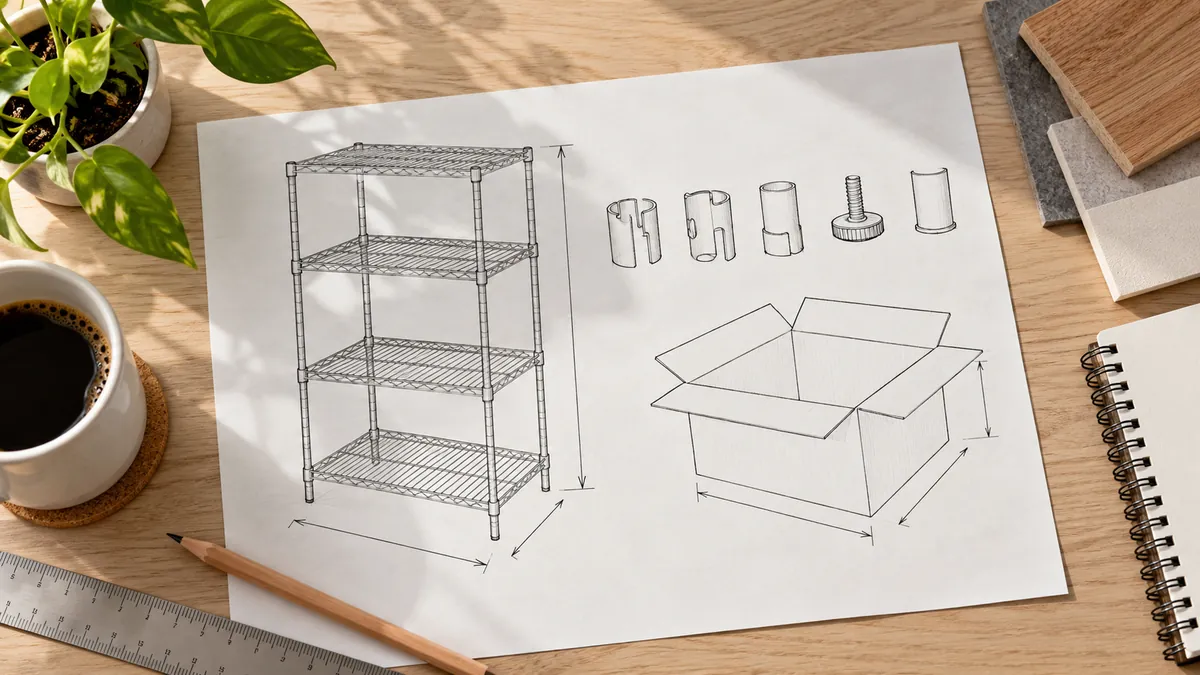
Begin the RFQ by defining the product architecture and intended SKU. Say whether the rack stands on its own, how many shelves it has, whether it is fixed-width or adjustable, and whether the assortment includes feet, leveling feet or casters. Include a reference image with callouts or a dimensioned drawing, but label it with a revision date so later samples and quotations can be compared to the same design.
A specialist wire-rack specification guide asks buyers to explain what will be held, the unit dimensions, opening size, transport conditions, stacking and quantities. That is useful as an example of the information a supplier needs; it is not a mandatory standard for household pantry shelves. See Acme Wire Products’ custom wire-rack specification guidance and adapt the fields to the actual retail product.Before sending the RFQ, write one short configuration line that identifies the SKU, finish, shelf count, adjustment type, floor-contact parts and pack-out. Attach the drawing and identify its revision in the same message. Ask suppliers to return deviations in a marked-up copy instead of silently changing the configuration in a quote. That record gives the buyer a common reference for price, sample and later reorder discussions.
Distinguish a complete rack from a related accessory. A removable side basket that hooks onto a shelf or rail has a separate interface question: hook geometry, rack-wire fit and removal path. A full freestanding pantry unit has an overall frame, multiple shelf positions, floor-contact parts and assembly sequence. The countertop microwave rack importer fit guide covers the add-on interface; it should not replace a whole-unit RFQ.
Which dimensions belong in the RFQ?
List overall dimensions and usable dimensions separately. Overall width, depth and height determine footprint and carton planning. Clear shelf width and depth show which items can occupy the shelf. The distance between shelf levels, adjustment increments and the position of any crossbars affect access and usable volume. State where each measurement begins and ends, especially when posts or rails project beyond the shelf wire.
| Drawing or RFQ field | What to specify | Por que é importante |
|---|---|---|
| Overall unit envelope | Outside width, depth and assembled height | Space planning, carton fit and SKU identity |
| Shelf usable area | Clear width and depth between frame parts | Buyer can compare storage area, not just exterior size |
| Shelf count and positions | Number of shelves, fixed spacing or approved adjustment positions | Affects assortment, assembly and item fit |
| Frame and shelf geometry | Post shape, shelf edge, wire-grid opening or other buyer-controlled feature | Keeps the quoted architecture clear |
| Adjustment or retention | Clip, collar, pin, bolt or other model-specific retention method; location and count | Shows how shelves are positioned and what parts must be included |
| Floor-contact parts | Fixed feet, levelers, casters, quantity and finish | Changes the final height, contact surface and SKU contents |
| Finish and color | Named finish/color reference, visible surfaces and approval sample | Gives a repeatable appearance target |
| Carton scope | Unit pack, protective material, instructions, fastener bag and master-carton quantity | Enables pack-out and landed-cost comparisons |
If the rack is adjustable, define the allowed settings and how the adjustment is secured. If it is not adjustable, show the fixed spacing on the drawing. Do not describe “adjustable” as though it gives unlimited positioning: a collar or clip system may only permit certain increments, and the supplier’s assembly instructions may set the shelf order. Ask for the measurement at each approved setting, not a broad range without endpoints.
For representative items, list the buyer’s own size envelope rather than relying on terms such as “large jar” or “standard can.” You can identify maximum package height, base footprint and expected access direction without promising that every product of a category will fit. A fit matrix for the intended range helps a buyer decide whether one SKU is enough or whether multiple widths or heights are needed.
Which construction and accessory details change the offer?
Wire diameter, shelf geometry, frame construction and finish can affect a rack’s appearance and use, but one visible feature does not prove capacity or durability. If the product carries a capacity claim, request supporting evidence for the exact model and configuration, including how the rack was assembled, where and how the load was distributed, the support surface and the stated test method. Do not transfer a competitor’s rating or assume that heavier wire alone establishes an equivalent result.
List every supplied component and quantity. Depending on the design, this could include posts, shelves, clips or collars, feet, levelers, casters, fasteners, tools, wall restraint parts, printed instructions and spare pieces. Mark each item as included, optional or excluded. If accessories appear in product photography, confirm whether they are part of the shipped SKU. Otherwise, a buyer may approve a sample that contains parts missing from the production pack.
Finish specifications should name the reference, color and surfaces that matter to the buyer. If cosmetic faces or contact areas have different requirements, show them on the drawing. Agree on how the reference will be checked—such as a signed visual sample or an identified color reference—and on which party controls revisions. Avoid unsupported claims that a finish or material is corrosion-proof or suitable for every pantry environment.
The bill of materials and product drawing should use matching part names or identifiers. If the supplier proposes a substitute clip, foot, wire size or finish, require the deviation to be called out and approved before sample sign-off. A substitution can change assembly, clearance, final dimensions or appearance even when the product retains the same marketing name.
How should the importer approve the sample?
Review the sample against the dated drawing and the specific configuration requested in the RFQ. Count the shelves and included hardware; measure outside and usable dimensions; check that the rack assembles in the documented sequence; and record the actual adjustment positions. Verify that shelf retainers are present and located as shown, and that feet or casters match the agreed variant. Keep photos of important measurement points with the sample record.
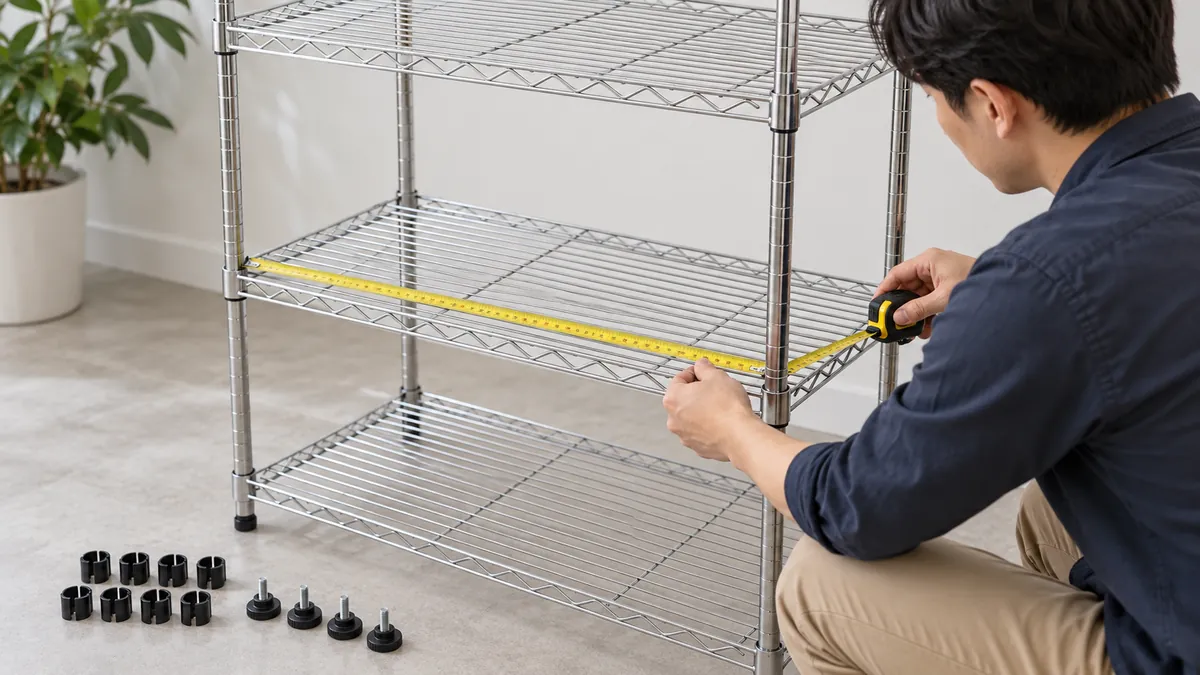
On a defined level surface, observe whether the assembled unit sits as intended and whether parts align as shown in the approved drawing. Note the surface, assembly method and any missing or loose components. These checks document the sample reviewed; by themselves, they do not establish long-term stability, capacity, fatigue life or performance on every floor. If a buyer needs a load test, define the test setup and acceptance criteria before production and link the result to the exact model revision.
Inspect visible edges and finish against the buyer’s agreed criteria. Do not make a broad claim based on one sample or treat appearance as proof of hidden process quality. Any issue should be recorded as a specific observation, with a photo, measurement where possible, sample revision, responsible owner and disposition. Corrected samples should be labeled so the team can tell whether they supersede an earlier version.
A clear sample-approval record can include:
- Drawing and BOM revision, date and supplier sample reference.
- SKU configuration, shelf count and all included-part quantities.
- Overall measurements, usable shelf areas and each adjustment position.
- Assembly sequence, tools and instructions checked.
- Finish/color reference and observed deviations.
- Buyer-defined functional or capacity tests, with method and acceptance result if required.
- Packaging sample, protective components, instruction version and carton marks.
- Open issues, owner, due date and the written disposition.
Approval should apply only to the recorded configuration and revision. If shelf spacing, posts, clips, material, finish, accessories or packaging changes later, the supplier should identify the change and the buyer should decide whether a new review or sample is needed. Avoid informal “same as approved” language without a way to identify the approved version.
How can quotes and packaging be compared fairly?
Ask suppliers to quote against the same complete scope. A compact quote comparison should show dimensions, shelf count and positions, included components, finish, assembly instructions, packaging, order quantity assumptions and any stated test evidence. If one supplier excludes casters or individually packed hardware, record it as a scope difference before comparing the total.
Packaging needs its own specification. Identify individual packaging, fastener bagging, scratch/deformation protection, carton dimensions, unit count per carton, labels and instruction-sheet version. Where the product can shift or rub during shipment, ask the supplier to explain how the agreed pack-out separates or secures the pieces. Review a packed sample or other agreed evidence for the actual carton design. Do not claim a drop test passed unless the buyer has a report for that exact pack-out and method.
For reorder control, preserve the approved sample reference, drawing, BOM, finish sample, packaging layout and carton markings in one revision-controlled record. Confirm which changes require buyer notification before production. This makes later quotes and incoming checks more comparable without assuming that a previous sample guarantees unchanged mass production.
Before requesting a final quotation or approving a sample, confirm that the RFQ answers these questions:
- Is the product freestanding, and what related designs are explicitly out of scope?
- What are the overall size and usable shelf dimensions?
- How many shelves are included, and which positions or adjustment increments are approved?
- What retention parts, feet/casters, fasteners, tools and instructions are included?
- What material/finish/color reference and visible-surface expectations apply?
- What evidence supports any capacity or performance statement?
- What does the sample acceptance record cover, and which revision does it approve?
- How is the unit protected, labeled and packed into the master carton?
- What happens when the supplier proposes a part, finish or pack-out change?
For broader sourcing context, see Koitor’s custom kitchen storage rack manufacturing page e OEM home-storage hardware overview. These pages provide category context; neither confirms that a complete freestanding wire pantry rack is a current Koitor product.
Perguntas frequentes
What is the most important wire pantry rack RFQ detail?
The complete configuration: overall and usable dimensions, shelf count and positions, retaining parts, feet or casters, finish, included accessories and pack-out. This lets suppliers quote the same version.
Does wire diameter alone define shelf capacity?
No. Capacity depends on the full design and stated test setup. Request evidence for the exact model, assembly, load placement, support surface and acceptance method before using a number in product copy.
Should an adjustable rack be specified with a range?
Yes. State the permitted positions or increments, the endpoints measured, and how each position is retained. Confirm those settings on the sample and in the instructions.
Does sample approval guarantee mass-production consistency?
A sample records an approved configuration; it does not, on its own, prove every later unit matches. Preserve the approved revision and clarify inspection, change notification and reorder controls.
Does Koitor currently manufacture a complete pantry shelving unit?
That specific capability is not confirmed. Buyers should verify the selected supplier’s current product scope, materials, components, evidence and manufacturing route before ordering.
Working with Koitor Hardware
Share a drawing or reference sample with the intended dimensions, shelf configuration, finish, included parts and packaging brief for a supplier-side discussion within Koitor’s confirmed scope.
Planning a freestanding wire rack project?
Send the unit envelope, shelf count and positions, components, finish reference and pack-out requirements so the team can review the sourcing questions within its confirmed scope.
OEM / MARCA PRÓPRIA
Transforme este guia de fornecimento num resumo do produto
Indique o produto pretendido, as dimensões, o acabamento, a quantidade a encomendar e os requisitos de embalagem. A sua equipa receberá uma análise prática da viabilidade de fabrico antes da apresentação do orçamento.
 English
 Español
 Português
 Français
 Deutsch
 العربية