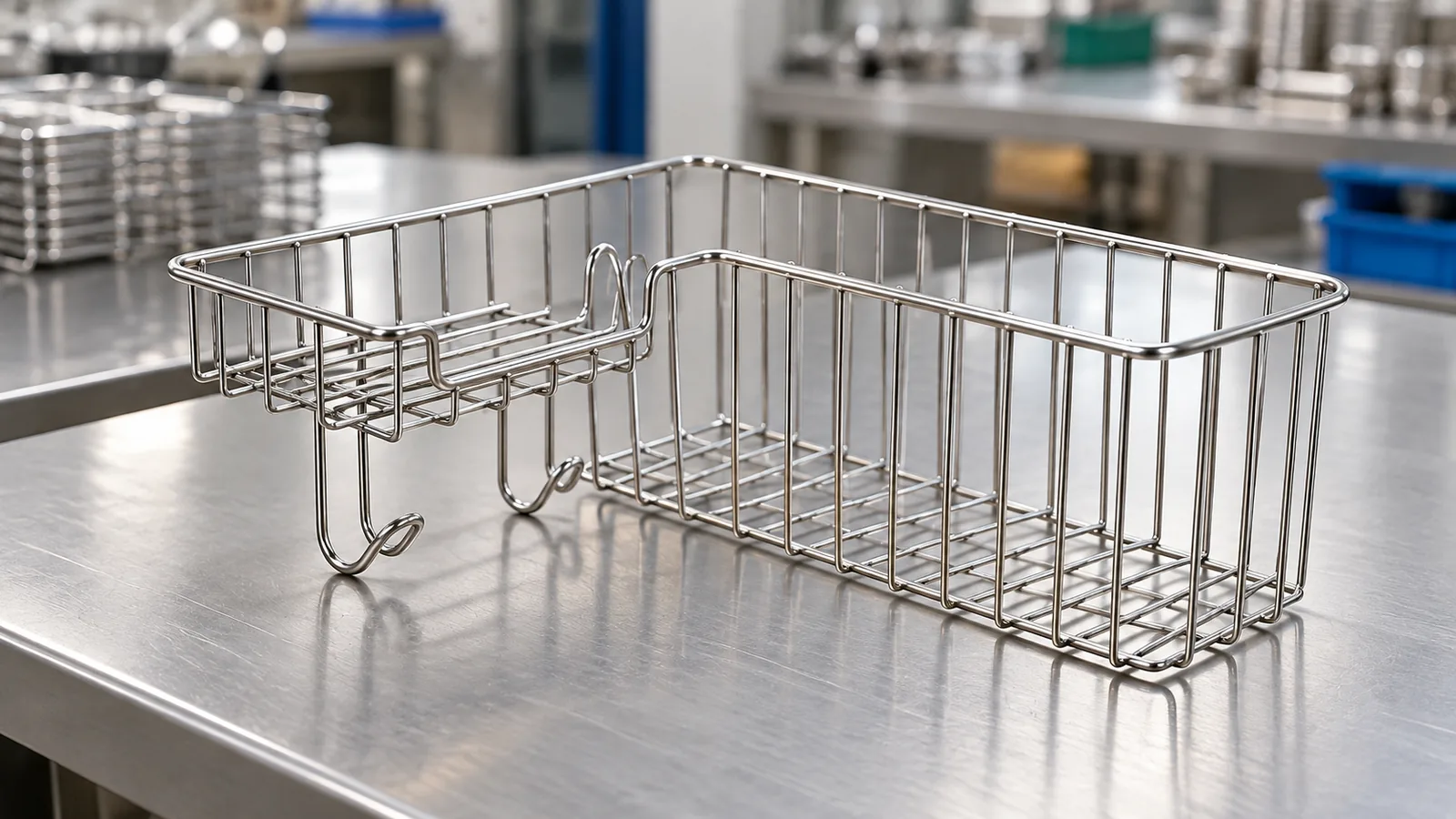
Stainless steel fabrication cross contamination is a preventable process risk, but a rust mark on a finished product does not prove that shared carbon-steel tools caused it. Importers should map every surface-contact step—from cutting and forming to grinding, racking, cleaning and packing—then ask the supplier how ferrous particles are prevented, removed where appropriate, and kept from returning. For stainless wire bathroom hardware, the useful control is a clear, proportionate process-and-evidence plan, not a vague promise that a product “will never rust.”
What does cross-contamination mean in stainless-steel fabrication?
In this context, cross-contamination means that free iron or other unwanted residues transfer onto a stainless surface from tools, fixtures, dust, handling equipment, storage or nearby operations. Stainless steel contains iron as part of its alloy; the concern is not simply that any iron atom exists, but that transferred free iron or embedded particles can oxidize and leave visible rust staining in a moist environment. The Nickel Institute’s fabrication guidance identifies carbon-steel dust, previously used tools and abrasives, blast media, clamps, transport hooks, forming rolls, presses, dies and brushes among possible sources. Nickel Institute / IMOA fabrication guidelines
For importers, this is a supplier-process question rather than a visual grade test. A shiny surface does not prove that contamination controls are adequate, and a brown mark does not by itself identify the cause. Grade selection, surface condition, weld cleanup, environmental deposits, water quality and handling history can also matter. Treat a suspected contamination complaint as a structured investigation: preserve the evidence, identify the exact lot and material, map the affected locations, and review the route the product took through fabrication and packing.
A supplier audit for stainless steel fabrication cross contamination should therefore focus on material-contact routes and agreed evidence, rather than treating final appearance as proof of prevention.
This guide is about stainless wire racks, towel accessories, shower caddies and metal baskets. It does not claim that every Koitor product is stainless steel, that every supplier needs a dedicated stainless-only factory, or that one cleaning treatment suits all designs. Buyers should agree on the product-specific level of cleanliness, inspection and documentation with the manufacturer.
Which process steps can transfer ferrous particles?
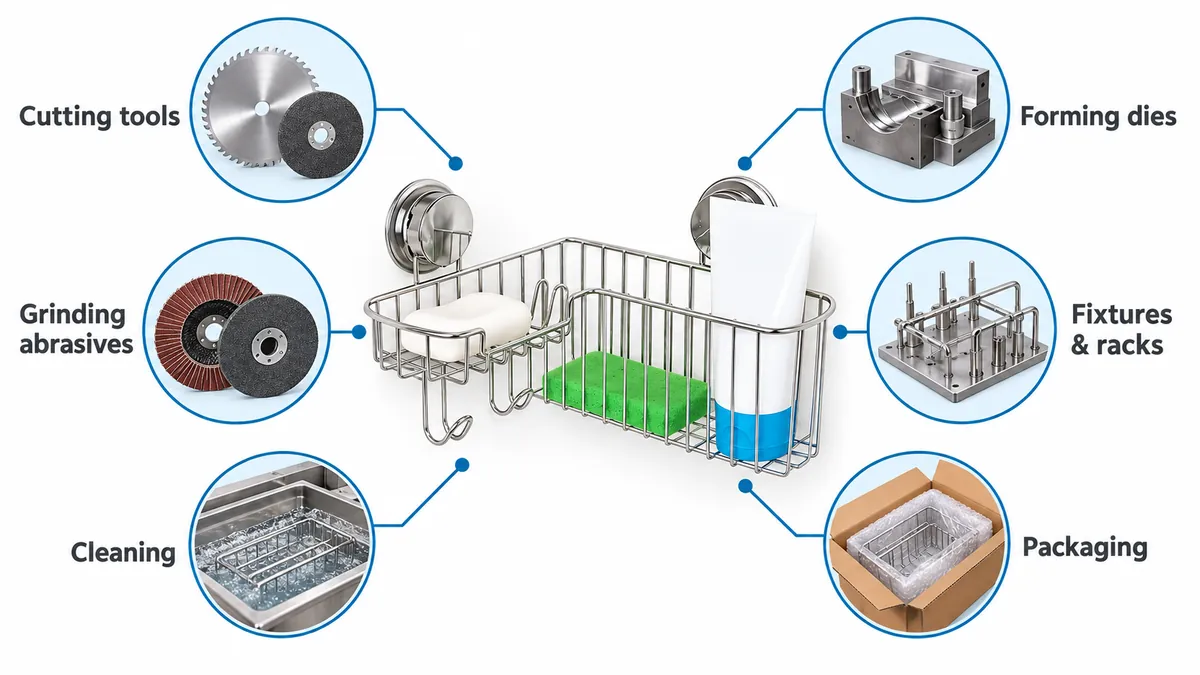
Contamination can be introduced at more points than the final grinding station. A supplier review should follow the part’s complete route and include contact points that are easy to overlook, such as a shared workbench or a metal hook used for temporary storage. Outokumpu advises against using the same tools for carbon steel and stainless steel when seeking to avoid extraneous rust. <a href="https://www.outokumpu.com/en/expertise/stainless-basics/machining-and-cutting-and-grinding">Outokumpu stainless machining guidance</a>.
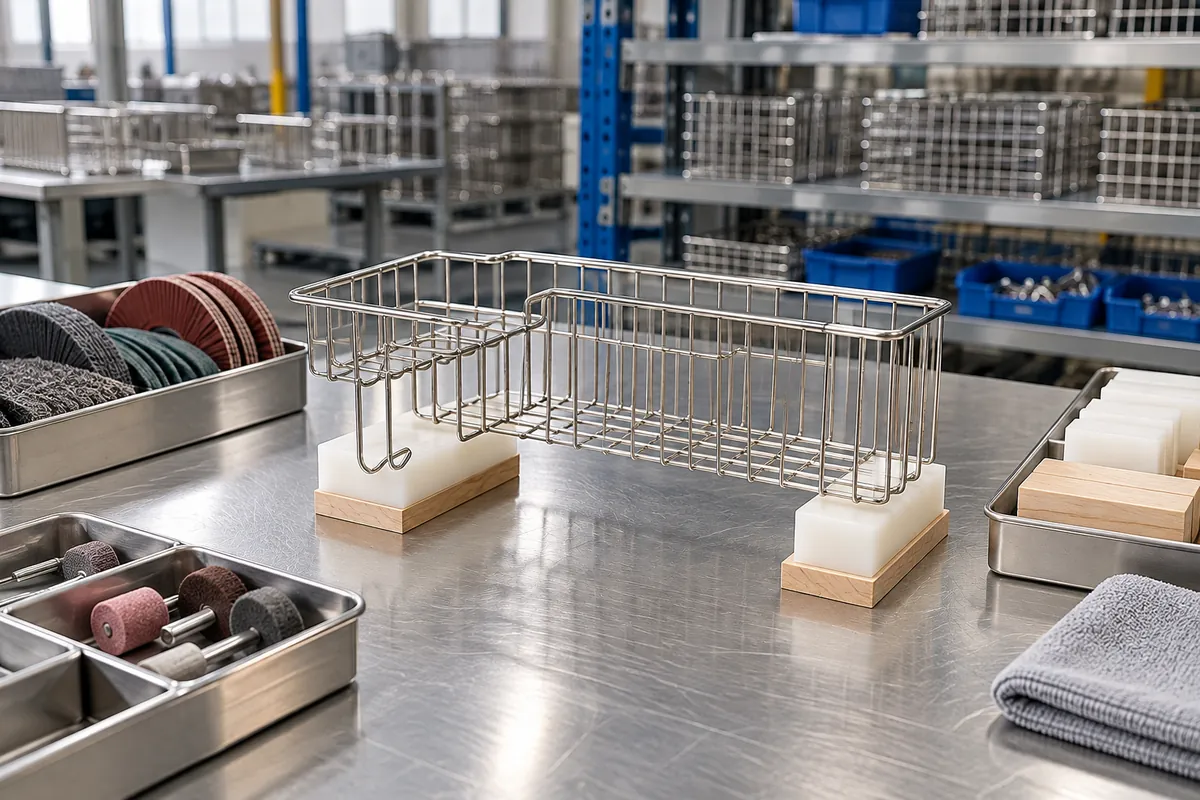
| Process step | Potential transfer route | Buyer question or evidence to request |
|---|---|---|
| Incoming stock and storage | Contact with carbon-steel stock, dirty racks, metal straps or grinding dust | How are stainless lots identified, separated or protected before use? |
| Cutting and shearing | Previously used blades, tooling, tables or swarf | What contact surfaces touch the stainless wire, and how are they cleaned or controlled? |
| Forming and bending | Shared rolls, dies, guides, pins or fixtures | Are contact points cleaned between material families, or are selected tools dedicated? |
| Welding and joint cleanup | Carbon-steel brushes, discs, wheels or mixed-metal work surfaces | How are abrasives identified, stored and kept from cross-use? |
| Handling and staging | Clamps, hooks, chains, carts, gloves or exposed benches | What protects visible stainless surfaces during transfers and work-in-process storage? |
| Cleaning and finishing | Contaminated rinse water, reused media or recontamination after cleaning | What cleaning route is used, and how is the cleaned part protected afterward? |
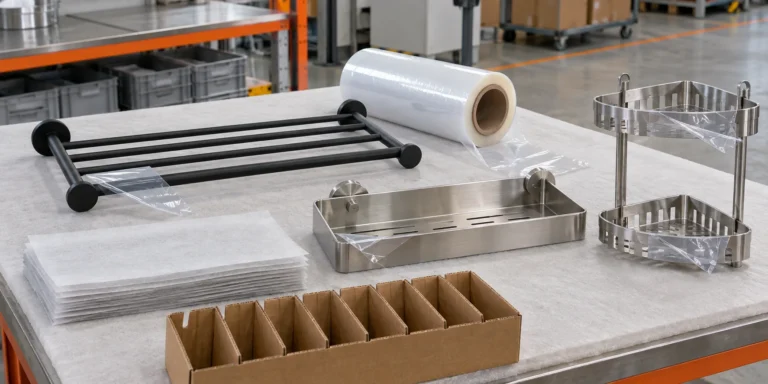
| Assembly and packaging | Dirty contact surfaces, fasteners, staples or abrasive movement in the carton | Are clean parts isolated from ferrous debris through final packing? |
This is a risk map, not a universal audit checklist. A product made from stainless wire may have different contact points from a formed sheet bracket or a mixed-material towel rack. The factory should identify actual operations, and the buyer should focus on surfaces that remain visible or are important to the intended use.
What evidence should buyers request from a supplier?
Ask for a concise process description, not a marketing statement. A capable supplier should be able to explain how the product is identified, where stainless parts contact tools or fixtures, how cross-use is controlled, and what happens if a process step changes. Evidence can be simple and practical: a marked process route, tool-identification practice, photographs of protected storage, a cleaning/line-clearance checklist, or a defined inspection record agreed for the order.
The appropriate evidence depends on risk. A simple indoor organizer may not justify the same controls as equipment used in a demanding industrial environment. Do not demand a pharmaceutical-style stainless-only facility for every bathroom accessory. Instead, match the control to the grade, surface finish, exposure, visible-area requirements, order volume and consequences of a field complaint.
Ask the manufacturer to distinguish “dedicated” from “cleaned before use.” If equipment is shared, the supplier should describe the sequence and the way residual dust or particles are removed before stainless work starts. A dedicated brush can still be contaminated or poorly stored; a shared bench may be manageable when cleaned, protected and verified. The label alone is not evidence.
For a new program, review a production-representative sample and document the material description, finish, visible surfaces, handling expectations and accepted inspection approach. If a supplier proposes a different tool, abrasive, fixture, cleaning route or material source, ask whether the change affects the approved sample or agreed acceptance criteria. The change should be reviewed before it is treated as an equivalent substitution.
How should a buyer compare prevention controls?
There is no single control package appropriate for every factory or order. Buyers can compare control options by where they interrupt the transfer route and how easy they are to verify. The following comparison is a discussion aid, not a certification scheme or a claim that any one method guarantees a rust-free product.
| Control approach | What it can help address | What the buyer should verify | Limitation |
|---|---|---|---|
| Dedicated stainless-contact tools | Cross-use of brushes, abrasives or selected hand tools | Clear identification, clean storage and replacement rules | Does not control every source, such as dust, racks or water |
| Shared equipment with documented clean-down | Residues on shared tables, dies, rolls or fixtures | Defined pre-use clean-down and who records/reviews it | A written step is weak if the contact surfaces are inaccessible or not checked |
| Protected storage and handling | Contact with dirty racks, hooks, chains, floors or adjacent carbon-steel work | Suitable barriers, separators, clean staging and packing route | Protection can be lost during later assembly or shipment |
| Cleaning or post-fabrication treatment | Existing surface residues, depending on the agreed process | Supplier explains method, compatibility and acceptance evidence | “Passivation” is ambiguous and does not replace prevention or good fabrication |
| Product-specific cleanliness checks | Detecting a defined contamination concern | Agreed method, location, sampling and acceptance criteria | A test result applies only to the tested item/conditions and stated method |
ASTM A380/A380M discusses cleaning, descaling and passivation of stainless parts and notes that surface cleanliness depends on design, fabrication, cleaning and protection against recontamination. It also describes different uses of the word “passivation,” which is why buyers should define what they mean in a specification instead of relying on that word alone. Its public scope lists possible cleanliness evaluation approaches, including visual inspection, wipe or water-break tests, humidity exposure and free-iron tests; it does not make every method mandatory for every consumer product. <a href="https://store.astm.org/a0380_a0380m-17.html">ASTM A380/A380M scope</a>.
How can buyers investigate rust marks without guessing?
Start by preserving the product and its history. Photograph the mark before cleaning, note whether it appears on one unit or many, record the lot and material description, and mark the location on a simple product sketch. Ask whether the same area contacts a forming die, fixture, hook, grinding surface, packaging support or another metal part. A pattern can guide the investigation, but it cannot independently prove a cause.
That distinction matters in stainless steel fabrication cross contamination investigations: a plausible transfer route is a lead to test, not a confirmed root cause.
Next, confirm what material and finish were actually supplied. Compare the order specification, approved sample, material records and supplier lot documentation. “Stainless steel” is not a complete grade specification, and a magnetic response alone should not be used as a definitive grade-identification method. A supplier may need qualified material identification or laboratory support if the discrepancy is consequential.
Then review alternative explanations. A weld area can show heat-related discoloration or cleanup issues; an exterior deposit may come from water or nearby carbon-steel dust; a coating or plating defect is a different mechanism from free iron on stainless. If the product includes both stainless and coated carbon-steel components, document which component is marked before drawing conclusions.
Agree on any testing or treatment with the supplier and, when needed, a qualified laboratory or finishing specialist. ASTM A380 indicates that appropriate cleanliness methods depend on the application and that some contaminants are not visible to ordinary inspection. Do not prescribe acid treatment or passivation chemicals from a photograph. Chemical process selection, handling, disposal and acceptance criteria require competent technical control for the actual alloy and product.
Finally, retain the sample and close the loop. Record the confirmed or still-uncertain root cause, the corrective action, the person responsible and the next verification point. If the cause is not confirmed, label it as a hypothesis rather than reporting a definitive failure analysis.
What mistakes create weak supplier controls?
The most common mistake is treating “stainless” as synonymous with “cannot stain.” Stainless grades differ, and surface contamination or service conditions can still produce visible marks. A second mistake is attributing every rust spot to carbon-steel tools. That may be one plausible source, but a buyer should consider material identity, weld condition, finishing, water and handling before deciding.
A third mistake is asking for “passivation” without saying what operation or outcome is expected. ASTM notes that the term is used for different operations. If the buyer needs removal of free iron, state the concern and agree an appropriate procedure or evidence with the supplier. Do not confuse cleaning, descaling and passivation as interchangeable words.
Other weak approaches include:
- Asking only whether the supplier has a stainless-only workshop, without asking about real contact points and protection.
- Accepting a general promise such as “we use good materials” instead of a defined material description and lot link.
- Looking only at the finished front surface while ignoring undersides, wire intersections, hooks, fixtures and packaging contacts.
- Cleaning a complaint sample before photographing it, which can erase useful evidence.
- Introducing a new abrasive or rework step after sample approval without checking the effect on appearance and agreed controls.
- Demanding an invented pass/fail threshold or a test report that was never part of the project agreement.
- Treating one inspection sample as proof that every production lot used the same process.
The better approach is specific and proportionate: define the product, identify process contact points, agree preventive controls and records, and choose an inspection method that answers the buyer’s actual risk question.
What should an importer include in an RFQ and approval checklist?
A useful RFQ makes the buyer’s needs understandable before quotation and sampling. It does not need to dictate every factory operation. For stainless bathroom hardware, include the following information where relevant:
- Product and application: towel rack, wire basket, shower caddy or other item; indoor bathroom, coastal retail range or another intended environment.
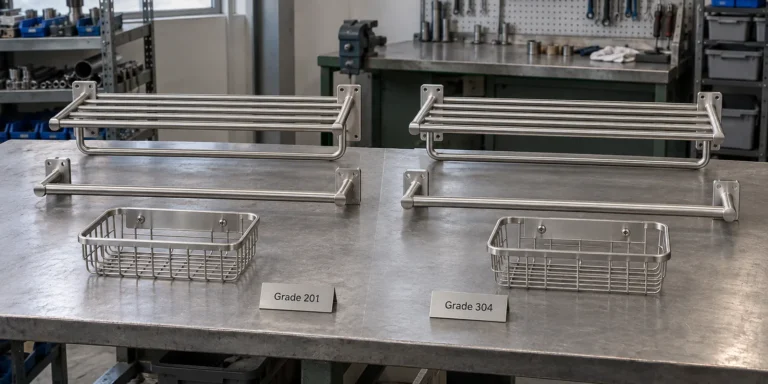
- Material identity: state the required grade or ask the supplier to propose one for approval. Do not use “stainless” alone when grade matters.
- Visible surfaces: mark front, underside, welds, contact points and cosmetic zones on the drawing or photographs.
- Fabrication route: ask which tools, abrasives, dies, fixtures and handling supports contact the stainless surfaces.
- Prevention approach: request an explanation of dedicated contact tools, clean-down, dust control, protected racks or other relevant controls; let the factory identify applicable steps.
- Cleaning/treatment language: define the concern and agree what “clean,” “free iron,” “passivated” or other terms mean for the project.
- Inspection evidence: specify the agreed visual locations, records, test method if any, sample quantity and acceptance decision owner. Avoid unsupported universal thresholds.
- Change notification: require review when a material source, contact tool, abrasive, finishing or cleaning step changes in a way that may affect the approved sample.
- Packaging and transport: identify surfaces that need protection from metal-to-metal rubbing, dirty supports or loose hardware.
- Complaint handling: define how a suspect sample is photographed, identified, retained and escalated before repair or cleaning.
Before bulk production, approve a representative finished sample against the same drawing and finish reference the factory will use. If the product uses mixed materials, list them individually. If the buyer approves a substitute material or treatment, update the controlled specification rather than leaving the decision in a chat message.
How can a small-batch OEM manufacturer support the review?
A specialized OEM manufacturer can help buyers translate a drawing or physical sample into a practical process discussion. For wire bathroom hardware, the review can connect wire grade and diameter, bend locations, weld access, grinding areas, surface finish, assembly points and packaging contact surfaces. Koitor Hardware’s published capabilities include wire forming, welding, polishing, finishing, inspection and packing preparation for bathroom and home storage hardware. That general capability statement does not establish a stainless-only area or a specific contamination test at Koitor.
For a new project, send the target product, intended market, required material description, reference drawing or sample, expected quantity, finish expectation and any known complaint pattern. Koitor can discuss whether the information is sufficient to review the product and sampling plan. Confirm the exact project scope, sample details, material availability, quotation and timing directly; they depend on product construction and order requirements.
A small trial order can help a buyer validate product presentation and the agreed inspection approach before planning a larger program. It should not be described as a statistical guarantee. The buyer and manufacturer should agree what the trial does and does not demonstrate—for example, whether the sample was made using production-intent material and handling steps, and which checks are included.
For product structure and sourcing context, see custom metal storage basket production and custom bathroom hardware manufacturing. Both links point to Koitor manufacturer pages rather than an assumed blog archive.
Frequently Asked Questions
Can carbon-steel tools cause rust marks on stainless steel?
They can transfer free-iron particles or residues that may later rust in a moist environment. The possibility is supported by stainless fabrication guidance, but a rust mark on a particular part still needs an evidence-based investigation rather than an automatic diagnosis.
Does a supplier need a completely separate stainless-steel factory?
Not necessarily. The buyer should assess the actual product risk and process contact points. Dedicated tools or areas may be appropriate for some operations; documented cleaning, protected handling and verification may be proportionate for others. Ask how the selected controls work and how they are checked.
Does passivation remove every stainless fabrication problem?
No. Cleaning or passivation cannot compensate for every material, design, welding, finishing, handling or packaging issue. The buyer should define the intended operation and verification with the supplier, and should not assume that the word “passivated” guarantees a specific result.
How can a buyer check a stainless wire basket for contamination?
Visual examination may reveal rust or visible residues, but ordinary visual inspection may not detect all thin films or free iron. If a complaint or product risk justifies a specific test, agree the method, location, sample and acceptance criteria with a qualified supplier or laboratory before testing.
Is rust at a weld proof that the stainless grade is wrong?
No. Weld cleanup, embedded iron, external deposits, grade selection, environmental exposure and other factors can contribute. Confirm the supplied material and review the fabrication and handling history before assigning root cause.
What should a buyer write instead of “use clean stainless tools”?
Identify which tools and contact surfaces matter, ask the supplier to describe its prevention or clean-down controls, define how parts are protected after cleaning, and agree what evidence is appropriate for the product risk. Keep the wording specific enough to audit without inventing a factory practice.
Work With Koitor Hardware
If you are sourcing stainless wire baskets, towel racks or related bathroom hardware, send your drawing or sample, material requirement, finish reference, target quantity and inspection questions. Koitor Hardware can discuss the product-development and OEM quotation requirements for your project.
OEM / PRIVATE LABEL
Turn this sourcing guide into a product brief
Share your target product, size, finish, order quantity and packaging requirements. Your team receives a practical manufacturability review before quotation.
 English
  Español
  Português
  Français
  Deutsch
  العربية