
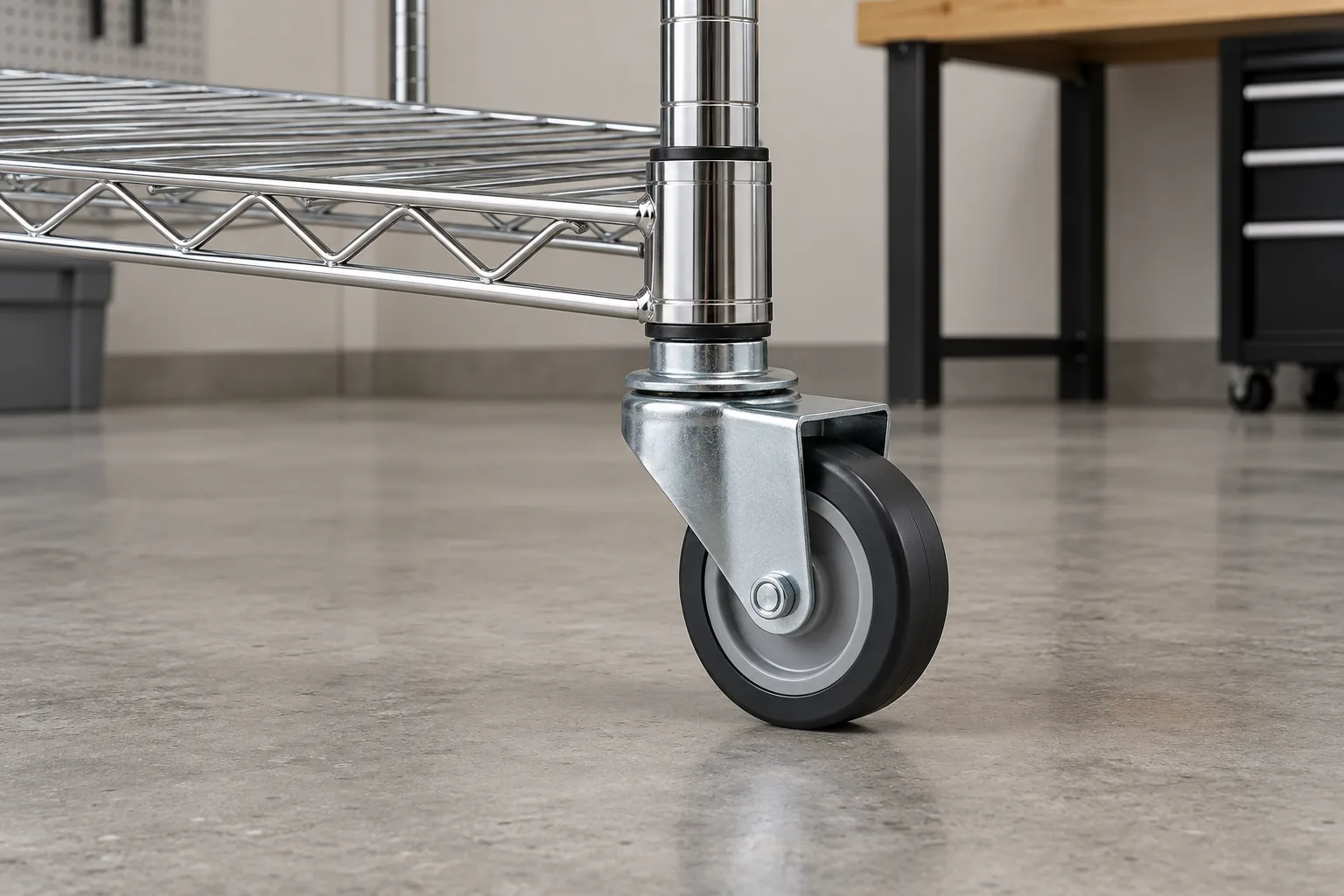
For storage rack caster specifications, buyers should define the rack’s loaded use case, caster attachment interface, wheel and swivel envelope, brake function, floor conditions and the exact assembly to approve. A caster’s advertised diameter or load figure alone does not establish that it will fit a custom metal rack or behave appropriately on the intended floor. The rack, mounting plate or stem, fasteners, wheel, brake access and packaging all need to be treated as a coordinated product configuration.
This guide is for importers, distributors and product developers sourcing a mobile metal storage rack or evaluating a caster-equipped product. It focuses on what to specify and verify before sample approval. It does not assign a universal load rating, wheel material or floor suitability; those depend on the selected caster, finished rack, use conditions and supplier evidence.
Why do caster and rack specifications need to be reviewed together?
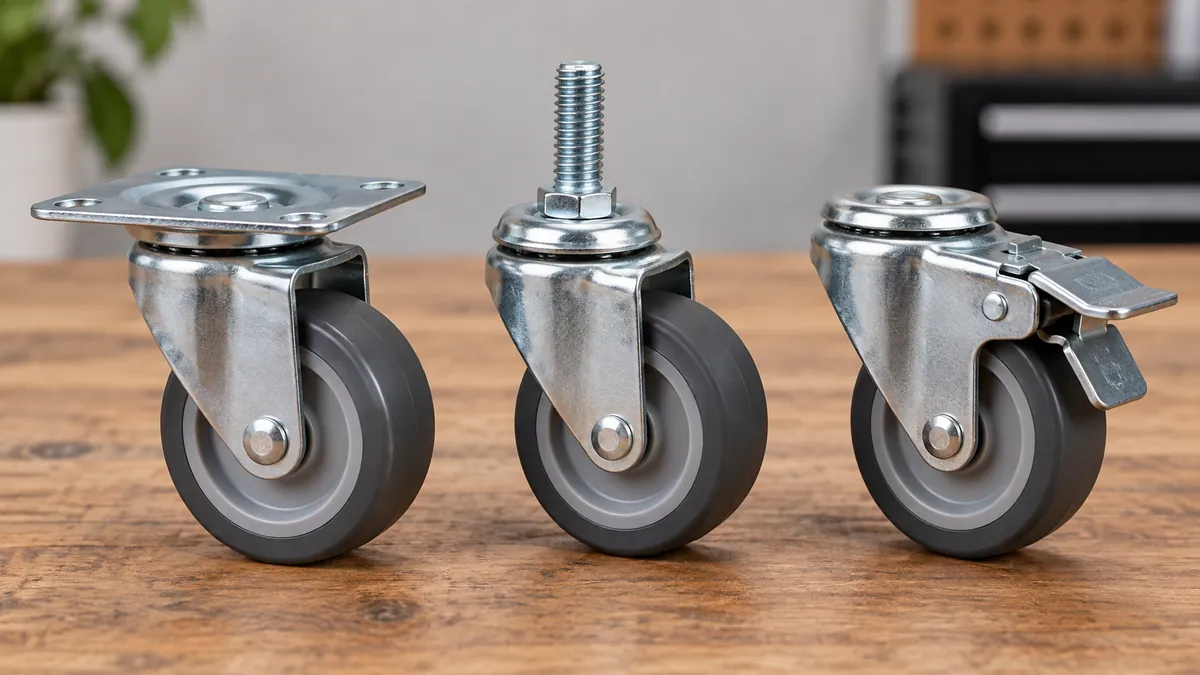
A caster may be a standard catalog component, but the finished rack is a system. A plate-mounted caster needs a matching footprint, hole pattern, support surface and fastener arrangement. A stem-mounted caster needs a compatible receiver and a retention method. In either case, mounting access and frame geometry can prevent the selected hardware from seating, swiveling or being serviced as intended.
The wheel’s overall envelope matters beyond its nominal diameter. Swivel radius, fork or housing dimensions, brake lever position and the clearance needed to rotate can affect the rack’s footprint and lower shelf height. A wheel can clear the floor when pointed forward but contact a leg or shelf when it swivels. Buyers should show the caster in the rack assembly drawing and confirm the clearance through a representative sample or a documented dimensional review.
The expected payload should be described carefully. Buyers need to distinguish the rack’s own weight from the intended contents, and clarify whether the load is normally stationary, frequently rolled, or moved over thresholds. Do not calculate or promise a safe capacity by dividing a supplier’s component figure across the number of casters without checking the caster maker’s stated application, load distribution assumptions and the rack’s own structure. Floor transitions, uneven loading and handling can change how forces are shared.
What information belongs in storage rack caster specifications for an RFQ?
Give each supplier a common basis. State the rack dimensions, intended loaded configuration, caster quantity and locations, mounting method, expected movement pattern and floor types. If the load target is not finalized, label it pending. Avoid issuing an RFQ that lists only a caster diameter and asks suppliers to choose the rest.
If the rack will be used in more than one environment, do not collapse all floor conditions into a broad phrase such as indoor use. Describe the relevant floor transitions and handling frequency separately, then ask whether the proposed caster’s published use guidance covers those conditions. Where this information is unknown, keep it as an open technical question for the product team rather than allowing a vendor to guess. That makes a later design decision traceable to the buyer’s intended use.
For a plate mount, call out the mounting face, plate footprint, hole pattern, fastener type and available tool access. For a stem mount, identify the receiver geometry and retention feature. Show the rack leg or support profile, material thickness where approved, and any nearby weld or bend that could affect a flat seating surface. These are design inputs to confirm with the product engineer and supplier, not universal rules for every caster.
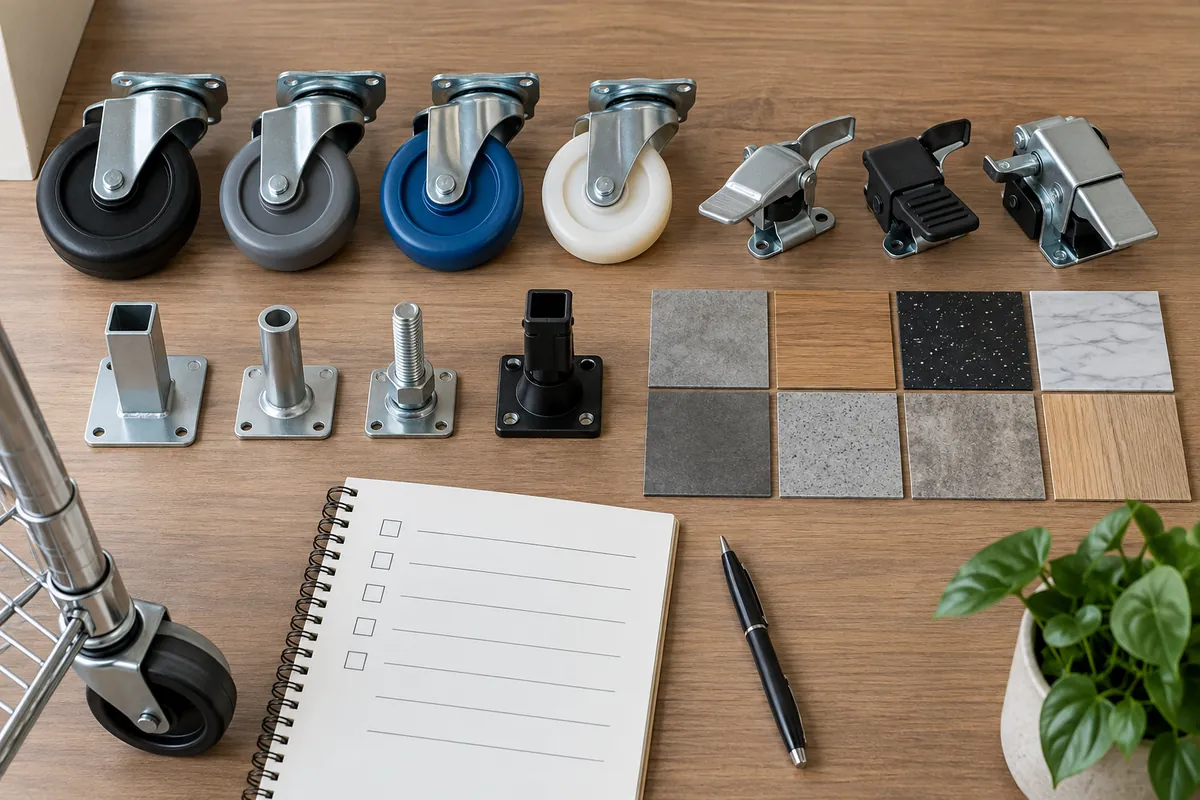
Also record:
- Motion: swivel or fixed orientation, movement frequency, direction changes and whether the rack must rotate in place.
- Brake: which wheel or swivel motion is intended to be restrained, the brake’s access side, and whether the user can engage it after the rack is loaded.
- Floor context: hard or resilient floor types, seams, thresholds, rugs or other transitions that the product is expected to encounter.
- Envelope: wheel diameter, total height, swivel clearance, brake projection, rack ground clearance and any exposed hardware.
- Appearance and handling: visible finish, color, noise or marking concerns to evaluate, and packaging protection for wheels and metal frame surfaces.
- Evidence: current caster datasheet, selected item number, sample configuration, installation instructions and any agreed product-level evaluation.
Separate confirmed inputs from supplier assumptions. If the caster model is proposed by the supplier, require its drawing and stated limitations before approving a sample. Ask suppliers to return exceptions in a comparison sheet; this makes quotations easier to evaluate and reduces later argument about what was included.
How should buyers compare caster mounting and brake options?
The best choice depends on whether the rack needs to be frequently moved, how it is built and what maintenance the buyer expects. Use the comparison to frame questions, not to select a design without project data.
| Configuration | Potential advantage | Buyer checks |
|---|---|---|
| Plate-mounted swivel caster | Defined fastener interface and directional maneuverability | Confirm plate footprint, hole access, swivel radius and clearance at all rotations. |
| Stem-mounted caster | Compact connection where a compatible receiver is part of the frame | Confirm receiver match, engagement and retention with the exact caster and rack revision. |
| Fixed caster | Can constrain travel direction in a planned layout | Check turning requirements and whether the rack can be positioned in the intended room or aisle. |
| Brake-equipped caster | Offers a user-operated restraint feature on selected wheels | Identify what the brake restrains, verify lever access, and assess operation on the target floor. |
Avoid treating “with brake” as a complete specification. Product designs differ in whether a brake acts on the wheel, swivel, or a combined function. If a buyer requires a particular behavior, name it in the RFQ and check the supplier’s drawing. The brake lever should be reachable in the final rack layout, including when shelves or stored items are present.
Wheel materials and tread also should not be selected by generic labels alone. Ask for the exact supplier specification and evaluate the finished rack on the intended surface. If noise, marking, rolling resistance or cleaning is important, make it an explicit evaluation question and define a representative check. Do not make a universal claim that a certain wheel material is silent, non-marking or compatible with every floor.
How can a sample review catch fit and use problems?
Use the production-intent caster, frame, fasteners, finish and assembly method. A caster attached to a temporary flat coupon can verify a limited interface but cannot show full swivel clearance, brake access or rack behavior. Record the sample’s limits and do not sign off functions that were not represented.
First confirm part identity and orientation. Measure the mounting interface against the drawing, then inspect fastener seating and access. Rotate the caster through its intended swivel range and check nearby legs, shelves, crossbars and stored-product envelopes. Operate the brake in the final position; note whether the lever is obstructed or difficult to access. Check the rack’s ground clearance and alignment on a level reference surface, without treating one bench check as a comprehensive mobility test.
Next, perform only the buyer-approved handling checks for the project. If the intended evaluation includes moving the loaded rack, define the sample configuration, load arrangement, route and observations before the check. Use caution and the supplier’s application limits. This article does not establish a safe load or test procedure. If the product needs a quantified rating, obtain qualified engineering input and product-specific substantiation.
Document the caster item and revision, mounting method, fasteners, rack drawing revision, finish, floor reference, brake behavior and any deviations. Photographs are useful, but include dimensions and part identity so the evidence can be repeated. If a mismatch appears, separate symptoms—such as a blocked brake or housing interference—from hypothesized causes. The issue could arise from the wrong model, hole pattern, rack geometry, installation direction or substituted frame component. Keep the storage rack caster specifications tied to the approved revision so a second sample is not evaluated against an obsolete mount or wheel option.
For a distributor, sample inspection should also include the parts that arrive in the carton. Confirm the caster count, fasteners, brake instructions and any replacement parts match the packing list. If wheels are installed by the buyer or retailer, make sure the installation direction and required tools are understandable and consistent with the mount. Ask the supplier how each caster is protected from rubbing against the rack finish in transit, then inspect the packaged sample for the actual contact points. A controlled pack-out review can reveal missing hardware or confusing assembly sequencing before a larger order, but it should not be described as proof of performance in every shipping route.
When comparing quotations, separate the caster component cost from frame changes, extra mounting hardware, packaging and sample development. A compact caster may appear cheaper but require a revised lower frame or a different receiver. A brake option can change the envelope or user access. Request the assumptions behind any proposed substitution and compare the full delivered configuration, not just the wheel price. For a trial order, decide which components are being held constant and what would trigger a revised sample approval. This makes purchasing comparisons clearer without turning a supplier’s estimate into a guaranteed landed cost.
What packaging and change-control details matter?
Casters can be damaged or scratched if they shift against a rack frame in a carton. Buyers should specify how loose casters, fasteners and small instructions are identified and associated with each unit. Evaluate the packaged sample for part completeness and visible transit contact. Do not claim that a particular carton or divider guarantees damage-free delivery; confirm the packing method and inspect it against project needs.
Treat substitutions as controlled changes. A replacement caster that shares a nominal wheel size may differ in total height, plate geometry, swivel radius, brake location or wheel material. Require advance notice and a comparison against the approved drawing. Re-review when the caster model, mount, fasteners, rack leg geometry, shelf clearance, brake function, floor assumptions or load/use scenario changes.
For OEM development, Koitor’s approved scope includes custom metal bathroom and home storage hardware, drawing or sample-based development, fabrication processes such as bending and welding where relevant, assembly and packaging preparation. The factory’s particular ability to integrate a caster, source a specified model or substantiate a load rating must be confirmed project by project. Do not assume component availability or a performance result from general metalworking capability.
Buyer checklist and FAQs
- Have we defined rack use, intended contents, movement frequency and floor transitions?
- Is the mount type and interface fully dimensioned, including holes or receiver details?
- Have we checked the full wheel and swivel envelope, brake lever access and ground clearance?
- Does the quote identify the exact caster item, brake behavior, fasteners and supplier documentation?
- Does the approval sample represent the production-intent rack and caster configuration?
- Are floor, noise, marking and movement concerns written as project-specific checks rather than generic claims?
- Are substitutions and packaging components under revision and change control?
- Have load or safety claims been left to qualified project evidence?
Is caster diameter enough to select hardware for a storage rack?
No. Mounting, total height, swivel envelope, brake access and intended use also affect fit.
Does a brake stop both the wheel and swivel?
Not necessarily. Confirm the exact function from the supplier documentation and sample.
Can a component rating be used as the rack’s load rating?
No. The frame, attachment, distribution and use conditions must be considered for the complete product.
Should a sample include all four production casters?
For a full product evaluation, use the intended quantity and positions; a partial fixture can only verify limited interface questions.
What should be checked after a caster substitution?
Review the mount, height, wheel and swivel envelope, brake behavior, floor assumptions and product-level approval evidence.
Developing a Custom Metal Storage Rack?
Send Koitor your drawing or sample, target dimensions, finish and packaging needs, and planned order quantity. We can discuss manufacturability and sample development for confirmed home-storage hardware scope; caster integration and performance requirements need project-specific review.
OEM / PRIVATE LABEL
Turn this sourcing guide into a product brief
Share your target product, size, finish, order quantity and packaging requirements. Your team receives a practical manufacturability review before quotation.
 English
  Español
  Português
  Français
  Deutsch
  العربية