
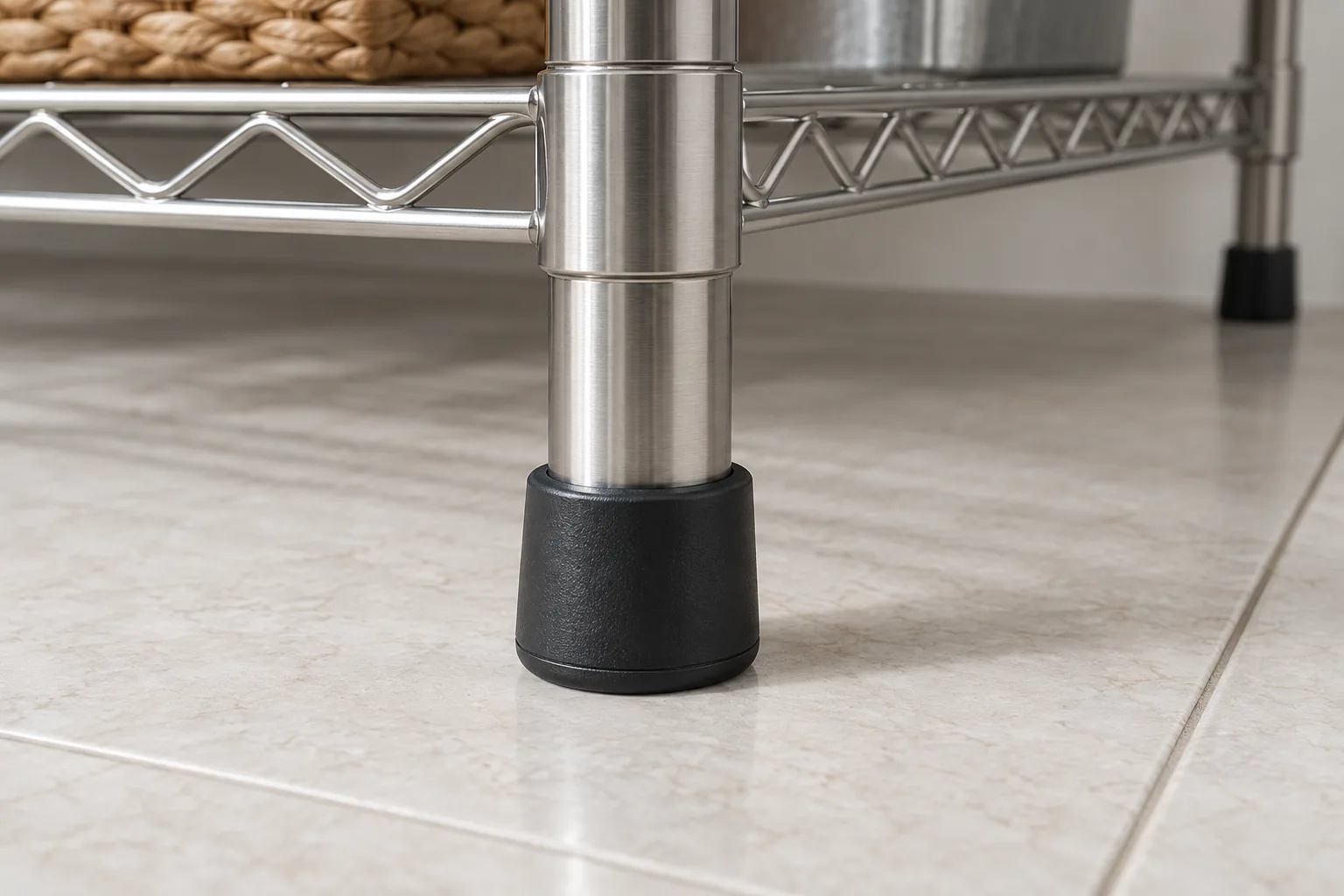
Buyers evaluating non staining rubber feet for a metal rack should specify the foot’s exact material and supplier, contact geometry, attachment method, intended floor finishes, and the conditions under which the finished product will be reviewed. “Rubber” is a broad material label, not a performance specification. A pad that appears soft and non-marking in a sample may behave differently on another floor, after longer contact, with a different finish, or when the component’s compound or source changes.
This guide is for home-storage private-label buyers and incoming-quality teams sourcing freestanding metal racks. It does not certify any elastomer or promise that a foot will never mark a surface. Its purpose is to make the material request, supplier evidence and sample review specific enough for a project decision.
Why can rack feet leave marks even when they look undamaged?
A floor mark is an observed result, not a diagnosis. It may be staining, transferred material, scuffing, abrasion, adhesive residue or a change in the floor finish. The cause may involve the foot compound, colorants or additives, floor coating, moisture, cleaning products, contact pressure, movement, temperature or dwell time. Without a controlled comparison and material information, a buyer should not assign blame to “rubber” as a category.
The contact interface depends on both sides. Floor types and their protective finishes differ, and the same pad can be evaluated under different conditions. A rack that remains in one position for weeks is not equivalent to one moved daily. The foot’s shape, surface area and edge profile can change how contact is distributed. If a foot is too small, unevenly installed or compressed differently than intended, a simple showroom check may not represent the product’s use.
Supplier documentation can help, but it applies to the exact product described. For instance, 3M’s page for its specific Bumpon SJ5018 urethane bumper describes that item as a plasticizer-free urethane product and states a non-staining surface claim for that product. The example is useful because it identifies a product-specific composition and supplier claim; it does not prove that every rubber-like foot, color, adhesive or rack-floor pairing has the same outcome. Buyers should review the current technical data for the selected component and qualify the actual assembly. See 3M’s SJ5018 product reference.
What should a buyer specify before requesting a quote?
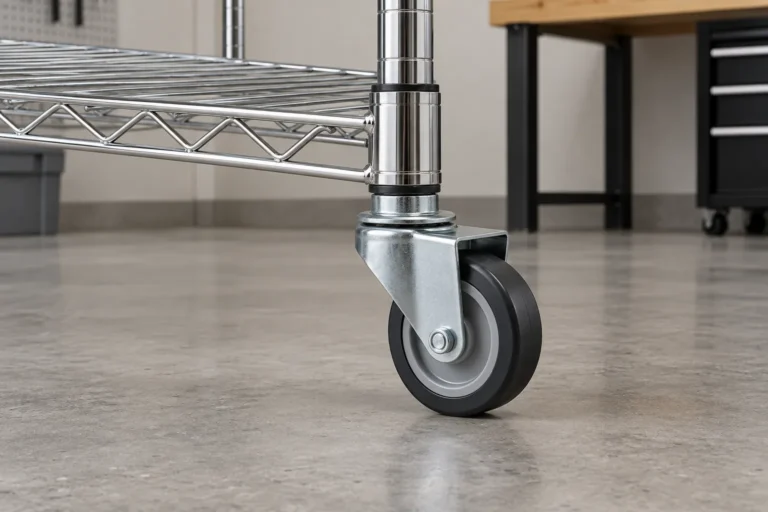
Start with the rack and the floor context. State whether the foot is integral, press-fit, threaded, capped, screwed or adhesively attached, using the actual design. Give the rack leg profile and dimensions, foot geometry, target color and the source or material requirements you need the supplier to meet. If you are open to material proposals, call them proposals and ask for the exact compound identification and supporting documentation.
Include the intended floor surface and finish if known. Name the actual material or commercial finish when the information is available, rather than relying on broad descriptions such as tile or wood. Note whether the rack may be damp, cleaned with a particular product, exposed to direct sun or left stationary for extended periods. These details define the question for sample review; they do not themselves create a test standard or guarantee.
In the RFQ, ask suppliers to identify:
- Material identity: supplier, product or compound designation, base material family where disclosed, color and revision.
- Foot geometry: profile, contact diameter or footprint, height, wall thickness where relevant and how it engages with the rack leg.
- Attachment: press-fit, threaded, mechanical retention or adhesive, plus assembly instructions and any surface preparation requirement.
- Evidence: current datasheet, supplier’s stated surface claims, relevant limitations and confirmation that the document matches the quoted item.
- Application conditions: intended floor sample or finish, contact duration, loaded configuration and movement or cleaning conditions to be considered.
- Change control: notice and approval requirements before a material, colorant, source, geometry or adhesive is substituted.
Ask the supplier to separate confirmed facts from recommended options. A statement such as “non-marking rubber” is not enough to compare two offers if one identifies a specific compound and another does not. If the supplier cannot disclose formulation details, ask what product-level claim or test evidence they can provide and what limits apply. Buyers can protect confidential formulations while still requesting item identity and appropriate evidence.
When non staining rubber feet are a purchase requirement, place that phrase beside a named supplier component and the relevant floor-contact question. This keeps the buyer’s commercial requirement visible while avoiding the false impression that the words alone define a material grade or guarantee an outcome.
How should material and attachment options be compared?
There is no universal choice for every rack or floor. Compare the exact available component and its support documentation against the intended product use.
| Option to evaluate | Potential consideration | Questions to resolve |
|---|---|---|
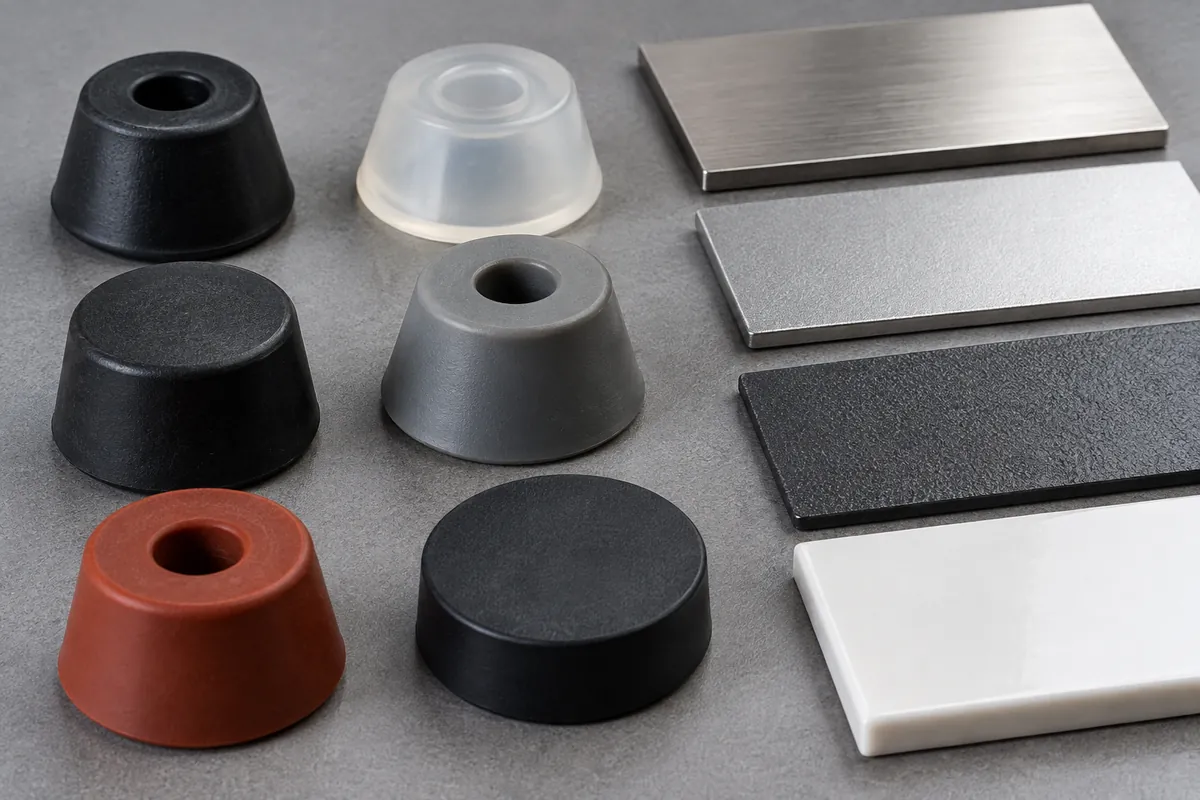
| Supplier-identified molded elastomer foot | Defined component from an identifiable source | Is the exact compound and color specified? Which surface claim and conditions does the supplier document? |
| Generic rubber-like cap | May be readily available for common leg profiles | Can the supplier identify the material family, dimensional range, source and substitution controls? |
| Adhesive bumper or pad | Can attach to a flat or prepared contact area | Is the adhesive appropriate for the actual surface and cleaning conditions? How is placement and surface prep controlled? |
| Mechanical cap or threaded foot | May provide a defined retention interface or adjustability | Does the rack geometry support it? Can the height and contact position be set consistently in assembly? |
Material descriptions alone do not determine compatibility. A urethane component may have a specific published claim, but that cannot be generalized to any urethane grade or any floor. Likewise, natural rubber, PVC, TPE or another polymer should not be described as automatically staining or non-staining without evidence. Record the actual product identifier and intended use conditions. A buyer should also compare availability, color consistency, attachment control and replacement sourcing if those are important to the assortment.
Consider the assembled rack, not just the foot coupon. A molded foot may fit the leg but sit unevenly if the tube end is angled or the cap is not fully seated. A soft adhesive bumper might move during packaging or be placed inconsistently by assembly operators. A threaded foot can adjust height but could introduce another component and assembly step. These are manufacturability questions for the specific design, not universal disadvantages.
How can sample checks be made meaningful?
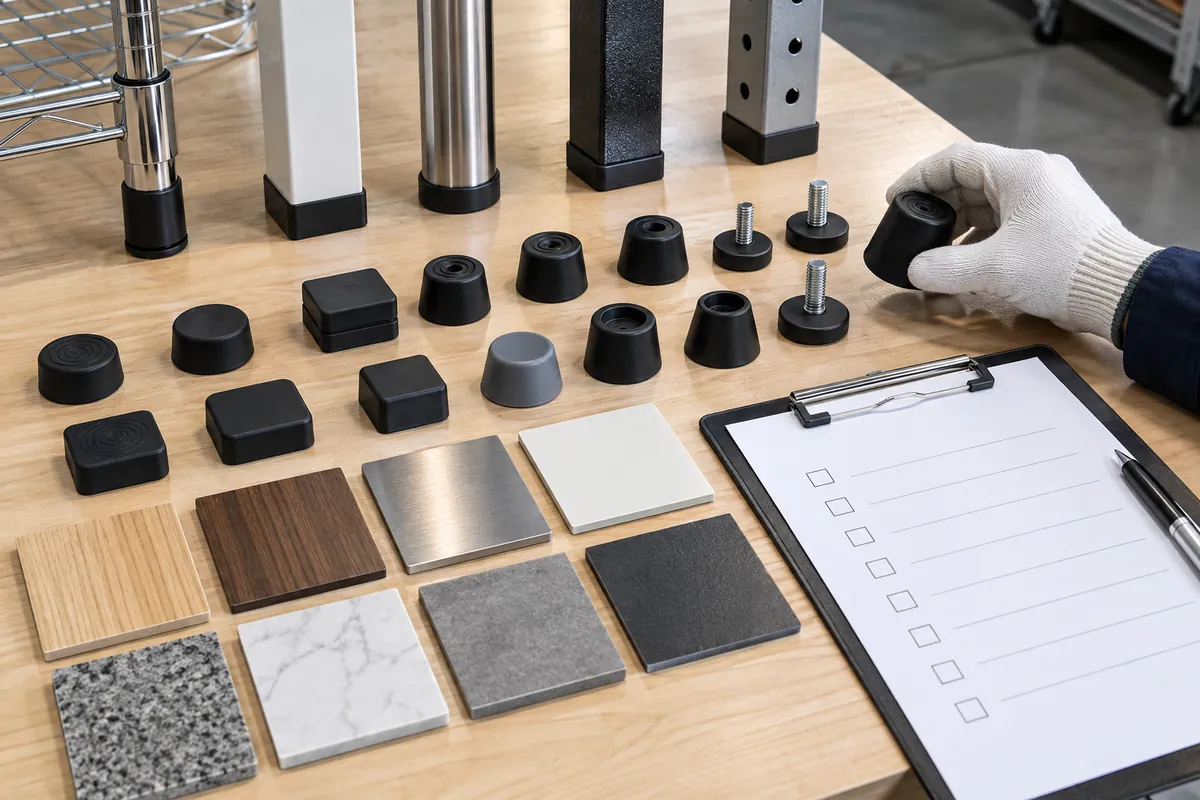
Plan a comparative sample review before the parts arrive. Identify the rack revision, foot part number, floor sample or finish, contact orientation, load arrangement if relevant, expected dwell, cleaning or movement condition, and evaluation method. A quick contact check may be useful for preliminary screening, but it cannot predict every long-term interaction. If a claim is commercially important, agree on a suitable protocol and qualified interpretation with the material supplier or an appropriate testing resource.
Use representative production-intent feet, not a visually similar substitute. Verify the material or item identifier on receipt, check the part geometry, and assemble it using the approved process. Photograph the foot before contact, after assembly and after the buyer-defined review. Inspect both the foot and floor under consistent lighting, and note whether the result is a visible color change, residue, abrasion or another observation. If there is a concern, preserve the samples and compare against a control surface and control foot when possible.
Control variables when investigating a complaint. Use the same floor material and finish, similar rack loading, contact point, dwell and handling. If multiple feet are compared, label each by supplier and lot. Do not change both the floor cleaner and the foot at once if the objective is to identify a contributor. This is not a prescribed universal lab method; it is a practical way to avoid confusing uncontrolled comparisons with evidence.
Write acceptance criteria before final approval. The buyer may define visual inspection conditions, contact duration and what is considered an unacceptable change, but those criteria must be appropriate to the product and reviewed with stakeholders. Do not invent a numerical stain threshold or claim a result applies to all floors. Keep the supplier’s published limitation and the buyer’s own review record attached to the selected component.
When an issue appears, trace the actual foot: supplier, part designation, lot or date code if available, color, geometry, adhesive, rack assembly and packaging. A changed material source or unapproved substitute can make a prior approval irrelevant. Separate symptom from cause and use corrective action to prevent the confirmed mechanism, rather than simply asking the supplier to use a “better rubber.”
What should be controlled for production and repeat orders?
Put the foot identification and approved sample reference on the product specification and purchase order. Require notification before changes to formulation, colorant, adhesive, supplier, tooling or dimensions. If the foot is part of a multi-component rack kit, list its quantity and packaging location so parts are not missing or mixed. Incoming checks can verify item identity, fit and visible condition; they should not be described as chemical testing unless that work is actually performed by a qualified resource.
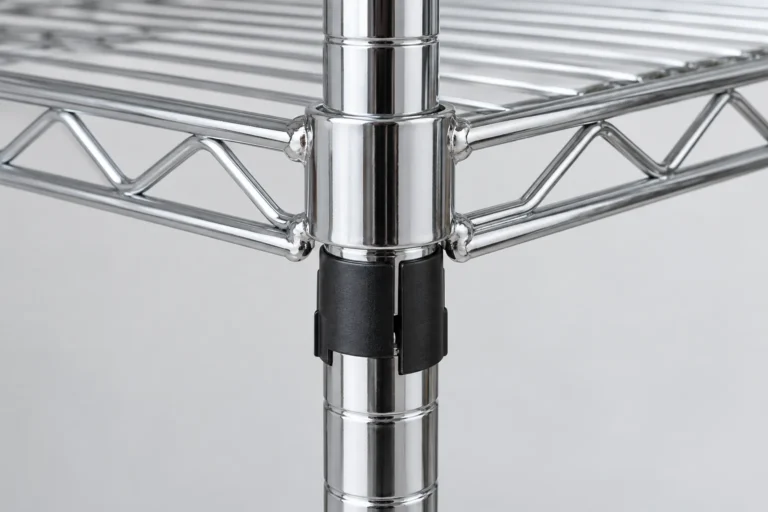
For rack makers, leg-end preparation and assembly also matter. Confirm that burrs or sharp edges do not damage a cap during fitting, that the tube end matches the retention feature, and that the finished foot sits in the intended orientation. A factory’s metal forming, punching, welding, finishing, assembly and packaging experience can help review the rack-side interface. Koitor is a family-owned custom metal hardware factory focused on bathroom and home storage hardware; a particular elastomer formulation, laboratory test or guaranteed floor outcome is not an implied capability.
If a new supplier offers a substitute, compare it on the same conditions as the approved item. Review dimensional fit, attachment, source documentation, color and floor-contact evidence. Keep the change conditional until the buyer approves the revised production sample. This protects the buyer from receiving a nominally similar part with a different contact behavior or assembly fit.
For a private-label program, align the retail claim with the supporting evidence. If the packaging says a foot is suitable for a named floor type or will not mark a surface, ask which exact component and conditions support that wording. Marketing copy should not broaden a narrow supplier statement into universal coverage. Keep approved descriptions, component identifiers and the sample record together so a future packaging revision can be checked against the same evidence. This is especially useful when product colors, suppliers or assortment variants are added after launch.
The buyer’s non staining rubber feet decision is therefore a controlled sourcing choice: identify the material product, define the surface interaction to evaluate, compare the finished assembly and limit claims to the evidence actually available. When the floor or use condition is not represented, record the uncertainty instead of treating an untested assumption as a passed requirement.
Buyer checklist and FAQs
- Have we named the rack leg interface, foot geometry, retention method and exact component source?
- Have we described the intended floor finish, contact duration, cleaning and movement conditions?
- Does the supplier’s document apply to this product, compound, color and revision?
- Is the sample production-intent and assembled using the approved method?
- Have we defined the observation period and pass/fail criteria before reviewing results?
- Are potential causes separated from the observed mark, residue or surface change?
- Are material, supplier, colorant, adhesive and tooling changes under approval control?
- Have we avoided promising compatibility with every floor or calling the foot universally non-staining?
Does “rubber foot” tell a buyer whether it will stain a floor?
No. The term covers different materials and products; request the exact component identity and supplier evidence.
Can one supplier claim be applied to another rubber foot?
No. Claims and limitations belong to the specific supplier product and should be checked against its current documentation.
Does a short sample check prove long-term floor compatibility?
No. It can screen a particular configuration, but longer contact or different conditions may require a different evaluation.
What should be recorded when a mark appears?
Record the floor finish, foot part and lot, rack condition, contact duration, cleaning and movement, plus photographs and the nature of the change.
Can an incoming visual check verify the foot’s chemistry?
No. Visual inspection can check identity or visible condition only; chemical claims require appropriate supplier documentation or qualified analysis.
Review a Custom Metal Rack Project
Share your drawing or sample, rack-leg interface, finish requirements, target quantities and packaging needs. Koitor can discuss manufacturability and sample development for confirmed metal hardware scope; elastomer selection and floor compatibility need supplier-specific evidence.
OEM / PRIVATE LABEL
Turn this sourcing guide into a product brief
Share your target product, size, finish, order quantity and packaging requirements. Your team receives a practical manufacturability review before quotation.
 English
  Español
  Português
  Français
  Deutsch
  العربية