
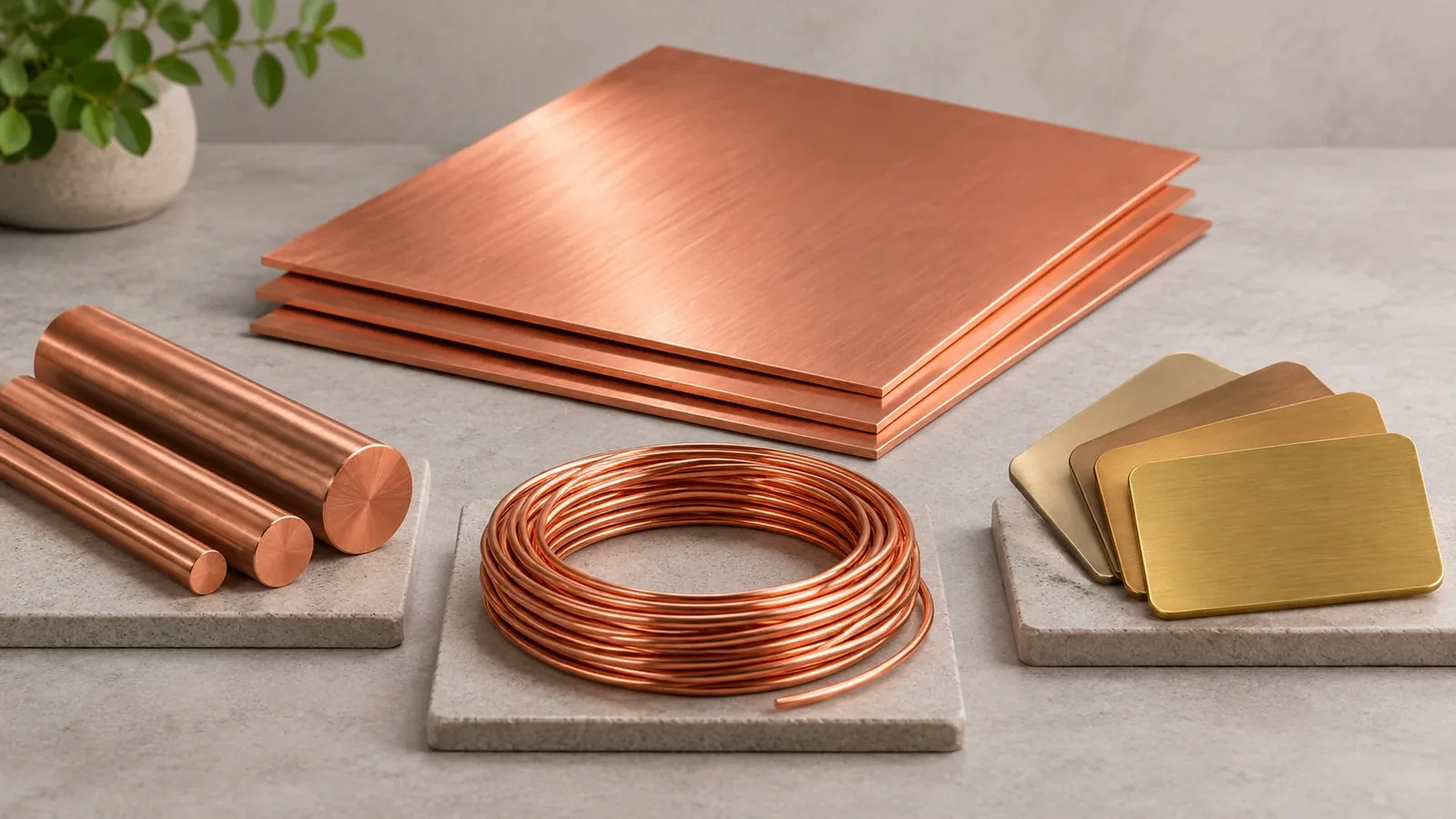
The types of copper can refer to commercial copper grades or, in a broader conversation, families of copper alloys. Those are not the same classification. A buyer should first identify whether a label describes a copper grade, an alloy family, a product form, or a finished component. Then specify the exact designation, form, condition, and evidence needed for the application. A reddish appearance or the word “copper” alone is not enough to identify a delivered material.
For a buyer sourcing bathroom or home-storage hardware, copper may appear in an individual fitting, a decorative component, an electrical part, or an alloyed bought-in item. The relevant requirement depends on the function. A general overview can help frame a supplier conversation, but it cannot select an electrical, pressure, food-contact, medical, or other regulated grade without the product details and applicable standards.
Begin by separating the classification axes
“Types of copper” is an umbrella expression. Under it, people may list grades of commercially pure copper, names based on production or oxygen content, families of copper alloys, or physical supply forms such as sheet and rod. If these are put in one ranked list, a buyer may mistake a family name for a grade or confuse the form with the chemistry.
Use a four-part map:
| Classification axis | What it describes | Example of a buyer question | What it does not establish by itself |
|---|---|---|---|
| Commercial copper grade | A specified copper material within a designation system | Which exact designation is on the drawing? | Performance in every product and environment |
| Copper-alloy family | A group whose composition includes copper and other alloying elements | Is this brass, bronze, copper-nickel, or another family? | The exact grade or composition |
| Product form and condition | How the material is supplied and its specified delivery condition | Is the component made from sheet, rod, tube, wire, or casting? | The alloy identity or finished part suitability |
| Surface construction | The substrate and any coating, plating, or finish | Is this solid copper or another substrate with a copper-colored finish? | The material grade beneath the finish |
These axes can coexist. A component can be a particular copper alloy, supplied as rod, in a defined condition, and later polished or coated. A product can also look copper-colored while being made from a different metal. Record each dimension separately in the drawing or purchase specification when it matters.
Types of copper: commercial descriptions
Some commercial descriptions identify copper by production method, oxygen content, or intended processing. Names such as oxygen-free copper, electrolytic tough-pitch copper, and free-machining copper appear in industrial references. Their exact definitions and availability depend on the standard, supplier specification, and product form. A name alone is not a complete procurement specification.
Oxygen-free copper
Oxygen-free is a commercial material description, not a universal statement that the copper is the purest or automatically the best choice. Buyers should not infer a specific conductivity, processing advantage, or suitability from the phrase without the relevant designation and evidence. If a design calls for an oxygen-controlled copper grade, state the required designation and applicable specification instead of relying only on a shorthand category.
Electrolytic tough-pitch copper
Electrolytic tough-pitch is another recognized commercial description. It identifies a material family within commercial copper discussions, but it does not answer every question a buyer might have about product form, condition, surface, dimensional tolerance, or end-use performance. The buyer should specify the intended component and request the documentation needed for the property that matters.
Free-machining copper
Free-machining descriptions signal that the material is associated with machining behavior, but they do not make every grade or product form interchangeable. A machined contact, decorative fitting, and formed tab can have different requirements. Before choosing a grade, identify the operation, geometry, surface requirements, mating parts, and evidence expected from the supplier. Avoid importing machining assumptions into a part that will be bent, stamped, welded, or finished differently.
The research sources support these as broad commercial descriptions. They do not justify a numerical grade table, a universal purity ranking, or a promise that any one type is suitable for all applications. Confirm the designated grade in a current supplier or standards document that applies to the specific product.
Copper-alloy families are a broader category
In wider material discussions, copper alloys are grouped into families that include brass, bronze, copper-nickel, and beryllium copper, among others. These are alloy families, not necessarily entries on a list of pure copper grades. They contain more specific grades and product forms, each with its own specification.
Brass
Brass is a copper-zinc alloy family. Other additions and specific grades can change the designation and properties. A brass-colored finish is not proof that an item is solid brass. A separate brass-versus-copper comparison addresses that paired question; this guide focuses on the broader copper classification map.
Bronze
Bronze is a family name used for copper alloys. It is inaccurate to assume that every bronze is simply copper and tin in a fixed ratio. The specific grade and naming convention matter. A supplier quotation that says only “bronze” should be clarified before a buyer approves the material for a defined component.
Copper-nickel
Copper-nickel describes copper alloys with nickel as a key addition. The family label does not establish a specific grade, environment rating, or product approval. If the component’s environment or application makes a property important, the buyer should state the exact requirement and confirm it against evidence for the supplied grade and form.
Beryllium copper
Beryllium copper is another alloy-family label. The name should prompt the buyer to obtain the precise designation and handle any applicable material or workplace requirements with qualified specialists. Do not infer that a component is acceptable for a particular use simply because a supplier uses the family name.
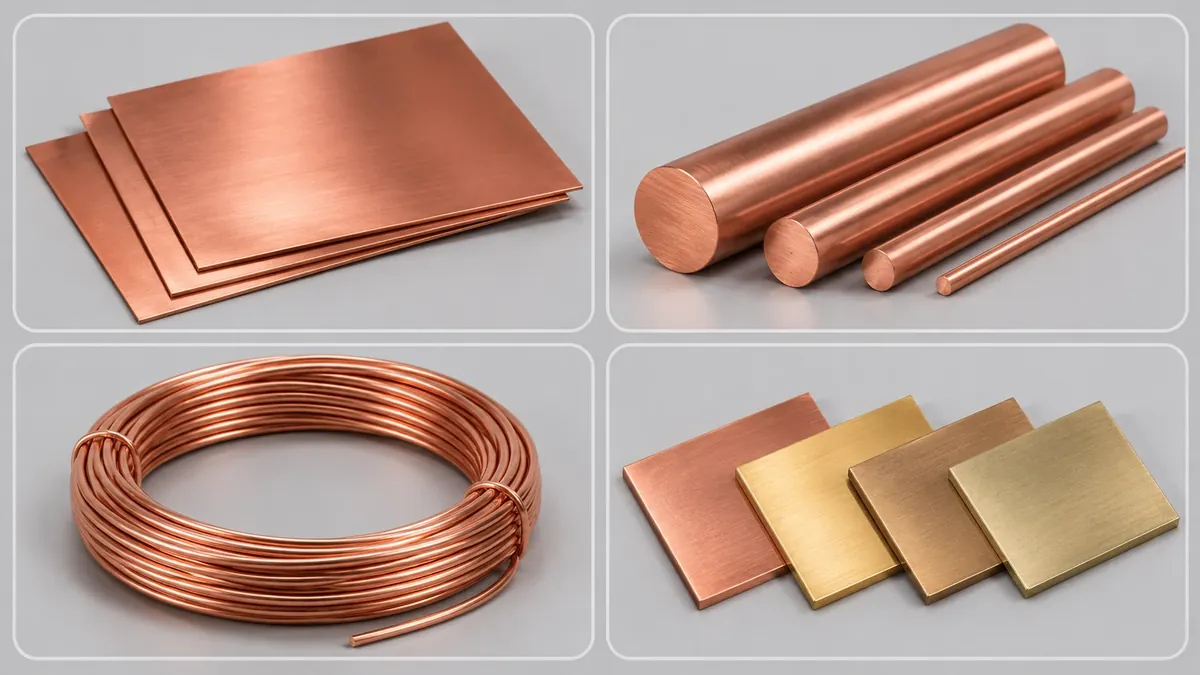
The family names are useful for orientation. They are not substitutes for product-specific technical information, and a taxonomy article cannot determine whether any family is appropriate for a buyer’s design.
Product forms do not define copper type
Copper and copper alloys may be supplied as sheet, strip, plate, rod, bar, tube, wire, forgings, or castings, depending on the alloy and supply chain. These forms describe geometry and manufacturing route. They do not by themselves identify a grade.
The distinction is practical. A buyer may request a copper tube, but the supplier still needs the alloy designation, dimensions, tolerance, condition, and relevant surface requirement. A sheet component may be punched and formed; a machined part may be cut from rod; a fitting may be cast and finished. These possible routes are examples, not claims that Koitor makes copper castings or processes every copper family.
The form can influence manufacturability and available dimensions. That is why a supplier should quote against the actual drawing or an adequately described sample, not merely a general family name. If the design changes from machined rod to formed strip, the responsible engineer should review the geometry, tolerance stack, joining method, and finish before treating the replacement as equivalent.
Condition, temper, and state
A material may also be supplied in a defined condition or temper. These terms refer to processing and delivery requirements specified in the relevant designation system. They should not be guessed from the material’s color or the finished shape. Use the applicable material specification and state the condition where the design requires it.
Where a particular condition affects formability, machining, assembly, or dimensional control, have the qualified designer define the requirement. A buyer guide can explain that the field matters; it cannot select a condition without knowing the grade, process, part geometry, and intended use.
Copper-colored surfaces and copper substrates
Products can be described as copper in casual retail language even when the phrase refers to a color or finish. A copper-colored coating, plating, or other surface may be applied to a steel, zinc-alloy, or other substrate. Conversely, a copper alloy may receive a different finish. The visible surface and the base material are distinct specifications.
For private-label bathroom or home-storage hardware, a buyer should state whether the requirement is for solid copper, a specific copper alloy, or a defined appearance on another substrate. The drawing should identify which parts have the finish, how the appearance will be approved, and which party controls the surface process. If the finish is important to corrosion behavior or regulatory claims, do not rely on a color name; require the relevant technical basis and review.
Appearance inspection can compare the delivered sample with an approved visual reference under agreed conditions. It cannot prove hidden composition or establish a property that requires a separate test. Material identification and finish acceptance are different evidence tasks. Keep them separate in the inspection checklist.
A buyer’s specification path
1. Identify the function
Describe what the component does and how it connects to the product. A decorative cover, structural bracket, threaded insert, electrical connection, and fluid-contact part may require different material decisions. Record the use, mating components, environment, assembly method, and any customer-defined requirements.
2. Choose the right classification level
Decide whether the design calls for a commercial copper grade, a copper-alloy family, a particular product form, a surface appearance, or a combination. If a technical drawing already specifies a grade, preserve the exact designation. If the buyer is still evaluating options, mark the requirement as open and request a controlled proposal rather than allowing the supplier to infer the choice.
3. State designation, form, and condition
Include the material designation, source standard or specification if applicable, product form, relevant dimensions, and condition. If a supplier proposes an alternative, request the full proposed designation and compare it against the intended function. “Similar copper” is not enough detail to approve a substitution.
4. Separate substrate and finish
Identify base material separately from coating, plating, polishing, or color. Define a visual sample or objective surface criteria where appearance matters. Assign responsibility for supplier selection and finish verification. If the production process has several vendors, record which party controls the base metal and which applies the finish.
5. Define the evidence
Select evidence that addresses the actual requirement. Depending on the application, the buyer may require a supplier declaration, material certificate, lot traceability, dimensional inspection, test results, or specialist review. No single document necessarily proves composition, condition, dimensions, appearance, and performance at once. Confirm that each record identifies the correct part, revision, and shipment or lot.
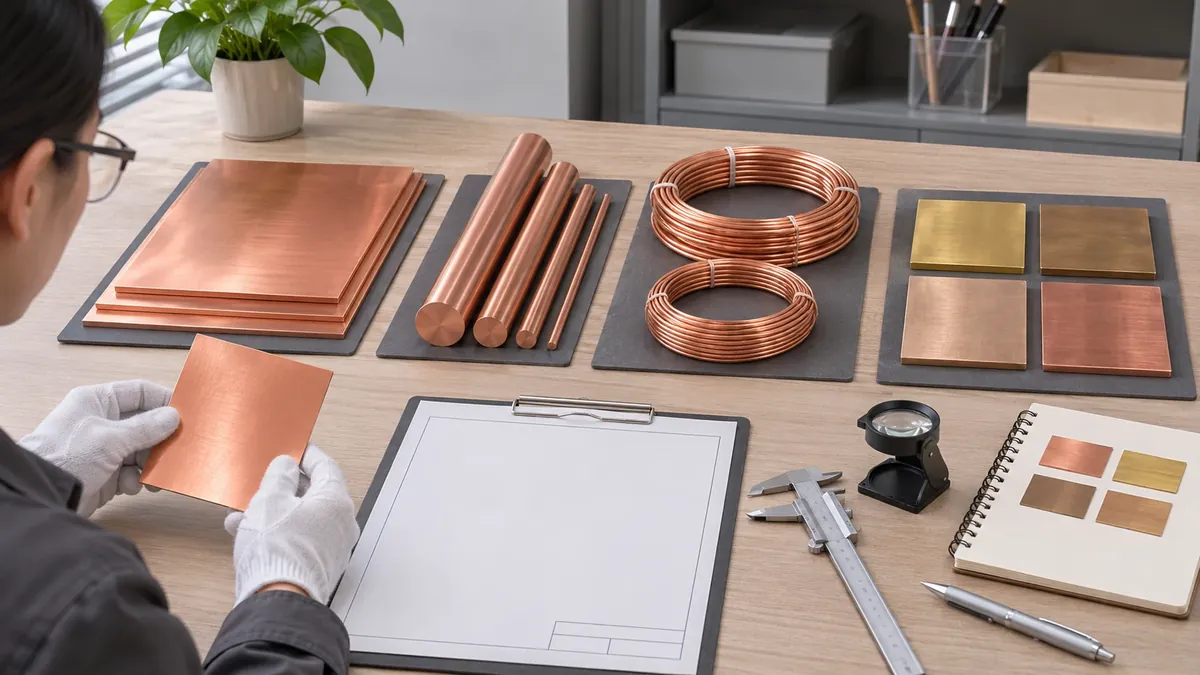
6. Control approval and repeat orders
Tie the accepted material and finish to a drawing revision, approved sample, or purchase specification. Store any deviation with the approval record. For reorders, compare the quoted material and process with the approved baseline. If the source, designation, form, or finish changes, route the change to the responsible technical owner before production.
Read a supplier quotation without guessing
A short quotation line is often optimized for price and convenience, not for complete material identification. If it says “copper,” “copper alloy,” or “copper finish,” ask the supplier to expand the description before the buyer compares offers. One supplier might be pricing a solid alloy part; another might be pricing a coated steel component. Those options may look similar in a photograph but differ in construction, process, scope, and purchase assumptions.
Request a quotation that identifies the proposed base material, product form, dimensions, surface state, included operations, and packaging. If the supplier cannot confirm a grade at the preliminary stage, mark it as provisional and state what information is needed before sample approval. This prevents a budgetary quote from being mistaken for a released production specification.
For custom parts, ask how the supplier will connect the material information to the production lot. A document that names a material family without referencing the exact order or component may be insufficient for a project that requires traceability. Conversely, do not request a complex certificate when the product requirement does not need it. Let the design risk and buyer’s stated acceptance criteria determine the evidence level.
Compare quotations only after aligning their assumptions. Check whether each offer uses the same alloy designation, product form, condition, finish, quantity, tooling scope, inspection expectation, and packaging. If one supplier leaves a field blank, record it as an unanswered item rather than assuming it matches the other quote. A low quotation can reflect a different construction or omitted process, not simply a more efficient source.
When the product has multiple components, create a simple material schedule rather than using one broad description for the entire assembly. A rack might contain a steel frame, fasteners, a polymer pad, and a decorative metal cap. The buyer can then identify which component needs a copper-related material and avoid applying that description to the whole product. The schedule also gives quality, packaging, and purchasing teams a clearer reference for substitutions and repeat orders.
Use the approved material record consistently in the drawing, BOM, purchase order, sample label, and inspection plan. If business software limits the available text, point each record to the same controlled specification or revision. Consistency makes a later discrepancy easier to investigate and reduces the chance that a generic line description will override the actual engineering requirement.
Common mistakes when comparing copper types
Mixing grades, families, and forms
“Copper-nickel” is an alloy family, while “tube” is a form. “Oxygen-free” is a commercial description, and “polished” is a surface state. These terms can all describe different attributes of one component. A product comparison that lists them as alternatives is likely comparing unlike things.
Treating a family name as a complete designation
Words such as brass, bronze, or copper-nickel do not establish the exact composition, product form, condition, or supplier evidence. If the purchase requires a particular grade, state it or define a review process for alternatives.
Treating all bronze as copper-tin
Bronze naming can cover more than a simple copper-tin pairing. Use the exact grade and applicable product definition instead of a broad historical simplification.
Inferring purity or performance from a marketing phrase
Descriptions such as oxygen-free or free-machining do not create a universal ranking. Ask what designation is supplied and what property the project needs. Then review evidence appropriate to that property.
Assuming color identifies the substrate
A reddish or copper-colored surface is not proof of solid copper. Verify the construction and finish separately, especially where product claims or customer specifications depend on the material.
Assuming one document verifies everything
A material document may identify an alloy but not verify a finished part’s dimensions, coating appearance, corrosion performance, or assembly fit. Match each claim to evidence that actually covers it.
Buyer checklist for a copper-related component
Before approving a drawing, sample, or quotation, confirm:
- Is the component copper, a copper alloy, or another substrate with a copper-colored finish?
- Does the primary label describe a grade, family, form, condition, or finish?
- What exact designation and specification apply?
- What product form, dimensions, and condition are required?
- Which product function or process makes the choice important?
- What surface system or appearance reference is approved?
- What evidence proves the exact required attribute?
- Does the evidence match the part, revision, supplier, and lot?
- Who may approve a proposed material or process substitution?
- Are the product page, label, and package claims consistent with the verified construction?
The checklist is deliberately focused on identifying the requirement and owner. It does not rank materials or make a grade recommendation. If the part has electrical, pressure, food-contact, medical, chemical, or other regulated requirements, obtain project-specific guidance from the qualified professional or authority responsible for that use.
Frequently asked questions
What are the main types of copper?
An introductory overview can distinguish commercial copper descriptions such as oxygen-free, electrolytic tough-pitch, and free-machining, alongside broader alloy families such as brass, bronze, copper-nickel, and beryllium copper. The exact grade and specification are needed for purchasing.
Are copper and copper alloys the same thing?
No. Commercial copper grades and copper-alloy families are related but distinct classification levels. Alloy families include additional elements and need their own specific grade designations.
Is brass a type of copper?
Brass is a copper alloy family. It should not be confused with an unalloyed commercial copper grade. A separate brass classification guide covers the narrower family question.
Does a copper finish mean a product contains copper?
Not necessarily. The phrase may refer only to a surface color or finish over another substrate. Confirm the base material and surface construction separately.
Can one copper type be selected from a color chart?
No. A color chart may help compare appearance, but it does not establish grade, composition, condition, or performance. Use the designation and appropriate evidence.
Keep copper-family terminology consistent across teams
The product engineer, sourcing buyer, and supplier may use different levels of detail when they discuss a material. A drawing may identify an exact designation, a buyer may say “copper alloy,” and a preliminary quote may state only “copper.” Before placing an order, reconcile those terms against the approved specification. If the records disagree, preserve the exact designation from the controlled document and ask the responsible owner to resolve the difference.
This is especially important when a material passes through more than one supplier. The first vendor may sell stock, another may machine or form it, and a final assembler may refer to the finished component by a commercial family name. Each handoff should keep the part number and material reference intact. A document that cannot be connected to the exact component and revision may not answer the buyer’s question.
For a product assortment, keep the material field separate from finish and marketing language. A product may have a copper-colored appearance without containing copper, or may use a copper alloy beneath a different surface finish. Product pages, carton descriptions, and internal product data should reflect the verified construction. If the construction is not yet confirmed, hold the claim until the supplier or qualified project owner provides adequate evidence.
Sources and scope
- Xometry: Types of copper — used for broad material-family labels only, not numerical chemistry, conductivity, or application approval.
- Belmont Metals: Different grades of copper — used for bounded commercial descriptions; no purity ranking or manufacturing recipe is asserted.
This overview is an orientation guide for buyers. It is not an alloy selection specification, certification, or claim that Koitor refines copper, casts every alloy, or supplies every copper component described.
Work With Koitor Hardware
Make the material and finish requirement explicit
If a custom bathroom or home-storage product includes a copper-colored component or copper-alloy fitting, send the drawing or sample, intended use, material designation if known, appearance reference, target quantity, and packaging brief. Koitor Hardware is a family-owned custom metal hardware factory focused on bathroom and home-storage products. Any material choice, bought-in component, or performance requirement should be confirmed for the actual project before production.
Review a Custom Hardware Material Requirement
Share your component drawing or sample, intended use, material and finish requirements, quantity, and packaging details. Koitor can review the confirmed product brief for an OEM discussion; grade selection and regulated-use acceptance remain with the qualified project owner.
OEM / PRIVATE LABEL
Turn this sourcing guide into a product brief
Share your target product, size, finish, order quantity and packaging requirements. Your team receives a practical manufacturability review before quotation.


 English
 Español
 Português
 Français
 Deutsch
 العربية