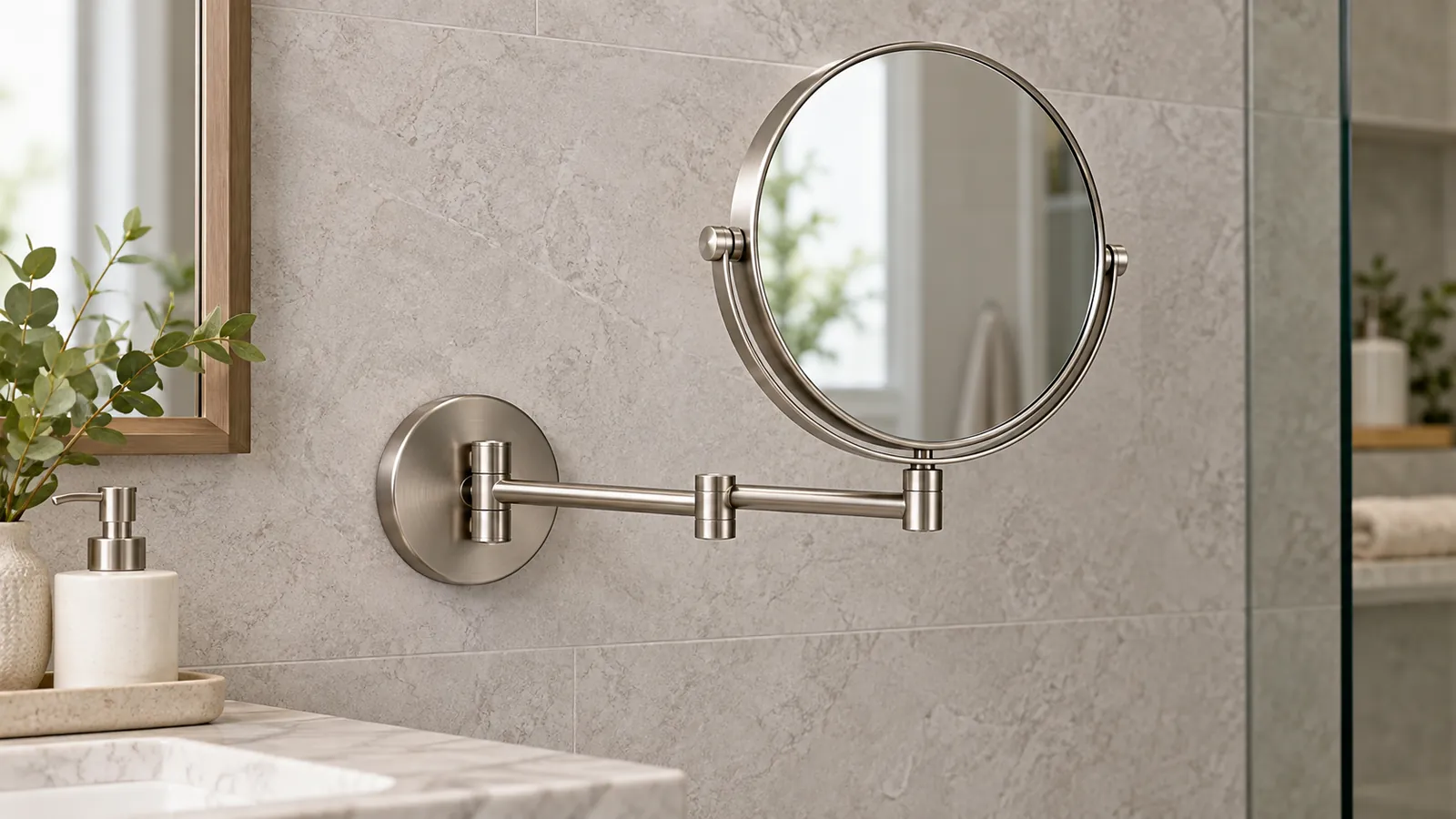
A wall mounted makeup mirror arm and hinge specification should define how the mirror moves, where it stops, how it holds position and how its weight reaches the wall. Private-label buyers should approve those mechanical interfaces on a representative non-illuminated sample before accepting a drawing or production quotation. Mirror diameter alone cannot predict the reach, folded clearance, movement feel or fixing demands that determine whether the finished product suits the intended bathroom. Treat optical performance and any electrical version as separate specialist scopes.
Which mechanical decisions belong in the buyer’s first brief?
The starting point is a use scenario, not a catalog photograph. Identify the target buyer, expected wall position, mirror-head size and mass, required viewing reach, preferred folded position and the user movements the arm must accommodate. A single pivot at the wall behaves differently from a two-link arm with a second joint; a head that also tilts adds another interface. The buyer should describe the intended sequence: pull the mirror out, rotate it, tilt the head, use it and return it without striking a cabinet, faucet, shower partition or adjacent wall.
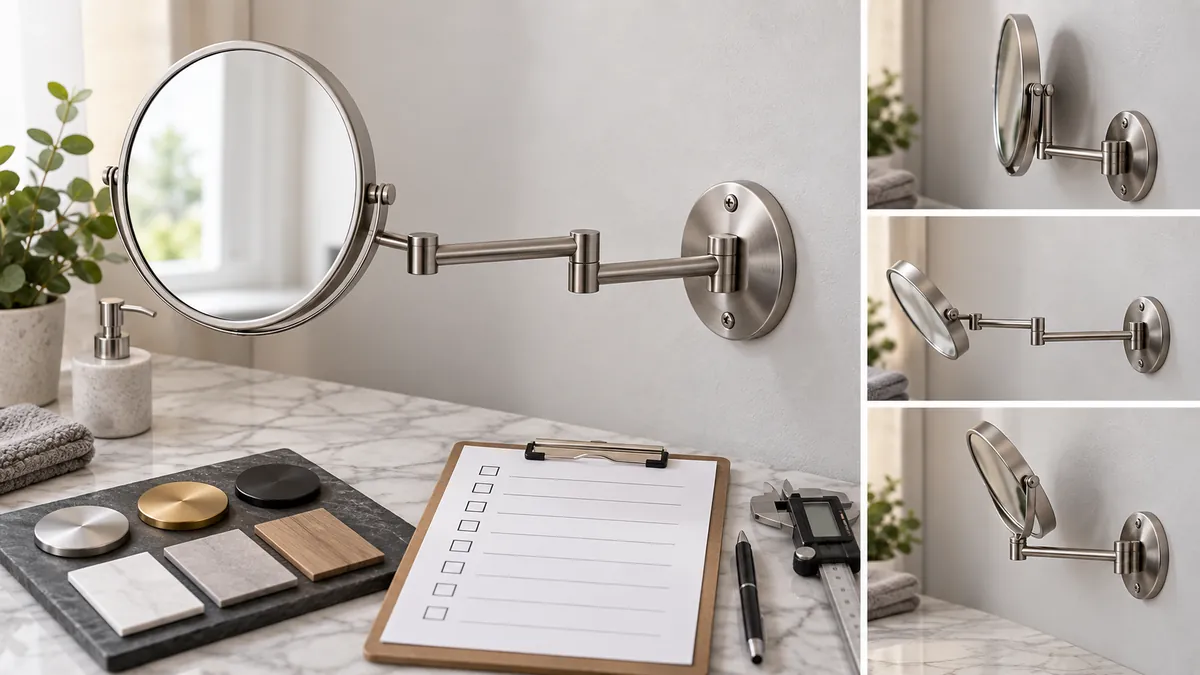
Prepare a simple position drawing showing the wall plane, mounting-plate center, mirror head and arm at its retracted, intermediate and extended positions. The drawing should show more than the maximum reach. A long arm may satisfy a measured reach but swing through a cabinet door or leave the mirror projecting into a narrow walkway when folded. The head’s rim and any adjusting knob also occupy space. Ask the supplier to mark physical stop positions and the shape of the path between them.
For a private-label assortment, separate fixed requirements from configurable choices. Fixed requirements might include the intended wall zone, visibility of screws, minimum retracted clearance and a consistent finish across an accessory family. Configurable choices might include arm length, number of pivots, mirror-head diameter and decorative wall-plate profile. If buyers leave these choices unresolved, samples from different suppliers may look similar yet solve different installation problems. A controlled comparison requires one agreed use envelope.
This article concerns an adjacent bathroom accessory. Koitor Hardware’s confirmed expertise lies in custom metal bathroom and home storage hardware, with drawing-based sampling, bending, welding, finishing and basic assembly. That expertise can inform questions about metal structure and supplier evaluation. It does not establish that Koitor currently makes makeup mirrors, glass optics, illuminated mirror electronics or certified safety products. The exact product and supplier capability must be confirmed for each project.
How should extended reach and folded clearance be drawn?
Use dimensions tied to visible datums. A wall-plate center, finished wall plane and mirror-head center are more useful than a loose “overall width” number. For each approved position, record the horizontal projection from the wall, the head-center location, the minimum gap between moving parts and nearby surfaces, and the arm’s likely swing arc. If the product will be installed beside a vanity cabinet, ask for the cabinet-door swing as part of the use envelope. A mirror that clears the wall when fully extended may collide with a cabinet during the motion.
Check the folded package separately. A sample may look compact when photographed from the front while its head projects farther than the buyer’s target depth. Head thickness, rim profile, knobs, rear fasteners and arm joints all contribute. Ask for side-view photographs and a measured sample position after the arm has been cycled. The agreed folded location should be repeatable, not just a position an operator can force once for a photograph.
For a dual-sided or tilting head, the face orientation changes the effective swept envelope. The mirror may rotate around the head mount while the arm also rotates around wall and elbow joints. A simple two-dimensional reach diagram can miss a collision caused by the head rim during tilt. Buyers should ask for representative three-dimensional views or inspect a physical sample in a mock bathroom layout. The goal is to prevent a product that satisfies nominal arm length but fails everyday movement.
Do not publish a universal reach or mounting-height recommendation without a defined user and installation condition. A retailer may target standing use at a vanity; a hospitality project may have different cabinetry, wall construction and access constraints. The buyer should identify the target scenario, then confirm the geometry on the actual product rather than import a competitor’s dimensions as a specification.
What hinge and position-retention information should the supplier provide?
A hinge is not merely a visual joint. It carries the mirror head, permits controlled movement and influences how the product feels after repeated use. Ask the supplier to identify every pivot, its intended adjustment method, the range of motion and any physical stop. The sample-review plan should note whether the head stays in the selected position when released, whether the arm drops or drifts, and whether the movement changes after a reasonable project-specific cycling exercise. Do not invent a cycle count or performance limit; agree the acceptance method with the buyer’s product and quality teams.
Position retention must be judged at the most demanding approved configuration. A mirror head may hold well when the arm is folded close to the wall but sag when fully extended. The buyer should therefore observe the same head at multiple arm positions, including the maximum intended reach, and record the observation. If a joint can be tightened during installation or service, specify who is allowed to adjust it and what tool or instructions are supplied. A hidden adjustment that cannot be reached after mounting may create a support problem despite passing factory inspection.
Check play, noise and contact protection. Excessive looseness can make a mirror feel unstable; excessive friction can make it difficult to position or may load the wall plate unexpectedly. Metal-on-metal contact, washers, bushings and finish boundaries should be described on the drawing rather than guessed from appearance. If a supplier proposes a change in pin, bushing or surface treatment, the buyer should require a new sample review because the movement may change even though the mirror head looks identical.
A useful supplier question is: “What component controls each pivot’s resistance, and can that component be replaced or adjusted after assembly?” The answer determines whether a complaint can be resolved with a service part, a revised assembly step or a redesigned joint. It also separates a genuine mechanical specification from a generic claim that an arm is “heavy duty.” Avoid accepting an unsupported lifetime or load-capacity claim without a defined test method and report.
How does the wall plate change the buyer’s decision?
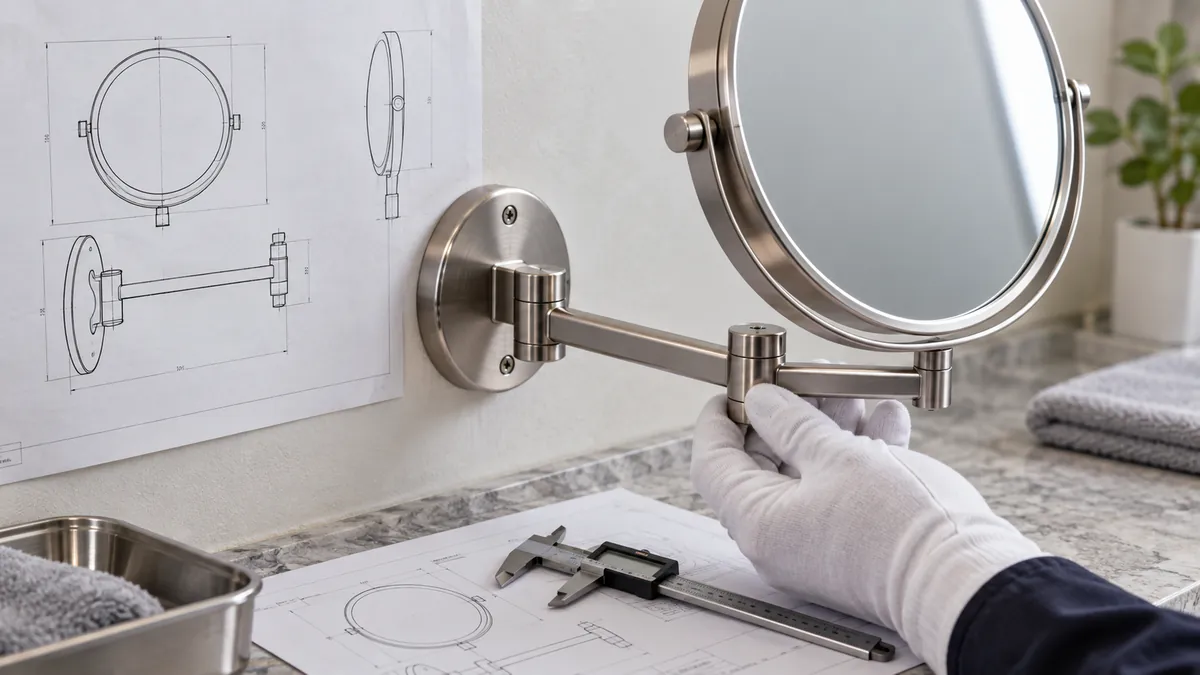
The wall plate closes the mechanical load path. The mirror head, arm, joints, plate, fasteners and wall substrate work as a system. A polished arm cannot compensate for an unsuitable installation method or unclear fixing instructions. Ask the supplier to show plate dimensions, hole pattern, fastener access, cover removal, finish protection and the method for keeping the plate level during installation. The buyer should identify the intended wall substrates in the target market and arrange a qualified installation review where needed.
Do not assume that one anchor works for tile, masonry, stud-backed wall and hollow board. A supplier may include one fastener set for a defined installation, but the buyer should verify what is actually included, what the instructions say and whether the fixture can be mounted without damaging the finish. The arm’s extended position increases the moment at the wall plate; a product assessment must consider the intended geometry and use instead of citing a fastener rating in isolation.
Check service access as well as first installation. A concealed cover may hide screws attractively, yet make re-tightening or removal difficult if the release feature is obscure. If a set screw retains the cover, the drawing should identify its position and tool approach. If the mirror will be used near a cabinet or corner, a tool may not reach a screw located on the side. The buyer can test this in the installation mock-up before approving packaging and instructions.
There is a related Koitor article on custom bathroom hardware manufacturing that frames broader metal accessory development. This mirror guide is narrower: it asks the buyer to lock the articulated arm, head and wall-plate interfaces on a specific adjacent product. Supplier selection and general towel-rack mounting are separate decisions and should not be repeated here.
How should buyers compare alternative arm constructions?
Compare constructions against the same use brief. A single-pivot arm may be simple to specify and have fewer joints, but it may not offer the retracted and extended positions a narrow vanity needs. A two-link arm can increase positioning flexibility while adding interfaces that require control and inspection. A telescoping mechanism may offer another reach option but brings a sliding interface, travel stop and potential cleaning and service questions. None is universally superior; the buyer should compare the actual product, target installation and desired user experience.
| Arm concept | Buyer benefit to validate | Mechanical question | Sample observation |
|---|---|---|---|
| Single pivot | Simple sweep and compact component set | Does the one arc reach the viewing location without collision? | Mark full sweep against cabinet and wall mock-up |
| Two-link articulated | More placement choices | Do both joints retain position at maximum extension? | Compare drift, play and folded depth at several positions |
| Telescoping | Adjustable reach along an axis | What stops travel and limits looseness? | Inspect extended and retracted fit after repeated movements |
| Tilting head | Different viewing angles | Does the head rim clear wall, arm and adjacent surfaces? | Observe tilt and rotation through intended range |
Compare surface finishes only after the mechanical design is stable. A change in decorative finish can affect the appearance of pivots and exposed fasteners, but the core questions remain joint fit, position retention, cleaning exposure and finish consistency across components. For bathroom use, buyers should specify cleaning guidance and ask how the actual finish responds to the intended maintenance method. Do not infer corrosion performance from a sample photograph or from a generic material name.
Cost should be discussed in terms of controlled design choices. More joints, more finished components and more assembly steps may affect cost and inspection effort, but the buyer should request a project-specific quotation rather than use a universal cost ranking. If a supplier offers a cheaper variant, compare what changed: wall plate, pivot construction, head mass, adjustment method, finish or packaging. A lower unit price is not equivalent if the product no longer fits the approved use envelope.
What belongs in sample approval and the final RFQ?
Approve the complete non-illuminated mirror as a system. The sample should include the head, frame, arm, joints, wall plate, fasteners, covers and intended packaging. Confirm that the supplier’s drawing revision identifies the same components and that the finish and movement match the proposal. Photograph the mirror in folded and extended positions and record any adjustment made before the observation. A sample that holds position only after a technician tightens a hidden joint should be documented as such.
Write a simple review route. First, inspect geometry and visible defects. Second, install the plate on a representative test wall appropriate to the project and review tool access. Third, move the arm through the agreed positions, noting collisions, uneven resistance, drift or contact noise. Fourth, check how the finished unit is protected during packing and transit. The buyer’s quality team can add project-specific cycles and acceptance values after determining how to measure them. This article does not supply generic pass/fail numbers.
For repeat orders, maintain a controlled component list. A different pivot pin, bushing, washer, wall plate or head assembly can change movement and retention. Ask suppliers to notify the buyer before such substitutions and to identify the affected drawing and sample version. If the product later gains an LED system or another electrical feature, treat it as a different scope requiring competent electrical and regulatory review; do not extend a mechanical guide into an unverified electrical claim.
- Identify the target buyer, market, non-LED product configuration and proposed retail claims.
- Provide mirror-head dimensions and mass, arm-link lengths, pivot locations and maximum projection.
- Define folded depth, sweep envelope, head tilt and collision boundaries.
- Specify wall-plate dimensions, hole pattern, cover and tool access.
- Ask the supplier to identify pivot resistance components, stops and service adjustments.
- Describe the wall types and installation instructions for qualified review.
- Record finish, cleaning exposure, sample version and packing method.
- Define sample observations for drift, play, movement and visible finish condition.
- Agree change-notification rules for joints, plates, materials and other critical parts.
- Keep optical, glass safety and any electrical assessment with competent specialists.
Koitor may be able to discuss metalworking and sample-development questions in this adjacent category, but buyers must confirm the exact mirror supply scope before an RFQ becomes a production commitment. The wall mounted makeup mirror arm and hinge specification should therefore be attached to the inquiry as buyer requirements, not presented as an existing Koitor catalog design.
What do buyers ask about articulated makeup mirror sourcing?
Can the same arm fit every bathroom vanity?
No. Cabinet swing, wall position, mirror-head size and desired reach vary. Ask for the target installation envelope and confirm the folded and extended sample positions against it.
Does a metal arm mean Koitor currently manufactures makeup mirrors?
No. Koitor’s documented expertise covers custom metal bathroom and home storage hardware. An articulated mirror is an adjacent product-research topic; exact current supply capability must be confirmed before any production claim.
What matters more than maximum reach?
A wall mounted makeup mirror arm and hinge specification must pair reach with folded clearance, collision-free movement and position retention. The mirror also needs an installation method appropriate to the wall and project-specific use.
Should the buyer ask for a universal hinge-cycle number?
No universal number is supplied here. Agree a method, number of movements, observation points and acceptance criteria appropriate to the product and market, then test the actual sample.
How should an LED version be handled?
As a separate product and compliance scope. A non-illuminated mechanical arm review does not establish electrical, lighting or optical performance.
Discuss a mechanical mirror brief
Send the intended arm positions, wall conditions and sample questions. Koitor can discuss relevant metalworking knowledge while the exact product supply scope is confirmed.
OEM / PRIVATE LABEL
Turn this sourcing guide into a product brief
Share your target product, size, finish, order quantity and packaging requirements. Your team receives a practical manufacturability review before quotation.
 English
  Español
  Português
  Français
  Deutsch
  العربية