
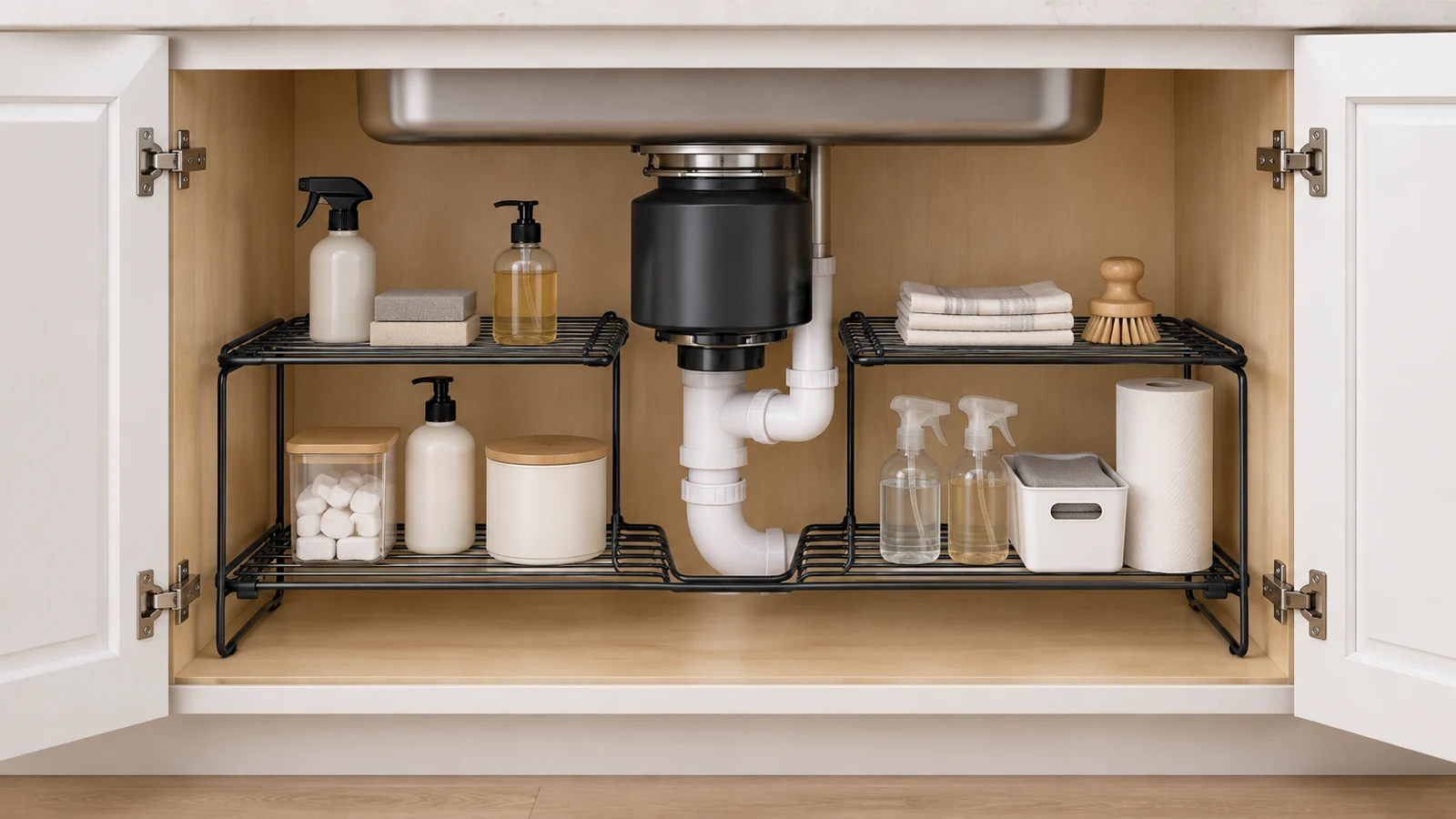
An under sink metal rack pipe clearance specification should start with the actual cabinet and plumbing envelope, not a generic rack width. For an importer or private-label buyer, the critical decision is whether the proposed shelves, frame and stored products can be installed and accessed around drains, disposal units, supply lines and door hardware. Draw those obstructions, agree the intended storage load and verify the complete arrangement on a representative sample before approving an OEM order.
Which cabinet measurements belong in the buyer’s RFQ?
An under sink metal rack pipe clearance specification begins with the usable inside width, depth and height of the cabinet, measured at the positions the organizer will occupy. The nominal outside cabinet dimension is not enough: panels, face frames, hinges, pipes and cleaning fittings consume space. Show the finished cabinet floor and side panels as reference planes on a drawing. Mark whether the opening is framed, how far a door opens, and where any shelf pin, brace or service fitting projects into the usable space.
Record the installation sequence as well as the static dimensions. A rack may fit when held inside an empty cabinet yet be impossible to insert through the narrower door opening or rotate around a fixed drain. If the organizer is supplied partly assembled, identify the largest assembled module and the tools needed inside the cabinet. If it is assembled in place, ask whether the final fasteners can be reached without removing plumbing. Buyers should not accept an attractive external product drawing as evidence of installability.
Different markets and cabinet programs have different sink, drain and waste-disposal layouts. A supplier cannot responsibly promise one universal fit from an average cabinet dimension. Segment the intended assortment into defined cabinet and plumbing types, or explain the adjustable range with explicit excluded configurations. Where customer measurements are unavailable, treat the design as a concept requiring fit trials, not as an approved mass-market claim.
The RFQ should also identify what buyers want to store: small cleaning bottles, tall detergent containers, cloths, spare supplies or a mixed assortment. Their footprint and removal path influence shelf depth and opening. A shelf that has enough nominal vertical space may still trap a bottle beneath the sink bowl or horizontal drain. Include the tallest intended article and its cap or pump in the sample review.
How should the pipe and disposal obstruction envelope be drawn?
Draw the drain tailpiece, P-trap, waste line, valves, supply hoses and any disposal unit as occupied volumes, not just centerlines. Add a service-access zone where a person must reach a shutoff valve or clean a trap. The metal rack must not turn routine maintenance into a dismantling exercise unless the buyer deliberately approves that trade-off. Photograph the representative cabinet from the front and side with a ruler or defined datum, then translate those observations into dimensioned zones.
For a two-tier design, examine each tier separately. The upper tier often conflicts with the sink bowl or drain; the lower tier may conflict with the trap, a disposal body or door hardware. An offset shelf, split panel or reversible installation may resolve one configuration while creating another constraint. Ask the supplier to show both the clear opening and the remaining usable storage area. Do not describe a cut-out merely by its width if the pipe changes direction at different heights.
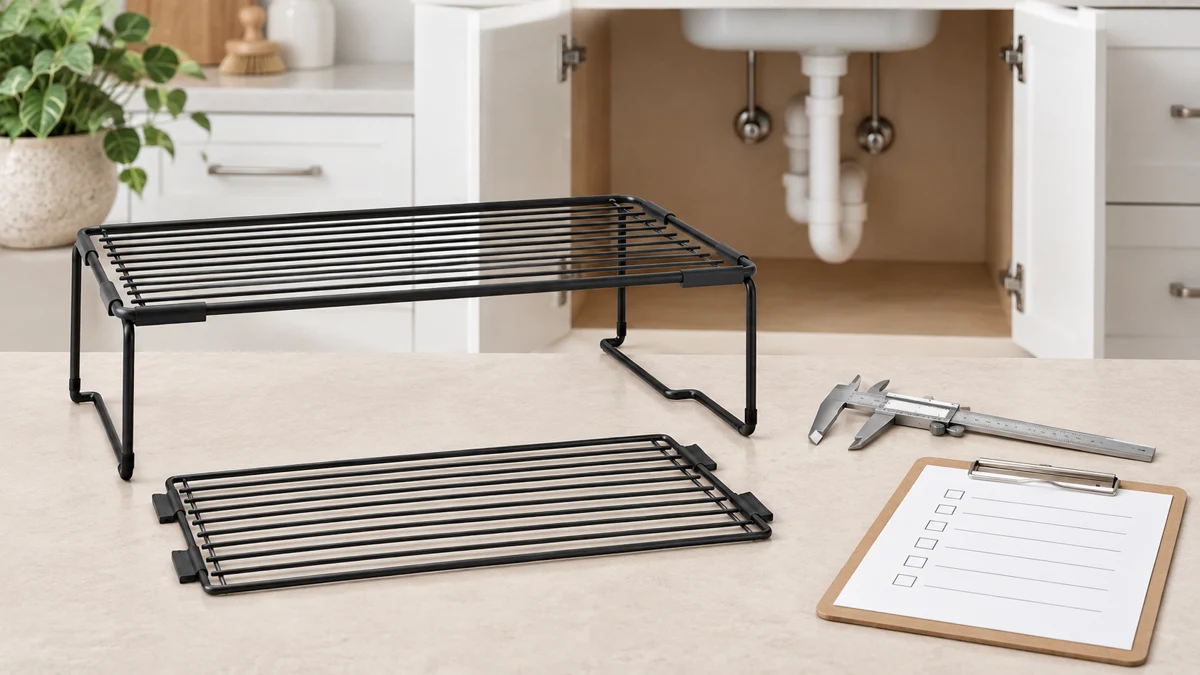
Mark a tolerance or adjustment strategy for expected variation. A threaded pipe joint, cabinet installation offset or sink model change can move the obstruction relative to the rack. The buyer and supplier should agree how much variation the product is expected to accept and what happens outside that range. This is a project-specific decision: inventing a universal clearance number would hide the real fit question. If the rack uses removable sections, confirm the resulting edges and support remain safe for the intended storage use.
Keep clearance for cleaning and inspection. A rack that barely clears a pipe on the drawing can rub it during loading, pull-out motion or assembly. Surface finish damage under a sink matters because moisture and cleaning products can be present. Specify the no-contact zones and inspect them on the sample after installation, while recognising that any corrosion claim requires a defined material, finish, environment and test basis.

When are adjustable or removable shelves useful?
An adjustable shelf can adapt to several pipe locations, but adjustment adds parts, assembly steps and possible looseness. A removable center panel can preserve storage on either side of a drain, but the remaining shelf must still support the intended items without distortion. The buyer should select a mechanism because it solves a documented cabinet problem, not because “adjustable” sounds marketable. Record the approved configurations and whether customers may safely change them after purchase.
Compare a fixed U-shaped shelf, split panels and a height-adjustable tier against the same cabinet drawings. A fixed opening may be simplest to manufacture and inspect when one plumbing location dominates. Split panels may accommodate varied layouts but introduce more edges and parts to protect. Height adjustment may help tall bottles yet reduce useful clearance above the lower shelf. Evaluate the complete kit, including clamps, screws and instructions; a metal frame alone does not prove the adjustable mechanism works.
| Design approach | Buyer benefit | Fit and quality question |
|---|---|---|
| Fixed offset or U-shaped shelf | Simple assembly for a defined plumbing layout | Does the actual drain fall inside the approved opening at every intended cabinet size? |
| Removable or split shelf panels | Allows several obstruction positions | Are exposed edges protected, panels retained and remaining storage areas useful? |
| Adjustable height or width | May cover several cabinet formats | Does the setting stay secure when loaded, and can a user reach the fasteners? |
| Pull-out frame | Improves access in a deep cabinet | Will the moving envelope clear the trap, doors and stored bottles throughout travel? |
Where plastic feet, clips or sliding parts are proposed, list their material and role separately. Koitor’s confirmed metal storage-hardware experience can inform frame geometry, bending, welding, finish and drawing-led development. It does not establish that Koitor currently manufactures an adjustable under-sink SKU, a particular polymer mechanism or a sliding system. Buyers should confirm the actual proposed product and supplier scope in an RFQ.
Ask for a parts list with drawing revision. If a supplier substitutes a clip or changes a panel hole pattern after sample approval, the fit and assembly may change even if the catalog image does not. Define which changes require a new sample or fit trial. For a private-label buyer, repeat-order consistency is as important as a successful first prototype.
What door, hinge and bottle-access clearances must be sampled?
The cabinet door and its hinges create a moving obstruction. Measure the door opening angle and the sweep of hinge cups, arms and soft-close hardware. A rack that fits behind a closed door may interfere during opening, or its front rail may prevent the door from closing fully. The sample should be installed in a representative cabinet with the actual hinge type. Check both doors if a double-door cabinet has a center stile or different hinge positions.
For a pull-out organizer, draw the full travel path of the rack and stored items. The frame, handle and bottles can sweep through different zones. A tall bottle may pass under a drain when the rack is parked but strike it when pulled forward. A narrow item may fit the shelf yet be difficult to retrieve behind a face frame. Record the loading pattern used for the trial, rather than testing an empty rack and assuming loaded behavior.
Accessibility is a practical buyer decision. Does the user reach the rear shelf without removing the front bottles? Can the rack be lifted out for cleaning? Are valve handles still reachable? These questions should shape the approved layout and instructions. A highly compact design can appear efficient in a product photograph while delivering poor access in an installed cabinet.
Check the floor condition too. A cabinet base can include a raised lip, protective mat or uneven edge. Feet, pads and frame corners should be reviewed on the actual surface. If the product is wall- or door-mounted instead, that is a distinct load path and installation decision; do not reuse a freestanding fit assessment for it.
How should material and finish choices be evaluated?
Under-sink placement can expose a rack to humidity, splashes, cleaning chemicals and occasional leaks, but exposure differs by household and market. Specify the intended environment and maintenance instructions before choosing a metal and finish. A low-carbon steel frame with an appropriate coating, a stainless frame or another construction can have different cost, appearance and fabrication implications. No material name alone guarantees performance. Ask for the exact grade, surface treatment, joining method and relevant project-specific evidence.
Inspect bends, welds and cut edges because these are the locations where coating coverage or surface appearance can differ from a flat panel. If the design includes removable panels, check the edges customers will handle. A coating may look acceptable on a display sample yet show chips where panels repeatedly touch the frame. Define an inspection method and acceptable condition using actual samples. Avoid presenting an unspecified salt-spray result or load rating as proof of suitability.
Under-sink storage also raises a packaging question. Hooks, feet, panels and fasteners can rub the finish during shipping. Ask the supplier to show how the parts are separated and identified, and whether a buyer can assemble the organizer without scratching the visible surfaces. Packaging, assembly and maintenance instructions are part of the product specification, not afterthoughts for the retailer.
For buyers considering Koitor, the confirmed capability to discuss is custom metal bathroom and home storage hardware, drawing- or sample-based development and relevant metal fabrication. Confirm the proposed material, coating and exact under-sink configuration for the project; do not infer a current catalog SKU from general manufacturing knowledge. A custom kitchen storage rack manufacturing discussion can cover potential frame requirements while the buyer retains responsibility for the target installation envelope.
Which checks belong in sample approval and the final RFQ?
Build a sample review around a defined group of representative cabinets. At minimum, include the layout that creates the greatest conflict for the intended range: an offset drain, large disposal or restrictive hinge. Install the rack using the supplied instructions and tools. Observe whether assembly is possible, whether the frame contacts plumbing, whether all approved shelf configurations lock in place and whether the door closes after the rack is loaded. Photograph each result and tie it to a drawing revision.
Test access with the intended stored items. Load the tallest bottle, reach the rear shelf, remove and replace a panel if applicable, open and close the cabinet door and operate the full pull-out travel if provided. Buyers should set their own acceptance values for fit, movement and loading; this guide deliberately provides no universal load or clearance figure. Where a configuration fails, record whether the fix is a product change, a narrower compatibility statement or an installation instruction.
An under sink metal rack pipe clearance specification is useful only if the accepted cabinet assumptions travel into production documents. Put the approved obstruction envelope, configuration options, parts list, finish reference, packaging method and installation exclusions on controlled drawings. Before repeat orders, ask whether a sink, hinge, slide, foot or shelf supplier has changed. Changes to seemingly minor components can invalidate the first fit trial.
- Identify the target market, buyer, cabinet program and intended product assortment.
- Provide usable cabinet dimensions, door opening and hinge locations from defined datums.
- Mark drain, trap, disposal, valves, hoses and service-access zones as three-dimensional obstructions.
- List the tallest and widest stored items, including caps or pumps, and the loading pattern.
- Choose fixed, split, adjustable or pull-out geometry based on measured fit problems.
- Specify metal grade, finish, exposed edges, component materials and packaging assumptions.
- Agree sample cabinets, installation method, loaded movement checks, evidence format and acceptance owner.
- Record exclusions, drawing revisions and changes that trigger another sample review.
If you need a supplier conversation about a metal frame, send the cabinet drawing and obstruction map with the RFQ. Contact Koitor Hardware to discuss whether the specific construction falls within current capabilities; an initial discussion should not be taken as confirmation that a complete adjustable under-sink model is already manufactured.
What do buyers ask about under-sink organizer development?
What dimensions should accompany the first RFQ?
Send usable cabinet width, depth and height, door-opening details, hinge positions and a dimensioned plumbing obstruction map. Add the intended item sizes and installation sequence. Nominal cabinet size and a front photograph alone leave too many fit decisions unresolved.
Can one under-sink rack fit every cabinet?
No responsible supplier should promise universal compatibility from a single sample. Define the target cabinet and plumbing range, adjustable configurations and explicit exclusions. Where the range is broad, test more than one representative installation before approving claims.
What should buyers inspect on a loaded sample?
Confirm assembly, door closing, no unwanted contact with plumbing, shelf retention, pull-out travel if present, bottle removal and service access. Use the intended item assortment and document any configuration changes made during the trial.
Should a removable shelf panel automatically be preferred?
Only when it solves a documented obstruction without weakening the intended storage or making assembly confusing. Compare the supported area, exposed edges, retention, finish and packaging against a fixed design in the same representative cabinet.
Which changes require another fit review?
A new shelf opening, foot height, hinge type, slide, fastener, clip, cabinet assumption or stored-item envelope can change installability. Record the approved drawing revision and route changes through the buyer’s sample-approval process.
Discuss an under-sink rack brief
Send the cabinet drawing, plumbing envelope and intended storage items. Koitor can review relevant metal-hardware work while confirming the exact product scope.
OEM / PRIVATE LABEL
Turn this sourcing guide into a product brief
Share your target product, size, finish, order quantity and packaging requirements. Your team receives a practical manufacturability review before quotation.

 English
  Español
  Português
  Français
  Deutsch
  العربية