
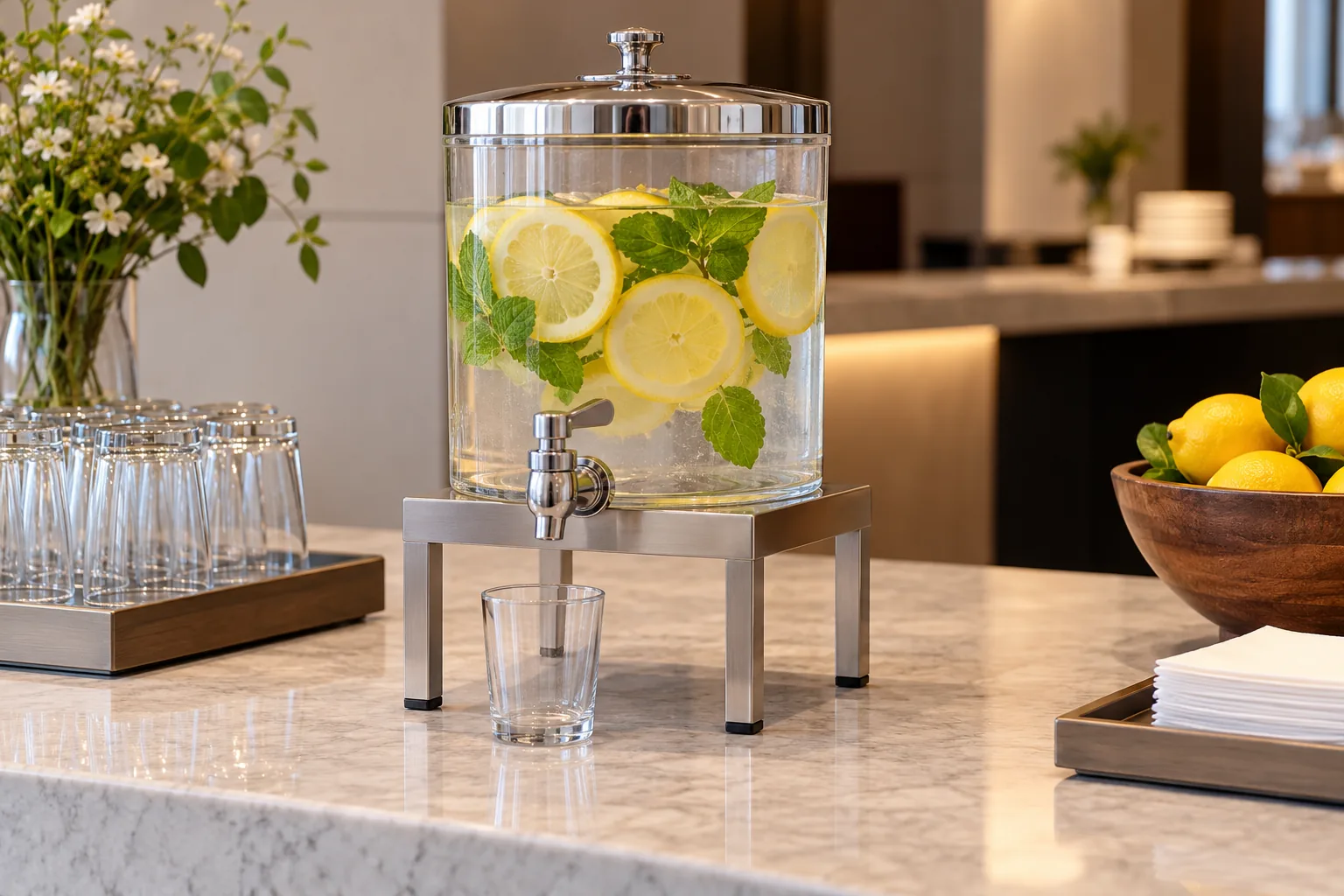
A beverage dispenser stand specification should name the exact vessel, its base-contact geometry, the filled configuration to be reviewed, and the clearance needed to operate its tap over a real cup or drip tray. The importer should check the dispenser and stand together because a nominal base diameter does not show how the base bears on the frame, while a stand that holds the vessel may still leave too little room for a cup or valve handle. Approve the specific vessel-and-stand combination and document the test conditions; do not infer a universal fit, capacity rating or food-contact status from a product listing.
Which vessel and stand configuration is being purchased?
First define whether the quote covers a stand only, a vessel and stand set, or a larger beverage service kit. List the source of the vessel, lid, tap, seals, cup, drip tray and any stabilizing or locating pieces. The metal stand supplier may not make the vessel or dispensing hardware, so responsibilities need to be clear in the bill of materials.
Tablecraft’s official beverage-stand material illustrates model-specific pairings and faucet clearances. One accessory sheet lists named dispenser models and dimensions for particular stand configurations. These details show that a vessel interface and tap clearance are real product properties. They do not prove that all vessels fit a stand of a similar size. Keep manufacturer measurements attached to the exact model and request current drawings when sourcing a replacement or alternative.
Record the vessel’s model, base diameter or outline, base foot or ring geometry, height, tap location, outlet projection, handle movement and available manufacturer information. Ask what the vessel weighs empty and obtain a source for the filled condition if a loading review is needed. Do not guess liquid mass from a promotional photograph or assume the vessel is filled to its brim in service.
| Component | Buyer records | Why it matters |
|---|---|---|
| Vessel | Model, base outline, foot/ring and overall envelope | Defines where the stand contacts |
| Tap | Height, outlet projection and handle travel | Affects cup and hand access |
| Stand | Contact surface, opening and any locating geometry | Determines the vessel-to-frame interface |
| Cup | Actual rim diameter and height | Shows whether it can reach the outlet |
| Drip tray | Footprint, height and removal route | Adds an interface below the tap |
| Fill condition | Empty/filled state and documented mass where available | Defines the reviewed configuration |
| Kit scope | Vessel, stand, tap, seals, tray and instructions | Makes supplier responsibilities visible |
How should base fit and contact points be inspected?
Measure more than the vessel’s widest diameter. The relevant contact may be a flat circular base, a raised foot, a recessed ring, three discrete pads, or another underside feature. A stand’s support rails or ring can interact differently with each shape. Request an underside drawing or inspect the real vessel and identify which areas are intended to bear on the stand.
Record the stand’s overall opening separately from its usable support span. A large opening can leave a small contact zone; a narrow rail may align with a vessel foot in an unintended way. Check whether the base is centered, whether the vessel can move laterally, and whether any lip, seam or protrusion prevents seating. If a locating feature is part of the design, capture its dimensions and confirm that the actual vessel reaches it as intended.
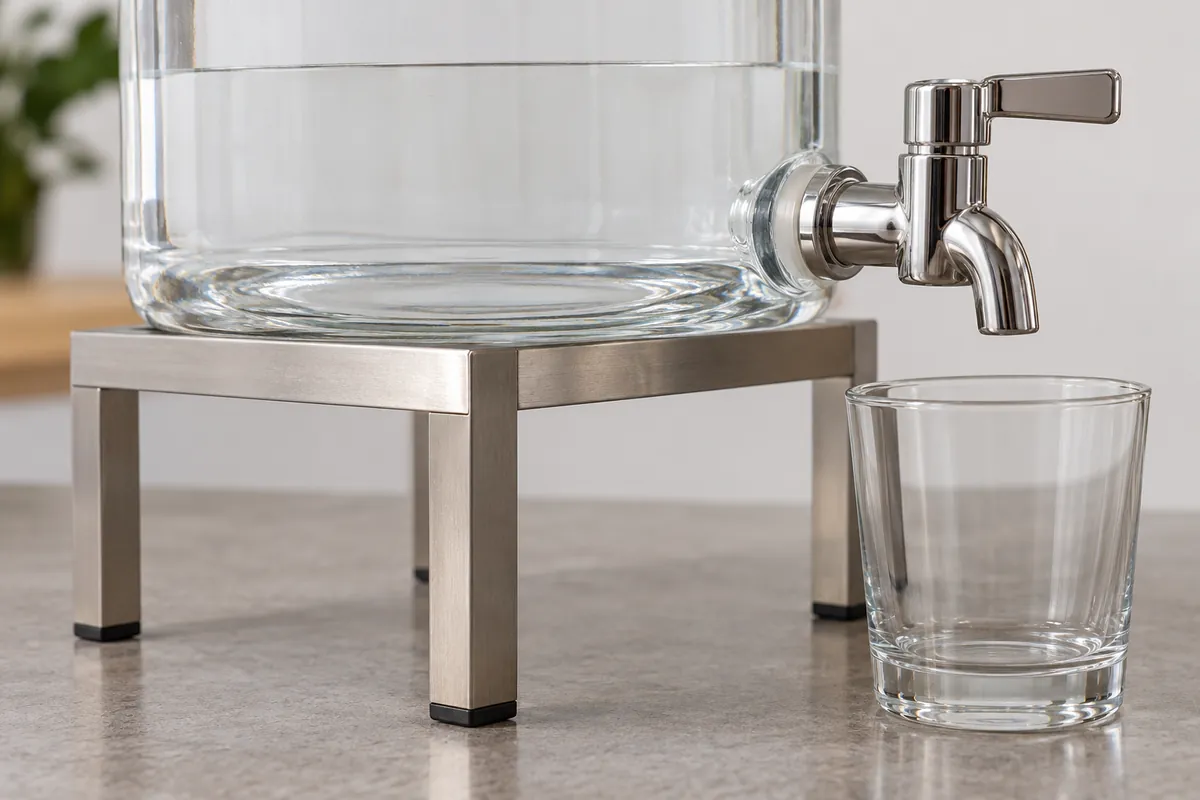
Trial the sample with the vessel empty first to observe seating without introducing an unsupported load claim. Then review the intended filled configuration using information and controls agreed by the vessel and stand suppliers. Record movement, rocking, contact marks or misalignment under that defined setup. Do not treat a visual fit as a load test and do not claim a safe capacity without documented evidence for the exact combination.
If the vessel supplier changes the base, foot, tap or material, recheck the interface. A replacement dispenser may carry the same nominal capacity but have a different base ring or outlet height. The metal stand should not be advertised for a broad family unless the actual supported models and evidence are identified.
How do tap, cup and drip-tray clearances affect use?
The tap must be reachable, operable and positioned so that the selected cup can be placed under the outlet. Measure from the counter or support surface to the tap outlet, and from the outlet to the nearest stand rail. Include the height and width of the cup, its rim, and any handle that projects into the surrounding space. If several cup sizes are part of the offer, check each relevant one.
Test the handle or valve movement through its actual operating range. A handle can collide with a frame upright, the vessel wall, a nearby wall, or the user’s hand. Do not assume that “faucet clearance” means the same thing across stand designs. Define the measurement points on a sketch and request the exact drawing or a sample.
A drip tray changes the space below the tap and may need to slide out for cleaning or emptying. Check its footprint, thickness, raised lip and removal direction. If the stand sits on a counter close to a backsplash, a tray may be difficult to reach even if its width appears acceptable on paper. Include the work surface and adjacent equipment in a simple placement mock-up.
Observe a normal pour using the exact vessel, valve, cup, stand and tray. This is a fit-and-access review, not proof of leak-free operation, serving speed, food safety, or long-term reliability. Any claim about those properties needs evidence from the responsible product suppliers and an appropriate test. Record the sample conditions and note whether fluid, temperature or cleaning requirements were outside the assessment.
What should be included in the combined sample review?
A paired sample review should address the vessel’s base, stand contact, faucet clearance, cup approach, tray access, and any movement under the agreed setup. It should also cover how staff load, refill, clean or remove the components. The important principle is to test the way the complete set will be used rather than approving isolated pieces in separate boxes.
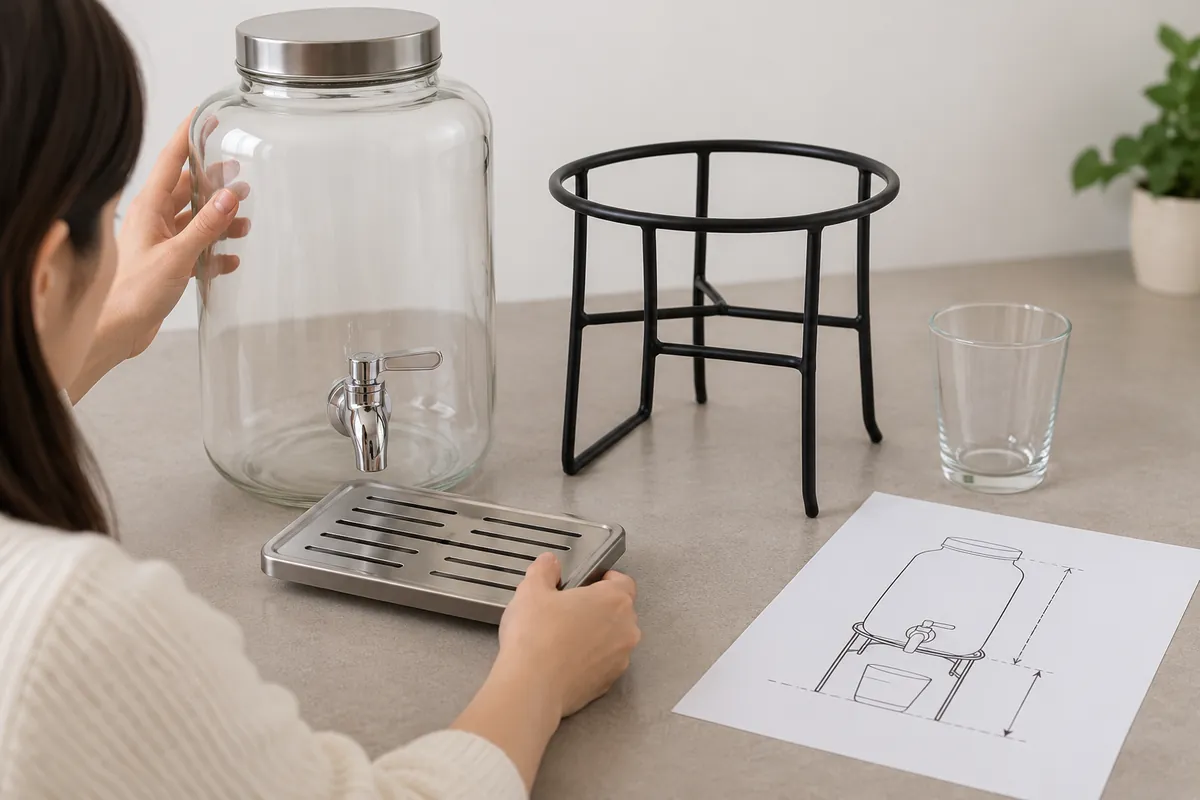
Use an approval sequence that can be repeated:
- Identify vessel, stand, tap, cup and tray model/revision.
- Compare current drawings and mark key interface dimensions.
- Seat the empty vessel and verify intended contact points.
- Review the tap-to-counter and tap-to-cup clearances.
- Move the handle and approach with the actual cup and hand.
- Place the drip tray and practice its removal or service.
- Review the agreed filled configuration using documented component data.
- Observe the sample in the intended layout and record exceptions.
- Check finish and visible contact areas after the operating trial.
- Record what was not tested and any claims still needing evidence.
If a sample has to be placed close to a counter edge, wall or another dispenser, include the site layout and intended orientation. A stand that appears centered on a broad photo table may be difficult to reach or refill in a compact buffet area. If multiple units will be placed side by side, confirm spacing, access and cup movement across the full arrangement.
What should an importer specify in the RFQ?
A clear RFQ should identify the vessel model and source, not merely a capacity label. The beverage dispenser stand specification should name the actual vessel revision, not only its nominal volume. Attach top, side and underside views, list base contact features, show the tap location and specify the intended stand relationship. If the buyer is still choosing a dispenser, state the range of candidate vessels and ask for separate fit confirmation rather than assuming one frame supports all of them.
Include the following:
- Stand-only or complete-set purchase scope.
- Named vessel and current drawing revision.
- Base outline, foot, ring and contact features.
- Empty and intended filled configuration, with data source.
- Tap outlet height, projection and handle operating envelope.
- Cup sizes, handle direction and actual drip tray.
- Counter, buffet or service layout and access direction.
- Metal construction and finish expectations for visible areas.
- Assembly steps, fasteners and any purchased components.
- Cleaning/care documentation supplied by each responsible vendor.
- Test or sample criteria, owner and record format.
- Packaging, labels, instructions, target order quantity and timing.
State who supplies seals, plastic parts, glass, taps, trays and other bought-in components. A metal hardware manufacturer should not be assigned unsupported responsibility for food-contact claims, glass quality, valve performance or testing of a vessel from another supplier. The buyer should coordinate product copy and technical data across the relevant suppliers.
Which sourcing mistakes should importers avoid?
The first mistake is using vessel capacity as a fit dimension. A volume label does not describe the base shape, tap elevation, body diameter or handle envelope. Use the actual model drawing and sample.
Another mistake is measuring only the stand ring or aperture. The outside diameter may look suitable while the vessel foot is unstable or misses the contact surface. Capture the base underside and stand’s usable support area.
A third error is checking the tap outlet without the cup. A tap can have enough nominal height but still be blocked by a rail, tray lip, cup handle or nearby wall. Use representative cups and the actual drip tray.
A fourth is accepting a claim that the stand supports “large dispensers” without the models or configuration. Request an approved model list and sample evidence. A broad compatibility statement should match the tested range, not the supplier’s visual impression.
A fifth is changing the vessel after approving the stand. A substitute vessel can change base, mass, tap position and cleaning method. Treat a changed component as an interface revision and recheck the assembly.
A sixth is assuming the metal finish proves suitability for repeated contact with liquid or cleaning agents. The correct care and corrosion guidance depends on the material, finish and use. Ask for documentation for the exact product and avoid importing unsupported claims into product copy.
How can Koitor assist with a metal stand feasibility review?
Koitor Hardware is a family-owned custom metal hardware manufacturer focused on bathroom and home-storage hardware. Its documented manufacturing knowledge includes forming, punching, bending, welding, grinding, polishing, finishing, powder coating, assembly, packaging and sample development. These capabilities can inform a discussion about a metal stand drawing, support contact, finish and packaging. They do not confirm a current beverage stand product, vessel compatibility, load rating, food-contact compliance, dishwasher suitability, valve performance or thermal use.
For an initial feasibility conversation, provide the vessel model and physical sample, the underside and tap drawings, intended cup and drip tray, service layout, finish reference, target quantities and packaging. Identify any parts sourced from other vendors and state who will provide their technical evidence. The conversation can then remain focused on whether the metal portion is suitable for a drawing or sample review.
For more background, see the Koitor OEM home-storage hardware page and custom metal storage-rack information. These pages reflect the factory’s documented core business and should not be read as a beverage-dispenser catalog. Send the drawing, components and requirements through the contact page.
What should the buyer retain as the approved reference?
Keep the approved vessel and stand identifiers together with the dimensioned interface drawing. The record should capture which cup and tray were used, the tap orientation, the intended filled condition and the arrangement on the reference surface. Include photographs that show contact and clearance, but keep the written measurements and observations as the actual evidence.
The sign-off should list:
- Vessel, tap, stand, cup and tray identifiers.
- Drawing revision, overall dimensions and contact geometry.
- Outlet height, valve movement and cup access.
- Empty and defined filled sample conditions and data source.
- Assembly orientation and location of the stand.
- Surface, neighboring objects and access constraints reviewed.
- Finish and visible-condition notes.
- Cleaning instructions and component owners.
- Tests performed, tests omitted and limitations.
- Change triggers for a new vessel, tap, stand, cup or tray.
- Packaging configuration and inspection after unpacking.
A complete record helps prevent a substitute vessel or modified frame from being treated as previously approved. It also lets the importer distinguish evidence for fit from evidence for a separate product claim. If the project needs a rated capacity, food-contact statement, cleaning claim or safety requirement, request the right evidence from the responsible supplier rather than inferring it from the sample review.
A beverage dispenser stand specification is most useful when it describes the interface as a real assembly. A named vessel, actual tap, suitable cup and removable tray turn a vague “fits dispenser” statement into a reviewable buyer requirement that can be quoted, sampled and controlled during reorders.
Frequently Asked Questions
Will a stand fit any dispenser with the same volume capacity?
No. Capacity does not specify base geometry, height, tap location, valve travel or cup clearance. Confirm the model and sample the assembly.
Why should buyers test a cup if the faucet clearance is listed?
The listed dimension may be model-specific and may not reflect the buyer’s cup, handle, tray or nearby surface. Confirm the actual points of measurement and test the service arrangement.
Does an empty-vessel fit test confirm the stand’s load capacity?
No. It checks fit and contact in the empty configuration. Any capacity statement needs separate evidence for the exact stand, vessel, filled condition and test method.
Can a metal stand be described as food-safe or dishwasher-safe?
Not based on metal construction alone. The applicable evidence depends on the exact materials, finish, components, use and responsible supplier documentation.
Work With Koitor Hardware
Reviewing a Beverage-Dispenser Stand Concept?
Share the actual vessel, tap and cup, base drawing, service layout, finish and target quantity for a bounded metal-component feasibility discussion.
OEM / PRIVATE LABEL
Turn this sourcing guide into a product brief
Share your target product, size, finish, order quantity and packaging requirements. Your team receives a practical manufacturability review before quotation.


 English
 Español
 Português
 Français
 Deutsch
 العربية