

The types of steel are often introduced as carbon, alloy, stainless and tool steel, but those labels do not form four mutually exclusive chemistry bins. Carbon and alloy describe composition-related classifications within a defined system; stainless is a steel family defined by its composition and behavior under applicable standards; tool steel describes steels intended for tooling applications and can include carbon or alloy steels. Buyers should separate composition, role, product form and condition before selecting material for a part.
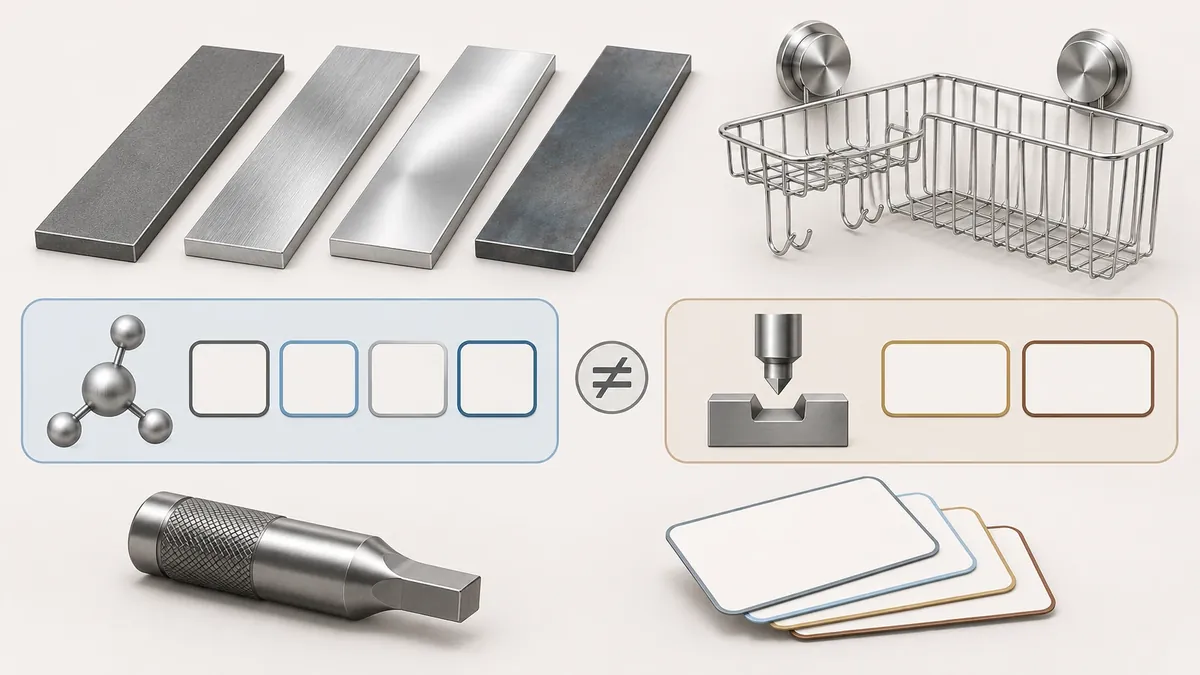
Why do steel-type charts cause confusion?
Many introductory charts place common steel terms in four side-by-side columns. That can be a convenient teaching device, but it can imply that each term is a separate, exclusive family. In practice, the labels answer different questions. A buyer may see “tool steel” and assume it cannot also be alloy steel, or see “all steel is an alloy” and conclude the commercial category “alloy steel” is meaningless. Both shortcuts miss the naming system used by the actual product specification.
For procurement, the important question is not how many boxes appear on a chart. It is what a supplier’s label means in a particular designation system and whether it describes the stock needed for the component. A steel punch, wire basket, sheet bracket and tube rail can all be steel products while requiring different product forms, grades, conditions and acceptance evidence. Tooling material used to make a part should not be confused with the material of the part being sold.
This guide provides a map for reading common categories. It is not an exhaustive grade chart or a material-selection standard. The exact designation, chemistry, product form and condition must be tied to the relevant standard or drawing. The Recycled steel content claim checklist compares those two composition-related categories in more detail; this article focuses on how multiple labels relate to each other.
What do the common labels describe?
Carbon steel
Carbon steel is a broad material family named in a composition context. Specific grades and designations are defined under particular systems; the phrase alone does not specify a sheet, wire, tube or bar product. It also does not state the supplied condition, dimensions, surface finish or evidence for a particular order. Buyers should record the exact designation and governing specification instead of relying only on the family label.
Carbon steel can be used in different product forms and applications, but this article does not infer that any named grade will meet a given strength, forming or corrosion requirement. Those properties depend on the grade, product, condition and intended process. A supplier chart may help orient a buyer, but the drawing and applicable standard control the purchase.
Alloy steel
“Alloy steel” can be used as a formal or commercial classification within a material system. The meaning depends on that system’s definitions and the selected grade. It should not be confused with the broad scientific observation that steel contains iron and carbon and can include alloying elements. When a quotation names alloy steel, ask which designation and specification it means.
Carbon steel and alloy steel are useful categories to compare when the grade system defines them that way. They are not a substitute for the actual product requirement. Read the Recycled steel content claim checklist for the separate pairwise distinction and avoid applying a generalized carbon threshold from an unrelated chart.
Stainless steel
Stainless steel is a steel family with composition and corrosion-related characteristics defined in applicable material systems. Its name does not mean that the product can never corrode or that every grade behaves the same way. The exact grade, finish, geometry, exposure, cleaning and manufacturing route matter. A stainless label should be paired with the intended designation and product form.
Stainless can also be alloyed. Therefore, placing “stainless” opposite “alloy steel” in a chart without explaining the classification axis can mislead readers. The standard system and product specification determine how a particular grade is classified. This article does not reproduce a complete stainless grade catalogue; see the separate Koitor material resources for stainless-family and finish questions.
Tool steel
Tool steel is commonly used to describe steels selected for tooling applications such as punches, dies or other tooling components. It is not necessarily a mutually exclusive chemistry family. A steelmaker explicitly describes tool steel as a category that includes carbon and alloy steels, which illustrates the overlap. The intended role—making tooling—differs from the stock family or composition label.
This distinction is important in manufacturing discussions. A punch may use a tool steel for a particular tooling task, while the finished metal hardware is made from sheet, wire or tube with its own material specification. The tooling choice does not transfer to the product. The Ferritic stainless forming surface characteristics covers a specific tooling comparison and should not be read as a recommendation for saleable hardware parts.
| Label | Main question it helps answer | How it can overlap with other labels |
|---|---|---|
| Carbon steel | Which broad composition-related family or designation is being discussed? | A particular product form and condition must still be stated |
| Alloy steel | Which classification does the governing grade system assign? | A tool steel may also be an alloy steel within its system |
| Stainless steel | Is the selected steel in a stainless family under the relevant specification? | It remains a steel alloy and can have multiple product forms |
| Tool steel | Is the material intended for tooling functions? | Tool steel may belong to carbon or alloy composition categories |
| Hot-rolled or cold-rolled | What processing description applies to the stock? | This is not a grade family by itself |
| Annealed or hardened | What condition is specified? | A condition does not replace grade or product form |
| Galvanized steel | What coated construction is being supplied? | It identifies steel with a zinc coating, not a base chemistry family |
The steelmaker’s tool-steel overview supports the point that tool steel can include carbon and alloy steels. Introductory material from ESAB can help readers recognize common headings, but broad guides are not the governing classification for a purchase. Do not transfer a source maker’s performance, equipment or product claims to another supplier.
Keep composition, product form and condition separate
A material designation should be interpreted in its system. Product form answers what is being supplied: sheet, strip, plate, bar, wire, tube or another product. Condition describes how it is supplied or processed under the relevant requirements. Surface condition and coating add still more information. A complete callout may need several of these fields rather than a single family name.
Hot-rolled and cold-rolled describe processing or supply routes, not universal steel families. Annealed, normalized, hardened and other condition terms must be interpreted within a particular standard and product. Galvanized identifies a steel substrate with a zinc coating applied through a specified route; it is not an independent base-metal family comparable to stainless or aluminum. The Steel sheet leveling route selection covers a different top-level distinction based on iron content.
The buyer’s RFQ can keep these items in separate fields: material designation and system; product specification; stock form and dimensions; delivery condition; surface or coating; and required documentation. That structure helps a supplier explain any ambiguity instead of choosing an interpretation silently. If a drawing has a grade but no product form, or a process note but no material designation, ask which requirement is missing.
How do steel labels affect a hardware sourcing decision?
Consider a hypothetical wire storage basket with a sheet mounting plate and purchased fasteners. The tooling used to punch or form the plate may have a tool-steel designation. The basket wire and mounting plate have their own product materials. The fasteners may come from a third supplier with separate material and finish documents. Applying the phrase “tool steel” to the entire assembly would confuse process tooling with the product material.
Map each component to its requirement. Identify the item, its material specification, form, finish, supplier and records. For a wire component, the buyer may need a wire designation and dimensions; for a sheet plate, the relevant sheet specification and thickness; for a purchased fastener, a fastener standard, grade and coating. The actual requirements depend on design and intended use. This map is more useful than saying the entire product is “carbon steel” if the assembly contains multiple materials.
A material change should be treated as a controlled engineering decision. A proposal to replace one steel family with another may affect forming, joining, surface appearance or fit. The intended end-use conditions and acceptance requirements should be reviewed by the design owner. A supplier quotation that says “equivalent” is not enough; ask what designation is being proposed, what standard supports the equivalence and who approves it.
What documents should a buyer request?
The appropriate documents vary by requirement. A drawing or purchase specification identifies what the buyer ordered. A material certificate or supplier record may identify the stock or lot, depending on the supply chain. Inspection results can address defined dimensions or characteristics. A process document may describe how a supplier controls an operation. Each document has a scope, and no single sheet of paper proves everything about a finished product.
Ask how the supplier connects the material description to the delivered part or lot. The answer may involve a purchase record, traceability identifier, material report or another control, depending on the project. The buyer should agree on the required evidence before order placement and verify that it is meaningful for the product. A generic certificate image from a website does not establish the identity of the material used in a particular shipment.
If the product is safety-critical, regulated or subject to a customer standard, the responsible technical and quality owners must define applicable requirements. This article is a classification overview, not engineering or regulatory advice. Do not use an online table to infer exact chemistry, heat treatment, strength or compliance. Obtain the complete controlled source and have a qualified reviewer approve the callout.
A component map prevents category mix-ups
Imagine a metal storage assembly with a formed sheet bracket, wire body and a purchased punch-made mounting clip. A sourcing record might describe the bracket by a sheet product specification, the wire by a wire material designation and the clip by its own purchased-component specification. The stamping die or punch that produced the clip belongs to the manufacturing process; its material is not the clip’s material. If a buyer sees “tool steel” in a factory document, the first question should be whether it names the die or the product part.
This component map is especially useful when a product uses several suppliers. One party may supply stock, another may perform coating, and a factory may assemble the finished item. The buyer should identify who owns the material requirement, who can provide lot evidence and how a substitute is approved. If the same component is sourced from a second facility, confirm that its designation and product form remain within the approved specification. A broad family word does not prove interchangeability.
The map also prevents an imprecise marketing description from replacing a technical callout. A consumer-facing page might say “steel storage rack,” while a purchase specification records the exact material and finish by component. The consumer description is not the manufacturing control. Keep the controlled engineering record as the authority for production and use the simpler wording only where it remains accurate.
Why is there no single definitive list of steel types?
Different references organize steel for different purposes. A materials introduction may group by chemistry; a stock catalog may group by product form; a tool supplier may group by intended application; a standards document may classify grades and conditions according to a specific scope. Each arrangement can be valid for its purpose without being a universal taxonomy. That is why one guide may list four “types,” while another lists many more.
The buyer should use a category list to generate questions, not to complete a specification. Ask what the label means in the supplied standard and how it ties to the part. If a source uses a broad category without the exact grade, note it as background rather than accepting it as an order requirement. Where a quotation combines a category, a finish and a condition in one line, ask the supplier to separate those elements so each can be checked.
This approach scales from a simple bracket to a multi-part product. It keeps material identity clear as the product moves through cutting, forming, joining, finishing and assembly. It also makes future change control more reliable because a buyer can tell whether a change is in chemistry, form, condition, surface treatment or intended use.
For repeat orders, preserve the exact callout and identify the responsible owner for any proposed revision.
If a material description cannot be tied to a standard or supplier record, keep it unresolved and obtain clarification before releasing the order.
For multi-part products, repeat this check per component; one assembly can include several steel designations, other metals and bought-in parts.
Common mistakes when reading steel-type charts
One mistake is treating all categories as mutually exclusive. Tool steel can overlap with carbon or alloy categories. Another is using “alloy steel” to mean every steel that contains alloying elements, even when a purchasing standard uses the term more narrowly. The correct meaning comes from the actual system, not a casual chart heading.
A third mistake is confusing product form with grade. Sheet, wire and tube describe supplied forms; grade or designation describes a material classification. A fourth is treating hot-rolled or cold-rolled as a chemistry family. A fifth is treating galvanized as a different base metal rather than steel with a zinc coating. A sixth is using a tooling grade as a recommendation for a finished component simply because both are steel.
Buyers also over-rely on generalized rankings: carbon steel is always stronger, stainless always resists corrosion, or tool steel is always harder than another part material. Such claims ignore the particular grade, condition, geometry and processing. A category can orient a conversation, but a controlled product specification decides the purchase.
Interpret certificates and supplier statements by scope
A material certificate, mill record or supplier declaration can be useful only when the buyer knows what it identifies. Check the named material, product form, applicable specification, lot or heat reference if provided, and the supplier that issued the document. A generic brochure describes a category; it does not prove which stock was used for a particular production order. A quality management certificate describes a system scope, not the grade of a component.
If the supply chain includes several parties, map how the material record follows the stock. A stock distributor may provide the material, a processor may cut or coat it and a factory may form or assemble it. The buyer should know who is responsible for each record and how a cut blank remains connected to the source lot where traceability is required. The exact evidence depends on the specification and contract; do not demand a document without agreeing what it must demonstrate.
Compare records to the purchase order, not just to a general product description. If the document uses a designation different from the drawing, request clarification and identify whether it is an approved equivalent or an unresolved mismatch. A buyer should not silently normalize a grade name because two terms appear in a public chart. Keep the original wording, source and approval path visible for a quality review.
These checks are especially useful when a product contains both saleable parts and process tooling. A tooling record may identify punch or die material, while the product material record identifies sheet, wire or tube. Store them under distinct asset or part records. That prevents a tooling specification from being misread as the specification for the finished hardware.
Buyer checklist for a steel material callout
Where a supplier offers more than one material source, compare the actual designations and records side by side. Similar commercial wording does not establish that the products fall under the same standard or condition.
- Identify the exact component and whether the material is product stock or process tooling.
- Record the grade designation and governing system exactly.
- State the product specification, form and dimensions separately.
- Record the supplied condition and surface condition where required.
- Distinguish base steel from zinc coating or another surface system.
- Identify all materials in a multi-component assembly.
- Request documentation tied to the actual order or lot where required.
- Confirm which supplier owns each material and processing stage.
- Review alternatives with the design and quality owners before substitution.
- Avoid transferring a source supplier’s claim to another material or manufacturer.
- Use current controlled standards for numeric and compliance requirements.
- Keep the approved designation and revision linked to repeat orders.
Frequently asked questions
Are carbon, alloy, stainless and tool steel four separate types?
They are common introductory labels, but not four mutually exclusive chemistry bins. Tool steel describes an intended tooling role and can include carbon or alloy steel. Read the actual material system.
Is all steel an alloy?
In a broad materials-science sense, steel contains iron with carbon and may include other elements. In procurement, “alloy steel” can be a defined category under a particular standard. Use the governing designation rather than a general statement.
Is galvanized steel a separate base material?
It is steel with an applied zinc coating. Specify the steel substrate and coating route as separate construction details.
Should a finished metal part use tool steel because the factory uses tool-steel punches?
Not on that basis. Tooling material and saleable product material serve different roles and must be specified independently.
Work with Koitor Hardware
For a custom metal storage product, share the drawing, component list, material callouts, finishes and intended application. Koitor Hardware is a family-owned custom metal hardware factory and can discuss drawing or sample customization, forming, joining, finish coordination, assembly and packaging within confirmed scope. Each product material and bought-in component must be specified and verified separately. Start a project discussion on the OEM home storage hardware page.

In practical sourcing, types of steel should frame a defined comparison; the purchase specification still needs the exact material or process, acceptance criteria, and evidence required for the actual part.
Sources
Discuss Your types of steel Requirements
Share the controlled drawing or sample, intended use and the specific question you are resolving. Koitor can discuss relevant metal hardware manufacturing scope and identify details that need confirmation for your project.
OEM / PRIVATE LABEL
Turn this sourcing guide into a product brief
Share your target product, size, finish, order quantity and packaging requirements. Your team receives a practical manufacturability review before quotation.



 English
 Español
 Português
 Français
 Deutsch
 العربية