
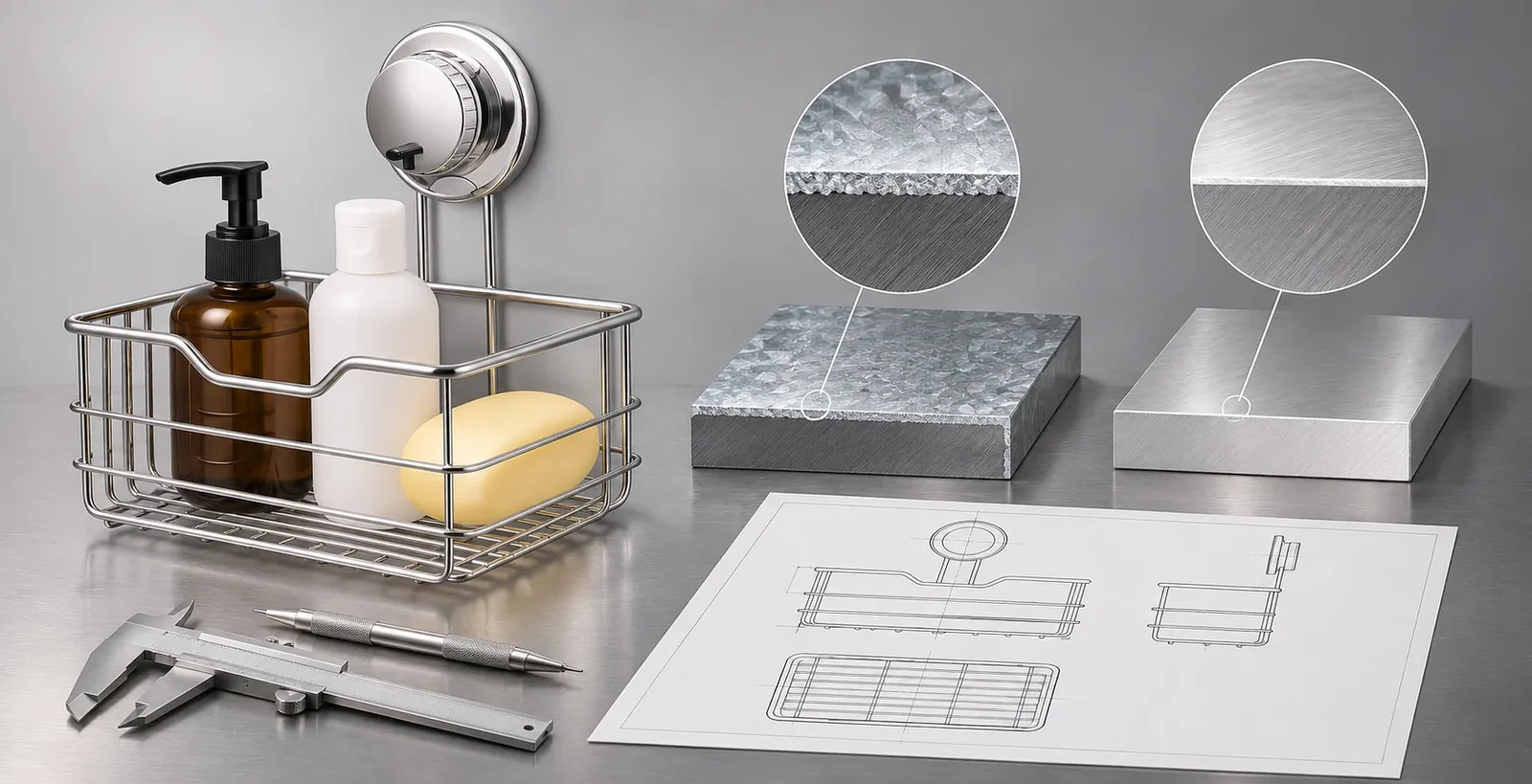
Galvanized steel vs aluminum compares two different material systems, not simply two metal colors. Galvanized steel has a steel substrate with a specified zinc coating route; aluminum is a separate base-metal and alloy system with its own alloy, temper and surface condition. Aluminum’s lower density does not by itself prove that a finished assembly will be lighter or meet a load requirement. Compare the actual geometry, joining, coating or finish, environment and supplier evidence before approving a substitution.
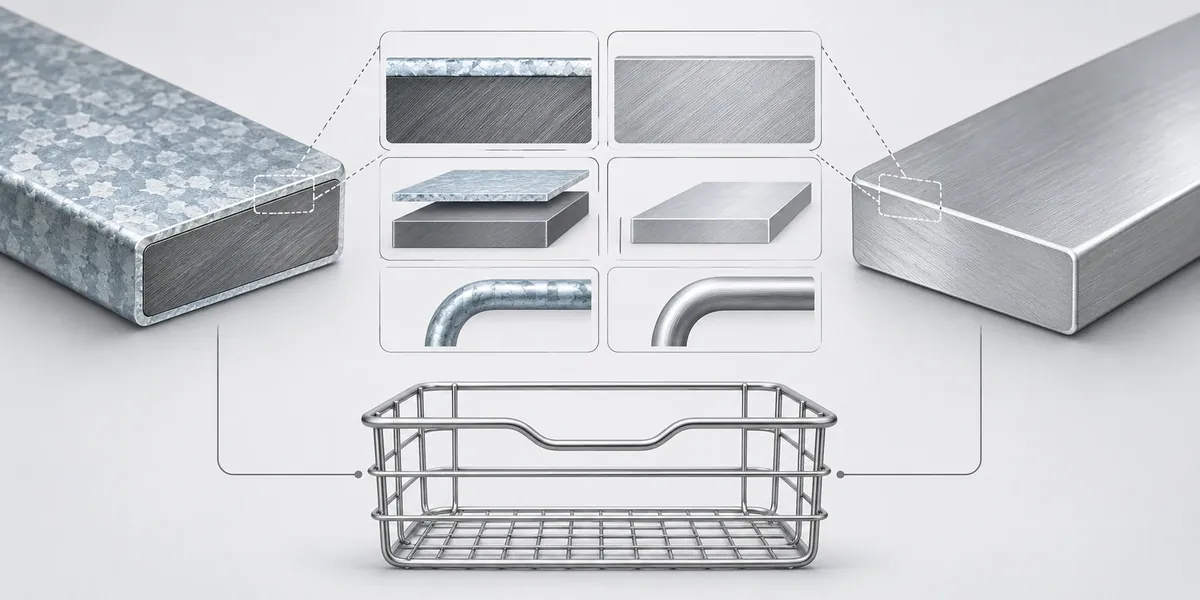
What decision does this comparison help a buyer make?
The buyer is deciding whether a part should use a steel substrate with an applied zinc coating or an aluminum alloy and its specified surface condition. These proposals differ in both the base material and the surface system. A comparison that says only “steel is stronger” or “aluminum is lighter” hides the product design, thickness, geometry and assembly that determine the finished part. The two material descriptions do not establish equal function or interchangeable manufacturing routes.
For a bracket, basket support, rail or formed component, compare the complete construction against the intended application. Identify the component’s dimensions, mounting method, expected contact, cleaning or moisture exposure and appearance requirements. Then ask which grade or alloy, temper, coating route and finish the supplier is proposing. If the buyer is changing only one component in a larger product, include the fasteners, inserts, joins and accessories in the review.
This article is a broad material-system comparison, not a roofing recommendation, a galvanizing recipe or a mixed-metal corrosion procedure. It does not provide universal strength, cost, maintenance or corrosion rankings. For deeper comparisons that address other pairs, see the guides to Anodizing versus powder coating for aluminum hardware and Aluminum coating cut-edge corrosion considerations.
What does galvanized steel mean?
Galvanized steel is steel with a zinc coating applied through a defined process. The steel remains the substrate; zinc is the coating. Different zinc-coating routes serve different product forms and manufacturing contexts. A coated sheet supplied for fabrication is not automatically equivalent to a finished component coated after forming. A buyer should identify the route in the supplier’s offer and confirm that it matches the drawing or accepted design.
The coating is relevant to the material system, but the word “galvanized” does not fully specify the part. The buyer may still need to state the steel designation, sheet or component form, dimensions, coating route, supplied surface, appearance, post-treatment and acceptance evidence. Do not assume a universal coating thickness or protective lifetime based only on the word. Confirm what the supplier means and what records apply to the actual material or order.
Fabrication sequence matters. If coated stock is cut or formed, edges or features may differ from broad flat surfaces. If coating occurs after fabrication, part geometry and access can affect the process. Joining may also be planned before or after finishing, and the relevant technical owner should review how the sequence affects the component. This article does not promise coverage or performance at every edge, joint or cavity.
The American Galvanizers Association overview describes zinc coatings and distinguishes application routes. Its general explanation supports the substrate-versus-coating distinction but does not transfer a specific protection multiplier, service-life estimate or thickness requirement to an unspecified hardware part.
What does aluminum mean in a product specification?
Aluminum in a quotation may refer to a base metal family, but the actual supply requires more precise identification. Alloy, temper, product form, dimensions and surface condition can matter. An aluminum sheet or extrusion is not fully described by the family name alone. A buyer should request the exact designation and any applicable product specification, then confirm that it suits the component’s geometry and manufacturing route.
Aluminum forms a natural oxide film on its surface. That fact is different from a deliberately applied zinc coating on steel. It does not guarantee that every aluminum alloy, finish or environment will resist corrosion in a particular way. The Kobelco material overview discusses aluminum characteristics and alloy/temper dependencies. Use its bounded material explanation; do not infer finished-product behavior from density alone or generalize it into environmental approval.
Alloy and temper can affect how the stock is used and specified. The same base family may be supplied in different forms and conditions. A material change should therefore identify the proposed alloy and temper rather than replacing a steel callout with a generic “aluminum” note. The design owner must determine whether a proposed material can meet the actual geometry, load, stiffness, joining and finish requirements.
Compare the complete construction, not just density
Density is a property of the material, but the finished product’s mass depends on geometry and all included components. A thinner or differently shaped component may not be functionally equivalent. Reinforcement, mounting plates, brackets, fasteners, inserts, coatings and assembly hardware also contribute. If weight is a requirement, compare the actual designs and calculate or measure the finished assembly rather than multiply a density value by an assumed volume.
Similarly, a general material strength statement does not establish a component’s load performance. Wall thickness, cross-section, support spacing, bends, holes, welds, fasteners and mounting substrate influence the design. The same geometry in a different material may behave differently, but the direction and acceptability require engineering review. Do not present a material family as proof of a load rating.
| Comparison field | Galvanized steel proposal | Aluminum proposal | Evidence or clarification needed |
|---|---|---|---|
| Base material | Steel designation and product form | Aluminum alloy and temper | Exact supplier callout and applicable specification |
| Surface system | Zinc-coating route and any treatment | Natural surface or specified finish | Process, finish and relevant records |
| Finished geometry | Component thickness, bends, joints and supports | Same or revised component geometry | Controlled drawing and engineering approval |
| Weight | Depends on dimensions and all assembly parts | Depends on dimensions and all assembly parts | Compare complete product mass, not density alone |
| Joining and assembly | Fasteners, welds or other approved joints | Compatible joining and interface design | Supplier and engineering review |
| Environment | Defined moisture, cleaning and contact conditions | Same application description and conditions | Product-specific assessment, not a blanket ranking |
How do coating and finish affect the choice?
The galvanized-steel route includes a zinc surface over a steel substrate. The aluminum proposal may use a specified finish, or it may rely on a supplied surface condition. Those are different systems. A buyer who compares a coated steel part with an unfinished aluminum sample is not comparing equivalent proposals. State the target appearance and the required functional surface properties separately.
Appearance is not a complete acceptance criterion. Samples can differ in gloss, texture, color and visible process marks. If the finish is important, approve a representative sample under agreed viewing conditions and identify the part revision. A visual sample does not establish coating identity, corrosion behavior or lot conformity. Ask what supplier documents and inspections support the actual requirement.
For a galvanized product, confirm whether the stock is coated before fabrication or the finished part receives coating later. For an aluminum part, confirm the alloy and temper and specify any applied finish. If one supplier proposes a different sequence, ask how it affects dimensions, edges, joins and appearance. A process change should be evaluated as a controlled design and sourcing change.
What about joining and contact with other metals?
Assemblies often combine metals. A galvanized steel bracket may touch aluminum, stainless hardware or another material. Contact conditions, moisture, finish, geometry and design details can affect the interaction; the buyer should not assume that two materials are compatible or incompatible based on a generic pair label. This article does not provide a galvanic corrosion design procedure or prescribe an isolation method.
Map every contacting component and identify which material and finish is proposed. Include screws, washers, clips, inserts and support structures. Ask the design owner to review the intended environment and contact arrangement. A supplier may be able to clarify its own material and process but cannot approve the entire assembly without the relevant design requirements and responsibility.
Joining methods can also differ. A proposed change from coated steel to aluminum can affect weld or fastener choices, joint design, assembly access and surface finish. The buyer should verify the actual method with the manufacturer and qualified engineering owner. Do not assume that an existing steel design can be converted to aluminum without drawing changes or prototype review.
Work through a material-change example
Consider a formed wall bracket that supports a bathroom storage accessory. The existing proposal uses galvanized steel. A second supplier suggests aluminum, describing it as lighter. The buyer should first establish the approved function and interface: mounting-hole pattern, support points, projection from the wall, contact with the accessory, and intended load requirements. Then compare the offered steel substrate and zinc route with the aluminum alloy and temper. A statement about density does not settle whether the redesigned bracket can meet those requirements.
Next, inspect the geometry. If the aluminum design changes thickness, bend radius, cross-section or reinforcement, the proposals are no longer identical except for material. Those changes may be necessary, but they require design review. If the geometry is held constant, the buyer still needs to assess the actual material and process properties, joining approach and finish. The comparison should identify the specific difference rather than attribute every result to the base metal.
Then map the interfaces. Does the bracket touch a stainless screw, a coated wall plate, an adhesive pad or another metal? Is the contact exposed to moisture or cleaning? Which supplier provides each part, and who evaluates the assembly? The article does not prescribe an isolation layer or corrosion test; it tells the buyer to document the contact system and obtain qualified review. The same approach applies if the proposed change goes in the opposite direction.
Finally, agree how the proposal will be validated. A first article or sample can support fit and assembly review, while material records can identify the stock and finish. Any functional test should have a defined product configuration, method and acceptance owner. Record the approved material, finish, drawing revision and evidence requirements on the controlled purchase documentation. This allows procurement to compare equivalent offers and helps production avoid an unapproved substitution.
How should suppliers describe the material route?
Ask the supplier to use explicit terms. For a galvanized-steel proposal, the response should identify the steel substrate and the coating application route as separate details. If the supplier uses “galvanized” as a shorthand, clarify whether it means coated coil or sheet, a finished-part coating process or another defined construction. Do not assume those routes produce the same surface condition on a formed part.
For aluminum, request the alloy, temper, supplied form and surface finish. If the quote lists an alternate alloy or condition, ask the supplier to show the exact change and identify which drawing or specification it meets. The same material family may have multiple product forms and conditions; a generic catalog page does not tie a specific lot to a purchase.
The supplier should also state what it controls and what another provider performs. One party may supply the base stock, another may apply a coating, and a factory may form and assemble the component. Clarifying that chain helps the buyer route questions to the responsible party and request evidence with the right scope. It avoids attributing an external coating supplier’s process or certification to the metal hardware factory.
For repeat orders, capture any approved changes in the item master and drawing. A change from coated steel stock to a post-coated fabricated part, or from one aluminum temper to another, can alter the process even when a catalog description looks similar. Recheck the relevant dimensions, appearance, assembly and records after a change. Keep the approved sample identified by revision and order so that visual reference does not become the sole material control.
Interpreting broad material information responsibly
Public material guides are useful for understanding terms and generating questions, but they are not a product approval. A general statement about aluminum density or a zinc coating mechanism is bounded by the source context. It cannot establish whether a particular bracket, basket or fastener performs as required. A buyer should connect each claim to the exact material, form, coating, geometry and intended environment under review.
The strongest comparison is therefore not an internet ranking. It is a record that makes two complete proposals visible, including what each supplier is offering and what remains unknown. If material evidence is missing, mark the item as pending. If an engineering question is outside the supplier’s confirmed responsibility, send it to the authorized design owner. This prevents a marketing phrase from silently becoming a purchase requirement or performance guarantee.
Revisit the approval whenever a supplier, coating route, alloy condition or finished geometry changes.
Attach the approved material and finish record to the same part number used by procurement and quality, so the selected construction remains traceable after a quote is revised.
If the design uses a subassembly, preserve the material definition at both component and assembly levels. This helps ensure a coating change or alternate alloy is reviewed for the actual contact and joining arrangement rather than only the isolated part.
Common mistakes in material substitution
One mistake is treating galvanized steel as a base metal alongside aluminum. The construction includes a steel substrate and a zinc coating; both should be identified. Another is comparing a generic steel against a named aluminum alloy without matching form, condition and finish. A third is assuming that lower density means the final product will be proportionally lighter or more efficient.
Buyers also overstate material performance: all galvanized steel behaves the same, aluminum’s oxide guarantees corrosion resistance, one option is universally stronger, or a price difference automatically produces a cost saving. These statements ignore grade, coating route, shape, process, supplier and operating conditions. A fourth mistake is substituting stock while holding only the outside dimensions constant. Internal section, reinforcement or fasteners may change to meet the intended function.
A fifth mistake is ignoring the manufacturing sequence. Pre-coated stock and post-finished fabricated parts have different process contexts. A sixth is approving a surface sample without documenting the material system. A seventh is overlooking mixed-metal contact and environmental exposure. Capture these questions before the production drawing is frozen.
Record the proposal as a controlled substitution
When a supplier proposes changing galvanized steel to aluminum, capture the proposal before updating the purchase order. Record the current approved construction and the proposed alternative with exact material, finish and geometry descriptions. Identify why the change is being considered—weight, availability, manufacturing route, appearance or another buyer-defined goal. Avoid recording an unmeasured benefit as a fact. If the reason is only a supplier suggestion, state that clearly.
Assign a technical owner to compare the actual part, not just the material datasheets. The review can consider dimensions, mounting, expected service, joining, finish, interface to adjacent components and evidence. If a sample or prototype is needed, define what it is intended to confirm and which limits it cannot prove. A fit check, for example, does not establish load performance or service life.
Once the change is approved, update the controlled drawing, bill of materials, supplier specification and quality records. Ensure the old material does not remain active in a purchasing system that might be used for repeat orders. Link approval to the part revision and production date. If the supplier changes its alloy or coating route again, reopen the decision rather than relying on the previous approval.
For a project with several items, assess substitution at the component level and then at the assembly level. A change to one bracket can affect a connected fastener, finish interface or installation method. Keep the original function constant only when the actual geometry and evidence support that comparison. This makes the decision reviewable without claiming that either material is generally superior.
Buyer checklist before approving a material change
Keep the decision record with the controlled revision and share it with purchasing, manufacturing and inspection so each team follows the same approved construction.
- Identify the exact steel substrate and zinc-coating route, or the aluminum alloy and temper.
- Confirm supplied form, dimensions and finish for each proposal.
- Compare the complete component geometry and assembly, not a raw material coupon alone.
- Calculate or measure finished product mass if weight is a requirement.
- Review load, stiffness and mounting requirements with the design owner.
- Map all contacting metals, fasteners, inserts and coatings.
- Clarify fabrication and finishing sequence, including edges and joined features.
- Define cosmetic surfaces and the approved reference sample.
- Request evidence that is connected to the actual stock and production order.
- Review fit and assembly on a sample if the design or process changes.
- Record the approved substitution and revised drawing before production.
- Avoid universal corrosion, strength, cost or maintenance claims.
Frequently asked questions
Is galvanized steel the same material as aluminum?
No. Galvanized steel is a steel substrate with a zinc coating; aluminum is a separate base-metal and alloy system. They differ in both core and surface construction.
Is aluminum always lighter as a finished product?
Its material density is lower than steel, but finished-product weight depends on geometry, thickness, reinforcements, joins and hardware. Compare the actual assemblies.
Is galvanized steel always more corrosion resistant than aluminum?
No universal ranking applies to every grade, coating, finish and environment. Define the actual materials and application, then seek product-specific review and evidence.
Can I replace galvanized steel with aluminum without changing the drawing?
Not automatically. The design, finish, joining, fit and structural requirements may need review. Get approval for the specific material and geometry before production.
Work with Koitor Hardware
For a metal bathroom or home-storage product, share the drawing or sample, material callout, finish, target application and any proposed substitution. Koitor Hardware is a family-owned custom metal hardware factory and can discuss drawing or sample customization, forming and joining sequence, finish coordination, assembly and packaging within confirmed project scope. Material selection and structural approval remain with the authorized design owner. Start a project conversation through the OEM home storage hardware page.

In practical sourcing, galvanized steel vs aluminum should frame a defined comparison; the purchase specification still needs the exact material or process, acceptance criteria, and evidence required for the actual part.
Sources
- American Galvanizers Association: Zinc coatings
- Kobelco: Characteristics of aluminum
- Anodizing versus powder coating for aluminum hardware
Discuss Your galvanized steel vs aluminum Requirements
Share the controlled drawing or sample, intended use and the specific question you are resolving. Koitor can discuss relevant metal hardware manufacturing scope and identify details that need confirmation for your project.
OEM / PRIVATE LABEL
Turn this sourcing guide into a product brief
Share your target product, size, finish, order quantity and packaging requirements. Your team receives a practical manufacturability review before quotation.


 English
 Español
 Português
 Français
 Deutsch
 العربية