

A useful metal tie scarf hanger specification describes how the intended fabrics are placed, displayed and retrieved, rather than naming only a bar count. Buyers should decide whether ties and scarves hang folded over rails, pass through openings, rest on loops or use another support architecture. They should then test the actual fabric bulk, drape and retrieval path with representative samples. A product silhouette alone cannot show whether a particular assortment will crowd, slide or be difficult to access.
What should a metal tie scarf hanger specification define?
Start with the product architecture and intended assortment. A hanger with parallel bars, separated loops, open J-shaped supports or a continuous frame presents fabric in different ways. A tie may be folded once over a broad bar or threaded through a small opening; a scarf can be folded, rolled or hung with substantial loose fabric. Buyers should name the intended method and not assume one design serves every presentation need.
The specification should list the target garment types and how many pieces the buyer wants to display. “Twenty ties” is incomplete if the buyer does not say whether ties are narrow, thickly woven, lined or folded into a particular arrangement. “Scarves” is also broad: a light neck scarf, a bulky winter scarf and a long shawl have different occupied envelopes. Use a short reference set that covers the assortment the product is meant to serve.
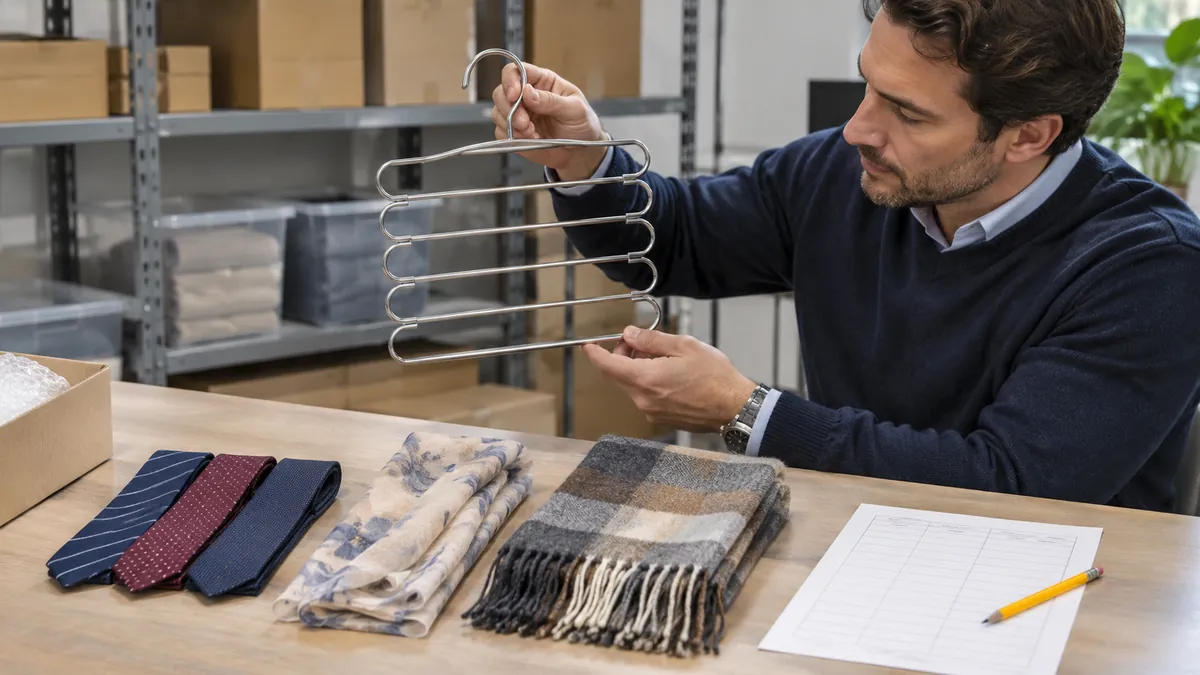
Capture the critical measurements and geometry in a drawing: support opening or bar spacing, edge shape, usable span, frame depth, overall width, and any moving or detachable component. The exact dimensions should come from the program brief, actual samples and the chosen design. Do not copy measurements from a competing product as if they were universal. The images below are conceptual examples and do not represent an approved Koitor product.

Separate visible dimensions from functional clearance. A hanger can have an adequate outer width but an opening that is difficult to thread. A narrow gap may hold a folded tie in place yet make repeated retrieval awkward. A generously open shape can improve access but allow a fabric edge to shift. These are competing choices for the buyer to test; neither should be stated as a universal advantage.
How should buyers evaluate fabric bulk and drape?
Use actual representative articles or faithful fabric mockups during sample review. For each sample, record how the fabric is folded or looped over the support, where the fold sits, whether it obscures a neighboring item, and how much space the complete group occupies. Assess both the fullest product and the thinnest or most slippery item relevant to the assortment.
A practical review has four steps:
- Load the selected assortment: use the intended number of pieces and the planned fold or threading method.
- Inspect spacing: check whether adjacent ties or scarves overlap, hide labels, or become difficult to distinguish.
- Retrieve from several positions: remove one item from the center and from the ends without pulling neighboring pieces unintentionally.
- Return the item: confirm that a user can put the fabric back without bending a component or disturbing the display arrangement.
Record what is observed rather than turning one test into a broader performance claim. For example, “the buyer’s medium-weight scarf sample passed through the opening without being forced” is bounded to that piece and setup. It does not establish snag resistance for every textile, colorfastness, crease prevention or suitability for delicate fabric. Fabric behavior depends on material, weave, surface texture, fold, edge finish and handling.
The number of supports should follow the buyer’s product mix. More bars can create more positions but can also reduce the opening available for each item or increase the overall depth. A single broad support can make loading simple while producing a bulky bundle. Compare the displayed capacity and retrieval effort together; do not optimize an abstract “pieces per hanger” number while ignoring how a retail customer uses the product.
Which support architecture suits the assortment?
Choose architecture by the dominant buyer task. A simple crossbar may suit folded ties if the expected bundle remains accessible. Individual loops can help separate pieces, but the opening and edge finish need review. A multi-bar design can separate categories, while a dense arrangement may slow browsing. An open-frame or ring arrangement can handle varied folding approaches but may take more space in a wardrobe or display bay.
The manufacturer-facing evidence confirms that products sold under similar accessory-hanger language can differ materially. Pact Group’s 2022 Matalan manual includes several scarf presentation architectures with different support spans. Weber Hangers presents metal tie-holder examples and accessory forms, including coated loops. MUJI’s aluminum tie and scarf hanger uses an open J-form support and a different material combination. These are product-specific examples, not evidence that one architecture performs best across all fabrics. Product claims and cautions must remain specific to each maker. See the Pact/Matalan manual, Weber accessory hanger range and MUJI tie and scarf hanger.
When choosing a construction, ask the supplier to identify which parts are metal, whether another material joins the frame, and which areas will be visible after assembly. Material labels alone do not establish edge smoothness, coating suitability or textile-care performance. Buyers can set an appearance reference and handling expectation, then inspect the sample under consistent lighting and with actual textiles.
The source products above serve different commercial contexts, and one vendor’s presentation or care claim should not be transferred to another product. In particular, avoid statements such as “snag-free,” “crease-free” or “safe for all fabrics” unless the buyer has relevant evidence and the claim has been reviewed for the exact product and use conditions.
What should be included in the sample approval record?
Bind the physical sample to a clear drawing, SKU, finish reference and pack configuration. This matters when an assortment contains several widths, colors or support shapes. A photo can help identify the item but cannot replace a dimensional record where the interface or opening controls use.
The approval record should include:
| Field | Buyer record | Reason for recording it |
|---|---|---|
| Assortment scope | Tie, scarf, shawl or defined mix | Prevents a broad product name from implying unreviewed fabrics |
| Loading method | Fold, loop, thread or drape | Makes review conditions repeatable |
| Sample set | Representative thin, bulky and textured items | Shows what was actually assessed |
| Support geometry | Opening, bar spacing, span and frame envelope | Identifies dimensions that govern presentation |
| Appearance | Finish, visible edges and color reference | Separates cosmetic acceptance from functional fit |
| Retrieval observations | Position tested and any movement or interference | Records the real user action examined |
| Pack and label | SKU identity, instructions and retail contents | Keeps the listing and shipment configuration aligned |
| Revision | Sample, drawing and packaging version | Prevents an unapproved revision from replacing the reference |
Note exceptions explicitly. If a particular thick scarf is difficult to load, decide whether the buyer will exclude that use case, choose another support, or revise the design. Avoid making a broad correction based only on one item if the assortment includes many fabrics. Changes to loop opening, bar spacing or edge details can affect both use and manufacturing, so the updated sample should be rechecked.
What do manufacturers need before they can quote a metal hanger?
The quotation brief should let the supplier understand the whole assembly, quantity split and finish. Provide a two-dimensional drawing or dimensioned reference images, a target style, the textile types that control the design, the planned loading method, surface finish, branding, packaging and expected quantities by variant. If a physical sample is available, state whether it is a visual guide, a dimensional master or simply a market benchmark.
Ask the factory to identify assumptions in its quotation. These may include material selection, wire or sheet construction, formed joints, welding and polishing access, coating or plating, assembly, inspection and protective packaging. The supplier should not silently decide a fabric-facing edge or alter support spacing without buyer approval. A change to an exposed bend or weld may alter the appearance; a change to packaging can affect how the frame is protected in transit.
Koitor is a family-owned custom metal hardware manufacturer focused on bathroom and home storage hardware. Its website does not confirm a current tie or scarf hanger product range. This article therefore provides adjacent-category specification guidance, not a claim that Koitor manufactures this hanger. A buyer considering a custom metal concept should first send the drawing and target scope for capability confirmation through the contact page. The general custom metal storage rack page explains the relevant broad manufacturing context, not a guarantee that every adjacent design can be produced.
For early development, keep the first sample brief narrow. Specify one support architecture, one representative textile set and a short list of critical dimensions. After fit and presentation are resolved, evaluate color, branding and packaging variants. This sequencing reduces confusion about whether a sample was accepted for shape, appearance or complete retail readiness.
When assortment color matters, include textiles that resemble the actual product range rather than relying only on neutral swatches. Dark and light fabrics can reveal different visual issues around a metal frame, while patterned fabrics can make spacing problems more visible. This is a presentation check, not a test of color transfer or chemical compatibility. If the buyer has a care requirement, define that separately and seek suitable product-specific evidence rather than treating a visual sample review as proof.
Finally, record the storage context. A retail display, closet accessory and travel organizer can demand different clearances and handling. If the product will be shipped flat, assembled, nested or in a multi-pack, include that state in the brief. Pack orientation can affect whether the formed support needs additional protection and whether a customer can identify the intended use from the included instructions. A packaging sample should not change the approved metal geometry without a revised drawing and sign-off.
Buyer checklist before requesting a quotation
- Define the intended tie, scarf, shawl or mixed assortment.
- State the piece count and expected loading or folding method.
- Provide representative fabrics, including bulky and textured examples where relevant.
- Identify the desired architecture: bars, loops, open frame or another arrangement.
- Dimension the usable span, opening, spacing and overall storage envelope.
- Describe visible edges and the finish reference without unsupported care claims.
- Define the target retail pack, branding, instructions and SKU coding.
- Provide forecast volumes by size, finish and product configuration.
- Ask for the supplier’s material, joining and finish assumptions in writing.
- Approve a dated sample with the exact drawing and packaging revision.
A metal tie scarf hanger specification is useful only when the textile examples and loading method are recorded alongside the geometry.
Frequently asked questions
Can one metal hanger serve both ties and bulky scarves?
Possibly, but the intended fabrics and loading method must be reviewed together. A design that presents ties neatly may have insufficient clearance for a thick scarf bundle. Use representative samples and document the limits of the approved use.
Does a coated loop prevent fabric snags?
The presence of a coating alone does not prove a snag-free result. Buyers should examine surface condition and test representative fabrics. Avoid universal claims unless there is relevant substantiation for the actual item.
Should the buyer specify an exact piece capacity?
Specify the assortment, loading method and target count as a review condition. A count without the fabric thickness and spacing can be misleading. Include a loaded sample or clear reference set when possible.
Is a wide support always better for scarves?
No. A wider support may accommodate a larger fold but can increase the occupied envelope or allow thinner items to move. Compare loading, presentation and retrieval with the planned fabrics.
What should the buyer approve first: finish or function?
First clarify the product architecture and fabric interface, then confirm appearance and pack details on the sample. Surface finish still needs to be reviewed before production, but it should not distract from unresolved openings or access paths.
Work With Koitor Hardware
Discuss a Custom Metal Storage Hardware Concept
Send a drawing or sample, the intended application, finish reference and quantity split. Koitor can first confirm whether the product and process fit its current bathroom and home storage hardware scope.
OEM / PRIVATE LABEL
Turn this sourcing guide into a product brief
Share your target product, size, finish, order quantity and packaging requirements. Your team receives a practical manufacturability review before quotation.


 English
 Español
 Português
 Français
 Deutsch
 العربية