

A stainless steel shower caddy rust proof line is supportable only when the actual construction, including hooks and fasteners, can carry that wording. 304, 201, coated steel, aluminum, and chrome-on-steel should not inherit the same stainless steel shower caddy rust proof carton phrase just because the silhouettes look similar.
In most retail programs the safer default is rust resistant, written with environment limits, unless the buyer has a project evidence file that covers every wet-zone part. A magnet test, a bright polish, or a generic “stainless” callout is not enough to move a stainless steel shower caddy rust proof line, or a rust-free line, into artwork.
This page is a wording matrix. It does not repeat the construction-freeze and salt-spray-file process used for a hanging-caddy listing brief; it asks, for each common construction, which words the file can honestly support.
Which constructions can support rust-proof versus rust-resistant wording?
Wording follows the weakest wet-zone part, not the most flattering name on the basket. If the tray is 304 and the hook is coated steel, the product-level claim is a mixed-construction claim and should be written that way, or the hook should be brought into the same approved construction.
The following table is a decision aid, not a laboratory result and not a Koitor product promise. Each row assumes a hanging hook-over shower caddy sold into an indoor residential shower, and it assumes the buyer will still confirm hooks, rivets, screws, and any soap tray as part of the same SKU.
| Construction | When rust-proof wording is hard to support | Safer wording direction | Limits that usually belong on the brief |
|---|---|---|---|
| 304 stainless, all wet-zone parts in the same approved grade, with agreed weld and cut-end treatment | Absolute rust-proof or rust-free lines still require a project evidence file that covers welds, cut ends, hooks, and fasteners. Grade alone does not authorize those words. | Rust resistant in indoor showers, or a construction-descriptive line that names 304 and does not claim immunity | Exclude untested cleaners, coastal outdoor use, and any part not in the approved grade |
| 201 stainless, or a mixed 201 basket with 304-looking polish | A rust-proof line is usually harder to support than on a fully specified 304 construction, especially if the listing implies the same performance as 304 | Name the grade honestly; use rust resistant with tighter environment limits, or stay with a material description only | Do not relabel 201 as 304 in artwork; state mixed grades if they exist |
| Coated or powder-coated steel | The claim is about the coating system remaining intact. Chips, holidays, and cut ends expose steel, so rust-proof and rust-free lines are rarely supportable | Rust resistant while the coating is intact, or “coated steel, designed to improve rust resistance,” with no immunity language | State that damaged coating, exposed ends, and indoor-shower use are part of the claim boundary |
| Aluminum | Aluminum does not form red rust the way carbon steel does, but it is not immune to corrosion. “Will not rust” and rust-proof lines overclaim if they imply no corrosion | Describe the metal; if any corrosion wording is used, keep it limited and do not treat aluminum as a rust-proof synonym | Watch cut edges, coating, and galvanic contact with steel screws; do not promise a stain-free life |
| Chrome on steel | A bright chrome face can look like stainless and still rust at wear-through, cut ends, or missed coverage. Rust-proof wording is usually not supportable from appearance alone | Rust resistant with a wear and environment limit, or a finish description without a rust-proof icon | Name the substrate as steel; include hooks and any unplated cuts in the wording review |
Official U.S. advertising law still expects a reasonable basis for objective claims before they are disseminated, as stated in the FTC Policy Statement Regarding Advertising Substantiation. That policy does not pick rust-proof wording for you. It does mean rust proof, rust free, and similar performance phrases are claims that need a basis in the construction you actually ship.
A separate FTC jewelry guide, 16 CFR 23.11, contrasts rust proof with rust resistant in official language, but it applies to the jewelry, precious metals, and pewter industry guides, not automatically to shower caddies.
This page cites it only as a terminology contrast: rust proof is treated there as a very strong, all-parts immunity idea, and rust resistant as a milder, normal-use idea. Austenitic stainless is listed in that guide among metals that may be considered rust resistant, which is not a license to print rust proof on every 304 or 201 caddy.
How should 304 and 201 stainless claims be written?
Write the grade that will ship, then write a claim no stronger than the all-parts construction. A 304 basket does not justify a 304 claim if the hook, the lower rail, or the fasteners are a different grade, and a 201 caddy should not borrow 304 retail language.
304 and 201 are both commonly described as austenitic stainless families, but they are not interchangeable retail names. 201 is typically specified with lower nickel and higher manganese than 304 in mill standards such as the ASTM A240/A240M stainless plate, sheet, and strip family.
This article does not reprint chemistry tables or invent corrosion-rate numbers. The buyer point is simpler: if the purchase specification and the mill document say 201, the carton should not say 304, and the claim should not imply that the two grades were compared and found equal unless the project has that comparison.
A magnet is a poor grade certificate. Some austenitic parts can show a magnetic response after cold work, and a non-magnetic response does not prove 304. Wording should rest on the purchase specification and incoming documents, not on a sales-floor magnet demonstration.
Even a correct 304 construction can stain at welds or from free iron, which is why rust-proof or rust-free wording remains a high bar. The British Stainless Steel Association’s discussion of iron contamination and rust staining on stainless steel is a useful external reminder that visible rust on stainless is often a contamination or fabrication issue, not proof that the mill grade was fake. It is also not proof that rust-proof artwork is safe.
Practical wording patterns that usually stay supportable, depending on the file, include “304 stainless steel shower caddy” as a material description, or “rust resistant in indoor residential showers when installed and cleaned as directed.” Patterns that usually need to stay off the 304 or 201 line are never-rust wording, “rust proof stainless,” and any comparison that says 201 is equal to 304 without evidence.
If a program sells both grades, keep them as separate SKUs or as clearly marked options in the portal. A shared lifestyle photograph is fine. A shared rust-proof icon is not, unless both constructions were approved against the same wording and the same all-parts rule.
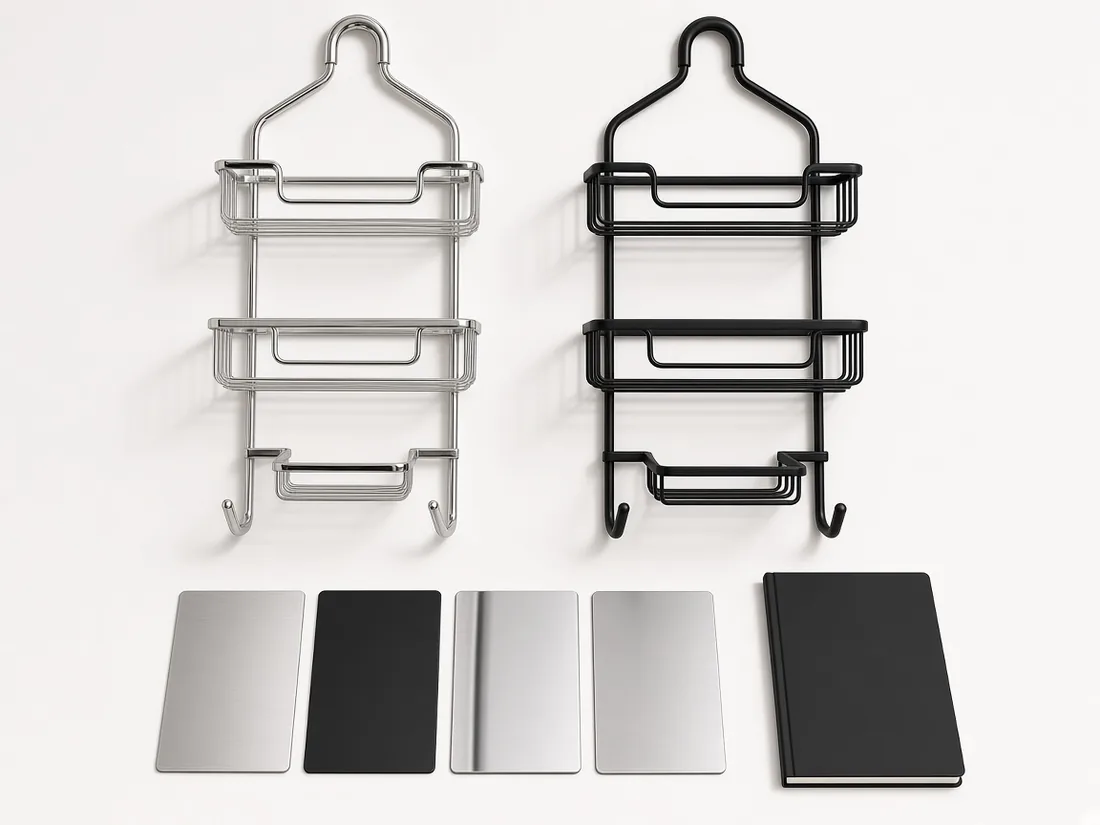
What can coated steel and chrome-on-steel support?
Coated steel and chrome-on-steel can often support a careful rust-resistant line, or a plain construction description, if the coating or plating system is locked and the limits are honest. They rarely support a rust-proof or rust-free product claim, because the steel is still present under a finish that can be thin, chipped, or worn.
On powder-coated or similar organic coatings, the wording is really about film integrity. A mid-span color match does not speak for a cut end or a weld shoulder. Once the film is broken, red rust on steel is a predictable shopper complaint, and a rust-proof icon then looks like a broken promise.
Safer copy names the finish and, if needed, says the coating is intended to improve rust resistance in indoor use while it remains intact. It should not promise immunity after impact, abrasive cleaning, or edge wear.
Chrome on steel is a different visual trap. The part can photograph like stainless, especially in a wet bathroom, so marketplace titles often say rust proof simply because the caddy is shiny.
The substrate is still steel, and the claim should say so in the internal brief even if the consumer title stays shorter. Decorative stacks usually depend on undercoats as well as the visible chromium. Koitor’s page on a copper undercoat in nickel-chrome plating is relevant when a buyer is specifying that stack, but it is not a rust-proof authorization.
EN 248 is sometimes mentioned in bathroom chrome discussions. Koitor’s EN 248 bathroom accessories scope checklist is about the scope of that chrome-plating standard for sanitary taps and similar fittings. It should not be treated as a shower-caddy rust-proof license. If a buyer wants a plating performance method, write the actual method and edition in the project file, and keep the carton wording no stronger than that file.
Chrome wear points on a hanging caddy are often the hook contact, the front rail where bottles rub, and cut ends. If those sites are unplated or thinly plated, a rust-proof badge on the whole SKU is difficult to defend. A rust-resistant line that excludes worn-through or damaged plating is more consistent with how the part actually fails.
Do not let a salt-spray panel coupon, tested without hook abrasion, carry a chrome caddy’s rust-proof title by itself. If a report is used at all, the wording review should ask whether the specimen included the same plated cut ends and contact points that shoppers use. The method’s limits are discussed in Koitor’s salt spray test report interpretation page; this matrix only requires that wording not outrun the specimen.
Where does aluminum fit, and how should wording travel to the carton and portal?
Aluminum can be a rational wet-zone choice, but it should not be translated into “will not rust” or rust proof as if the metal were inert. Aluminum does not rust in the red-iron sense, yet it can corrode, pit, or show filiform attack at cut edges when a coating is present. A consumer comment that aluminum never shows rust is not a substantiation file.
If the caddy is bare or anodized aluminum, describe the metal and avoid rust-proof icons that shoppers will read as a promise of no corrosion marks. If the aluminum is coated, cut edges and film defects need the same honesty you would give coated steel, except the failure color and pattern may be different. Koitor’s article on aluminum filiform corrosion at coating cut edges is the closer process page for that edge risk.
Watch galvanic pairs. An aluminum basket with steel screws, a steel hook, or a steel wire accessory can create a local couple in soapy water. The product-level wording has to include those parts. If the screws are steel, a claim that “this aluminum caddy is rust proof” is incomplete, because shoppers will still photograph rusted fasteners and call the product rusty.
Once the matrix row is chosen, the same phrase should travel to every public surface: retailer title, bullet list, comparison chart, carton, hangtag, and any “rust proof” filter tag the portal uses. A portal filter that marks every stainless SKU as rust proof will undo a careful 201 or mixed-grade decision. The artwork brief should list each surface and the approved phrase, including the decision to use no rust claim at all.
Change control belongs on the wording as well as on the grade. If a hook supplier changes from 304 to 201, or from stainless to coated steel, the portal tag should go on hold until the matrix is run again. A silent substitution is how a once-cautious rust-resistant line becomes an inaccurate rust-proof filter.
Private-label style guides should treat rust-proof, rust-free, and rust-resistant as controlled terms, like a restricted chemical claim. A designer should not be free to drop a badge onto a lifestyle image because a competitor listing uses one. The style guide can show approved short titles for each construction row and a default “no rust badge” layout for mixed or undocumented BOMs.
Comparison charts need the same row logic. A five-SKU family that includes 304, 201, and chrome-on-steel should not share a single yes/no rust-proof column. Use construction-specific cells, or drop the column and describe materials in words. A yes cell that was copied across the family is still a claim about each SKU.
Returns language should not quietly upgrade the claim. If the listing said rust resistant in indoor showers, a customer-service script should not promise a rust-free replacement as a courtesy in a way that retrains shoppers to expect rust proof. Keep the goodwill policy and the public wording on the same level, or the next portal refresh will inherit the stronger phrase.
When a factory quote offers “304 or 201, same price, same rust-proof logo,” treat that as a wording risk, not a bargain. The logo is the expensive part if it is wrong. Ask for the grade on the hook and the basket separately, and only then assign a matrix row. A price match does not make two grades support the same adjective.
Importer teams can also keep a short “forbidden upgrades” list in the listing SOP: do not change resistant to proof to fit a character limit; do not add rust free to a bullet because a competitor did; do not mark a chrome-on-steel SKU as stainless in a filter; do not apply a bathroom rust-proof badge to a matching coated-steel utility hook sold in the same set. Those upgrades are how careful matrix work is undone at publish time.
A-plus or enhanced-brand-content modules deserve a separate pass. A main bullet may be careful, while a comparison table buried lower on the page still shows a rust-proof check mark. Review the modules as part of the same wording package, including any icon artwork supplied by a brand team or a retailer template.
If a previous season used rust-proof language and the new construction cannot support it, plan the cut-over. Old cartons in the warehouse, cached marketplace pages, and paid-search titles can keep the stronger phrase in circulation after the brief has changed. The wording file should name who will retire those surfaces and by which lot or listing date.
Translations and marketplace titles need the same discipline. A shortened Amazon title that drops “indoor use” or upgrades “resistant” to “proof” is still the buyer’s claim in most programs. Approve a short title that stays inside the matrix, rather than shortening first and reviewing later.

What should a wording checklist include for shower-caddy rust claims?
This checklist is for claim wording on hanging shower caddies. It would be the wrong list for a dish-rack acceptance standard or a towel-bar spare part.
- Identify the construction row: 304, 201, coated steel, aluminum, chrome-on-steel, or a mixed BOM, and do not assign a rust-proof icon until the row is chosen.
- List every wet-zone part (basket, hook, tray, hooks, screws, rivets) and mark whether each part matches the claimed metal or finish.
- Refuse a 304 retail name when the mill or purchase document is 201, or when the grade is not documented.
- Reject magnet tests or shine tests as the basis for rust-proof wording.
- For coated steel or chrome-on-steel, write whether the claim survives only while the finish is intact, and name wear or cut-end exclusions.
- For aluminum, block “will not rust” and rust-proof synonyms unless the file truly supports a corrosion claim, and review steel fasteners separately.
- Copy the approved phrase, or the decision to use no rust claim, onto the retailer title, bullets, filter tags, carton, and hangtag.
- Place the wording on hold if a hook, fastener, or finish source changes, including a silent substitution in a later lot.
How can Koitor review a wording-and-BOM brief?
Koitor Hardware is a family-owned custom metal hardware factory that builds bathroom and home storage products, including hanging shower caddies, for importers and private-label teams. A wording review here is a construction-and-copy review. It is not a statement that Koitor caddies are rust-proof, rust-free, or superior to other suppliers.
The useful package is a short BOM, the intended English (and any translated) listing sentence, and a note on hooks and fasteners. If two finishes or two grades share one photograph, say so. Koitor can then mark where the sentence is stronger than the parts list and suggest a narrower phrase. Development context for custom work sits on the custom shower caddy manufacturing page.
MOQ can start from about 100 pcs depending on the product. Samples usually take 5–7 working days after details are confirmed. Bulk production usually takes 4–6 weeks depending on product, order quantity, finish, and packaging. Those ranges describe order planning. They do not grade a rust-proof sentence.
Frequently asked questions
Can a 304 shower caddy use rust-proof wording if the hook grade is not documented?
Not safely at the product level. Shoppers see the hook as part of the caddy. Document the hook and fasteners, or write a narrower claim that does not imply every part is 304 and rust-proof.
Is rust resistant always the correct substitute for rust proof?
It is often safer, but it is still a performance claim and still needs a basis. In some programs the most honest line is a material description with no rust adjective at all, especially for mixed BOMs or untested chrome-on-steel.
Does aluminum wording get a free pass because aluminum does not red-rust?
No. Aluminum can corrode, and steel fasteners can rust on an aluminum caddy. “Will not rust” and rust-proof icons still overclaim if they suggest a mark-free life.
Can one rust-proof marketplace filter cover 304, 201, and chrome SKUs?
Only if each SKU was approved against that same wording and construction rule. In practice, a shared filter is how mixed grades pick up a claim they did not earn. Filter tags should follow the matrix row, not the photo set.
Where should chrome-on-steel wording mention the substrate?
At least in the internal brief and, where space allows, in the product description. A title may be short, but it should not imply the caddy is stainless if the substrate is steel. Wear and cut-end limits should be in the description if a rust-resistant line is used.
Work With Koitor Hardware
Need help matching stainless steel shower caddy rust proof wording to the BOM?
Send Koitor the parts list, the intended rust-proof or rust-resistant sentence, and any grade or finish documents you already have. The team can review whether the wording outruns the construction. This is not a rust-proof product certification.
OEM / PRIVATE LABEL
Turn this sourcing guide into a product brief
Share your target product, size, finish, order quantity and packaging requirements. Your team receives a practical manufacturability review before quotation.


 English
 Español
 Português
 Français
 Deutsch
 العربية