

A towel bar mounting bracket replacement is compatible only when it matches the retained wall-hole pattern, the post interface, the cover flange, and the left or right identity of the original set. A “universal” towel bar mounting bracket replacement that ignores those attributes will fail on the old bar or the old holes, even if the new flange looks similar in a photograph.
This page is about the wall bracket, the post, and the flange that dress that joint. It is not a guide to replacing the towel-bar rod or bar body, and it is not a DIY article on tightening a loose bar or choosing mounting height. If a program also sells replacement rods, keep that decision in a separate file so a towel bar mounting bracket replacement SKU is not asked to solve a rod-length problem.
What should be frozen on a replacement bracket before calling it compatible?
Freeze the mating interfaces, not the lifestyle look of the assembled bar. The retained product in the wall defines the replacement. The new bracket has to fit the existing holes and still accept the retained posts or the retained bar end, depending on which parts the customer keeps.
Write four attribute groups into the spare-part brief: hole pattern on the wall plate, post or bar-end interface, cover-flange coverage, and left/right or handed identity. Then write the kit contents and the wording limits, especially any use of the word universal. Finish color is a commercial match, but it does not make an incompatible plate fit.
Name which parts stay on the wall and which parts ship in the spare kit. Some programs replace only the hidden bracket and reuse the decorative post and flange. Others ship a post-and-bracket subassembly and reuse only the bar. Those two kits are not interchangeable, and a single SKU title that covers both will generate wrong-part returns.
Keep the mounting system consistent with a screw-fixed wall plate. Adhesive pads, suction cups, and over-cabinet hooks are different products. A replacement bracket brief that borrows those photographs will train a buyer to order the wrong spare. This article assumes a wall-anchored or wall-screwed towel bar with cover flanges.
Shared-plate programs need an extra line. If several accessories in a collection use one hidden plate, a towel-bar spare may also fit a robe hook or a tissue holder, or it may not, depending on hole spacing and post interface.
Koitor’s page on shared mounting plates in a bathroom accessory collection is the place to discuss collection standardization. This spare-part page only asks whether the replacement SKU is identified against the exact collection plate, or against one historic towel-bar model.
How should hole spacing and plate geometry be measured against the retained wall holes?
Measure the retained wall holes and the retained plate, then write those numbers as project values. Do not assign a “typical” inch spacing from memory and call the new plate universal. Any example dimension in a drawing must be confirmed on the retained set before it becomes a compatibility claim.
The primary measurement is center-to-center between the fixing holes, taken from the same datum used on the old plate. Add hole diameter, hole count, and whether the holes are round, slotted, or a mix. Slotted holes can absorb a small position error. Round holes cannot. If the new plate uses slots where the old plate used rounds, say whether the visible screw heads and the flange still sit correctly.
Plate outline and thickness matter after the flange is installed. A thicker plate can prevent the post from seating. A smaller outline can leave old holes or a paint ring outside the flange. Record overall plate length, width, and thickness with the same agreed tools used for the hole pattern, such as a caliper and, where useful, a pin gauge or a paper template taken from the retained plate.
Templates are part of metrology, not a substitute for it. A paper or card template should be marked with the datum, the hole centers, and a note that it was taken from a named sample or a named SKU. If the template shrinks or was photocopied at a wrong scale, it can approve a plate that will not fit.
The measurement clause should say how the template is verified against a steel rule or caliper, and that this check is not an AQL plan.
Old wall holes are not always the original pattern. A previous owner may have redrilled, used a different anchor, or installed the bar slightly out of level. A replacement program can still offer a plate, but the compatibility claim should distinguish “fits the original factory pattern” from “may cover a repaired or nonstandard pattern.” Those are different SKUs or different wording lines.
Lot sampling, if incoming or outgoing inspection uses it, belongs in a separate clause. ISO 2859-1:2026 can be the agreed attributes plan once the parties name the edition, inspection level, and AQL. Hole center-to-center, hole diameter, and plate thickness stay in the measurement clause with tools and datums. Do not write “measure C-C, AQL 1.0” as one recommendation. The number that describes a hole is not the number that describes a lot.
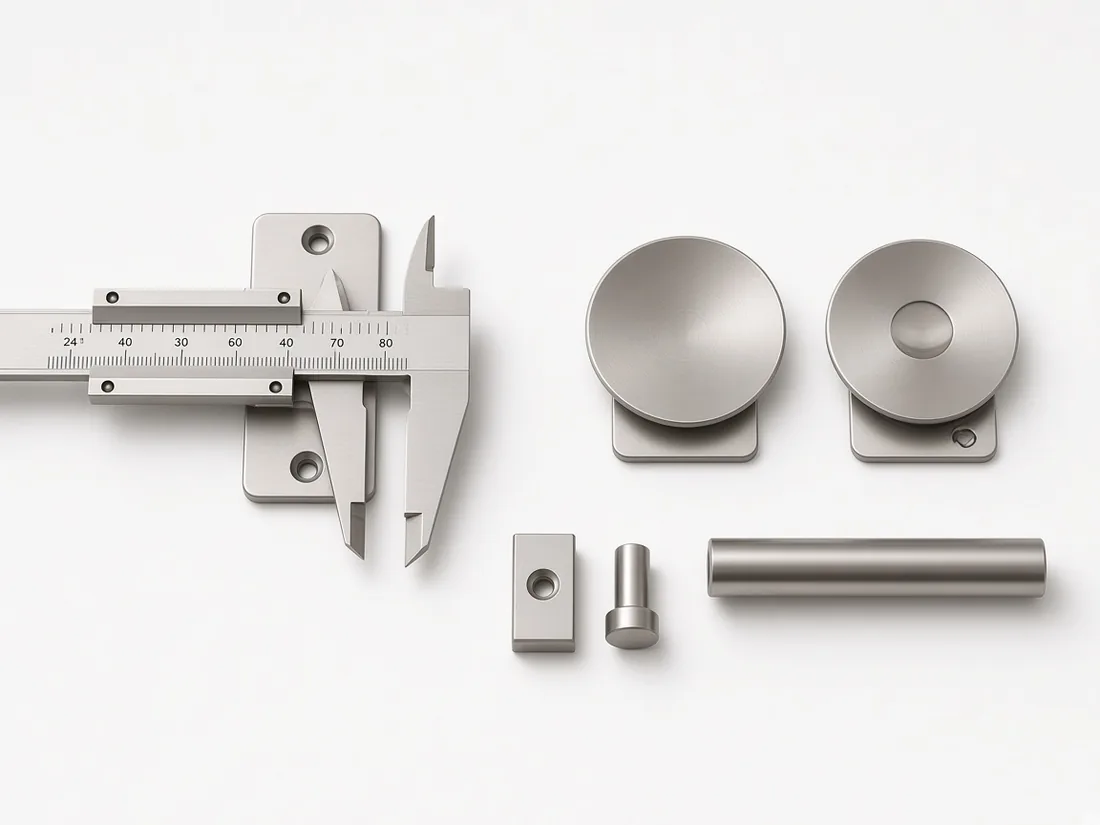
What post, set-screw and cover-flange interfaces must match the retained bar?
The post and flange have to accept the parts the customer will keep. If the bar stays, the post bore, tenon, or saddle must match that bar end. If the decorative post stays, the hidden bracket must pick up the same engagement, including any set-screw seat, slot, or snap interface.
Write the interface as a short stack: how the bracket meets the post, how the post meets the bar, and how the flange covers the joint. A replacement that only copies the flange diameter can still miss a set-screw location, a post diameter, or a seating depth. Those misses show up as a bar that will not enter, a screw that cannot reach its seat, or a flange that will not sit flush.
Set-screw geometry is an interface attribute on this page, not a full design essay. Record screw thread, length, head type, and the location of the seat or flat on the retained post or bar. If the replacement bracket moves that seat, the old screw may no longer lock.
Ship the correct screw in the kit if the old one will not fit, and say so on the packing list so a customer does not reuse a too-short screw and report that the “universal bracket” is loose.
Cover flanges are judged on inside clearance and outside coverage. Inside, the flange must clear the plate, the screw heads, and the post. Outside, it must cover the paint ring or old holes the customer expects to hide.
Flange outside diameter can be a renovation concern, but this article will not turn into a cover-flange sizing essay. It only requires that the spare brief state the flange OD, the plate outline, and whether the flange is meant to hide a stated maximum witness mark, as confirmed on the retained wall.
Bar engagement should be described without turning this into a rod-replacement specification. Note the retained bar diameter or end shape only as a mating size. Do not use this spare SKU to change bar length, to offer a new 18-inch or 24-inch rod, or to promise that any bar will drop in. Those are rod-program decisions and should stay out of the bracket claim.
A related spare-part discipline, in a different category, is written on Koitor’s replacement shower rail slider compatibility page: match the retained model and profile before calling a part a replacement. The same habit applies here, with hole pattern and post interface taking the place of a rail profile.
When are left and right brackets not interchangeable, and when is universal not supportable?
Left and right brackets are not interchangeable when the set-screw, slot, or post engagement is handed, or when the plate outline is mirrored. A universal claim is supportable only inside a written pattern range, and only if every interface in that range has been checked, not because the flange is round.
| Attribute | When a single SKU can work | When a universal or one-SKU claim usually fails |
|---|---|---|
| Hole center-to-center and hole size | The new plate matches the retained pattern, or uses slots that still hide under the flange and still hold the screw heads correctly | The title says universal, but the only pattern checked was one sample bar in the factory, or the old holes were redrilled |
| Left and right identity | The interface is truly symmetric, and that fact is confirmed on both posts | A set-screw or cable-style slot is handed, and a customer is told either part will fit either wall end |
| Post or bar-end interface | The bore, tenon, saddle, and screw seat match the retained parts the customer will keep | The kit mixes interfaces from two historic models under one “fits most bars” line |
| Cover flange | The flange clears the new plate and covers the agreed witness mark on the retained wall | The flange is copied from a current collection and is too small for a historic paint ring |
| Kit contents | The SKU states whether it is one end or a pair, and includes the correct screws and any handed parts | A single-end kit is sold as a complete replacement, or screws from another collection are thrown in without a check |
Handedness should be marked on the part, on the bag, and in the instructions, using the same clockwise or “as you face the wall” convention. If the factory can make a symmetric post, and inspection has confirmed there is no hidden handed seat, the brief can say “not handed.” That statement is evidence-based. It is not a default.
Universal is a marketing word with a narrow honest use. It can mean “fits the published hole patterns and post interfaces in this model list.” It cannot honestly mean “fits every towel bar still on a wall.”
If the buyer wants a wide range, publish the range: the patterns, the post diameters or end shapes, and the flange coverage, each as measured and confirmed. Anything outside that list is a no-fit, not a near-miss that the customer should file or drill.
Do not solve a loose-bar complaint by inventing a universal bracket. Looseness can come from a wall anchor, a missed stud, a short set screw, or a worn post, and those causes are not all bracket-pattern problems. This page does not provide a consumer tightening tutorial. It only requires the spare brief to say which symptoms the bracket is meant to correct, so customer service does not promise a plate when the retained bar interface is the wrong size.

What should a replacement-bracket checklist and kit brief include?
Use a checklist that would be wrong on a shower-caddy rust claim or a dish-rack tray standard. These items are for a screw-mounted towel-bar bracket spare.
- State which parts the customer keeps and which parts ship: hidden plate only, plate plus post, pair of ends, or one handed end.
- Record retained hole center-to-center, hole diameter and shape, and plate outline and thickness from a named sample or a named model, with tools and datums in a measurement clause.
- Record the post or bar-end interface, including any set-screw seat, and ship the matching screw if the old screw will not fit.
- Record cover-flange inside clearance and outside coverage against the retained witness mark, without treating that as a full renovation-flange project.
- Mark left and right parts, or document that the interface is not handed, and use the same convention in instructions and bag labels.
- Limit any universal wording to a published pattern and interface list; do not claim the plate fits every historic bar.
- List kit contents: pair or single, screws, anchors only if they are actually in scope, template if offered, and a statement that rod replacement is out of this SKU.
- Keep ISO 2859-1 sampling, if used, in a separate clause from the hole and interface measurements.
Instructions should show the datum and the handedness convention, and should tell the installer to compare the new plate to the retained holes before drilling new ones. If new holes would be required, that is no longer a drop-in replacement, and the wording should not say it is.
Retailer titles should repeat the model or pattern range, not only “universal towel bar bracket.” Searchers use that phrase, but the product page has to define the range or the return rate will define it later. The primary keyword can appear naturally in the title and the opening without promising a fit that was never measured.
Historic-model identification should start with the hidden plate, not only with the visible bar style. Two collections can share a similar flange and still use different hole centers or a different post tenon. Ask customers or retailer service teams for a photograph of the plate with the flange off, plus a scale or a stated center-to-center, before assigning a spare SKU. A style name alone is a weak key.
Finish mismatch is a commercial issue, not a hole-pattern issue. A correct chrome plate can still be refused if the retained posts are brushed nickel. The brief should say whether the spare is sold as a functional replacement, a finish-matched replacement, or both, so a fit-correct part is not marked defective for color. Do not solve a finish complaint by changing hole spacing.
Left and right SKUs need separate identifiers all the way through the warehouse: item codes, barcodes, bag labels, and carton marks. A bin labeled “brackets, mixed” is how a handed part is shipped to the wrong end of the bar. If a pair is sold as one kit, the inner bags should still be marked, so a broken bag does not scramble the set.
Wall anchors are usually an installation-surface choice, not a property of the bracket pattern. If the kit includes anchors, state the intended wall type or state that the installer must select anchors. A plate that fits the holes can still fail in drywall if the wrong anchor is used, and that failure should not be written up as an incompatible universal bracket. Keep anchor selection out of the compatibility sentence, or write it as a kit-option line of its own.
Returns codes should distinguish “wrong pattern,” “wrong hand,” “missing screw,” “finish mismatch,” and “customer needed a new rod.” If every ticket is coded as universal-bracket failure, the buyer cannot see whether the listing, the warehouse, or the rod program is the cause. The same five codes can sit in the aftersales SOP next to the checklist above.
If a retailer asks for a fit guide illustration, show the hidden plate and the hole datum, not only an assembled lifestyle bar. A lifestyle image hides the very attributes that decide compatibility. Keep the illustration claims-safe: no invented hole sizes presented as industry standards, and no “fits all” banner.
The same restraint applies to paid-search titles and marketplace search terms. The query may be “universal,” but the landing page still has to show the measured range. A title that outruns the brief will create the return the checklist was written to prevent.
How can Koitor review a replacement-bracket brief?
Koitor Hardware is a family-owned custom metal hardware factory that manufactures bathroom towel racks and related accessories for importers, distributors, and private-label programs. A spare-bracket review is a fit review against a retained interface. It is not a claim that Koitor stocks every historic bracket, and it is not a promise that one plate is universal.
The useful package is a retained sample or a clear photograph of the hidden plate, the post, and the flange, plus the intended spare wording. If only dimensions are available, say how they were taken. Koitor can then mark missing attributes and whether left and right parts must be separate SKUs. Collection-level design context is also on the custom bathroom towel rack manufacturing page.
MOQ can start from about 100 pcs depending on the product. Samples usually take 5–7 working days after details are confirmed. Bulk production usually takes 4–6 weeks depending on product, order quantity, finish, and packaging. Those ranges help plan a spare run. They do not make a bracket compatible.
Frequently asked questions
Can one replacement bracket SKU be sold as both left and right?
Only if the interface is confirmed to be symmetric, including the set-screw seat. If the seat is handed, sell left and right, and mark them on the part and the bag.
Does a larger cover flange make a plate universal?
No. A larger flange may hide a paint ring, but it does not change hole center-to-center or the post interface. Coverage and fit are separate checks.
Should a replacement-bracket kit also include a new towel bar?
Not by default, and not under this SKU’s compatibility claim. Replacing the rod is a different spare decision. If a set is sold together, write two interfaces: the wall pattern and the bar, and do not let the kit title hide that complexity.
How should nonstandard or redrilled wall holes be handled in wording?
Do not file them under a universal claim. Offer a pattern-specific replacement, or state that nonstandard holes need a different plate or a site assessment. A drop-in claim should be reserved for the original, measured pattern.
Can hole spacing and an AQL number be written in one inspection sentence?
They should not be. Center-to-center, hole size, and plate thickness are measurements with tools and datums. ISO 2859-1 describes a sampling plan once the parties agree the edition and AQL. Keep the clauses separate.
Work With Koitor Hardware
Need a towel bar mounting bracket replacement brief reviewed?
Send Koitor a retained plate, post and flange, or the measured hole pattern and interface, plus the wording you want to use for a replacement kit. The team can review fit attributes and whether a universal claim is too broad. This is not a promise that one bracket fits every bar.
OEM / PRIVATE LABEL
Turn this sourcing guide into a product brief
Share your target product, size, finish, order quantity and packaging requirements. Your team receives a practical manufacturability review before quotation.


 English
 Español
 Português
 Français
 Deutsch
 العربية