
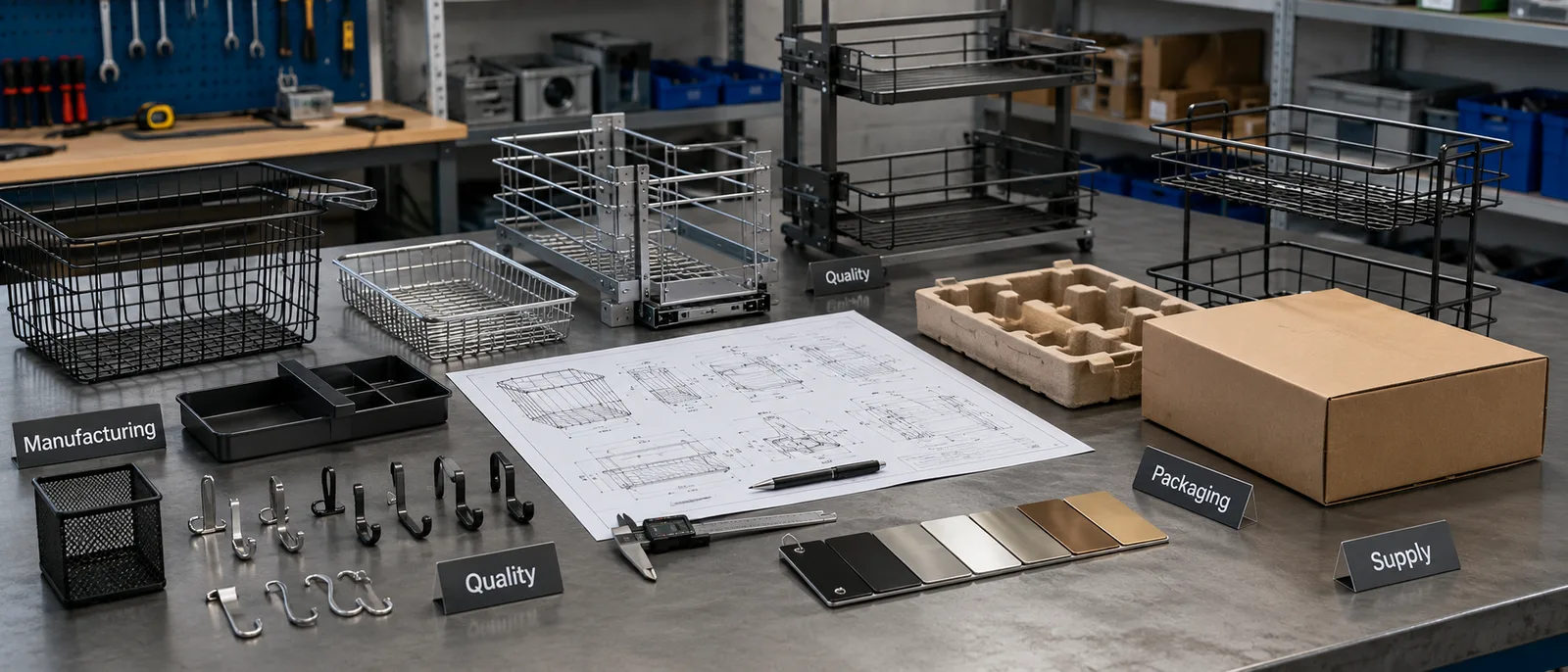
A reliable OEM partner for home storage hardware should do more than quote a competitive unit price. The manufacturer should understand the product function, convert buyer requirements into controlled specifications, repeat the approved sample in production, protect visible metal surfaces during packing and communicate changes before they affect cost or timing. Reliability is demonstrated through evidence across several orders, not claimed in a supplier introduction.
For home organization brands, the strongest partner is usually the one whose manufacturing processes, order flexibility and communication style match the planned product range. Buyers should evaluate the complete development and supply workflow rather than selecting a factory from one sample or one price comparison.
What Defines a Reliable OEM Home Storage Hardware Partner?
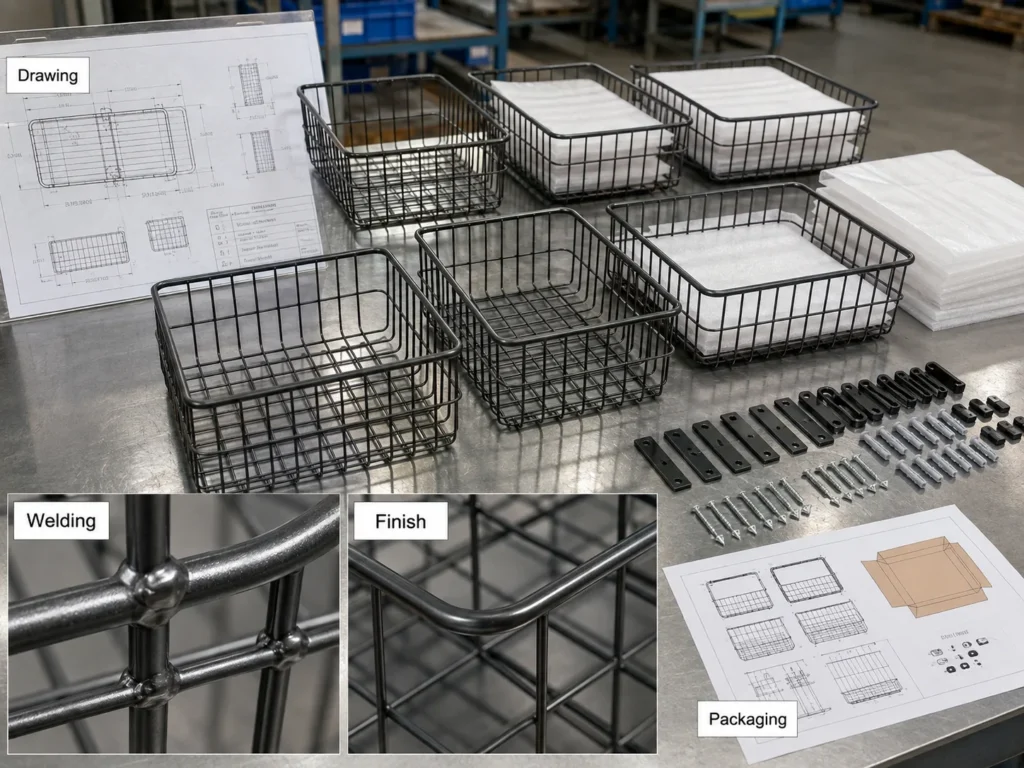
A reliable partner combines product-category understanding, manufacturing control, commercial clarity and consistent communication. The supplier should recognize how wire spacing, frame geometry, welding, finish, assembly and packaging affect products such as storage baskets, kitchen racks, cabinet organizers, hooks and freestanding shelves.
Reliability starts with accurate interpretation. A useful quotation reflects the requested material, dimensions, finish, accessories, packaging and quantity. If information is missing, the supplier asks specific questions instead of silently choosing the cheapest or easiest assumption.
Manufacturing transparency also matters. The factory should explain which processes are suitable, which features create tooling or fixture requirements and which details may cause variation. Buyers do not need exaggerated claims about factory scale; they need a practical explanation of how their product will be made and checked.
Commercial reliability means that unit price, tooling, samples, packaging, payment terms and delivery assumptions are clear. A quotation that excludes important mounting parts or protective packing is not directly comparable with a complete offer.
Finally, a dependable supplier records approvals. Drawings, finish samples, artwork and packaging layouts should have identifiable revisions. Verbal agreement alone becomes fragile when a program grows to more products, more team members or repeat orders.
How Should Buyers Evaluate Manufacturing Fit and Product Knowledge?
Buyers should evaluate manufacturing fit by comparing the planned product structure with the supplier’s practical process experience. A factory may be capable of making metal products generally but still lack useful experience with the alignment, visible finish, mounting interfaces or packaging needs of home storage hardware.
| Evaluation area | What to ask | Useful evidence | Warning sign |
|---|---|---|---|
| Product structure | Which dimensions and joints are critical? | Drawing comments, fixture plan or manufacturability suggestions | Supplier accepts an incomplete brief without questions |
| Forming and welding | How will alignment and visible weld areas be controlled? | Relevant process samples and defined inspection points | Only general factory photos are provided |
| Surface finish | How are color, gloss or polishing direction approved? | Physical reference and consistent review method | Finish is described only as “standard” |
| Assembly interface | How are feet, caps, screws, brackets or shelves checked? | Complete assembled sample and pack-content list | Loose accessories are not included in sample review |
| Packaging | How are metal contact points and movement controlled? | Physical pack sample, separators and carton plan | Packaging is postponed until production is complete |
| Order flexibility | What affects MOQ and timing for this exact item? | Conditional answer based on material, finish and packaging | Universal MOQ or lead-time promise for every product |
Ask the supplier to explain one product in process order: material preparation, cutting or forming, welding, grinding or polishing, finishing, assembly, inspection and packing. The answer should connect product features to process decisions.
For example, a wire basket needs review of rim construction, wire spacing, base stability, weld placement, finish coverage and protection between nested units. A kitchen rack may require checks for shelf interfaces, bottle clearance, feet or pads and packed volume. Buyers can compare these needs with OEM home storage hardware manufacturing capabilities before starting a sample.
How Do Sample Development and Change Control Show Reliability?
Sample development shows reliability when the supplier converts open product ideas into a documented, manufacturable reference. The sample is not only a visual model; it should establish dimensions, structure, finish direction, assembly, accessories and the initial packaging concept.
Start with a complete input pack. Provide a drawing or physical reference, intended use, target dimensions, material preference, finish, expected quantity, packaging idea and target market. Mark fixed requirements separately from features that remain open to a manufacturing proposal.
A useful supplier identifies conflicts before making the sample. A requested wire diameter may not suit a tight bend. A decorative bracket may create an inaccessible weld or visible grinding area. A nested basket design may save carton space but allow coated surfaces to rub. Raising these questions early is a positive sign.
After review, issue a sample approval record. It can include photographs, measured critical dimensions, finish reference, assembly notes, pack contents and approved deviations. Add a revision code so the same reference can be used for quotation, purchase order, production and inspection.
Change control becomes especially important after approval. Material availability, tooling, finish processing or packaging may lead to a proposed adjustment. The supplier should state the reason, affected specification, cost or timing effect and whether a new sample is needed. Production should not use the change until the buyer approves it.
Koitor Hardware develops samples from buyer drawings or physical samples. Samples usually take about 5-7 working days after product details and materials are confirmed. Timing can vary with complexity, finish and component availability, so the development plan should be confirmed for each project.
How Should Quality, Finish and Packaging Be Controlled?
Quality, finish and packaging should be controlled as one connected system because a dimensionally correct product can still fail commercially through poor appearance, missing parts or transit marks. The approved sample should be translated into inspection points that can be repeated during production.
Identify critical dimensions first. These may include mounting centers, cabinet fit, shelf spacing, overall footprint, handle clearance or interfaces between components. Cosmetic dimensions can use different decision rules from dimensions that affect installation or function.
Review structure on representative units. Check alignment, wobble, wire spacing, weld location, sharp edges, grinding marks and assembly. Any load requirement should be defined for the specific structure and confirmed through project-specific testing rather than assumed from material thickness alone.
Finish approval should use a controlled reference. Powder coating can vary in color, gloss, coverage and surface preparation. Stainless steel can show differences in polishing direction, handling marks and visible-area treatment. Material, environment, construction and care all influence corrosion performance, so no product should be described as universally rust-proof.
Packaging should prevent movement and metal-to-metal contact. Review sleeves, separators, hardware bags, instruction placement, retail-box fit, carton arrangement and outer markings. A carton with excessive void can allow movement, while pressure placed against a bracket or hook can damage the product or box.
For custom metal storage basket production, Koitor can review rim structure, welding points, finish and nesting or separation before sampling. Similar reviews apply to custom kitchen storage racks, where shelf fit, assembly, stability and packed volume may drive approval criteria.
Recommended Production Approval Stages
- Drawing approval: Confirm product revision, critical dimensions, material and interfaces.
- Sample approval: Review structure, assembly, finish direction and initial pack concept.
- Pre-production confirmation: Freeze components, finish reference, artwork and pack contents.
- In-process review: Check forming, welding, alignment or other points that are difficult to correct later.
- Final inspection: Evaluate representative packed and unpacked units against agreed criteria.
- Shipment release: Confirm quantity, carton markings, documents and closure of open issues.
How Do Communication and Supply Planning Support Long-Term Cooperation?
Communication and supply planning support long-term cooperation when decisions, risks and changes are visible early enough for both parties to act. Fast replies are helpful, but accurate information, clear ownership and written follow-through are more important than message volume.
Use one open-point list for each product. Record the issue, reference, owner, due date, decision and closure status. Separate drawing approval, finish approval, packaging approval and shipment release so a general “OK” cannot be misunderstood.
When a problem appears, evaluate how the supplier responds. A useful corrective-action reply identifies affected goods, contains the issue, reviews the process cause, proposes a control and explains how the result will be verified. A promise that workers will simply pay more attention is not a complete process response.
Supply planning should show dependencies. Material, finish, accessories, printed packaging and buyer approvals can each affect the schedule. Bulk production often takes about 4-6 weeks after details are confirmed, depending on product complexity, order quantity, material availability, finish and packaging. The date should be reconfirmed before every order.
MOQ also varies by project. Koitor orders can start from around 100 pieces for some products, depending on structure, material, finish and packaging. A small-batch trial can help the buyer test demand and supplier execution before increasing volume, but it still needs a complete specification and inspection plan.
A reliable OEM partner for home storage hardware should improve with repeat orders. Review whether previous issues remain closed, approved revisions are reused correctly, packaging records are maintained and forecasts lead to better preparation. Long-term cooperation should reduce avoidable uncertainty rather than repeat the same clarification cycle.
What Should Be on an OEM Partner Selection Checklist?
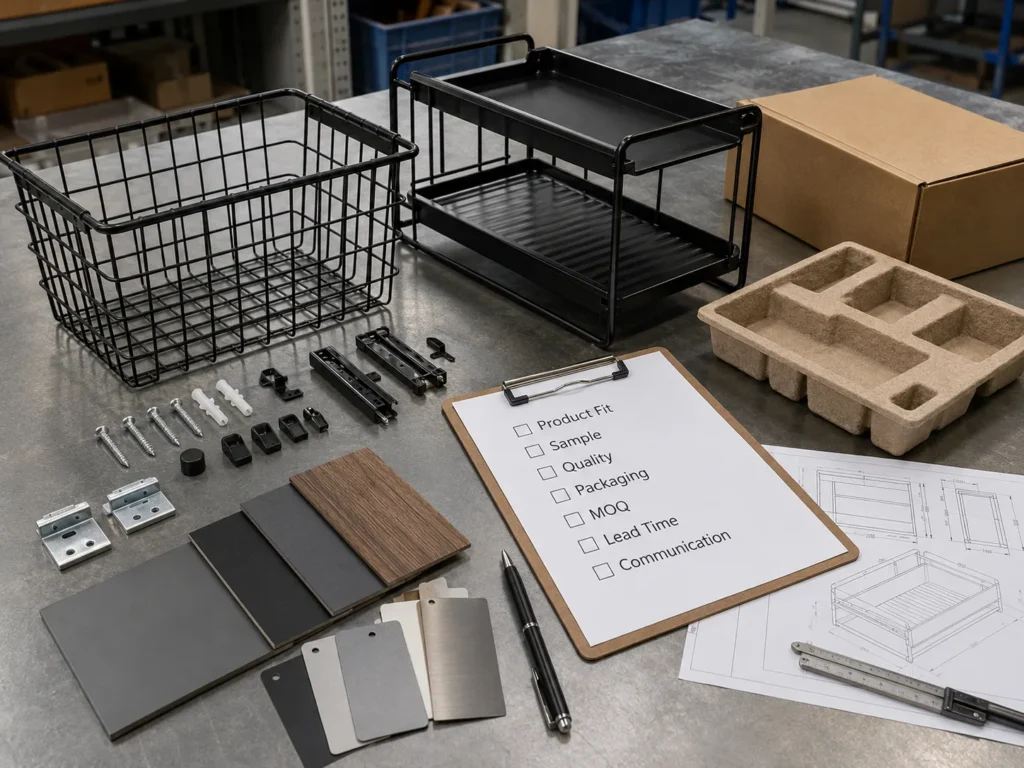
An OEM partner selection checklist should test product fit, development discipline, repeatability, packaging, commercial clarity and communication. Evidence for a reliable OEM partner for home storage hardware should come from samples and trial orders instead of presentations or general factory claims.
- Relevant experience with wire, tube or sheet-metal home storage products
- Clear explanation of forming, welding, finishing, assembly and packaging steps
- Questions that identify missing dimensions, interfaces or usage requirements
- Drawing or physical-sample development with visible revision control
- Complete sample review covering finish, accessories and packaging concept
- Written approval process for material, component or structural changes
- Inspection points tied to critical dimensions and commercial appearance
- Finish reference for color, gloss, polishing direction or visible surfaces
- Packaging plan that separates metal contact points and controls movement
- Transparent quotation for tooling, samples, unit price and packing
- Conditional MOQ and lead-time explanation for the specific project
- Issue log, corrective action and verification process
- Trial-order support before larger-volume commitment
- Consistent records reused correctly on repeat orders
Do not allow one strong score to hide a critical gap. A supplier may communicate well but lack process fit, or make a good product sample while failing to control packaging. Define mandatory criteria separately from weighted preferences such as payment terms or optional customization.
The final decision should state the approved product and process scope. Passing a trial for a powder-coated wire basket does not automatically approve polished stainless products, different mounting systems or complex retail kits. Expand the partnership product family by product family.
Frequently Asked Questions
What is the first sign of a reliable OEM supplier?
A useful early sign is the quality of the supplier’s questions. A capable supplier identifies missing dimensions, materials, finish references, assembly details or packaging requirements before treating the quotation as complete.
Should buyers visit the factory before ordering?
A factory visit or audit can provide useful evidence when the project requires it, but it does not replace sample approval, specification control and batch inspection. Buyers should choose verification steps according to project value, complexity and risk.
How can a buyer compare two OEM quotations fairly?
Send the same controlled specification and compare material, finish, accessories, packaging, tooling, MOQ, payment and delivery assumptions. A lower unit price may exclude work or components included by another supplier.
Is a low MOQ enough to make a supplier suitable?
No. A low MOQ can reduce initial commercial exposure, but the supplier must still demonstrate manufacturability, sample accuracy, batch consistency, packaging control and clear communication.
When should a buyer place a repeat order?
Place a repeat order after trial-order findings are documented, critical issues are closed and the approved product, finish and packaging references are clear. Any planned changes should be reviewed before the repeat order begins.
Work With Koitor Hardware
Looking for a Practical Long-Term OEM Partner?
Send Koitor your drawing, physical sample, finish target, packaging idea and expected quantity. Our team can review the product structure, manufacturability, sample plan and small-batch production options before quotation.
OEM / PRIVATE LABEL
Turn this sourcing guide into a product brief
Share your target product, size, finish, order quantity and packaging requirements. Your team receives a practical manufacturability review before quotation.
 English
  Español