
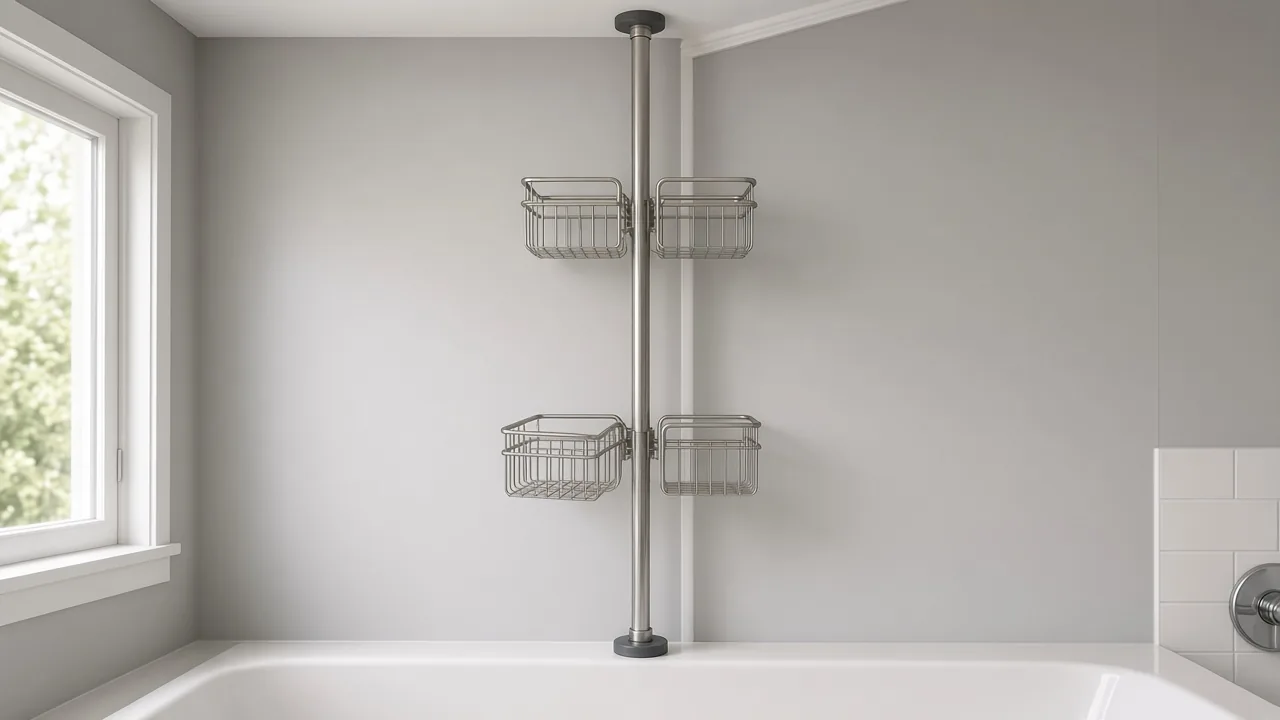
Height fit does not tell you whether a basket will stay where the user left it. A tension pole shower caddy baskets spin complaint and a marketed 360° swivel are opposite files. Freeze whether baskets must hold a facing, whether rotation is a claimed feature with a defined stop, or whether spin under ordinary use is a defect, before artwork and the first-article check are approved.
This guide is for importers and private-label teams specifying basket clocking on a tension-pole shower caddy. It does not rewrite ceiling-height fit, joint rust observation, foot-pad slip, or inner-tube anti-rotation keys. Koitor Hardware, a family-owned China OEM manufacturer of bathroom and home-storage metal hardware, can review a collar and stop brief with a drawing or a sample; the buyer still has to name the architecture and the listing words.
Why height, rust, and tube keys do not close basket clocking
Tension pole shower caddy height range freezes endpoints and pole-section combinations so a program can be sold into a stated ceiling range. A pole that reaches the ceiling can still carry baskets that drift when a shopper grabs a bottle. Reach is not clocking.
Joint rust observation is about which seats, overlaps, and fasteners are first to stain in the wet zone. A collar can be rust-observed and still be loose on the pole. Do not treat a rust brief as a rotation brief, and do not treat this page as a rust file.
Foot-pad slip and ceiling-mark questions live on their own pages when they exist. A pad that stays put does not stop a basket collar from turning on the tube. Keep those interfaces apart in the RFQ.
Inner-tube anti-rotation, where a square, keyed, or otherwise non-round telescoping section is specified, is about the pole sections twisting against each other. Basket clocking is about the collar or shelf interface on the outside of the pole. A keyed inner tube can still leave a round collar free to spin.
Worked example: artwork shows four baskets facing the bather. The height sample is in range. In a wet trial, the lower pair slowly clock toward the wall when bottles are removed from one side. The return is logged as baskets that spin. The height table was never the right file.
Worked example: a retailer merchandises a 360° rotating shower caddy from a shopping card. The factory sample has a friction collar with no defined stop and no way to lock a facing. Shoppers who wanted rotation complain that shelves will not stay; shoppers who wanted a fixed facing complain that shelves wander. The architecture was never named.
Should the SKU hold a facing, or is rotation a claimed feature?
Name the architecture first, in one sentence the listing and the inspection team can share. There are three honest families, and they are not the same product.
A fixed-facing SKU is specified so baskets stay on an agreed clocking after installation and after ordinary use. Residual play may be written as a project limit, but free rotation under a named bottle map is a defect, not a feature.
A claimed-swivel SKU is specified so baskets or shelves can be turned on purpose, and so they can be left at a facing or within an agreed stop. A 360° line without a stop, a detent, or an instruction that the shelf is not meant to hold a position is how a feature becomes a complaint.
An uncontrolled-spin SKU is the leftover case: the drawing is silent, the listing is silent, and the sample turns when loaded or when a bottle is pulled. That silence is not a third marketing story. It is a gap that should be closed as either fixed facing or claimed swivel before artwork is locked.
Do not mix the families on one SKU code. If a program wants both a fixed everyday facing and an occasional turn for cleaning, say how the user locks the facing again. A friction-only collar that slowly drifts is not a lock.
Worked example: the brief says baskets may be rotated for cleaning and must hold the last facing under the agreed bottle map. That is a claimed-swivel-with-hold brief. The drawing then has to show the collar, the stop or detent, and the check. A 360° line alone does not carry the hold requirement.
Worked example: the brief says baskets face the bather and must not rotate in use. That is a fixed-facing brief. A marketing team should not later add a 360° badge because a competitor’s shopping card used one.
What collar, screw, key, or stop belongs on the drawing?
Write the hardware that actually sets clocking, not a generic note that baskets attach to the pole. Typical interfaces, depending on the design, include a clamp collar with a lock screw, a split bushing, a keyed or flattened pole section that the collar cannot turn on, a friction sleeve, a swivel joint with a stop or detent, or a combination of those parts.
Say whether each basket is independently clocked or whether a pair shares a sleeve. Independent collars can drift one at a time; a shared sleeve can take two baskets off-facing together. The inspection check should match the architecture that will be sold.
If a screw is the lock, show access in the installed attitude. A screw that can only be reached before the pole is tensioned, or that backs out in a wet room, is not a finished clocking method until those facts are written. Do not invent a torque figure on this page; if a project later agrees a tightening method, record it as a project value.
If friction alone is the method, say so and accept that residual drift must be checked with the agreed load and wait. Friction that works on an empty beauty sample can fail once bottles are in the basket and a soapy hand twists the rail.
Worked example: the drawing shows a collar screw but not whether the pole is locally flattened under the screw. On the first-article pole, the screw bears on a round tube and polishes a shiny ring; the basket still turns. The missing flat or dimple was the clocking feature, and it was never frozen.
Drainage around the collar is a neighbor concern, not this decision’s core. Shower caddy drainage design is about water leaving trays and wires. Mention a collar that traps soapy water only if it changes the lock or the friction you are counting on, then return to clocking. Do not turn this page into a drainage redesign.

What loaded clocking check can be agreed without inventing a load?
Agree a bottle map, a starting facing, an action, a wait, and a way to read residual rotation. Do not print a safe load, a kilogram badge, or a Koitor torque on this page. The check exists to see whether the facing holds, or whether a claimed swivel returns to a usable stop, on the map you actually sell.
The bottle map should name types and positions, not only a fully loaded slogan. A single heavy bottle at the outer rail can twist a collar differently from a symmetric set. Record whether the action is grabbing a bottle, bumping the rail, or turning the shelf on purpose, depending on the architecture.
Split temporary movement from a lasting change of facing. A basket may flex and spring back when a bottle is pulled; that is not the same as a collar that has walked ten degrees after the wait. Write which of those you will reject.
Measurement and sampling stay separate. The method says how to mark a facing, how to read residual rotation after the agreed action and wait, and what hold or stop means on this SKU. A later lot plan may say how many assembled poles are checked. The lot plan does not define the collar.
Worked example: for a fixed-facing SKU, mark the collar against the pole, place the agreed bottles, remove the outer bottle from the lower left basket, wait the agreed time, and read whether the mark has moved outside the agreed band. No kilogram number is required for that sentence to be usable, provided the bottle map is real.
Worked example: for a claimed-swivel SKU, turn the shelf through the marketed motion, leave it at a facing or against the stop, apply the same bottle map, and read whether it stays or continues to freewheel. If it freewheels, the 360° line is not a hold-a-position feature.
The listing and the sample have to tell the same story. A tension pole shower caddy baskets spin issue in reviews is often a mismatch: the card promised rotation as a benefit, or promised shelves that stay put, and the collar did neither in a reliable way.
If the SKU is fixed facing, do not print 360° rotation, spin-the-shelves merchandising, or similar feature language. If the SKU is a claimed swivel, print what the user can do and whether the shelf is meant to stay where it is left. If you cannot yet say, stay silent and close the brief before photography.
Lifestyle video that spins baskets as a demo is artwork. If the production collar is tighter than the demo, or looser, shoppers will complain in opposite directions. Approve the motion you will actually ship, on the production collar revision, not on a loose prototype.
Worked example: a marketplace title copied from a competitor includes rotating shelves as a 360° feature. The approved sample is a fixed-facing clamp collar. The title is wrong even if the photography is pretty. Change the title or change the architecture; do not leave both in the same pack.
Instructions, if any, should say how to set the facing or the stop after installation and after cleaning. A sentence that only says to install the pole and hang bottles leaves the user without a clocking step on a SKU that needs one.
What should the importer freeze before the first article?
This list is specific to basket clocking on a tension-pole caddy. It is not a height, rust, or pad checklist under another name.
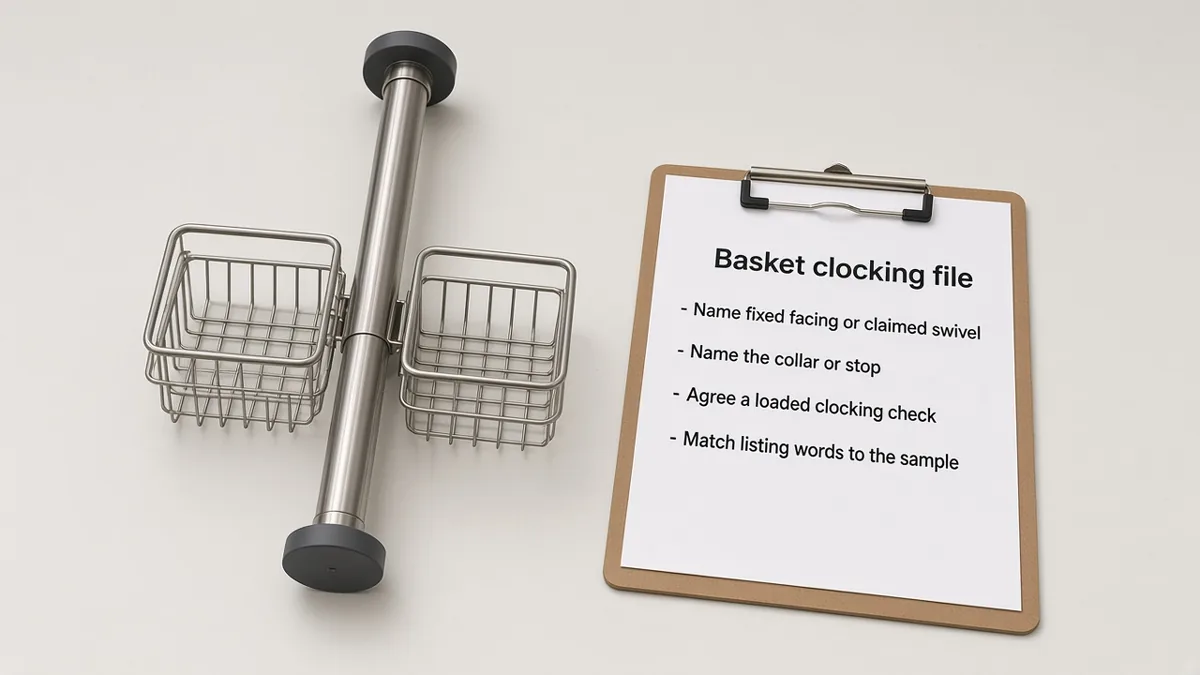
- The architecture sentence: fixed facing, claimed swivel with a defined hold or stop, or an explicit decision that the SKU is not ready for artwork.
- The collar, screw, key, sleeve, or swivel parts that will actually be sold, including whether baskets share a sleeve.
- How a facing is set after installation and after cleaning.
- The bottle map, action, wait, and residual-rotation reading for the first-article check.
- What residual play is acceptable, written as a project band, not as a universal degree or kilogram limit invented here.
- Listing words that match the sample, including a ban on 360° language if the SKU is fixed facing.
- A reminder that height, rust, pads, and inner-tube keys are separate files and are not being asked to carry clocking.
If those lines are missing, a tension pole shower caddy baskets spin return will have no acceptance rule to stand on. A request that only says baskets should not spin is not yet a collar file.
| Architecture | What to freeze on the drawing | What the assembled sample should show | What to keep off artwork until then |
|---|---|---|---|
| Fixed facing | Collar or key that holds clocking, plus how the facing is set | Facing stays inside the agreed band after the bottle-map check | 360° or spin-the-shelves merchandising |
| Claimed swivel with a hold or stop | The swivel joint, the stop or detent, and how the user leaves a facing | The marketed motion works, and the shelf does not freewheel past the hold | A silent SKU that turns in use with no stop |
| Friction-only collar | That friction is the method, plus the bottle map and wait | Drift after the check is inside the project band, or the method is rejected | A stay-put line based on an empty beauty sample |
| Shared sleeve vs independent collars | Which baskets move together | The check is run on the baskets that can actually drift | A photo of one neatly aligned side used as proof for all |
| Silent / uncontrolled spin | Nothing yet; this is a gap, not a family | The sample turns under the map and there is no listed intent | Any rotation or stay-put claim |
First-article photography should show the starting mark, the bottle map in place, and the mark after the wait, with the same camera attitude. A single beauty still of aligned empty baskets does not prove clocking. If a basket is supposed to hold a facing, photograph the mark on the collar and on the pole in one frame so later arguments are not about memory.
If a collection will include both a fixed-facing SKU and a claimed-swivel SKU, give them different item numbers and different listing sentences. Shared lifestyle photography is how a stay-put line leaks onto a swivel card, or the reverse. The factory brief should say which collar revision belongs to which number, because a screw length or a missing flat can be easy to mix in assembly.
After-sales replacements deserve a short note in the same file. A spare basket sold as a loose part will not clock correctly if its collar does not match the pole revision in the field. If you will sell spares, freeze the interface as a spare-part rule, not only as a complete-pole rule, and say whether a replacement collar is supplied with the basket.
Do not copy shopping-card adjectives into the RFQ and call the file closed. Retail 360° language is merchandising. The factory needs the architecture sentence, the collar parts, and the check. If a competitive listing is used only as a market reference, label it that way and still write your own stop or hold requirement.
Installation sequence can hide a clocking miss. A pole that is tensioned first, with baskets added later, may leave a screw or a key in a different attitude than a factory-assembled sample that was checked already dressed. Write whether the first-article check is run on a pole assembled in the factory sequence, on a pole assembled as the instruction sheet will tell a shopper, or both. If those sequences differ, the brief should say which one the listing is allowed to rely on.
How can a family-owned OEM review the collar brief?
Koitor Hardware can review a drawing or a sample together with the architecture sentence and the intended listing phrase. The useful conversation is construction and acceptance: whether the collar can be made as drawn, whether a screw or key is reachable, and whether the listing words are broader than the brief. That is not a promise of a universal anti-rotation torque.
Small-batch customization is often where a program has to choose. A standard pole may already exist; a flattened seat, a different collar screw, or a stop for a swivel SKU is a design decision that should be quoted against a clear brief, not discovered in reviews. If the collar revision changes, repeat the clocking check on the new revision.
MOQ can start from about 100 pcs depending on the product. Samples usually take 5–7 working days after details are confirmed. Bulk production usually takes 4–6 weeks depending on the project, finish, quantity, and packaging. Those figures are planning ranges and do not, by themselves, include a loaded clocking study unless the brief asks for one.
When you send the collar brief and a sample to Koitor, include the architecture sentence, a drawing or photo of the collar, the bottle map you want used, and the listing phrase or an explicit decision to stay silent. Koitor can then discuss custom shower caddy manufacturing options as a construction and acceptance review, not as a shopping guide for 360° cards.
Frequently asked questions
Does a height-range pass mean baskets will not spin?
No. Height range freezes whether the pole can be installed in a stated ceiling span. Basket clocking is a collar and facing question. Use both files when both decisions matter, and do not let one stand in for the other.
Can we print 360° rotation if the sample can be turned by hand when empty?
Only if rotation is the intended architecture and you have also decided whether the shelf must hold a facing or stop. An empty, loose collar is not automatic permission for a 360° badge, and it is a defect on a fixed-facing SKU.
Is inner-tube anti-rotation the same as basket anti-rotation?
No. Tube keys address whether pole sections twist against each other. Basket clocking addresses whether a collar or shelf turns on the pole. Specify both if both can fail, but do not write one as a substitute for the other.
How do we check clocking without printing a safe load?
Name the bottle map, the starting facing, the action, the wait, and how residual rotation is read. That is an acceptance method. It is not a kilogram rating and should not be rewritten as one on the pack.
What if reviews already say the baskets spin?
Treat those reviews as a symptom, then open the architecture file. Either the SKU was supposed to hold a facing and the collar is not doing it, or a rotation feature was merchandised without a stop. The CAPA should name which family you are now specifying.
Can Koitor invent a standard collar for every tension-pole program?
No universal Koitor collar or friction value is stated here. Koitor can review the collar you specify, or discuss options after the architecture sentence is on the brief. The buyer still owns the listing words and the check.
Work With Koitor Hardware
Need a tension-pole basket clocking brief reviewed?
Send Koitor your drawing or sample, the architecture sentence (fixed facing or claimed swivel), and the bottle map you want used. Our team can review collars, stops, and listing words as a construction and acceptance brief before quotation. MOQ can start from about 100 pcs depending on the product; samples usually take 5–7 working days after details are confirmed; bulk production usually takes 4–6 weeks depending on the project.
OEM / PRIVATE LABEL
Turn this sourcing guide into a product brief
Share your target product, size, finish, order quantity and packaging requirements. Your team receives a practical manufacturability review before quotation.


 English
 Español
 Português
 Français
 Deutsch
 العربية