

A hook that clears a door thickness is not a profile result. An over cabinet organizer crown molding brief should freeze the hook return against a named top profile, such as a crown, ogee, or bevel, with contact points, a seated attitude, and a pass rule that does not invent a universal gap. Do not treat a thickness-only fit file as a substitute for that profile check.
This guide is for importers and private-label teams specifying over-cabinet organizers whose hooks hang from the top of a cabinet door or a similar panel. It does not invent a standard crown size, and it does not close general door-thickness or sample-approval questions that belong on a broader fit page. Koitor Hardware, a family-owned China OEM manufacturer of bathroom and home-storage metal hardware, can review a hook-to-profile brief with a drawing or a sample; the buyer still has to name the profile, the return, and the words that may appear on the listing.
Why a thickness-only fit file does not clear a named profile
Existing over-cabinet fit work often treats the top edge mainly as a thickness: will the hook opening pass over a door of a stated size, and will the basket hang clear of the door face. That is a useful hanging-geometry file. A hook can pass a thickness and still rock, sit proud, or leave a return that does not follow an ogee or a large crown. Shoppers then say the organizer will not sit on the moulding, even though a flat-top sample was accepted.
Over-cabinet door storage rack specification and sample approval is the neighbor for overall hanging fit and first-article flow. Use it for thickness, door height, and sample steps. Do not use it as a silent stand-in for hook-return compatibility with a named crown or ogee. Keep this page on the profile.
Over-cabinet towel bars are a related hanging family, but they are not this organizer. A towel-bar hook return can share a mounting idea and still have a different bite and a different basket or tray load path. Do not copy a towel-bar photograph and call the organizer profile closed. If a towel-bar RFQ neighbor exists outside the official link list used for this job, mention the split without treating that page as a substitute method.
Worked example: first-article photos show the organizer seated on a flat door cap of a named thickness. A week later, a buyer hangs the same SKU on a door with a full crown and finds the return touching only the front bead, so the organizer tips forward. The thickness file was not wrong. The profile was never named.
Worked example: artwork says fits most cabinets or works with crown moulding, with no profile name and no return drawing. Those words will be read as a profile promise. Either bound them to a named profile, or remove them.
Face-frame doors, frameless doors with a later added moulding, and decorative caps that sit only at the top front edge are different profiles even when the door thickness is the same. Write the actual top geometry, not a generic cabinet door.
How should the hook return and the crown or ogee be named?
Name the profile with a sample or a drawing, not with a catalogue adjective. Say whether the top is a flat cap, a small bevel, an ogee, a cove, or a larger crown, and include the front overhang and the back side if the hook return has to reach beyond a protruding bead. A phrase such as standard crown is not a profile. Two crowns with the same height can fail differently if one has a deep hollow and the other is a shallow bevel.
Name the hook return: the opening height, the return depth, the shape of the inner bend, and whether the return is a simple hook, a double bend, or a padded contact. Say which surfaces are intended to bear: the top flat, the rear drop, a front lip, or a soft pad. An organizer that bears only on a sharp front bead can mark the finish even when it still hangs.
Record the seated attitude. The check should show the hook on the named profile, with the organizer in the hanging attitude, not only a hook lying on a table beside a moulding offcut. A table dry-fit is useful, and it should be kept, but the hanging attitude can change the contact points once the basket is on the door face.
Worked example: the brief says the hook is dry-fitted to a named ogee sample that matches the buyer’s door drawing, then hung on a door mock-up with the same profile, empty and with a named light-tool map. The return is intended to bear on the rear drop and to clear the front bead. That sentence can be repeated. Fits crown moulding cannot.
American and British listing language may say molding or moulding. Keep the product words consistent with the market, and keep this page’s focus on the hook-to-profile decision. Do not let a spelling difference hide two different profiles in one collection.
End miters and short runs of crown need an explicit line. A hook placed near a mitered end can sit partly on the profile and partly on a return piece, or it can hang off the end of a short cap. If the listing shows a hook at the end of a door, include that placement or exclude it.
Pads and sleeves change the contact shape. If a later revision adds a vinyl sleeve to protect a painted crown, repeat the seated check. The sleeve can rescue a sharp contact, and it can also take up space so a tight return no longer seats in the hollow.
How should seating, rocking, and finish contact be judged?
Write what counts as a fail. Typical project rules include a return that will not pass over the profile, a hook that rocks on a bead, a hanging organizer that leans off the door, or a contact that marks the finish under a named light load. This article does not invent a universal gap or a safe hang load. The project writes the rule it will actually use.
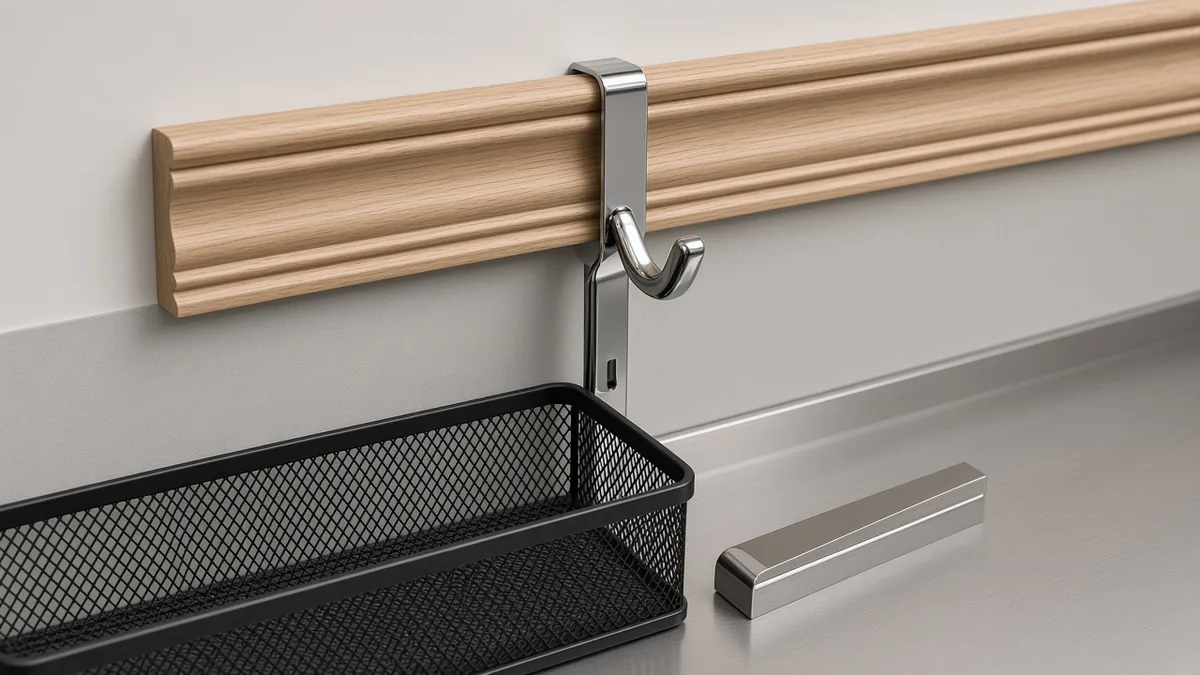
Temporary lift and a lasting mis-seat should be split. A hook may click over a bead and then settle into a hollow. A hook may also look seated until the basket is hung and then rock onto the front edge. Record both the dry-fit and the hanging state. Do not let a pretty table photograph hide a hanging rock.
Worked example: the return passes the crown offcut on the table, then the loaded organizer rotates forward because only the front bead is supporting the hook. The thickness was never the issue. The contact points failed the hanging attitude, and the listing cannot say the organizer sits on that crown.
Worked example: the hook seats in the hollow and the organizer hangs plumb, but the inner bend rubs a painted highlight on the ogee and leaves a mark after a short hang. That is a finish-contact result in this file, not a reason to invent a hardness rating. The project may require a pad, a smoother bend, or a listing exclusion for painted profiles.
Door-face clearance and basket depth remain neighbors. If the organizer leans because the profile seats the hook farther forward than a flat cap would, record that lean as a profile effect, then send remaining face-clearance details to the general fit file. Do not turn this page into a full over-cabinet specification rewrite.
Measurement and sampling stay separate. The method names the profile sample, the return, the hanging attitude, and the fail rule. A later lot plan may say how many hooks are checked on a retained profile gauge. The lot plan does not invent a universal crown size.
What must stay off the listing until the profile is frozen?
Do not print fits all crown molding, works with any ogee, or universal cabinet-top hook unless the named profile was checked and the words are bounded to that profile. Those phrases will be read as a compatibility promise. If the profile is not named, stay silent on crown or ogee fit.
Lifestyle photos that show a hook on a flat door, or on a small bevel, are not evidence for a large crown. If the market you sell into uses full crowns, either include that profile in the method or keep crown language off the artwork. A shopper will treat the photo as a fit claim.
If an over cabinet organizer crown molding line appears in a title or a bullet, the listing should point to the profile family that was actually used, or it should drop the line. Prefer a named profile and a return description over a slogan that cannot be repeated at first article.
Worked example: a retailer wants fits crown moulding in the title. There is no profile sample and no hanging check. The honest options are to write the hook-to-profile method, to drop the line, or to run a project mock-up whose result is owned by the buyer, not invented here as a universal crown fit.
Worked example: a collection includes a shallow hook for flat caps and a deeper hook for large crowns under one organizer name. Inheriting the flat-cap result is not conservative enough. Split the SKUs, or split the listing language, after each return is checked on its intended profile.
Retail copywriters sometimes turn silence on profiles into fits most kitchens. Those words are still compatibility claims if a shopper can reasonably read them as a crown promise. If the brief has no profile and no result, keep those adjectives off the hook-return sentence.
What should the importer freeze before artwork is approved?
This list is specific to hook-return compatibility with a named cabinet-top profile. It is not a general door-thickness list and not a towel-bar hook list.

- The organizer family and the hook-return outline, including pads or sleeves if they will be shipped.
- The named profile: crown, ogee, cove, bevel, or flat cap, with a retained sample or drawing, not a generic crown adjective.
- Where the hook is intended to bear, and whether a hanging load is part of the seated check.
- The fail rule: will not seat, rocks, leans, or marks the finish, with no universal gap invented here.
- An explicit split from thickness-only door fit, which stays on the broader specification neighbor.
- An explicit ban on unbounded crown or ogee slogans unless the named profile was checked.
- How table dry-fit and hanging photographs are kept together in the first-article pack.
- How later lot observation will be sampled against a retained profile gauge, written separately from the method.
If those lines are missing, an over cabinet organizer crown molding complaint will have no profile rule to stand on. A request that only says it must fit the moulding is not yet a hook-return file.
| Question | What to freeze | What the seated sample should show | What to keep off artwork until then |
|---|---|---|---|
| Profile | A named crown, ogee, bevel, or cap, with a retained sample | The hook on that profile, not only on a flat door | Fits crown molding with no profile named |
| Hook return | Opening, depth, bend, and intended bearing surfaces | A dry-fit and a hanging attitude that match the drawing | A towel-bar hook photo used as the organizer pass |
| Seating | Rock, lean, or failure to pass over the profile | A stable seat under the project rule, or a written reject | A table offcut photo used as a hanging pass |
| Finish contact | Whether marking of a painted or finished bead is a fail | Contact that matches the rule, with or without a pad | A padded later revision defended by a bare-hook photo |
| Neighbors | Door thickness and general sample approval in their own file | Those results, if needed, in the specification pack | A single fits-all-cabinets line used to close both files |
First-article records should keep the profile sample identification, the table dry-fit, and the hanging photograph in one pack. A single pretty kitchen shot on a flat door does not replace that set. If the lifestyle room uses a different profile from the retained sample, label the photo as styling and do not use it as a pass.
If a program will sell several hook returns under one organizer name, do not inherit a profile result from the deepest hook or from the flat-cap hook. Repeat the method on the return that will be listed for that market, and give the SKUs different item numbers if their profile results are not the same.
After-sales comments that the organizer will not sit on the crown, or that it rocks and marks the paint, are the reason this file exists. Classify those comments as hook-to-profile until a thickness or basket-clearance issue has also been checked, and do not close the complaint on a flat-cap photograph alone.
Frameless doors with a planted moulding can present a thin door and a large profile at the same time. The hook must clear the profile and still hold the door thickness at the back. Write both facts in the brief, and keep the thickness part aligned with the general fit neighbor so the two files do not disagree.
Inbound distortion of a hook return, such as a widened opening from packing, is not automatically a profile incompatibility. Photograph the hook as received, then after a documented correction the project allows, or reject the piece as damage. Do not silently squeeze a widened hook onto a crown and call the later seat a factory profile pass.
Retail sets that include a second hook for a matching towel bar should still be checked as organizer hooks if the listing shows the organizer on a crown. Shared packing does not make the returns identical.
Glass-front cabinet doors often carry a thin top rail instead of a full wood cap. A hook return designed around a deep crown can sit on that rail and still look seated, then mark the glass or the narrow wood edge once the basket hangs. If the program may sell into glass-door kitchens, either include a thin-rail profile in the method or exclude glass doors from the listing language. Do not let a large-crown photograph defend a glass-rail installation.
Overlay and inset doors also change how a planted moulding meets the hook. An overlay door can present a thick front and a short return path; an inset door can present a tighter reveal next to the face frame. Write the door style when the profile is planted rather than integral, so the hook is not approved on one style and shipped into the other under the same crown claim.
How can a family-owned OEM review the profile brief?
Koitor Hardware can review a drawing or a sample together with the hook return, the named profile, and the intended listing phrase. The useful conversation is construction and acceptance: whether the return can be made as drawn, and whether the words on the listing are broader than the brief. That is not a promise of a universal crown fit.
Small-batch customization is often where a return is lengthened for a larger crown, or a pad is added, without a new seated check. If the return or the pad changes, repeat the method on the new revision. Do not carry a previous flat-cap photo forward as proof.
MOQ can start from about 100 pcs depending on the product. Samples usually take 5–7 working days after details are confirmed. Bulk production usually takes 4–6 weeks depending on the project, finish, quantity, and packaging. Those figures are planning ranges and do not, by themselves, include a profile-seat study unless the brief asks for one.
When you send the profile brief and a sample to Koitor, include the return drawing, the profile sample or drawing, and the listing phrase or an explicit decision to stay silent on crown language. Koitor can then discuss custom kitchen storage rack manufacturing as a construction and acceptance review, not as a source of a pack fit rating. Preparing drawings and samples is a useful place to make the return and the profile visible in the same pack.
Frequently asked questions
Can a door-thickness pass be used to say an organizer fits crown moulding?
No. Thickness is about whether the hook opening can pass a stated door. Profile seating is about whether the return bears correctly on a named crown or ogee. Run both when both can fail.
Do we need a physical profile sample?
A retained offcut or a gauge that matches the buyer’s drawing is much stronger than a verbal standard crown. If only a drawing exists, use it, and still confirm on a first hanging mock-up before crown language goes on the listing.
Should the check be empty or with items in the organizer?
Do at least a hanging check in the attitude the listing shows. An empty dry-fit can hide a forward rock that appears once the basket is dressed. Write the map if a loaded hang is in scope; do not invent a safe load here.
What if the market uses several crown styles?
Either check the profiles you will claim, or keep crown language off the artwork and show only the profiles you have seated. One successful ogee does not cover every large crown.
Can Koitor publish a hook that fits every crown?
No universal Koitor crown-fit rating is stated here. Koitor can review the return and the profile you specify, and can discuss a project method. The buyer still owns the listing words.
Does a pad on the return close the file automatically?
No. A pad changes contact and can change whether the hook still seats. Repeat the seated check on the padded revision.
Work With Koitor Hardware
Need a hook-to-profile brief reviewed?
Send Koitor your drawing or sample, the hook return, and the crown or ogee profile you want used. Our team can review organizer construction and listing words as an acceptance brief before quotation, without inventing a pack crown-fit rating. MOQ can start from about 100 pcs depending on the product; samples usually take 5–7 working days after details are confirmed; bulk production usually takes 4–6 weeks depending on the project.
OEM / PRIVATE LABEL
Turn this sourcing guide into a product brief
Share your target product, size, finish, order quantity and packaging requirements. Your team receives a practical manufacturability review before quotation.


 English
 Español
 Português
 Français
 Deutsch
 العربية